100% FREE ACCESS
9th Standard CBSE Syllabus & Materials
9th Standard CBSE
CBSE 9th Science Is matter around us pure? - New Model Questions Papers Study Material - QB365 Set A
NEW9th Standard CBSE
CBSE 9th Science Matter in our surroundings - New Model Questions Papers Study Material - QB365 Set A
NEW9th Standard CBSE
CBSE 9th Mathematics Heron's Formula Sample Question Papers Study Material - QB365 Set A
NEW9th Standard CBSE
CBSE 9th Mathematics Circles Sample Question Papers Study Material - QB365 Set A
NEW9th Standard CBSE
CBSE 9th Mathematics Quadrilaterals Sample Question Papers Study Material - QB365 Set A
NEW9th Standard CBSE
CBSE 9th Mathematics Triangles Sample Question Papers Study Material - QB365 Set A

Published on: 05/09/2019
Quadrilaterals
Download CBSE Class 9th Standard CBSE Mathematics question papers, sample papers, important questions, and previous year solved papers in PDF format. Get free study materials, NCERT solutions, and exam preparation resources for Class 9th Standard CBSE Mathematics
Questions + Answers key
Take MCQ Mathematics Test
1.
Prove that the opposite angles of an isosceles trapezium are supplementary.
2.
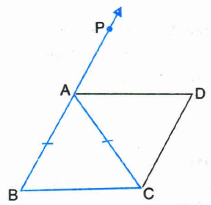
ABC is an isosceles triangle in which AB = AC AD bisects \(\angle \) PAC and CD II AB. Show that
(i) \(\angle \) DAC =\(\angle \) BCA
(ii) ABCD is a parallelogram
3.
The angle between the two altitudes of a parallelogram through the vertex of an obtuse angle is 50°. Find the angles of a parallelogram
4.
In a parallelogram, show that the angle bisectors of two adjacent angles intersect at right angle.
5.
Two parallel lines I and m are intersected by a transversal ' t'.Show that the quadrilateral formed by bisectors of interior angles is a rectangle.
6.
If an angle of a parallelogram in two-third of its adjacent angle then find the measure of all the angles,
7.
In a parallelogram PQRS, if \(\angle \)QRS=2x, \(\angle \)PQS=4x, and \(\angle \)PSQ=4x, find the angles of the parallelogram.
8.
Show that the line segments joining the mid-points of the opposite sides of a quadrilateral bisect each other.
9.
The quadrilateral formed by joining the mid-point of a quadrilateral taken in order is a
kite
parallelogram
rectangle
square
10.
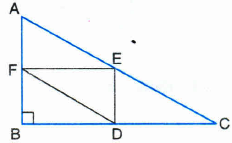
The triangle formed by joining the mid-points of the sides of a angled triangle is a
scalene
isosceles
equilateral
right
11.
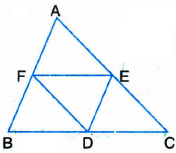
Find the perimeter of quadrilateral BDEF.
8 cm
11 cm
7 cm
3.5 cm
12.
If a pair of opposite sides of a quadrilateral is equal and parallel, then the quadrilateral is a
parallelogram
rectangle
rhombus
square
13.
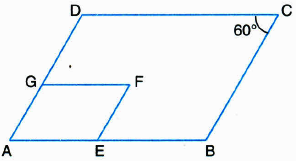
Find the measure of \(\angle \)AGF.
60°
120°
30°
90°
14.
If the diagonals of a parallelogram are equal and mutually perpendicular, then it will be a
rectangle
rhombus
trapezium
square.
15.
A quadrilateral whose all the four sides and all the four angles are equal is called a
rectangle
rhombus
square
parallelogram.
16.
A blackboard is
a parallelogram
a rhombus
a trapezium
kite.
17.
Which of the following is not true?
A rectangle is not a square
A rhombus is not a square
A trapezium is a parallelogram
A kite is not a parallelogram.
18.
Which of the following is false?
A square is a rectangle
A square is a rhombus
A parallelogram is a trapezium
A kite is a parallelogram.
19.
If only one pair of opposite sides of a quadrilateral are parallel, then the quadrilateral is a
Paralleogram
trapezium
rhombus
rectangle
20.
How many sides does a quadrilateral have?
3
5
6
4
21.
Two consecutive angles of a parallelogram are in the ratio 1 : 3, then what will be the smaller angles?
22.
The angles of a quadrilateral are in the ratio 2 : 3 : 6 : 7. The largest angle of the quadrilateral is
23.
If in quadrilateral ABCD; ∠A=90° and AB=BC=CD=DA, then ABCD is a square.
24.
Rani has a photo-frame without a photo in the shape of a triangle with sides a, b, c in length. She wants to find the perimeter of a triangle formed by joining the mid-points of the sides of the photoframe. She could not understand how to overcome this problem. She shares this problem with her classmate Renu. Renu helps her and the required perimeter is computed.
(i) Find the perimeter of the triangle formed by joining the mid-points of the frame.
(ii) Which mathemetical concept is used in the above problem?
(iii) Which value is depicted between Rani and Renu?
1.
In trapezium ABCD,
AB II DC and AD = BC
Through C, draw
CE II DA.
DC II AE and CE is transversal.
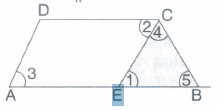
∠1=∠2
∠3=∠1
∠2=∠3=∠1
∠2+∠3=2∠1
∠A+∠C=∠3+∠2+∠4
=2∠1+∠4
Also ∠1=∠5
∠A+∠C=∠1+∠4+∠5=180°
Similarly, we can show that ㄥB+ㄥD=180°
Hence, the opposite angles of an isosceles trapezium are supplementary.
2.
Given: ABC is an isosceles triangle in which AB = AC. AD bisects L PAC and CD IIAB.
To Prove:
(i) \(\angle \)DAC =\(\angle \)BCA
Proof:
(i) In \(\Delta \) ABC,
\(\because\) AB = AC
\(\therefore\) \(\angle \)B =\(\angle \)C .......(1) I Angles opposite to equal sides of a triangle are equal
Also, Ext. \(\angle \)PAC =\(\angle \)B +\(\angle \)C
⇒
⇒ 2\(\angle \)CAD = 2\(\angle \)C
⇒ \(\angle \)CAD =\(\angle \)C
\(\therefore\) AD II BC
Also, CD II AB I Given
\(\therefore\) ABCD is a parallelogram IA quadrilateral is a parallelogram if its both the pairs of opposite sides are parallel.
3.
AM丄DC, AN丄BC
In quadrilateral AMCN,
ㄥA+ㄥM+ㄥC+ㄥN=360°
ㄥA+ㄥC=180°
⇒ 50°+ㄥC=180° ⇒ ㄥC=130°
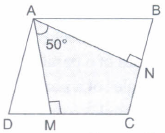
In parallelogram, ㄥA=ㄥC=130°
ㄥB=ㄥD=180°-130°
=50°
4.
ㄥADC+ㄥBCD=180°
⇒ \(\frac{1}{2}\)ㄥADC+\(\frac{1}{2}\)ㄥBCD=90°
or ㄥ1+ㄥ2=90°
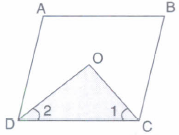
In ΔODC,
ㄥ1+ㄥ2+ㄥDOC=180°
ㄥDOC=90°
5.
∠APR=ㄥDRP
or ㄥ1=ㄥ2
But these are alternate interior angles
SP II RQ, SR II PQ
PQRS is a parallelogram
∠APR+ㄥBPR=180°,(linear pair)
⇒ \(\frac{1}{2}\) ∠APR+\(\frac{1}{2}\)ㄥBPR=\(\frac{1}{2}\)x180°
⇒ ∠1+ㄥ3=90°
⇒ ∠SPQ=90°
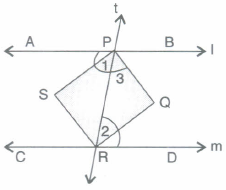
PQRS is a rectangle
6.
72°, 108°, 72°, 108°
7.
\(36°\),\(144°\),\(36°\), \(144°\)
8.
Given: ABCD is a quadrilateral. P, Q, R, and S are the mid-points of the sides DC, CB, BA, and AD respectively.
To Prove: PR and QS bisect each other.
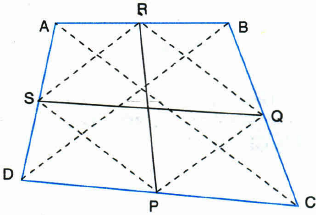
Construction: Join PQ, QR, RS, SP, AC and BD
Proof: In \(\Delta\)ABC,
\(\because\) R and Q are the mid-points of AB and BC respectively.
\(\therefore\) RQ II AC and RQ = \(1\over2\)AC.
Similarly, we can show that
PS II AC and PS = \(1\over2\) AC
\(\therefore\) RQ II PS and RQ = PS.
Thus a pair of opposite sides of a quadrilateral PQRS are parallel and equal.
\(\therefore\) PQRS is a parallelogram.
Since the diagonals of a parallelogram bisect each other.
\(\therefore\) PR and QS bisect each other.
9.
PQ II DB, SR II DB
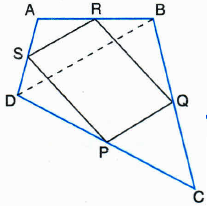
\(\therefore\) PQ II SR
Similarly, PS IIQR
\(\therefore\) PQRS is a parallelogram.
10.
FE IIBC, ED II AB
\(\therefore\)BDEF is a parallelogram
11.
Perimeter of quadrilateral BDEF
= BD + DE+EF+FD
= 2 (BD + DE)
= 2 (\(1\over2\)BC + \(1\over2\)AB)
= BC + AB = 4 + 3 = 7 cm.
12.
Theorem
13.
\(\angle \)AGF +\(\angle \) GAE = \(180°\)
\(\Rightarrow \) \(\angle \)AGF+\(60°\)=\(180°\)
\(\Rightarrow \)\(\angle \)AGF=\(120°\)
14.
Theorem
15.
see a square
16.
See a blackboard
17.
In a trapezium, only one pair of opposite sides is parallel.
18.
opposite sides are not equal in a kite
19.
(b)
trapezium
20.
(d)
4
21.
()
Let the consecutive angles be x° and (3x)°
x°+3x°=180°
4x°=180°
x°=45°
ஃ Smaller angle=x°
=45°
22.
()
Let the angles of the quadrilateral be 2x°, 3x°, 6x°,7x°.
2x°+ 3x°+ 6x°+7x°=360°
[Angle sum property of quadrilateral]
⇒ 18x = 360°
⇒ x=20°
ஃ Largest angle = 7x°= 140°
23.
()
True
24.
(i) Let the photo-frame be ABC such that BC = a, CA = band AB = c and the mid-points of AB, BC and CA are respectively D, E and F.
We have to determine the perimeter of ΔDEF
In ΔABC, DF is the line-segment joining the mid-points of sides AB and AC.
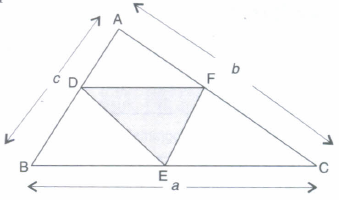
So, DF is parallel to BC and half of it.
i.e., DF=\(\frac{BC}{2}\)=\(\frac{a}{2}\)
Similarly, DE=\(\frac{AC}{2}=\frac{b}{2}\)
and EF=\(\frac{AB}{2}=\frac{c}{2}\)
DF + DE + EF=\(\frac{a}{2}+\frac{b}{2}+\frac{c}{2}\)=\(\frac{a+b+c}{2}\)
Hence required perimeter=\(\frac{1}{2}\)(a+b+c)
(ii) Mid-point theorem.
(iii) Unity and cooperation or Mutual understanding.

9th Standard CBSE Syllabus & Materials
9th Standard CBSE
CBSE 9th Mathematics Lines and Angles Sample Question Papers Study Material - QB365 Set A
NEW9th Standard CBSE
CBSE 9th Mathematics Introduction to Euclid's Geometry Sample Question Papers Study Material - QB365 Set A
NEW9th Standard CBSE
CBSE 9th Mathematics Linear Equations in Two Variables Sample Question Papers Study Material - QB365 Set A
NEW9th Standard CBSE
CBSE 9th Mathematics Coordinate Geometry Sample Question Papers Study Material - QB365 Set A



CBSE 9th Standard CBSE Subjects
CBSE Standards