100% FREE ACCESS
9th Standard CBSE Syllabus & Materials
9th Standard CBSE
CBSE 9th Science Is matter around us pure? - New Model Questions Papers Study Material - QB365 Set A
NEW9th Standard CBSE
CBSE 9th Science Matter in our surroundings - New Model Questions Papers Study Material - QB365 Set A
NEW9th Standard CBSE
CBSE 9th Mathematics Heron's Formula Sample Question Papers Study Material - QB365 Set A
NEW9th Standard CBSE
CBSE 9th Mathematics Circles Sample Question Papers Study Material - QB365 Set A
NEW9th Standard CBSE
CBSE 9th Mathematics Quadrilaterals Sample Question Papers Study Material - QB365 Set A
NEW9th Standard CBSE
CBSE 9th Mathematics Triangles Sample Question Papers Study Material - QB365 Set A

Published on: 15/09/2018
Second Revision Test
Download CBSE Class 9th Standard CBSE Mathematics question papers, sample papers, important questions, and previous year solved papers in PDF format. Get free study materials, NCERT solutions, and exam preparation resources for Class 9th Standard CBSE Mathematics
Questions + Answers key
Take MCQ Mathematics Test
1.
Construct a right triangle whose base is 4 cm and sum of its hypotenuse and other side is 8 cm.
2.
\(\triangle \)ABC is an isosceles triangle with AB = AC.The perimeter of the triangle is 36 cm and AB = 10 cm. What is the area of the triangle?
3.
The sides of a triangle are in the ratio of 25: 17: 12 and its perimeter is 1080 cm. Find its area.
4.
Construct an equilateral triangle, given its side and justify the construction.
5.
Find the radius of the base of a right circular cylinder whose curved surfac area is \(\frac { 2 }{ 3 } \)of the sum of the surface areas of two circular faces. The height of the cylinder is given to be 15 cm.
6.
The curved surface area of a right circular cylinder of height 14 cm is 88 cm2. Find the radius of the base of cylinder.
7.
Find the radius of a sphere whose surface area is 616 cm2.
8.
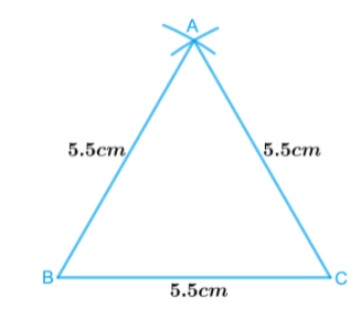
Construct an equilateral triangle PQR,When PQ = 5.5 cm
9.
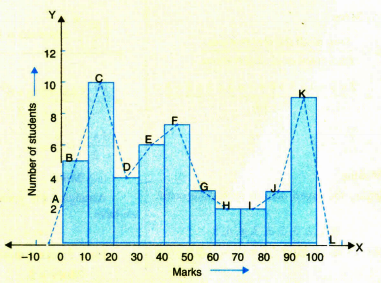
Consider the marks, out of 100, obtained by 51 students of a class in a test:
| Marks | Number of students |
|---|---|
| 0-10 | 5 |
| 10-20 | 10 |
| 20-30 | 4 |
| 30-40 | 6 |
| 40-50 | 7 |
| 50-60 | 3 |
| 60-70 | 2 |
| 70-80 | 2 |
| 80-90 | 3 |
| 90-100 | 9 |
| Total | 51 |
Draw a frequency polygon corresponding to this frequency distribution table.
10.
Prepare a frequency table from the data follows:
| Marks obtained | No. of students |
| More than or equal to 0 | 50 |
| More than or equal to 20 | 48 |
| More than or equal to 40 | 41 |
| More than or equal to 60 | 30 |
| More than or equal to 80 | 12 |
11.
The marks obtained out of 75 by 30 students of a class in an examination are given below:
42,21,50,37,42,37,38,42,49,52,38,53,57,47,29,59,61,33,17,17,39,44,42,39,14,7,27,19,54,51
Prepare a frequency distribution table in which the size of class intervals is the same and one class intervalis 0-10.
12.
Find the volume of a sphere of radius 11.2 cm.
13.
A cylindrical container of base radius 28 cm contains sufficient water to submerge a rectangular block of iron with dimensions 32 cm \(\times\) 22 cm \(\times\) 14 cm. Find the rise in the level of water, when the block is completely submerged.
14.
How many cylindrical glasses of 3 cm base radius and height 8 cm can be refilled from a cylindrical vessel of base radius 15 cm which is filled upto a height of 32 cm?
15.
The volume of a right circular cylinder is 1100 cm3 and the radius of its base is 5 m. Find its curved surface area. \(\left( Use\ \pi =\frac { 22 }{ 7 } \right) \)
16.
A solid cuboid of dimensions 12 cm \(\times \) 18 cm \(\times \) 10 cm is cut into cubes of side 2 cm. How many such cubes can be cut from the cuboid? Compare the total surface area of the cube and cuboid.
17.
The height, breadth and length of a cuboidal box are in the ratio 1 : 2 : 3. Find the volume of the box if its surface area is 1078 dm2.
18.
The surface area of a cuboid is 1372 cm2.If its dimensions are in the ratio 4: 2: 1, find its length.
19.
Manisha has a garden in the shape of a rhombus.The-perimeter of the garden is 40 m and its diagofial is 16 m. She wants to divide it into two equal parts and use these parts in rotation. Find the area of each part of the garden.
20.
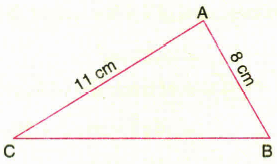
Find the area of a triangle two sides of which are 8 cm and 11 cm and the perimeter is 32 cm.
21.
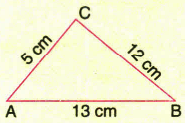
The sides of a right triangle ABC are 5 cm, 12 cm and 13 cm. Find the area of the triangle.
22.
Find the area of a right-angled \(\Delta \)ABC, right angled at B in which AB = 24 metre and BC = 10 metre.
23.
In a histogram, the heights of the rectangles are
inversely proportional to the frequencies of the corresponding classes
directly proportional to the frequencies of the corresponding classes
directly proportional to the widths of the corresponding classes
inversely proportional to the widths of the corresponding classes.
24.
The class marks of frequency distribution are 10,20,30,40, .... The class representing the class mark 30 is:
20-40
30-40
25-30
25-35
25.
In the following frequency distribution, what is the frequency of the variable 13?
3
4
6
5.
26.
When the information is gathered from a source which already had the information stored, the data obtained is called
Primary data
Secondary data
Useless data
fictitious data
27.
Identify the wrong statement of the following:
A square can be drawn on our notebook.
A circle can be drawn on the blackboard.
A rectangle can be drawn on a piece of paper.
A triangle cannot be drawn on a wall.
28.
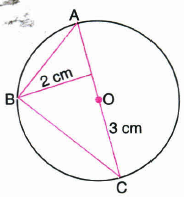
Find the area of a right-angled triangle, if the radius of the semi-circle is 3 cm and altitude drawn to the hypotenuse is 2 cm.
4 cm2
6 cm2
8 cm2
12 cm2
29.
The perimeter of a triangular plot is 16 m.If the measures of its two sides are 5 m, and 6m, then find the third side.
2 m
3 m
5 m
4 m
30.
The semiperimeter of a triangle having the length of its sides as 20 cm, 15 cm, and 9 cm is
44 cm
21 cm
22 cm
None
31.
Base of a triangle =
\(\frac { 2\times Area }{ Height } \)
\(\frac { Area }{ Height } \)
\(\frac { Area }{ 2\quad Height } \)
\(\frac { Area }{ 4\quad Height } \)
32.
Area of a triangle =
\(\frac { 1 }{ 2 } \times\) Base \( \times\) Height
Base \( \times\) Height
\(\frac { 1 }{ 3} \times\) Base \( \times\) Height
\(\frac { 1 }{ 4 } \times\) Base \( \times\) Height
33.
A die is thrown, what will be the probability of getting an even number?
34.
The range of the data is: 25,18,20,22,16,6,17,12,30,32,10,19,8,11,20 is:
35.
Two cylinders have bases of same size. The diameter of each is 7 cm. If one of the cylinder is 10 cm high and the other is 20 cm high, then the ratio of their volumes is _________________
36.
Find the mode of the numbers: 14,14,15,27,26,27,27,22,13
37.
Find the capacity of a tank of demensions 8 am \(\times\)6 cm \(\times\)2.5 cm.
1.
Steps of construction:
i) Draw a ray BX and cut off line segment BC = 4cm
ii) Construct ㄥXBY = 90o
iii) From BY cut off line segment BD = 8 cm,
iv) Join CD.
v) Draw the ⊥ bisector of CD, intersecting BD at A
vi) Join AC, ABC is the required triangle
2.
48 cm2
3.
36000 cm2
4.
Given: Side (say 4 cm) of an equilateral triangle.
Required: To construct the equilateral triangle and justify the construction.
Steps of Construction:
1. Take a ray AX with initial point A. From AX, cut off AB = 4 cm.
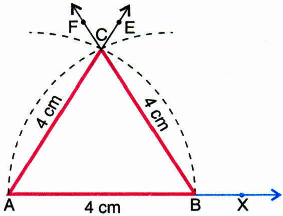
2. Taking A as centre and radius (= 4 em), draw an arc of a circle, which intersects AX, say at a point B.
3. Taking B as centre and with the same radius as before, draw an arc intersecting the previously drawn arc, say at a point C.
4. Draw the ray AE passing through C.
5. Draw the ray BF passing through e. Then \(\Delta \) ABC is the required triangle with given side 4 cm.
5.
Given, h = 5
C.S.A.=\(\frac { 2 }{ 3 } \)(Sum of circular faces)
\(2\pi rh=\frac { 2 }{ 3 } (2\pi { r }^{ 2 })\)
\(15=\frac { 2 }{ 3 } r\)
\(\frac { 45 }{ 2 } =r\)
r = 22.5 cm.
6.
Given, CSA of a cylinder = 88 cm2
height = 14 cm
CSA of a cylinder = 2\(\pi\)rh
\(\Rightarrow \ 88=2\times \frac { 22 }{ 7 } \times r\times 14\)
\(\Rightarrow \ r=\frac { 88\times 7 }{ 2\times 22\times 14 } \)
= 1 cm
7.
Surface area of shere =4\(\pi\)2.
\(\therefore\) 4\(\pi\)r2 = 616
\(\Rightarrow\) \(\pi\)r2 = 154
\(\Rightarrow \ { r }^{ 2 }=\frac { 154\times 7 }{ 22 } \left( \because \pi =\frac { 22 }{ 7 } \right) \)
\(\Rightarrow\) r2 = 49
\(\therefore\) r = 7
Hence, the radius of sphere is 7 cm.
8.
Steps of Construction:
i) Draw any line segment PQ = 5.5. cm
ii) With P as centre and radius 5.5 cm draw an arc
iii) With Q as centre and radius 5.5 cm draw an arc to cut the previous arc at R
iv) Join PR and QR, then PQR is the required triangle.
9.
Let us first draw a histogram for this data and mark the mid-points of the tops of the rectangles as B, C, D, E, F, G, H, I, J, K, respectively. Here, the first class is 0-10. So, to find the class preceeding 0-10, we extend the horizontal axis in the negative direction and find the mid-point of the imaginary class-interval (–10) - 0. The first end point, i.e., B is joined to this mid-point with zero frequency on the negative direction of the horizontal axis. The point where this line segment meets the vertical axis is marked as A. Let L be the mid-point of the class succeeding the last class of the given data. Then OABCDEFGHIJKL is the frequency polygon, which is shown in Fig.
10.
| 0-20 | 2 |
| 20-40 | 7 |
| 40-60 | 11 |
| 60-80 | 18 |
| 80 & Above | 12 |
11.
| Class | Frequency |
| 0-10 | 1 |
| 10-20 | 4 |
| 20-30 | 3 |
| 30-40 | 7 |
| 40-50 | 7 |
| 50-60 | 7 |
| 60-70 | 1 |
| Total | 30 |
12.
Required volume \(=\frac{4}{3} \pi r^{3}\)
\(=\frac{4}{3} \times \frac{22}{7} \times 11.2 \times 11.2 \times 11.2 \mathrm{~cm}^{3}=5887.32 \mathrm{~cm}^{3}\)
13.
4 cm
14.
100
15.
440 cm2
16.
270, 1 : 43
17.
2058 dm3
18.
28 cm
19.
48 m2
20.
Here we have perimeter of the triangle = 32 cm, a = 8 cm and b = 11 cm.
Third side c = 32 cm – (8 + 11) cm = 13 cm
So, 2s = 32, i.e., s = 16 cm,
s – a = (16 – 8) cm = 8 cm,
s – b = (16 – 11) cm = 5 cm,
s – c = (16 – 13) cm = 3 cm.
Therefore, area of the triangle = \(\sqrt{s(s-a)(s-b)(s-c)}\)
\(=\sqrt{16 \times 8 \times 5 \times 3} \mathrm{~cm}^{2}=8 \sqrt{30} \mathrm{~cm}^{2}\)
21.
30 cm2.
22.
Area of \(\Delta \)ABC = \(=\frac { AB\times BC }{ 2 } =\frac { 24\times 10 }{ 2 } \) = 120 m2.
23.
Method of drawing a histogram
24.
20 - 10 = 10
10 + 2 = 5
30 - 5 = 25
30 + 5 = 35
25.
(a)
3
26.
Definition of a secondary data
27.
(d)
A triangle cannot be drawn on a wall.
28.
(b)
6 cm2
29.
(c)
5 m
30.
s=\(\frac { 20+15+9 }{ 2 } \)=22 cm
31.
Formula
32.
Formula
33.
()
Favourable number of outcomes = 3(2,4,6)
Total number of outcomes = 6
Required probability\(=\frac{3}{6}=\frac{1}{2}\)
34.
()
26
35.
()
Let r denotes the radius of both cylinders and l and h be their heights respectively.
Ratio of their volumes = \(\frac { \pi { r }^{ 2 }h }{ \pi { r }^{ 2 }h' } =\frac { h }{ h' } =\frac { 10 }{ 20 } \)
= 1 : 2.
36.
()
Mode = 27
37.
()
Capacity of the tank = 120 cm3
Capacity of the tank = length\(\times\)breadth\(\times\)height
= 8 cm\(\times\)6 cm\(\times\)2.5 cm
= 120 cm3

9th Standard CBSE Syllabus & Materials
9th Standard CBSE
CBSE 9th Mathematics Lines and Angles Sample Question Papers Study Material - QB365 Set A
NEW9th Standard CBSE
CBSE 9th Mathematics Introduction to Euclid's Geometry Sample Question Papers Study Material - QB365 Set A
NEW9th Standard CBSE
CBSE 9th Mathematics Linear Equations in Two Variables Sample Question Papers Study Material - QB365 Set A
NEW9th Standard CBSE
CBSE 9th Mathematics Coordinate Geometry Sample Question Papers Study Material - QB365 Set A



CBSE 9th Standard CBSE Subjects
CBSE Standards