100% FREE ACCESS
9th Standard CBSE Syllabus & Materials
9th Standard CBSE
CBSE 9th Science Is matter around us pure? - New Model Questions Papers Study Material - QB365 Set A
NEW9th Standard CBSE
CBSE 9th Science Matter in our surroundings - New Model Questions Papers Study Material - QB365 Set A
NEW9th Standard CBSE
CBSE 9th Mathematics Heron's Formula Sample Question Papers Study Material - QB365 Set A
NEW9th Standard CBSE
CBSE 9th Mathematics Circles Sample Question Papers Study Material - QB365 Set A
NEW9th Standard CBSE
CBSE 9th Mathematics Quadrilaterals Sample Question Papers Study Material - QB365 Set A
NEW9th Standard CBSE
CBSE 9th Mathematics Triangles Sample Question Papers Study Material - QB365 Set A

Published on: 05/09/2019
Triangles
Download CBSE Class 9th Standard CBSE Mathematics question papers, sample papers, important questions, and previous year solved papers in PDF format. Get free study materials, NCERT solutions, and exam preparation resources for Class 9th Standard CBSE Mathematics
Questions + Answers key
Take MCQ Mathematics Test
1.
Show that the angles of an equilateral triangle are 60° each.
2.
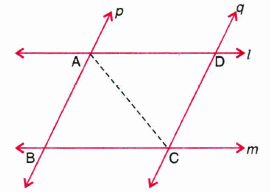
l and m are two parallel lines intersected by another pair of parallel lines p and q (see figure). Show that \(\triangle ABC\cong \triangle CDA\)
3.
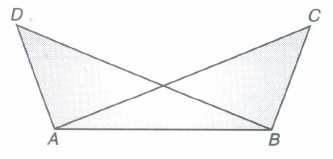
ABCD is a quadrilateral in which AD = BC and \(\angle DAB=\angle CBA\) (see fihure).Prove that:
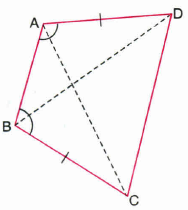
(i) \(\triangle ABD\cong \triangle BAC\)
(ii) BD = AC
(iii) \(\angle ABD=\angle BAC\)
4.
Prove that the medians of an equilateral triangle are equal.
5.
In a rectangle ABCD, E is a point which bisects BC Prove that AE = ED
6.
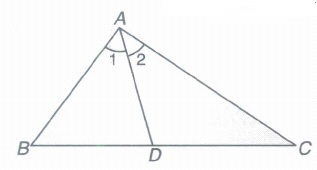
In the figure, given AC > AB and AD is the bisector of \(\angle\)A. Show that \(\angle\)ADC > \(\angle\)ADB.
7.
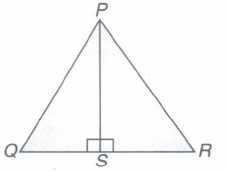
PS is an altitude of an isosceles triangle PQR in which PQ = PR. Show that PS bisects \(\angle\)P.
8.
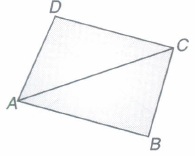
In the figure below, the diagonal AC of quadrilateral ABCD bisects \(\angle\)BAD and \(\angle\)BCD.Prove that BC = CD.
9.
In ΔABC, ㄥA = 60°, ㄥB = 40°, which side of this triangle is the smallest? Give reasons for your answer.
10.
In ΔABC, if ㄥA = 50° and ㄥB = 60°, determine the shortest and the longest side of the triangle.
11.
Two triangles are congruent, if any two pairs of angles and one pair of corresponding sides are equal. This rule is known as
SAS congruence rule
ASA congruence rule
AAS congruence rule
SSS congruence rule
12.
Two triangles are congruent, if two angles and the included side of one triangle are equal to two angles and the included side of other triangle. This rule is known as
SAS congruence rule
ASA congruence rule
SSS congruence rule
AAS congruence rule.
13.
Two triangles are congruent, if two sides and the included angle of one triangle are equal to two sides and the included angle of the other triangle. This rule is known as
SAS congruence rule
ASA congruence rule
SSS congruence rule
RHS congruence rule.
14.
ΔABC ≅ ΔPQR.If AB = 5cm, ㄥB = 400and ㄥA = 800, then which of the following is true?
QP = 5cm, ㄥP = 600
QP = 5cm, ㄥR = 600
QR = 5cm, ㄥR = 600
QR = 5cm, ㄥQ = 400
15.
ΔABC ≌ ΔPQR, then which of the following is true:
A↔R
AB=QR
AC=PQ
AB=PQ
16.
Two circles are congruent.If the radius of one circle is 3cm, what is the radius of the other circle?
3 cm
6 cm
1.5 cm
1 cm
17.
The symbol for correspondence is
⟶
⇔
↔
≡
18.
The symbol for congruence is
=
~
0
≅
19.
A triangle has
2 verticles
3 verticles
4 verticles
5 verticles
20.
A closed figure formed by three intersecting lines is called
circle
square
triangle
rhombus
21.
Is it possible to construct a triangle, when its sides are 5.4 cm, 2.3 cm, 3.1 cm?
22.
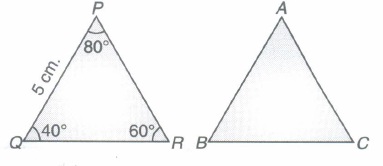
\(\triangle PQR\cong \triangle ABC\), if PQ = 5 cm, \(\angle\)Q = 40° and \(\angle\)P = 80°, calculate the value of \(\angle\)C.
23.
In given fig., AD = BC and \(\angle\)BAD =\(\angle\)ABC, then prove that \(\angle\)ACB = \(\angle\)BDA.
24.
What do we call a triangle if the angles are in the ratio 5 : 3 : 7?
25.
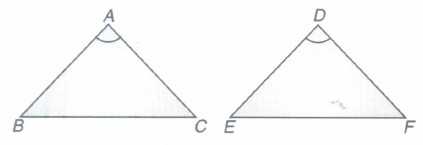
In \(\triangle\)ABC and \(\triangle\)DEF, AB=DE, \(\angle\)A=\(\angle\)D. What will be the condition in which the two triangles will be congruent by SAS axiom?
26.
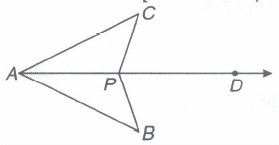
In the given figure, AD is the bisector of \(\angle\)BAC and \(\angle\)CPD = \(\angle\)BPD. Prove that\(\triangle CAP\cong \triangle BAP\) and CP = BP.
1.
Given: An equilateral triangle ABC
To prove: \(\angle A+\angle B+\angle C={ 60 }^{ 0 }\)
Proof: ABC is an equilateral triangle
AB = BC = CA ....... (1) |
AB = BC
\(\angle A=\angle C\) .......... (2) | Angles opposite to equal sides of a triangle are equal
BC = CA
\(\angle A=\angle B\) ......... (3) | Angles opposite to equal sides of a triangle are equal
From (2) and (3), we obtain
\(\angle A=\angle B=\angle C\) ........ (4)
In \(\triangle ABC\)
\(\angle A+\angle B+\angle C={ 180 }^{ 0 }\) ...... (5) | Sum of all the angles of a triangle is 180°
Let \(\angle A={ x }^{ 0 }\) then, \(\angle B=\angle C={ x }^{ 0 }\)
From (5)
\({ x }^{ 0 }+{ x }^{ 0 }+{ x }^{ 0 }={ 180 }^{ 0 }\)
\(3{ x }^{ 0 }={ 180 }^{ 0 }\)
\({ x }^{ 0 }={ 60 }^{ 0 }\)
\(\angle A=\angle B=\angle C={ 60 }^{ 0 }\)
2.
Given: l and m are two parallel lines intersected by another pair of parallel lines p and q
To Prove: \(\triangle ABC\cong \triangle CDA\)
Proof: \(AB\parallel DC\) and \(AD\parallel BC\)
Quadrilateral ABCD is a parallelogram.
| A quadrilateral is a parallelogram if both the pairs of opposite sides are parallel
BC = AD ........... (1) | Opposite sides of a \(\parallel \) gm are equal
AB = CD .............(2) | Opposite sides of a \(\parallel \) gm are equal
\( \angle ABC=\angle CDA\)......(3) | Opposite angles of a \(\parallel \) gm are equal
In \(\triangle ABC\) and \(\triangle CDA\),
AB = CD | From (2)
BC = DA | From (1)
\( \angle ABC=\angle CDA\) | From (3)
\(\triangle ABC\cong \triangle CDA\) | SAS Rule
3.
Given ABCD is a quadrilateral in which AD=BC and \(\angle DAB=\angle CBA\)
To prove: (i) \(\triangle ABD\cong \triangle BAC\)
(ii) BD = AC
(iii) \(\angle ABD=\angle BAC\)
Proof: (i) In \(\triangle ABD\) and \(\triangle BAC\)
AD = BC
AB = BA
\(\angle DAB=\angle CBA\)
\(\triangle ABD\cong \triangle BAC\) |SAS Rule
(ii) \(\triangle ADB\cong \triangle BAC\) |Proved in (i)
BD = AC | C.P.C.T
(iii) \(\triangle ABD\cong \triangle BAC\) |Proved in (i)
\(\angle ABD=\angle BAC\) | C.P.C.T
4.
Given: ABC is an equilateral triangle whose medians are AD, BE and CF.
To prove: AD = BE = CF
Proof: In \(\triangle ADC\) and \(\triangle BEC\)
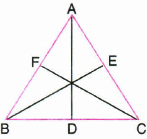
AC = BC
\(\angle ACD=\angle BCE\)
AD is a median DC = DB = 1/2 BC
BE is a median EA = EC = 1/2 AC
AC = BC
DC = EC
\(\triangle ADC\cong \triangle BEC\) | SAS congruence rule
AD = BE | C.P.C.T
Similarly, we can prove that
BF = CF ... (2)
CF = AD ....(3)
From (1), (2) and (3)
AD = BE = CF
5.
Given: In a rectangle ABCD, E is a point which bisects BC
To Prove: AE = ED
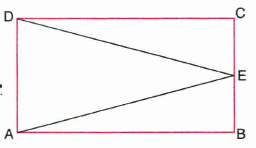
Proof: In \(\triangle EBA\) and \(\triangle ECD\)
EB = EC
\(\angle EBA=\angle ECD\) | Each 900 (ABCD is a rectangle)
BA = CD | Opposite sides of rectangle ABCD
\(\triangle EBA\cong \triangle ECD\) | SAS congruenece rule
AE = DE | C.P.C.T
AE = ED
6.
In \(\triangle\)ABC, AC >AB
\(\therefore\) \(\angle\) ABC > \(\angle\)ACB
(Angles opposite to larger side is greater)
\(\therefore\) \(\angle\)ABC + \(\angle\)1 > \(\angle\)ACB + \(\angle\)1
(Adding \(\angle 1\)on both sides) Y.
\(\therefore\) \(\angle\)ABC + \(\angle\)1 > \(\angle\)ACB + \(\angle\)2
(AD bisects \(\angle\)A, \(\angle\)1 = \(\angle\)2)
\(\therefore\) \(\angle\)ADC > \(\angle\)ADB.
(Exterior angle property of triangle)
7.
In \(\triangle\)PQS and \(\triangle\)PRS,
PQ = PR (Given)
PS = PS (Common)
\(\angle\)PSQ = \(\angle\)PSR = 90°
(PS is altitude)
By R.H.S. rule,
\(\triangle PQS\cong \triangle PRS\)
\(\angle\)QPS = \(\angle\)RPS (By c.p.c.t.)
Hence, PS bisects \(\angle\)P.
8.
In \(\triangle\)ADC and \(\triangle\)ABC,
AC is Common
\(\angle DAC=\angle BAC\)
\(\angle DCA=\angle BCA\)(Given)
Hence, \(\triangle ADC\cong \triangle ABC\) (By AAS rule)
\(\Rightarrow\) CD = BC (By c.p.ct) Proved
9.
AC as ㄥB is the smallest.
10.
BC, AB
11.
Theorem
12.
Theorem
13.
Theorem
14.
(b)
QP = 5cm, ㄥR = 600
15.
Obviously AB=PQ
16.
Two circles of the same radii are congruent
17.
↔ denotes correspondence
18.
≌ represents congruence.
19.
(b)
3 verticles
20.
(c)
triangle
21.
()
No, Because, 2.3 + 3.1 = 5.4 cm (third side)
\(\therefore\) Not possible to construct a triangle.
22.
()
\(\angle\)R= 180° - 80° - 40° = 60°
\(\triangle PQR\cong \triangle ABC\)
\(\therefore\) \(\angle\)R = \(\angle\)C = 60°
23.
()
AD = BC (Given)
\(\angle\)BAD =\(\angle\)ABC (Given)
AB = AB (Common)
\(\triangle DAB\cong \triangle CBA\) (By SAS)
\(\angle\)BDA =\(\angle\)ACB (By c.p.ct)
24.
()
Let the angles of triangle are 5x, 3x and 7x, then
5x + 3x + 7x = 180°
\(\Rightarrow\) 15x = 180°
Thus, x = 12°
\(\therefore\) Angles are 60°, 36°, 84°
\(\therefore\) Each angle is less than 90°
\(\therefore\) The triangle is an acute-angled triangle.
25.
()
Since AB = DE, \(\angle\)A =\(\angle\)D and \(\triangle\)ABC\(\cong \)\(\triangle\)DEF by SAS.
Therefore AC = DF.
26.
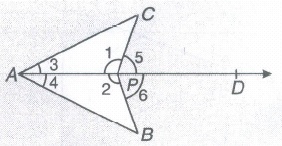
\(\angle\)1 + \(\angle\)5 = 1800 = \(\angle\)2 + \(\angle\)6
(linear pair)
\(\Rightarrow\) \(\angle\)1 =\(\angle\)2 (\(\because\) \(\angle\)5 = \(\angle\)6)
In \(\triangle\)CAP and \(\triangle\)BAP,
\(\angle\)1 = \(\angle\)2 (proved)
\(\angle\)3 = \(\angle\)4
(AD is the bisector of \(\angle\)BAC)
AP =AP
\(\triangle CAP\cong \triangle BAP\) (By SAS)
\(\Rightarrow\) CP = BP (By c.p.c.t.) Proved

9th Standard CBSE Syllabus & Materials
9th Standard CBSE
CBSE 9th Mathematics Lines and Angles Sample Question Papers Study Material - QB365 Set A
NEW9th Standard CBSE
CBSE 9th Mathematics Introduction to Euclid's Geometry Sample Question Papers Study Material - QB365 Set A
NEW9th Standard CBSE
CBSE 9th Mathematics Linear Equations in Two Variables Sample Question Papers Study Material - QB365 Set A
NEW9th Standard CBSE
CBSE 9th Mathematics Coordinate Geometry Sample Question Papers Study Material - QB365 Set A



CBSE 9th Standard CBSE Subjects
CBSE Standards