100% FREE ACCESS
9th Standard CBSE Syllabus & Materials
9th Standard CBSE
CBSE 9th Science Is matter around us pure? - New Model Questions Papers Study Material - QB365 Set A
NEW9th Standard CBSE
CBSE 9th Science Matter in our surroundings - New Model Questions Papers Study Material - QB365 Set A
NEW9th Standard CBSE
CBSE 9th Mathematics Heron's Formula Sample Question Papers Study Material - QB365 Set A
NEW9th Standard CBSE
CBSE 9th Mathematics Circles Sample Question Papers Study Material - QB365 Set A
NEW9th Standard CBSE
CBSE 9th Mathematics Quadrilaterals Sample Question Papers Study Material - QB365 Set A
NEW9th Standard CBSE
CBSE 9th Mathematics Triangles Sample Question Papers Study Material - QB365 Set A

Published on: 28/09/2019
Triangles
Download CBSE Class 9th Standard CBSE Mathematics question papers, sample papers, important questions, and previous year solved papers in PDF format. Get free study materials, NCERT solutions, and exam preparation resources for Class 9th Standard CBSE Mathematics
Questions + Answers key
Take MCQ Mathematics Test
1.
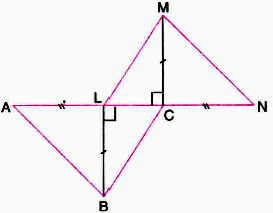
In the given figure \(BL\bot AC,MC\bot LN\), AL = CN and BL = CM. Prove that \(\triangle ABC\cong \triangle NML\)
2.
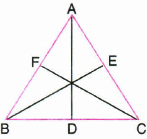
Prove that the medians of an equilateral triangle are equal.
3.
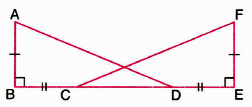
In the given figure, if AB = FE, BC=ED, \(AB\bot BD\) and \(FE\bot EC\), then prove that
(i) \(\triangle ABD\cong \triangle FEC\)
(ii) \(AD\cong FC\)
4.
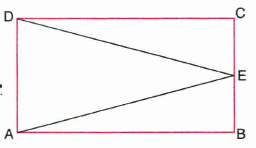
In a rectangle ABCD, E is a point which bisects BC Prove that AE = ED
5.
AD and BC are equal perpendiculars to a line segment AB (see figure).
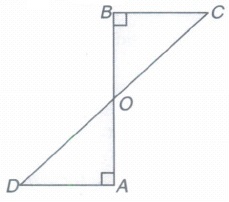
(i) Show that CD bisects AB.
(ii) Which mathematical concept is used in this problem?
(iii) What is its value?
6.
I and m are two parallel equal lines intersected by another pair of parallel lines p and q (see figure) :
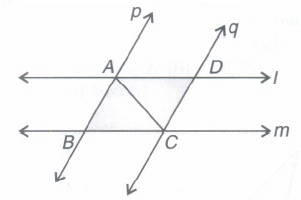
(i) Show that \(\triangle ABC\cong \triangle CDA\)
(ii) Which mathematical concept is used in this problem?
(iii) What is its value?
7.
For spreading the message "Save Girl Child Save Future" a rally was organized by some students of a school. They were given triangular cardboard piece PQR which they divided in to two parts by drawing the angle bisectors QO and RO of base angles Q and R and wrote a slogan. Prove that \(\angle\)QOR = 90° + \(\frac{1}{2}\)\(\angle\)P. What is the benefit of these types of rallies?
8.
In \(\triangle\)ABC, if AB is the greatest side, then prove that LC > 60°.
9.
In the figure, AD = AE, BD = EC. Prove that \(\triangle\)ABC is an isosceles triangle.
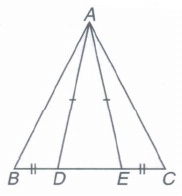
10.
In the figure below, ABC is a triangle in which AB = AC. X and Yare points on AB and AC such that AX = AY. Prove that \(\triangle ABY\cong \triangle ACX\) .
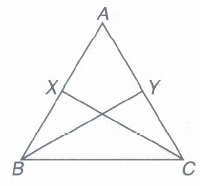
1.
In \(\triangle MCL\) and \(\triangle BLC\)
MC = BL
\(\angle MCL=\angle BLC\)
CL = LC
\(\triangle MCL\cong \triangle BLC\)
ML = BC | C.P.C.T
and \(\angle MLC=\angle BCL\) | C.P.C.T
In \(\triangle ABC\) and \(\triangle NML\)
BC = ML
\(\angle BCL=\angle MLN\)
AL = CN
AL + LC = LC + CN
AC = NL
\(\triangle ABC\cong \triangle NML\) | SAS congruence rule
2.
Given: ABC is an equilateral triangle whose medians are AD, BE and CF.
To prove: AD = BE = CF
Proof: In \(\triangle ADC\) and \(\triangle BEC\)
AC = BC
\(\angle ACD=\angle BCE\)
AD is a median DC = DB = 1/2 BC
BE is a median EA = EC = 1/2 AC
AC = BC
DC = EC
\(\triangle ADC\cong \triangle BEC\) | SAS congruence rule
AD = BE | C.P.C.T
Similarly, we can prove that
BF = CF ... (2)
CF = AD ....(3)
From (1), (2) and (3)
AD = BE = CF
3.
Given:
AB = FE
BC = ED
\(AB\bot BD\)
\(FE\bot EC\)
To prove: (i) \(\triangle ABD\cong \triangle FEC\)
(ii) \(AD\cong FC\)
Proof: (i) In \(\triangle ABD\) and \(\triangle FEC\)
AB = FE ......... (1)
\(\angle ABD=\angle FEC\) ... (2) | Each 900
BC = ED
BC + CD = ED + DC
BD = EC ....... (3)
In view of (1), (2) and (3)
\(\triangle ABD\cong \triangle FEC\) | SAS congruence rule
(ii) AD = FC | C.P.C.T
4.
Given: In a rectangle ABCD, E is a point which bisects BC
To Prove: AE = ED
Proof: In \(\triangle EBA\) and \(\triangle ECD\)
EB = EC
\(\angle EBA=\angle ECD\) | Each 900 (ABCD is a rectangle)
BA = CD | Opposite sides of rectangle ABCD
\(\triangle EBA\cong \triangle ECD\) | SAS congruenece rule
AE = DE | C.P.C.T
AE = ED
5.
(i) AB and CD intersect atO0
\(\therefore\) \(\angle\)AOD = \(\angle\)BOC
(Vertically opp. angles) ...(i)
In \(\triangle\)AOD and \(\triangle\)BOC, we have
\(\angle\)AOD = \(\angle\)BOC ...(ii)
\(\angle\)DAO = \(\angle\)CBO = 90° (Given)
and AD = BC (Given)
\(\triangle AOD\cong \triangle BOC\)
(By AAS congruence criterion)
\(\Rightarrow\) OA = OB (By c.p.c.t.)
i.e., O is the mid-point of AB
Hence, CD bisects AB.
(ii) Congruency of triangles.
(iii) Equality is the sign of democracy.
6.
(i) I and m are two parallel lines intersected byanother pair of parallel lines p and q.
AD II BC
and AB II CD.
\(\Rightarrow\) ABCD is a parallelogram.
i.e., AB = CD
and BC = AD
Now in \(\triangle\)ABC and \(\triangle\)CDA,we have
AB = CD (Prop. of IIgm)
BC =AD
and AC = AC (Common)
\(\therefore\) \(\triangle ABC\cong \triangle CDA\)
(By SSS criterion of congruence)
(ii) Congruency of triangles.
(iii) Equality is the sign of democracy.
7.
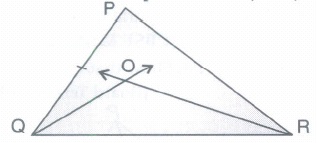
Proof: QO is bisector of \(\angle\)PQR
\(\angle\)OQR = \(\frac{1}{2}\)\(\angle\)PQR = \(\frac{1}{2}\) =\(\angle\)Q
RO is bisector \(\angle\)ORQ
\(\therefore\) \(\angle\)ORQ =\(\frac{1}{2}\) \(\angle\)PRQ = \(\frac{1}{2}\) \(\angle\)R
In \(\angle\)OQR
\(\angle\)QOR + \(\angle\)OQR + \(\angle\)ORQ = 180°
(Angle sum property)
\(\angle\)QOR + \(\frac{1}{2}\) \(\angle\)Q + \(\frac{1}{2}\) \(\angle\)R = 180°
\(\angle\)QOR = 180°- \(\frac{1}{2}\)(\(\angle\)Q + \(\angle\)R)
But in \(\angle\)PQR
\(\angle\)P + \(\angle\)Q + \(\angle\)R = 180°
\(\angle\)Q + \(\angle\)R = 180°- \(\angle\)P
\(\angle\)QOR = 180°- \(\frac{1}{2}\) (180°- \(\angle\)P)
= 180°-90° + \(\frac{1}{2}\)\(\angle\)P
= 90° + \(\angle\)P Hence Proved.
These type of rallies spread awareness among people for not to kill girl child and helping in equalising sex ratio.
8.
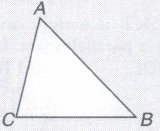
In \(\triangle\)ABC, as AB is the greatest side
\(\Rightarrow\) AB > BC \(\Rightarrow\) \(\angle\)C > \(\angle\)A
AB > AC \(\Rightarrow\) \(\angle\)C > \(\angle\)B
On adding (1) and (2), we get
2\(\angle\)C > \(\angle\)A + \(\angle\)B
\(\Rightarrow\) 2\(\angle\)C + \(\angle\)C > \(\angle\)A + \(\angle\)B + \(\angle\)C
\(\Rightarrow\) 3\(\angle\)C > 180°
\(\therefore\) \(\angle\)C > 60°.
9.
Proof: In \(\triangle\)ADE, we have
AD = AE
\(\angle\)ADE = \(\angle\)AED
180°- \(\angle\)ADE = 180°- \(\angle\)AED
\(\Rightarrow\) \(\angle\)ADB = \(\angle\)AEC
Consider \(\triangle\)ABD and \(\triangle\)ACE
AD =AE
\(\angle\)ADB = \(\angle\)AEC
BD = EC
By SAS congruence,
\(\triangle ADB\cong \triangle AEC\)
By c.p.c.t., AB = AC
\(\therefore\) \(\triangle\)ABC is an isosceles triangle.
10.
In \(\triangle\)ABY and \(\triangle\)ACX,
AB = AC (Given)
AY = AX (Given)
\(\angle\)A =\(\angle\)A (Common)
\(\therefore\) By SAS, \(\triangle ABY\cong \triangle ACX\)

9th Standard CBSE Syllabus & Materials
9th Standard CBSE
CBSE 9th Mathematics Lines and Angles Sample Question Papers Study Material - QB365 Set A
NEW9th Standard CBSE
CBSE 9th Mathematics Introduction to Euclid's Geometry Sample Question Papers Study Material - QB365 Set A
NEW9th Standard CBSE
CBSE 9th Mathematics Linear Equations in Two Variables Sample Question Papers Study Material - QB365 Set A
NEW9th Standard CBSE
CBSE 9th Mathematics Coordinate Geometry Sample Question Papers Study Material - QB365 Set A



CBSE 9th Standard CBSE Subjects
CBSE Standards