100% FREE ACCESS
9th Standard CBSE Syllabus & Materials
9th Standard CBSE
CBSE 9th Science Is matter around us pure? - New Model Questions Papers Study Material - QB365 Set A
NEW9th Standard CBSE
CBSE 9th Science Matter in our surroundings - New Model Questions Papers Study Material - QB365 Set A
NEW9th Standard CBSE
CBSE 9th Mathematics Heron's Formula Sample Question Papers Study Material - QB365 Set A
NEW9th Standard CBSE
CBSE 9th Mathematics Circles Sample Question Papers Study Material - QB365 Set A
NEW9th Standard CBSE
CBSE 9th Mathematics Quadrilaterals Sample Question Papers Study Material - QB365 Set A
NEW9th Standard CBSE
CBSE 9th Mathematics Triangles Sample Question Papers Study Material - QB365 Set A

Published on: 29/08/2019
Quadrilaterals
Download CBSE Class 9th Standard CBSE Mathematics question papers, sample papers, important questions, and previous year solved papers in PDF format. Get free study materials, NCERT solutions, and exam preparation resources for Class 9th Standard CBSE Mathematics
Questions + Answers key
Take MCQ Mathematics Test
1.
How many pairs of opposite sides a quadrilateral have?
1
2
3
4
2.
How many diagonals does a quadrilateral have?
1
2
3
4
3.
How many angles are three in a quadrilateral have?
4
2
1
3
4.
What is the number of vertices of a quadrilateral?
1
2
4
3
5.
How many sides does a quadrilateral have?
3
5
6
4
6.
D, E, F are the mid-points of sides BC, CA and AB of ΔABC. If perimeter of ΔABC is 12·8 cm, then perimeter of ΔDEF is: .....
7.
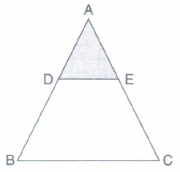
In an equilateral triangle ABC, D and E are the mid-points of sides AB and AC respectively, then length of DE is....
8.
Two consecutive angles of a parallelogram are in the ratio 1 : 3, then what will be the smaller angles?
9.
The angles of a quadrilateral are in the ratio 2 : 3 : 6 : 7. The largest angle of the quadrilateral is
10.
If in quadrilateral ABCD; ∠A=90° and AB=BC=CD=DA, then ABCD is a square.
1.
(b)
2
2.
(b)
2
3.
(a)
4
4.
(c)
4
5.
(d)
4
6.
()
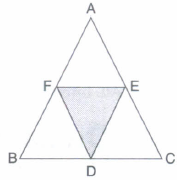
Given, perimeter of ΔABC=12.8 cm
ஃ Perimeter of ΔDEF=\(\frac{12.8}{2}\)=6.4cm
7.
()
Since D and E are mid-points of sides AB and AC respectively, so, by mid-point theorem, DE=\(\frac{1}{2}\)BC.
8.
()
Let the consecutive angles be x° and (3x)°
x°+3x°=180°
4x°=180°
x°=45°
ஃ Smaller angle=x°
=45°
9.
()
Let the angles of the quadrilateral be 2x°, 3x°, 6x°,7x°.
2x°+ 3x°+ 6x°+7x°=360°
[Angle sum property of quadrilateral]
⇒ 18x = 360°
⇒ x=20°
ஃ Largest angle = 7x°= 140°
10.
()
True

9th Standard CBSE Syllabus & Materials
9th Standard CBSE
CBSE 9th Mathematics Lines and Angles Sample Question Papers Study Material - QB365 Set A
NEW9th Standard CBSE
CBSE 9th Mathematics Introduction to Euclid's Geometry Sample Question Papers Study Material - QB365 Set A
NEW9th Standard CBSE
CBSE 9th Mathematics Linear Equations in Two Variables Sample Question Papers Study Material - QB365 Set A
NEW9th Standard CBSE
CBSE 9th Mathematics Coordinate Geometry Sample Question Papers Study Material - QB365 Set A



CBSE 9th Standard CBSE Subjects
CBSE Standards