100% FREE ACCESS
9th Standard CBSE Syllabus & Materials
9th Standard CBSE
CBSE 9th Science Is matter around us pure? - New Model Questions Papers Study Material - QB365 Set A
NEW9th Standard CBSE
CBSE 9th Science Matter in our surroundings - New Model Questions Papers Study Material - QB365 Set A
NEW9th Standard CBSE
CBSE 9th Mathematics Heron's Formula Sample Question Papers Study Material - QB365 Set A
NEW9th Standard CBSE
CBSE 9th Mathematics Circles Sample Question Papers Study Material - QB365 Set A
NEW9th Standard CBSE
CBSE 9th Mathematics Quadrilaterals Sample Question Papers Study Material - QB365 Set A
NEW9th Standard CBSE
CBSE 9th Mathematics Triangles Sample Question Papers Study Material - QB365 Set A

Published on: 05/09/2019
Motion
Download CBSE Class 9th Standard CBSE Science question papers, sample papers, important questions, and previous year solved papers in PDF format. Get free study materials, NCERT solutions, and exam preparation resources for Class 9th Standard CBSE Science
Questions + Answers key
Take MCQ Science Test
1.
You must have the story of the hare and tortoise. The two started simultaneously from the same point for a common destination. The hare slept for sometime along the way, and the tortoise reached the destination first. Since in this journey the tortoise took less time than the hare, the average speed of the tortoise was greater than that of the hare. But everyone knows that when the hare was actually running, it was much faster than the tortoise.
(a) Define the term speed.
(b) What is the S.I. unit of speed?
(c) Define average speed.
(d) Can the average speed of an object be negative?
2.
Give two differences between distance and displacement
3.
What is meant by motion in a straight line? Give some examples of each a motion.
4.
Describe the various types of motions observed in bodies.
5.
An object may appear to be moving for one person and stationary for some others. For the passengers in a moving bus, the roadside trees appear to be moving backward. A person standing on the roadside perceives the bus alongwith the passengers as moving. However, a passenger inside the bus sees his fellow passengers to be at rest. So motion is not absolute, it is relative.
(a) Are rest and motion absolute or relative terms?
(b) Can an object be at rest as well as in motion at the same time?
(c) You are walking towards India Gate. Is India at rest with respect to you or it is moving with respect to you?
6.
What can you say about the motion of an object whose distance-time graph is a straight line parallel to the time axis?
7.
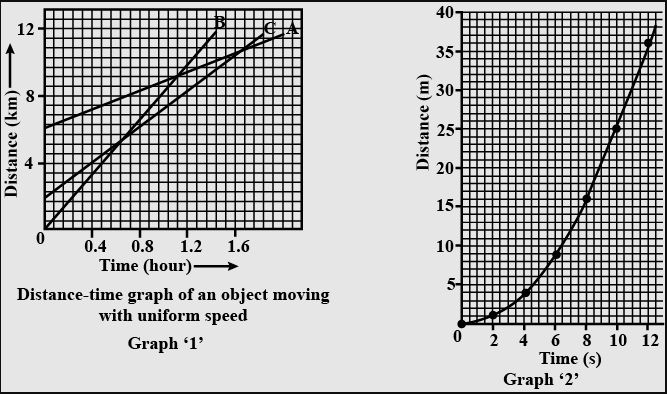
What is the nature of the distance-time graphs for uniform and non-uniform motion of an object?
8.
A train starting from a railway station and moving with uniform acceleration attains a speed 40 km h–1 in 10 minutes. Find its acceleration.
9.
What do you mean by the term retardation? Give two examples of such a motion
10.
Distinguish between speed and velocity.
11.
A body moves in a circle of radius '2R' What is the distance covered and displacement of the body after 2 complete rounds?
12.
What is non-uniform motion? Give some examples.
13.
On a 100 km track , a train travels the first 30 km at a uniform speed of 30 km \(h^{ -1 }\)How fast must the train travel the next 70 km so as to average 40 km \(h^{ -1 }\) for the entire trip?
14.
A wooden slab starting from rest slides down a 10 m long inclined plane with an acceleration of 5 \(ms^{ -2 }\) what would be its speed at the bottom of the inclined plane?
10 \(ms^{ -1 }\)
12 \(ms^{ -1 }\)
10 \(cms^{ -1 }\)
12 \(cms^{ -1 }\)
15.
The initial velocity of a train which is stopped in 20 s by applying brakes retardation due to brakes being 1.5 \(ms^{ -2 }\) is
30 \(ms^{ -2 }\)
30 \(cm^{ -1 }\)
20 \(cm^{ -1 }\)
24 \(ms^{ -1 }\)
16.
In 12 minutes a car whose speed is 35 km/h travels a distance of
7 km
3.5 km
14 km
28 km
17.
The initial velocity of a body is u.It is under uniform acceleration a its velocity v at any time t is given by
\(v=u+at^{ 2 }\)
\(v=u+\frac { 1 }{ 2 } at^{ 2 }\quad \)
v = u + at
v = u
18.
The SI of velocity is
\(ms^{ -1 }\)
\(ms^{ -2 }\)
\(ms^{ -3 }\)
\(Nm^{ -1 }\)
19.
Displacement is a .......... quantity and distance is a ..................... quantity
20.
Define speed of body.
21.
What is the SI unit of displacement?
1.
(a) Speed is defined as the distance travelled by a body per unit time.
(b) The SI unit of speed is m s-1
(c) Average speed is the total distance travelled by a body, divided by the total time taken to cover that distance.
(d) No, the average speed of an object can't be negative.
2.
| Distance | Displacement |
| 1.Distance is the length of the actual path traversed by a body irrespective of its direction of motion | 1. Displacement is the shortest distance between the initial and final position of a body in a given direction. |
| 2.Distance between two given points may be same or different for different paths chosen. | 2.Displacement between two given points is always same |
| It is a scalar quantity | It is a vector quantity |
| Distance covered is always positive or zero | Displacement covered may be positive negative or zero. |
3.
A body is said to move along a straight line if its position keeps on changing with time.
Examples of motion in a straight line or rectilinear motion:
(i) A bus moving on a straight road;
(ii) A train moving on a straight track;
(iii) A runner running along a straight track.
(iv) A ball moving along a straight path ; and
(v) An object falling vertically downwards towards the surface of the earth.
4.
Different types of Motions:
1.Translatory Motion When a body moves as a whole along a straight or curved path, it is said to be in translatory motion.It is again of two types:
(i) Rectilinear motion Here a body moves as a whole along a straight path.For example a train moving on straight rails has translatory rectilinear motion.
(ii) Curvilinear motion.Here a body moves as a whole along a curved path For example motion of a bicycle taking a turn along a curved path.
2.Rotatory motion.When a body rotates about a fixed point or axis , it has rotatory motion For example motion of a flywheel about a shaft.
3.Vibratory or oscillatory motion. When a body moves to and from about a mean position again and again it has vibratory or oscillatory motion For example the motion of the pendulum of a wall clock.
4.Complex motion. Sometimes ,the motion of a body may be a combination of more than one types of motion For example a ball rolling down an inclined plane has botth translatoruy and rotatory motions.
5.
(a) Rest and motion are relative terms/
(b) Yes. An object may be at rest relative to one object and at the same time it may be in motion relative to another object.
(c) Moving.
6.
When an object is at rest, its distance-time graph is a straight line parallel to the time axis.
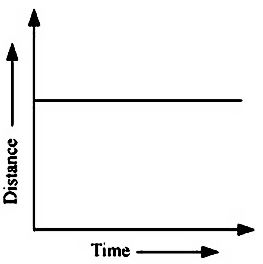
A straight line parallel to the x-axis in a distance-time graph indicates that with a change in time, there is no change in the position of the object. Thus, the object is at rest.
7.
(i) The nature of the distance-time graphs for the uniform motion of an object is a straight line. (Follow the below graph 1.)
(ii) The nature of the time distance-time graph for non-uniform motion is a curved line. Distance-time graph for a car moving with non-uniform speed. (Follow the below graph 2.)
8.
Initial speed,u = 0
Final speed,v = \(40\frac { km }{ h } =\frac { 40X1000m }{ 3600s } =\frac { 100 }{ 9 } ms^{ -1 }\)
Time,t = 10 min = 600 s
Acceleration,a = \(\frac { v-u }{ t } =\frac { \frac { 100 }{ 9 } -0 }{ 600 } =\frac { 100 }{ 9X600 } ms^{ -2 }\)
\(=\frac { 1 }{ 54 } ms^{ -2 }\)
9.
Retardation. When the velocity of a body decreases, its acceleration is negative Negative acceleration is called 'retardation' or 'deceleration' When a stone is thrown upwards, it is under retardation. Similarly, when a bus approaches a bus stop, its motion gets retarded.
10.
Speed of a body needs only magnitude and not direction for its complete description while the velocity needs both magnitude and direction for its complete description so speed is a scalar quantity while velocity is a vector is a vector quantity for example when a car moves wit a speed of 60km/h in the direction 45 degree south of west,we can say that the car moves with a velocity of 60 km/h 45 degree south of west Here the word velocity replaces both the words speed and direction
11.
Distance covered after 2 complete rounds
= 2 x Circumference
= 2x 2\(\pi \) (2R) = 8 \(\pi \)R
After 2 complete rounds, the body comes back to its initial position
\(\therefore \) Displacement = 0.
12.
Non-uniform motion .If an object covers unequal distances in equal intervals of time,it is said to be in non-uniform motion. Most of the motions seen in our daily life are non-uniform. For example,if we drop a ball from the roof of a building we will note that the ball covers 4.9 m in the 1st second 14.7 m in the 2nd second 24.5 m in the 3rd second , and so on That is the ball covers increasingly larger distances in successive seconds as it falls down. Thus, the motion of a freely falling body is non-uniform
Other examples of non-uniform motion:
(i) A stone dropped from the top of a building
(ii) A ball thrown vertically upwards
(iii) The motion of a train as it leaves the station
(iv) The motion of a bus as it approaches a bus-stop
(v) The motion of a ball rolling down an inclined plane.
13.
\(v_{ av }=\frac { s_{ 1 }+s_{ 2 } }{ t_{ 1 }+t_{ 2 } } =\frac { s }{ \frac { s_{ 1 } }{ v_{ 2 } } +\frac { s_{ 2 } }{ v_{ 2 } } } \)
\(40=\frac { 100 }{ \frac { 30 }{ 30 } +\frac { 70 }{ v_{ 2 } } } \)
\(=1+\frac { 70 }{ v_{ 2 } } =\frac { 100 }{ 40 } =\frac { 5 }{ 2 } \)
\(\frac { 7 }{ v_{ 2 } } =\frac { 5 }{ 2 } -1=\frac { 3 }{ 2 } \)
\(v_{ 2 }=\frac { 7X2 }{ 3 } =\frac { 14 }{ 3 } =4.67\quad km\quad h^{ -1 }\)
14.
(a)
10 \(ms^{ -1 }\)
15.
(a)
30 \(ms^{ -2 }\)
16.
(a)
7 km
17.
(c)
v = u + at
18.
(a)
\(ms^{ -1 }\)
19.
20.
()
Speed of body is equal to total distance travelled by the body by the total time taken to travel that distance... its SI unit is kilometres per hour or miles per hour or metre per second.
21.
()
The SI unit of displacement is meter (m).

9th Standard CBSE Syllabus & Materials
9th Standard CBSE
CBSE 9th Mathematics Lines and Angles Sample Question Papers Study Material - QB365 Set A
NEW9th Standard CBSE
CBSE 9th Mathematics Introduction to Euclid's Geometry Sample Question Papers Study Material - QB365 Set A
NEW9th Standard CBSE
CBSE 9th Mathematics Linear Equations in Two Variables Sample Question Papers Study Material - QB365 Set A
NEW9th Standard CBSE
CBSE 9th Mathematics Coordinate Geometry Sample Question Papers Study Material - QB365 Set A



CBSE 9th Standard CBSE Subjects
CBSE Standards