100% FREE ACCESS
9th Standard CBSE Syllabus & Materials
9th Standard CBSE
CBSE 9th Science Is matter around us pure? - New Model Questions Papers Study Material - QB365 Set A
NEW9th Standard CBSE
CBSE 9th Science Matter in our surroundings - New Model Questions Papers Study Material - QB365 Set A
NEW9th Standard CBSE
CBSE 9th Mathematics Heron's Formula Sample Question Papers Study Material - QB365 Set A
NEW9th Standard CBSE
CBSE 9th Mathematics Circles Sample Question Papers Study Material - QB365 Set A
NEW9th Standard CBSE
CBSE 9th Mathematics Quadrilaterals Sample Question Papers Study Material - QB365 Set A
NEW9th Standard CBSE
CBSE 9th Mathematics Triangles Sample Question Papers Study Material - QB365 Set A

Published on: 31/12/2018
Grade 9 Revision Test
Download CBSE Class 9th Standard CBSE Science question papers, sample papers, important questions, and previous year solved papers in PDF format. Get free study materials, NCERT solutions, and exam preparation resources for Class 9th Standard CBSE Science
Questions + Answers key
Take MCQ Science Test
1.
Proper care and management of farm animals is called.................................... .
2.
Uneven heating of air over land and water bodies causes ............
3.
One of the major characteristics considered for classifying all organisms is whether they are made of ............ or ........... cells.
4.
Common salt is obtained from sea water by ................
5.
When ice melts there is a ............ in volume.
6.
While determining the density of the material of metallic sphere using a spring balance and measuring cylinder, Ruby noted the following readings:
(i) Mass of the sphere = 81 g
(ii) (a) Reading of water level in the cylinder without sphere = 59 mL
(b) Reading of water level in the cylinder with sphere = 68 mL
On the basis of these observations, find the density of the material of the sphere.
7.
Compare the use of manure and fertilizers in maintaining soil fertility.
8.
How is ultrasound used for cleaning?
9.
A body of mass 5 kg is thrown vertically upwards with a speed of 10 m/s.What is its kinetic energy when it is thrown? Find its potential energy when it reaches at the highest point.Also find the maximum height attained by the body.
10.
Why are seat belts provided in automobiles and aeroplanes?
11.
(a) What is Coelom?
(b) The presence of 'coelom' in an animals body is considered as advantageous. Why?
12.
If one mole of carbon atoms weighs 12 grames, what is the mass of 1 atom of carbon?
13.
Give three reasons to support that brass is a mixture, not a compound.
14.
Two bodies of masses 3 kg and 12 kg are placed at a distance 12 m. A third body of mass 0.5 kg is to be placed at such a point that the force acting on this body is zero. Find the position of that point
15.
What management practices are common in dairy and poultry farming?
16.
Two objects, each of mass 1.5 kg, are moving in the same straight line but in opposite directions, The velocity of each object is \(2.5 m s^{-1}\) before the collision during which they stick together. What will be the velocity of the combined object after collision?
17.
Write down the hierarchic categories which are generally used for classification of animals.
18.
What is the utility of the mole concept?
19.
What is the utility of tissues in multi-cellular organisms?
20.
State any three differences between mass and weight.
21.
What are the three differences between plants and animals?
22.
The distance travelled by a freely falling body is proportional to the
mass of the body
square of the time of fall
square of the acceleration due to gravity
time of fall
23.
(i) Define relative density. Give its mathematical form.
(ii) The mass of an iron cube having an edge length 1.5 em is 50 g. Find its density.
(iii) The volume of a 250 g sealed tin is 400 cubic cm. Find the density of the tin in g (cc)-1. State, if the object would sink or float in water
24.
(i) list two differences between thrust and pressure.
(ii) What is meant by 1 pascal and 1 newton? How will the pressure change, if area of contact is doubled?
25.
A scotter starts from rest moves in a straight line with a constant acceleration and covers a distance of 64 m in 4s.
(i) Calculate its acceleration and its final velocity.
(ii) At what time the scooter had covered half the total distance?
1.
()
animal husbandry
2.
()
winds
3.
()
prokaryotic, eukaryotic
4.
()
evaporation
5.
()
decrease
6.
From Archimedes' principle,
Volume of sphere
= Volume of water displaced by sphere
= (68 - 59) mL = 9 mL
As, density = \(\cfrac { mass }{ volume } \)
=\(\cfrac { 81 }{ 9mL } =9\cfrac { g }{ mL } \)
= 9000 kgm-3
7.
1. Manures are rich in organic matter but are poor supplier of nutrients. So, the cultivated field which is not supplied with fertilizers may suffer from deficiency of nutrients and not give very good yield.
2. The cultivated field which is supplied with fertilizers only may face drainage problem and water logging due to lack of organic matter in the soil. This may harm the crop and the yield. Use of fertilizers over long periods of time can destroy the soil structure by killing the soil microorganisms that recycle nutrients in the soil.
8.
The object to be cleaned is placed in a cleaning solution and ultrasonic waves are sent into the solution.Due to the high frequency, the particles of dust, grease and dirt get detached and the object gets thoroughly washed.
9.
Here, m = 5 kg, v = 10 ms-1, g = 10 ms-2
Initial K.E. of the body = 1/2mv2 = 1/2 x 5(10)2 = 250J
P.E. at the highest point = K.E. lost by the body = 250J
mgh = P.E.
5 x 10h = 250
Height attained, h = 250/50 = 5m
10.
A sudden movement of the vehicle results in the sudden change in the state of motion of the vehicle and of our feet in contact with it. But the rest of our body oppose this change due to its inertia and tends to remain where it was. Seat belts are provided to protect the passengers from falling backward or forward during such situations.
11.
(a) Coelom is a cavity which lies in between the body wall and gut (alimentary canal) and is lined by mesodermal cells.
(b) The coelom allows greater body flexibility. In it the organs of the body can accommodate in a better way.
12.
1 mole of carbon atoms = 6.022 x 10²³ atoms
Now 6.022 x 10²³ atoms of carbon weigh = 12 g
One atom of carbon weighs = \(\frac { 12 }{ 6.023\times { 10 }^{ 23 } } =1.99\times { 10 }^{ 23 }\)
13.
Brass is a mixture because:
(i) Different samples of brass may have variable compositions.
(ii) Different constituents of brass may have variable compositions.
(iii) The properties of brass depending on the percentage of each pure substance in it.
14.
Given, ml = 3 kg and m2 = 12 kg
Let the mass, rrt:, = 0.5 kg be placed at a distance of x from m1 as shown in figure
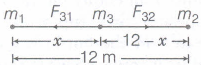
Then, force acting on m3 due to m1 is equal and opposite to the force acting on m3, due to m2
\(\therefore \) F31 = F32
\(\cfrac { G{ m }_{ 1 }{ m }_{ 2 } }{ { x }^{ 2 } } =\cfrac { G{ m }_{ 3 }{ m }_{ 2 } }{ \left( 12-x \right) ^{ 2 } } \)
\(\Rightarrow \quad \cfrac { 3 }{ { x }^{ 2 } } =\cfrac { 12 }{ \left( 12-x \right) ^{ 2 } } \)
\(\Rightarrow \quad \left( \cfrac { 12-x }{ x } \right) ^{ 2 }=\cfrac { 12 }{ 3 } =4\Rightarrow \cfrac { 12-x }{ x } =2\)
\(\Rightarrow\)12-x = 2x \(\Rightarrow\) 12 = 3x
\(\Rightarrow\) x=4m
The position of required point is at a distance 4 m from the mass 3 kg.
15.
Important points to remember in dairy and poultry farming are:
(i) Proper housing, hygienic conditions i.e., cleaning, sanitation, spraying disinfectants at regular intervals.
(ii) Vaccination for prevention of infectious disease.
(iii) Selection of good quality breed.
(iv) Enough space, proper light intensity and duration, maintenance of temperature.
(v) Proper feeding management.
16.
Here, \({ m }_{ 1 }={ m }_{ 2 }=1.5kg,\ { u }_{ 1 }=2.5{ ms }^{ -1 },\ { u }_{ 2 }=-2.5{ ms }^{ -1 }\)
Let v be the velocity of the combined object after the collision. By conservation of momentum,
Total momenta after collision = Total momenta before collision
\(\left( { m }_{ 1 }+{ m }_{ 2 } \right) v={ m }_{ 1 }{ u }_{ 1 }+{ m }_{ 2 }{ u }_{ 2 }\)
\(\left( 1.5+1.5 \right) v=1.5\times 2.5+1.5\times \left( -2.5 \right) \)
\(3.0\ v=0\)
\(v=0\ { ms }^{ -1 }.\)
17.
(i) Kingdom. Highest category of classification.
(ii) Phylum (for animals) Division (for plants). A group of closely related classes having certain common characters.
(iii) Class. A group of closely related orders having certain common characters.
(iv) Order A group of closely related families having certain on characters.
(v) Family. A group of closely related genus having certain on characters.
(vi) Genus. A group of closely related species have certain common characters.
(vii) Species. A group of organisms which are similar enough to breed and perpetuate.
18.
Utility of mole concept:
(i) Form the number of moles of a substance, we can calculate the number of elementary particles because the number of moles of a substance is directly proportional to the number of elements particles.
(ii) One mole of a gas occupies 22.4 litres at S.T.P
(iii) One mole of any gas under the same conditions of temperature and pressures occupies the same volume
(iv) One mole is equal to molecular mass in grams which is equal to 6.022 x 10²³ atoms, molecules, ionsetc.Thus, we can calculate absolute masses of atoms and molecules.
19.
It helps in growth, organisation of different organs and performing different functions.
20.
Difference between mass and weight:
| Mass | Weight |
|---|---|
| 1. Mass is the quantity of matter contained in a body and is the measure of its inertia. | Weight of a body is the force which a body is attracted towards the centre of the earth. |
| 2. Its value remains constant at all places. | Its value (W=mg) changes from place to place due to the change in the value of acceleration due to gravity 'g'. |
| 3. It is a scalar quantity. | It is a vector quantity. |
| 4. It is measured by a pan balance. | It is measured by a spring balance. |
| 5. Mass of a body is never zero. | Weight of a body is zero at the centre of the earth because there 'g' becomes zero. |
| 6. Its unit is kg | Its unit is Newton or kg-wt. |
21.
Plants and Animals differ as given in the table below:
| Plants | Animals |
|---|---|
| 1. Most of the plants, around us, are stationary and do not move from one place to another. | 1. Most of the animals around us, are mobile i.e., they can move from one place to another. |
| 2. Green plants can synthesise their own food in presence of sunlight from \(H_{ 2 }O\) and \(CO_{ 2 }\). In their green parts, like leaves, chlorophyll pigment (green pigment) is found which helps in food preparation by the process of photosynthesis. | 2. Animals cannot synthesise their food because they lack chlorophyll. So, they directly (by eating plants) or indirectly (eating other animals who eat plants) depend on plants. |
| 3. Most of the plants continue growing throughout their life. The growth may be in length (height) or producing spreading branches. | 3. Animals stop growing especially in length (height) after attaining certain maturity. |
| 4. Plant cells have cell walls as outer most covering. | 4. Animal cell do not have cell walls. |
22.
(b)
square of the time of fall
23.
(i) The relative density of a substance is the ratio of its density to that of water.
Relative density of a substance
= \(\cfrac { Density\quad of\quad the\quad substance }{ Density\quad of\quad water } \)
Relative density of a substance
=\(=\cfrac { Mass\quad of\quad the\quad substance }{ Volume\quad of\quad the\quad substance } \times \cfrac { Volume\quad of\quad water }{ Mass\quad of\quad water } \) \(\left[ \therefore Density=\cfrac { mass }{ volume } \right] \)
Given that, mass of the cube = 50 g
Side of cube = 1.5 cm
\(\therefore\) Volume of cube = (1.5)3 cm3 = 3.375 cm3
\(\therefore\) Density =\(\cfrac { mass }{ Volume } \)
=\(\cfrac { 50 }{ 3.375 } \) = 14.81 g cm-3
(iil) Given that, mass, m = 250 g
Volume, V= 400 cc
\(\therefore \) Density=\(\cfrac { mass }{ Volume } \)
= \(\cfrac { 250 }{ 400 } \)g(cc)-1= 0.625 g (cc)-1
As we know that, density of water = 1 g (cc)-1. So, density of tin is less than that of water and hence tin will float.
24.
() Difference between thrust and pressure are
| Thrust | Pressur |
| The force exerted by the body perpendicular to the surface is known as thrust. | Thrust acting on unit area is called pressure, i.e. Pressure\(\left( P \right) =\cfrac { Force\left( F \right) }{ Area\left( A \right) } \) |
| 81 unit of thrust is newton (N). | SI unit of pressure is Nm-2 or Pa (pascal). |
The pressure exerted by 1 N of force, acting perpendicular on the s~rface of 1m 2 area is called 1pascal.
1 Pa= 1Nm-2
(1)
The force required to accelerate 1 kilogram of mass at the rate of 1 metre per second square is called 1newton.
1N = 1 kg ms-2
Since, pressure is inversely proportional ro the area 0 contact, Le. \(p\propto \cfrac { 1 }{ A } \)
Therefore, pressure will reduce to half, if area of contact is doubled.
25.
a = 8 \(ms^{ -2 }\),v = 32 \(ms^{ -1 }\)
(ii) t = \(2\sqrt { 2\quad s } \)

9th Standard CBSE Syllabus & Materials
9th Standard CBSE
CBSE 9th Mathematics Lines and Angles Sample Question Papers Study Material - QB365 Set A
NEW9th Standard CBSE
CBSE 9th Mathematics Introduction to Euclid's Geometry Sample Question Papers Study Material - QB365 Set A
NEW9th Standard CBSE
CBSE 9th Mathematics Linear Equations in Two Variables Sample Question Papers Study Material - QB365 Set A
NEW9th Standard CBSE
CBSE 9th Mathematics Coordinate Geometry Sample Question Papers Study Material - QB365 Set A



CBSE 9th Standard CBSE Subjects
CBSE Standards