
 100% FREE ACCESS
9th Standard Syllabus & Materials
9th Standard
TN 9th Tamil உள்ளத்தின் சீர் -கற்கண்டு (இலக்கணம்) - தொடர் இலக்கணம், ஆகுபெயர் Important Questions And Answers Study Material - QB365 Set A
NEW9th Standard
TN 9th Tamil உள்ளத்தின் சீர் -விரிவானம் (துணைப்பாடம்) - தாய்மைக்கு வறட்சி இல்லை! Important Questions And Answers Study Material - QB365 Set A
NEW9th Standard
TN 9th Tamil உள்ளத்தின் சீர் -கவிதை பேழை (செய்யுள்) - மார்கழி பெருவிழா Important Questions And Answers Study Material - QB365 Set A
NEW9th Standard
TN 9th Tamil உயிருக்கு வேர்-இலக்கணம் - பகுபத உறுப்பிலக்கணம் Important Questions And Answers Study Material - QB365 Set A
NEW9th Standard
TN 9th Tamil அமுதென்று பேர் - இலக்கணம்-எழுத்து -அளபெடை Important Questions And Answers Study Material - QB365 Set A
NEW9th Standard
TN 9th Tamil அமுதென்று பேர்-துணைப்பாடம் - ஆறாம்திணை Important Questions And Answers Study Material - QB365 Set A

Published on: 13/05/2022
QB365 provides detailed and simple solution for every book back questions in class 9 Maths subject.It will helps to get more idea about question pattern in every book back questions with solution.
latest Book back QuestionsDownload Tamil Nadu 9th Standard Maths question papers, model tests, one-mark questions, important questions, and public exam papers in PDF format. Free study materials and answer keys for TN State Board students.
Questions + Answers key
Take MCQ Maths Test1.
Find the value of k, for the following system of equation has infinitely many solutions. 2x − 3y = 7;(k + 2)x − (2k +1)y = 3(2k −1)
2.
Solve by cross-multiplication method
(i) 8x − 3y = 12 ; 5x = 2y + 7
(ii) 6x + 7y −11 = 0 ; 5x + 2y = 13
(iii) \(\frac { 2 }{ x } +\frac { 3 }{ y } =5;\frac { 3 }{ x } -\frac { 1 }{ y } +9=0\)
3.
Given 4a + 3b = 65 and a + 2b = 35 solve by elimination method.
4.
Check whether (5, −1) is a solution of the simultaneous equations x – 2y = 7 and 2x + 3y = 7.
5.
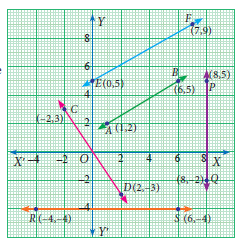
Find the slopes of all the lines from the adjacent figure,
6.
(i) Prove that (x - 1) is a factor of x3- 7x2 + 13x - 7
(ii) Prove that (x + 1) is a factor of x3 + 7x2 + 13x + 7
7.
If \(\left( y-\frac { 1 }{ y } \right) ^{ 3 }\) =729, then find the value of \(y-\frac { 1 }{ y } \) and \({ y }^{ 3 }-\frac { 1 }{ { y }^{ 3 } } \) .
8.
Write the following polynomials in standard form.
| S.No | Polynomial | Standard form |
|---|---|---|
| 1 | 5m4 -3m + 7m2 + 8 | |
| 2 | \(\frac { 2 }{ 3 } y+{ 8y }^{ 3 }-12+\sqrt { 5 } { y }^{ 2 }\) | |
| 3 | 12p2 -8p5 -10p4 -7 |
9.
Find the remainder when f(x) = x3–ax2 + 6x – a is divided by (x – a)
10.
Check whether f(x) = x3– x + 1 is a multiple of g(x) = 2 – 3x.
1.
Given two linear equations are
2x - 3y = 7;
(k + 2)x - (2k + 1)y = 3(2k - 1)
\(\left[ \begin{matrix} { a }_{ 1 }x+{ b }_{ 1 }y+{ c }_{ 1 }=0 \\ { a }_{ 2 }x+{ b }_{ 2 }y+{ c }_{ 2 }=0 \end{matrix} \right] \)
Here a1 = 2, b1 = −3, a2 = (k + 2), b2 = −(2k +1), c1 = 7, c2 = 3(2k −1)
For infinite number of solution we consider \(\frac { { a }_{ 1 } }{ { a }_{ 2 } } =\frac { { b }_{ 1 } }{ { b }_{ 2 } } =\frac { { c }_{ 1 } }{ { c }_{ 2 } } \)
\(\frac { 2 }{ k+2 } =\frac { -3 }{ -(2k+1) } =\frac { 7 }{ 3(2k-1) } \)
\(\frac { 2 }{ k+2 } =\frac { -3 }{ -(2k+1) } \)
2(2k +1) = 3(k + 2)
4k + 2 = 3k + 6
k = 4
\(\frac { -3 }{ -(2k+1) } =\frac { 7 }{ 392k-1) } \)
9(2k −1) = 7(2k +1)
18k − 9 = 14k + 7
4k = 16
k = 4
2.
(i) 8x- 3y = 12 ...(1)
5x-2y = 7 ..(2)
8x- 3y-12 = 0
5x-2y- 7 = 0
For cross multiplication method, we write the co-efficients as

\(\cfrac { x }{ (-3)(-7)(-2)(-12) } =\cfrac { y }{ (-12)(5)-(-7)(8) } =\cfrac { 1 }{ (8)(-2)-(5)(-3) } \)
\(\cfrac { x }{ 21-24 } =\cfrac { y }{ -60+56 } =\cfrac { 1 }{ -16+15 } \)
\(\cfrac { x }{ -3 } =\cfrac { y }{ -60+56 } =\cfrac { 1 }{ -16+15 } \)
\(\therefore \ \cfrac { x }{ 3 } =\cfrac { 1 }{ -1 } \ \cfrac { y }{ -4 } =\cfrac { 1 }{ -1 } \)
x = 3 , y = 4
\(\therefore\) Solutions: x = 3; y = 4
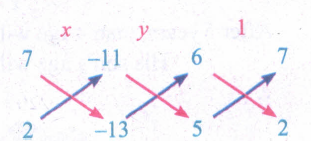
(ii) 6x+ 7y-11 = 0
5x+ 2y-13 = 0
For cross multiplication method, we write the co-efficients as
\(\cfrac { x }{ -91-(-22) } =\cfrac { y }{ -55-(-68) } =\cfrac { 1 }{ 12-35 } \)
\(\cfrac { x }{ -91+22 } =\cfrac { y }{ -55+78 } =\cfrac { 1 }{ -23 } \)
\(\cfrac { x }{ -69 } =\cfrac { y }{ 23 } =\cfrac { 1 }{ -23 } \)
\(\cfrac { x }{ -69 } =\cfrac { 1 }{ -23 } \quad \cfrac { y }{ 23 } =\cfrac { 1 }{ -23 } \)
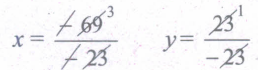
x = 3, y= -1
\(\therefore\) x = 3; y= -1
(iii)
\(\cfrac { 2 }{ x } +\cfrac { 3 }{ y } -5=0\)
\(\cfrac { 3 }{ x } -\cfrac { 1 }{ y } +9=0\)
In (1), (2) Put \(\cfrac { 1 }{ x } =a,\cfrac { 1 }{ y } =b\)
(1) \(\Rightarrow\) 2a + 3b - 5 = 0
(2) \(\Rightarrow\) 3a - b + 9 = 0
For cross multiplication method, we write the co-efficients as
\(\cfrac { a }{ (3)(9)-(-1)(-5) } =\cfrac { b }{ (-5)(3)-(9)(2) } =\cfrac { 1 }{ (2)(-1)-(3)(3) } \)
\(\cfrac { a }{ 27-5 } =\cfrac { b }{ -15-18 } =\cfrac { 1 }{ -2-9 } \)
\(\cfrac { a }{ 22 } =\cfrac { b }{ -33 } =\cfrac { 1 }{ -11 } \)
\(\therefore \ \cfrac { a }{ 22 } =\cfrac { 1 }{ -11 } \cfrac { b }{ -33 } =\cfrac { 1 }{ -11 } \)
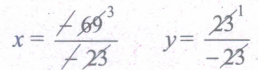
a = -2 b = 3
\(a=\cfrac { 1 }{ x } =-2\quad b=\cfrac { 1 }{ y } =3\)
\(\therefore \ x=\cfrac { -1 }{ 2 } \ \ y=\cfrac { 1 }{ 3 } \)
solution \(\ x=\cfrac { -1 }{ 2 } \ \ y=\cfrac { 1 }{ 3 } \)
3.
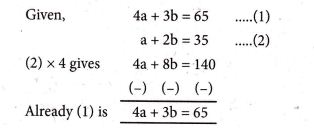
5b = 75 which gives b = 15
Put b = 15 in (2):
a + 2(15) = 35 which simplifies to a = 5
Thus the solution is a = 5, b = 15.
Verification :
4a+3b = 65 ...(1)
4(5)+3(15) = 65
20 + 45 = 65
65 = 65 True
a + 2b = 35 ...(2)
5 + 2(15) = 35
5+30 = 35
35 = 35 True
4.
Given x – 2y = 7 …(1)
2x + 3y = 7 …(2)
When x = 5, y = −1 we get
From (1) x – 2y = 5 – 2(−1) = 5 + 2 = 7 which is RHS of (1)
From (2) 2x + 3y = 2(5) + 3(−1) = 10−3 = 7 which is RHS of (2)
Thus the values x = 5, y = −1 satisfy both (1) and (2) simultaneously. Therefore (5,−1) is a solution of the given equations.
5.
Slope of AB = \(\frac { { y }_{ 2 }-{ y }_{ 1 } }{ { x }_{ 2 }-{ x }_{ 1 } } =\frac { 3 }{ 5 } \)
Slope of CD = \(\frac { change\ in\ y }{ change\ in\ x } =-\frac { 3 }{ 2 } \)
Slope of EF = \(\frac { 4 }{ 7 } \)
Slope of PQ = Undefined Slope of Rs. = 0.
6.
(i) Let p(x) = x3 - 7x + 13x - 7
Sum of coefficients = 1 − 7 + 13 − 7 = 0
Thus (x -1) is a factor of p (x)
(ii) Let q(x) = x3 + 7x2 + 13x + 7
Sum of coefficients of even powers of x with constant = 7 + 7 = 14
Sum of coefficients of odd powers of x = 1 + 13 = 14
Hence, (x + 1) is a factor of q (x)
7.
Given, \(\left( y-\frac { 1 }{ y } \right) ^{ 3 }\)= 729
Take cube root on both sides
\( \sqrt [ 3 ]{ \left( \left( y-\frac { 1 }{ y } \right) ^{ 3 } \right) } =\sqrt [ 3 ]{ 729 } =\sqrt [ 3 ]{ 9^{ 3 } } \)
Therefore, \(y-\frac { 1 }{ y } \) = 9
\(\left( y-\frac { 1 }{ y } \right) ^{ 3 }=\left( y-\frac { 1 }{ y } \right) ^{ 3 }+3\left( y-\frac { 1 }{ y } \right) \) [∵ a3-b3 = (a-b)3+3ab(a-b]
= 93 + 3(9)
\({ y }^{ 3 }-\frac { 1 }{ { y }^{ 3 } } \)= 756
8.
| S.No | Polynomial | Standard form |
|---|---|---|
| 1 | 5m4 -3m + 7m2 + 8 | 5m4+7m2-3m +8 |
| 2 | \(\frac { 2 }{ 3 } y+{ 8y }^{ 3 }-12+\sqrt { 5 } { y }^{ 2 }\) | \({ 8y }^{ 3 }+\sqrt { 5 } { y }^{ 2 }+\frac { 2 }{ 3 } y-12\) |
| 3 | 12p2 -8p5 -10p4 -7 | -8p5-10p4 + 12p2- 7 |
9.
We have
f(x) = x3– ax2 + 6x – a
f(a) = a3- a(a)2+ 6a - a
=a3- a3+ 5a = 5a
Hence the required remainder is 5a
Hint:
Let g(x) = x–a
g(x) = 0
x – a = 0
x = a
10.
\(\therefore f(\frac{2}{3}) =(\frac{2}{3})^{3}-\frac{2}{3}-1\)
\(=\frac{8}{27}-\frac{2}{3}+1\)
=\(\frac{8-18+27}{27}=\frac{17}{27}\ne0\)
⇒ f(x) is not multiple of g(x)
Hint:
g(x) = 2–3x = 0
gives x = \(\frac{2}{3}\)

9th Standard Syllabus & Materials
9th Standard
TN 9th Tamil உள்ளத்தின் சீர் - திருக்குறள் Important Questions And Answers Study Material - QB365 Set A
NEW9th Standard
TN 9th Tamil உள்ளத்தின் சீர் - மணிமேகலை Important Questions And Answers Study Material - QB365 Set A
NEW9th Standard
TN 9th Tamil உள்ளத்தின் சீர் - ஏறு தழுவுதல் Important Questions And Answers Study Material - QB365 Set A
NEW9th Standard
TN 9th Tamil உயிருக்கு வேர் - தண்ணீர் Important Questions And Answers Study Material - QB365 Set A



Tamilnadu Stateboard 9th Standard Subjects
Tamilnadu Stateboard Standards





