
 100% FREE ACCESS
9th Standard Syllabus & Materials
9th Standard
TN 9th Tamil உள்ளத்தின் சீர் -கற்கண்டு (இலக்கணம்) - தொடர் இலக்கணம், ஆகுபெயர் Important Questions And Answers Study Material - QB365 Set A
NEW9th Standard
TN 9th Tamil உள்ளத்தின் சீர் -விரிவானம் (துணைப்பாடம்) - தாய்மைக்கு வறட்சி இல்லை! Important Questions And Answers Study Material - QB365 Set A
NEW9th Standard
TN 9th Tamil உள்ளத்தின் சீர் -கவிதை பேழை (செய்யுள்) - மார்கழி பெருவிழா Important Questions And Answers Study Material - QB365 Set A
NEW9th Standard
TN 9th Tamil உயிருக்கு வேர்-இலக்கணம் - பகுபத உறுப்பிலக்கணம் Important Questions And Answers Study Material - QB365 Set A
NEW9th Standard
TN 9th Tamil அமுதென்று பேர் - இலக்கணம்-எழுத்து -அளபெடை Important Questions And Answers Study Material - QB365 Set A
NEW9th Standard
TN 9th Tamil அமுதென்று பேர்-துணைப்பாடம் - ஆறாம்திணை Important Questions And Answers Study Material - QB365 Set A

Published on: 12/06/2021
QB365 provides detailed and simple solution for every book back questions in class 9 Maths subject.It will helps to get more idea about question pattern in every book back questions with solution.
Download Tamil Nadu 9th Standard Maths question papers, model tests, one-mark questions, important questions, and public exam papers in PDF format. Free study materials and answer keys for TN State Board students.
Questions + Answers key
Take MCQ Maths Test1.
Solve for x and y: 8x − 3y = 5xy, 6x − 5y = −2xy by the method of elimination.
2.
(Graphing made easier!) Draw the graph of the line given by the equation y = 4x – 3.
3.
Factorise each of the following polynomials using synthetic division:
(i) x3-3x2-10x +24
(ii) 2x3-3x2-3x+2
(iii) −7x+3+ 4x3
(iv) x3+x2-14x-24
(v) x3-7x+6
(vi) x3-10x2-x+10
4.
Factorise the following:
(i) x2+10x + 24
(ii) z2+ 4z -12
(iii) p2- 6p -16
(iv) t2+72 -17t
(v) y2-16 - 80
(vi) a2+10a - 600
5.
Factorise 2x2-15x+27
6.
Find GCD of the following:
(i) 16x3y2, 24xy3z
(ii) (y3+1) and (y2-1)
(iii) 2x2-18 and x3-2x-3
(iv) (a-b)2, (b-c)3, (c-a)4
7.
Factorise the following:
(i) am + bm + cm
(ii) a3- a2b
(iii) 5a -10b - 4bc + 2ac
(iv) x+y-1-xy
8.
Evaluate the following by using identities:
(i) 983
(ii) 10013
9.
If (x + a)(x + b)(x + c) = x3+14x2+ 59x + 70, find the value of
(i) a + b + c
(ii) \(\frac { 1 }{ a } +\frac { 1 }{ b } +\frac { 1 }{ c } \)
(iii) a2+ b2+ c2
(iv) \(\frac { a }{ bc } +\frac { b }{ ac } +\frac { c }{ ab } \)
10.
Multiply the following polynomials and check whether their product is also a polynomial. Also find the degree of the resultant polynomial.
| S.no | Polynominal | Product | Degree of the resultant polynominal |
| 1 | \(p(x)=3{ x }^{ 3 }+2x-{ x }^{ 2 }+8\\ q(x)=7x+2\) | ||
| 2 | \(r(y)=5{ y }^{ 3 }-3{ y }^{ 2 }+4\\ s(y)=9{ y }^{ 2 }-2y+6\) | ||
| 3 | \(p(m)=8m-9\\ q(m)=9{ m }^{ 2 }-1+2m\) |
1.
The given system of equations are 8x − 3y = 5xy ...(1)
6x − 5y = −2xy ...(2)
Observe that the given system is not linear because of the occurrence of xy term. Also note that if x =0, then y =0 and vice versa. So, (0,0) is a solution for the system and any other solution would have both x \(\neq \) 0 and y \(\neq \) 0
Let us take up the case where x \(\neq \) 0 and y \(\neq \) 0
Dividing both sides of each equation by xy,
\(\frac { 8x }{ xy } -\frac { 3y }{ xy } =\frac { 5xy }{ xy } \)
\(\frac { 6x }{ xy } -\frac { 5y }{ xy } =\frac { -2xy }{ xy } \)
Let \(a=\frac { 1 }{ x } ,b=\frac { 1 }{ y } \)
We get, \(\frac { 8 }{ y } -\frac { 3 }{ x } =5\) .....(3)
\(\frac { 6 }{ y } -\frac { 5 }{ x } =-2\) .......(4)
(3)&(4) respectively become, 8b − 3a = 5 ...(5)
b − 5a = −2 ...(6)
which are linear equations in a and b.
To eliminate a, we have, (5) \(\times\) 5\(\Rightarrow\) 40b −15a = 25 .....(7)
(6) × 3\(\Rightarrow\) 18b −15a = −6 .....(8)
Now proceed as in the previous example to get the solution\(\left( \frac { 11 }{ 23 } ,\frac { 22 }{ 31 } \right) \).
Thus, the system have two solutions \(\left( \frac { 11 }{ 23 } ,\frac { 22 }{ 31 } \right) \) and (0,0).
2.
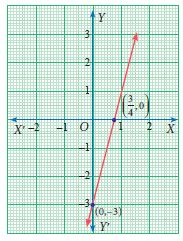
We have already come across one method: forming a table of values, listing and plotting ordered pairs and joining the points.
But, to fix a line, after all, how many points do we need? Just two! These can easily be obtained when a line is given in the form y = mx + c.
The given line y = 4x – 3
put x = 0 to get y-intercept
y = 4(0)–3
y = –3
point is (0, –3) and y-intercept = – 3
put y = 0 to get x-intercept
0 = 4x – 3
3 = 4x
\(\frac { 3 }{ 4 } =x\)
point is \(\left( \frac { 3 }{ 4 } ,0 \right) \) and x-intercept = \(\frac { 3 }{ 4 } \)
The graph may be drawn through two points (0,−3) and \(\left( \frac { 3 }{ 4 } ,0 \right) \)
3.
(i) x3 - 3x2 -10x + 24
Let p(x) = x3 - 3x2 -10x + 24
Sum of all the co-efficients = 1- 3 - 10 + 24 = 25 -13 = 12 ≠ 0
Hence (x - 1) is not a factor.
Sum of co-efficient of even powers with constant = -3 + 24 = 21
Sum of co-efficients of odd powers = 1 - 10 = - 9
21 ≠ -9
Hence (x + 1) is not a factor.
p(2) = 23+ 3(22) -10\(\times\)2+24
= 8 -12 - 20 + 24
= 32 - 32 = 0 ஃ (x - 2) is a factor.
Now we use synthetic division to find other factor
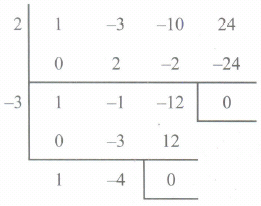
Thus (x - 2) (x + 3) (x - 4) are the factors.
ஃ x3 - 3x2 - 10x + 24 = (x - 2)(x + 3)(x - 4)
(ii) 2x2 - 3x2 - 3x + 2
Let p (x) = 2x3 - 3x2 - 3x + 2
Sum of all the co-efficients are
2 - 3 - 3 + 2 = 4 - 6 = -2 ≠ 0
ஃ (x - 1) is not a factor.
Sum of co-efficients of even powers of x with constant = -3 + 2 = - 1
Sum of co-efficients of odd powers of x = 2 - 3 = - 1
(-1) = (-1)
ஃ (x + 1) is a factor
Let us find the other factors using synthetic division
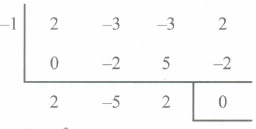
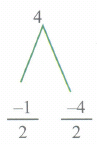
Quotient is 2x2- 5x + 2 = 2x - 4x - x + 2 = 2x (x - 2) - 1 (x - 2)
= (x - 2)(2x - 1)
ஃ 2x3- 3x2- 3x +2 = (x +1) (x - 2) (2x - 1)
(iii) -7x+ 3 + 4x3
Letp (x) = 4x3 + 0x2 - 7x + 3
Sum of the co-efficients are = 4 + 0 - 7 + 3
= 7 - 7 = 0
ஃ (x - 1) is a factor
Sum of co-efficients of even powers of x with constant = 0 + 3 = 3
Sum of co-efficients of odd powers of x with constant = 4 - 7 = -3
3 ≠ -3
ஃ (x + 1) is not a factor
Using synthetic division, let us find the other factors.
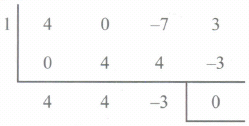
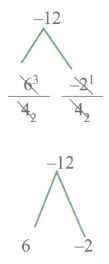
Quotient is 4x2 + 4x - 3
= 4x2+ 6x - 2x - 3
= 2x(2x + 3) -1(2x + 3)
= (2x + 3)(2x - 1)
ஃ The factors are (x -1), (2x + 3) and (2x - 1)
ஃ -7x + 3 + 4x3= (x+1)(2x+3)(2x-1)
(iv) x3 + x2 - 14x - 24
Let p(x) = x3 + x2 - 14x - 24
Sum of the co-efficients are 1 + 1-14 - 24 = -36 ≠ 0
ஃ (x - 1) is not a factor
Sum of co-efficients of even powers of x with constant = 1 - 24 = -23
Sum of co-efficients of odd powers of x = 1 - 14 = -3
-23 ≠ -13
ஃ (x + 1) is also not a factor
p(2) = 23 + 22 - 14 (2) - 24 = 8 + 4 - 28 - 24
= 12 - 52 ≠ 0, (x - 2) is a not a factor
p(-2) = (-2)3 + (-2)2 - 14 (-2) - 24
-8 + 4 + 28 - 24 = 32 - 32 = 0
ஃ (x + 2) is a factor
To find the other factors let us use synthetic division
x3+x2-14x-24
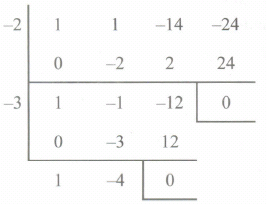
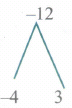
ஃ The factors are (x + 2),(x + 3),(x - 4)
ஃ x3+x2-14x - 24 = (x + 2)(x + 3)(x - 4)
(v) x3- 7x + 6
Let p (x) = x3+ 0x2-7x + 6
Sum of the co-efficients are = 1+0 -7+ 6 = 7-7 = 0
ஃ (x - 1) is a factor
Sum of co-efficients of even powers of x with constant = 0 + 6 = 6
Sum of coefficient of odd powers of x = 1 - 7 = - 7
6 ≠ -7
ஃ (x + 1) is not a factor
To find the other factors, let us use synthetic division.
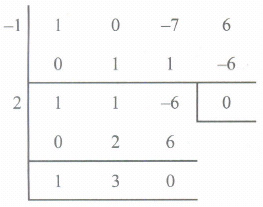
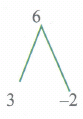
ஃ The factors are (x - 1), (x - 2), (x + 3)
ஃ x3 + 0x2 - 7x + 6 = (x - 1)(x - 2)(x + 3)
(vi) x3-10x2- x + 10
Let p(x) = x3-10x2- x + 10
Sum of the co-efficients = 1 - 0 - 1 + 10
= 11 -11 = 0
(x - 1) is a factor
Sum of co-efficients of even powers of x with constant = -10 + 10 = 0
Sum of co-efficients of odd powers of = 1 - 1 = 0
ஃ (x + 1) is a factor
Synthetic division
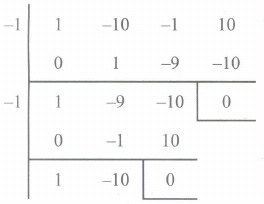
ஃ x3 + 10x2- x + 10 = (x - 1) (x + 1)(x -10)
4.
(i) x2+10x + 24 = x2+ 6x + 4x + 24
= x(x + 6) + 4(x + 6)
= (x + 6)(x + 4)

(ii) z2+ 4z -12
= z2+ 6z - 2z -12
= z(z + 6) -2(z + 6)
= (z + 6)(z - 2)

(iii) p2- 6p -16 = p2- 8p + 2p -16
= p(p - 8)+2(p - 8)
= (p - 8)(p + 2)

(iv) t2+ 72 -17t = t2-17t + 72
= t2- 9t - 8t + 72
= t(t - 9) - 8 (t - 9)
= (t - 9)(t - 8)

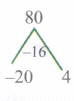
(v) y2 -16y- 80 = y2 - 20y + 4y - 80
= y(y - 20) + 4 (y - 20)
= (y - 20) (y + 4)
(vi) a2 + 10a - 600
= a2 + 30a - 20a - 600
= a(a + 30)- 20(a + 30)
= (a + 30)(a - 20)

5.
Compare with ax2+bx+c
we get, a = 2, b = -15, c = 27
product ac = 2\(\times\) 27 = 54 and sum b = -15
∴ we split the middle term as -6x and -9x
| Product of numbers ac = 54 |
Product of numbers b = -15 |
Product of numbers ac = 54 |
Product of numbers b = -15 |
| 1 \(\times\) 54 | 55 | -1 \(\times\) -54 | -55 |
| 2 \(\times\) 27 | 29 | -2 \(\times\) -27 | -29 |
| 3\(\times\) 18 | 21 | -3 \(\times\) -18 | -21 |
| 6 \(\times\) 9 | 15 | -6 \(\times\) -9 | -15 |
The required factors are -6 and -9
2x2-15x + 27 = 2x2- 6x - 9x + 27
=2x(x - 3) -9(x - 3)
=(x - 3)(2x - 9)
Therefore, (x - 3) and (2x - 9) are the factors of 2x2-15x + 27
6.
(i) 16x3y2 = \(2 \times 2 \times 2 \times 2 \times x^{3} y^{2}=2^{4} \times x^{3} \times y^{2}=2^{3} \times 2 \times x^{2} \times x \times y^{2}\)
24xy3z = \(2 \times 2 \times 2 \times 3 \times x \times y^{3} \times z=2^{3} \times 3 \times x \times y^{3} \times z=2^{3} \times 3 \times x \times y \times y^{2} \times z\)
Therefore, GCD = 23xy2
(ii) y3+1 = y3+13 = (y+1)(y2-y+1)
y2-1=y2-12 = (y+1)(y-1)
Therefore, GCD = (y+1)
(iii) 2x2-18 = 2(x2-9) = 2(x2-32) = 2(x+3)(x-3)
x2-2x-3 = x2-3x+x-3
= x(x-3)+1(x-3)
= (x-3)(x+1)
Therefore, GCD = (x-3)
(iv) (a-b), (b-c)3, (c-a)4
There is no common factor other than one.
Therefore, GCD = 1
7.
(i) am+bm+cm
am+bm+cm
m(a+b+c) factored form
(ii) a3-a2b
a2. a - a2. b group in pairs
a2 \(\times\) (a-b) factored form
(iii) 5a −10b −4bc +2ac
5a-10b+2ac-4bc
5(a-2b)+2c(a-2b)
(a-2b)(5+2c)
(iv) x + y −1−xy
x-1+y-xy
(x-1)+y(1-x)
(x-1)-y(x-1) [(a-b)= -(b-a)
(x-1)(1-y)
8.
(i) 982 = (100-2)3
(a-b)3 ≡ a3- 3a2b + 3ab2- b3
983 = (100 - 2)2 = 1003- 3\(\times\)1002\(\times\)2 + 3\(\times\)100\(\times\)22- 23
= 1000000 - 3\(\times\)10000\(\times\)2 + 300\(\times\)4 - 8
= 1000000 - 60000 +1200 - 8 =1001200 - 60008
= 941192
(ii) 10013= (1000 + 1)3
(a+b)3 ≡ a3+3a2b+3ab2+b3
(1000+1)3=10003+3(1000)\(\times\)12+13
= 1000,000,000 + 3,000,000 + 3000 + 1
= 1,003,003,001
9.
(x + a)(x + b)(x + c) = x3+14x2+ 59x + 70...(1)
(x + a)(x + b)(x + c) ≡ x3+ (a + b + c)x2+ (ab + bc + ca)x + abc...(2)
(i) Comparing (1) and (2)
We get, a + b + c =14
(ii) \(\frac{1}{a}+\frac{1}{b}+\frac{1}{c}=\frac{bc+ac+ab}{abc}=\frac{59}{70}\)
(iii) (a + b + c)2 = a2+ b2+ c2 + 2 ab + 2 bc + 2 ca
a2+ b2+ c2 = (a+b+c)2- 2(ab+bc+ca)
= 142-2(59) =196-118 = 78
(iv) \(\frac{a}{bc}+\frac{b}{ac}+\frac{c}{ab}=\frac{a^2+b^2+c^2}{abc}=\frac{78}{70}=\frac{39}{35}\)
10.
| S.no | Polynominal | Product | Degree of the resultant polynominal |
| 1 | \(p(x)=3{ x }^{ 3 }+2x-{ x }^{ 2 }+8\\ q(x)=7x+2\) | \(p(x)\times q(x)=(3x^{ 3 }+2x-{ x }^{ 2 }+8)(7x+2)\\ =21{ x }^{ 4 }+14{ x }^{ 2 }-{ 7x }^{ 3 }+56x+6{ x }^{ 3 }+4x-2x^{ 2 }+16\\ =21x^{ 4 }-x^{ 3 }+12x^{ 2 }+60x+16\) | 4 |
| 2 | \(r(y)=5{ y }^{ 3 }-3{ y }^{ 2 }+4\\ s(y)=9{ y }^{ 2 }-2y+6\) | \(r(y)\times s(y)=(5{ y }^{ 3 }-3y^{ 2 }+4)9y^{ 2 }-2y+6)\\ =45y^{ 5 }-10y^{ 4 }+30y^{ 3 }-27y^{ 4 }+6y^{ 3 }-18y^{ 2 }+36y^{ 2 }-8y+24\\ =45y^{ 5 }-37y^{ 4 }+36y^{ 3 }+18y^{ 2 }-8y+24\) | 5 |
| 3 | \(p(m)=8m-9\\ q(m)=9{ m }^{ 2 }-1+2m\) | \(p(m)\times qm=(8m-9)(9m^{ 2 }-1+2m)\\ =72m^{ 3 }-8m+16m^{ 2 }-81m^{ 2 }+9-18m\\ =72m^{ 2 }-65m^{ 2 }-26m+9\) | 3 |

9th Standard Syllabus & Materials
9th Standard
TN 9th Tamil உள்ளத்தின் சீர் - திருக்குறள் Important Questions And Answers Study Material - QB365 Set A
NEW9th Standard
TN 9th Tamil உள்ளத்தின் சீர் - மணிமேகலை Important Questions And Answers Study Material - QB365 Set A
NEW9th Standard
TN 9th Tamil உள்ளத்தின் சீர் - ஏறு தழுவுதல் Important Questions And Answers Study Material - QB365 Set A
NEW9th Standard
TN 9th Tamil உயிருக்கு வேர் - தண்ணீர் Important Questions And Answers Study Material - QB365 Set A



Tamilnadu Stateboard 9th Standard Subjects
Tamilnadu Stateboard Standards





