
 100% FREE ACCESS
9th Standard Syllabus & Materials
9th Standard
TN 9th Tamil உள்ளத்தின் சீர் -கற்கண்டு (இலக்கணம்) - தொடர் இலக்கணம், ஆகுபெயர் Important Questions And Answers Study Material - QB365 Set A
NEW9th Standard
TN 9th Tamil உள்ளத்தின் சீர் -விரிவானம் (துணைப்பாடம்) - தாய்மைக்கு வறட்சி இல்லை! Important Questions And Answers Study Material - QB365 Set A
NEW9th Standard
TN 9th Tamil உள்ளத்தின் சீர் -கவிதை பேழை (செய்யுள்) - மார்கழி பெருவிழா Important Questions And Answers Study Material - QB365 Set A
NEW9th Standard
TN 9th Tamil உயிருக்கு வேர்-இலக்கணம் - பகுபத உறுப்பிலக்கணம் Important Questions And Answers Study Material - QB365 Set A
NEW9th Standard
TN 9th Tamil அமுதென்று பேர் - இலக்கணம்-எழுத்து -அளபெடை Important Questions And Answers Study Material - QB365 Set A
NEW9th Standard
TN 9th Tamil அமுதென்று பேர்-துணைப்பாடம் - ஆறாம்திணை Important Questions And Answers Study Material - QB365 Set A

Published on: 13/05/2022
QB365 provides detailed and simple solution for every book back questions in class 9 Maths subject.It will helps to get more idea about question pattern in every book back questions with solution.
latest Book back QuestionsDownload Tamil Nadu 9th Standard Maths question papers, model tests, one-mark questions, important questions, and public exam papers in PDF format. Free study materials and answer keys for TN State Board students.
Questions + Answers key
Take MCQ Maths Test1.
Solve for x and y: 8x − 3y = 5xy, 6x − 5y = −2xy by the method of elimination.
2.
(Graphing made easier!) Draw the graph of the line given by the equation y = 4x – 3.
3.
Factorise each of the following polynomials using synthetic division:
(i) x3-3x2-10x +24
(ii) 2x3-3x2-3x+2
(iii) −7x+3+ 4x3
(iv) x3+x2-14x-24
(v) x3-7x+6
(vi) x3-10x2-x+10
4.
Factorise the following:
(i) x2+10x + 24
(ii) z2+ 4z -12
(iii) p2- 6p -16
(iv) t2+72 -17t
(v) y2-16 - 80
(vi) a2+10a - 600
5.
Factorise 2x2-15x+27
6.
Find GCD of the following:
(i) 16x3y2, 24xy3z
(ii) (y3+1) and (y2-1)
(iii) 2x2-18 and x3-2x-3
(iv) (a-b)2, (b-c)3, (c-a)4
7.
Factorise the following:
(i) am + bm + cm
(ii) a3- a2b
(iii) 5a -10b - 4bc + 2ac
(iv) x+y-1-xy
8.
Evaluate the following by using identities:
(i) 983
(ii) 10013
9.
If (x + a)(x + b)(x + c) = x3+14x2+ 59x + 70, find the value of
(i) a + b + c
(ii) \(\frac { 1 }{ a } +\frac { 1 }{ b } +\frac { 1 }{ c } \)
(iii) a2+ b2+ c2
(iv) \(\frac { a }{ bc } +\frac { b }{ ac } +\frac { c }{ ab } \)
10.
Multiply the following polynomials and check whether their product is also a polynomial. Also find the degree of the resultant polynomial.
| S.no | Polynominal | Product | Degree of the resultant polynominal |
| 1 | \(p(x)=3{ x }^{ 3 }+2x-{ x }^{ 2 }+8\\ q(x)=7x+2\) | ||
| 2 | \(r(y)=5{ y }^{ 3 }-3{ y }^{ 2 }+4\\ s(y)=9{ y }^{ 2 }-2y+6\) | ||
| 3 | \(p(m)=8m-9\\ q(m)=9{ m }^{ 2 }-1+2m\) |
1.
The given system of equations are 8x − 3y = 5xy ...(1)
6x − 5y = −2xy ...(2)
Observe that the given system is not linear because of the occurrence of xy term. Also note that if x =0, then y =0 and vice versa. So, (0,0) is a solution for the system and any other solution would have both x \(\neq \) 0 and y \(\neq \) 0
Let us take up the case where x \(\neq \) 0 and y \(\neq \) 0
Dividing both sides of each equation by xy,
\(\frac { 8x }{ xy } -\frac { 3y }{ xy } =\frac { 5xy }{ xy } \)
\(\frac { 6x }{ xy } -\frac { 5y }{ xy } =\frac { -2xy }{ xy } \)
Let \(a=\frac { 1 }{ x } ,b=\frac { 1 }{ y } \)
We get, \(\frac { 8 }{ y } -\frac { 3 }{ x } =5\) .....(3)
\(\frac { 6 }{ y } -\frac { 5 }{ x } =-2\) .......(4)
(3)&(4) respectively become, 8b − 3a = 5 ...(5)
b − 5a = −2 ...(6)
which are linear equations in a and b.
To eliminate a, we have, (5) \(\times\) 5\(\Rightarrow\) 40b −15a = 25 .....(7)
(6) × 3\(\Rightarrow\) 18b −15a = −6 .....(8)
Now proceed as in the previous example to get the solution\(\left( \frac { 11 }{ 23 } ,\frac { 22 }{ 31 } \right) \).
Thus, the system have two solutions \(\left( \frac { 11 }{ 23 } ,\frac { 22 }{ 31 } \right) \) and (0,0).
2.
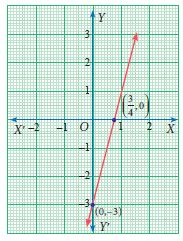
We have already come across one method: forming a table of values, listing and plotting ordered pairs and joining the points.
But, to fix a line, after all, how many points do we need? Just two! These can easily be obtained when a line is given in the form y = mx + c.
The given line y = 4x – 3
put x = 0 to get y-intercept
y = 4(0)–3
y = –3
point is (0, –3) and y-intercept = – 3
put y = 0 to get x-intercept
0 = 4x – 3
3 = 4x
\(\frac { 3 }{ 4 } =x\)
point is \(\left( \frac { 3 }{ 4 } ,0 \right) \) and x-intercept = \(\frac { 3 }{ 4 } \)
The graph may be drawn through two points (0,−3) and \(\left( \frac { 3 }{ 4 } ,0 \right) \)
3.
(i) x3 - 3x2 -10x + 24
Let p(x) = x3 - 3x2 -10x + 24
Sum of all the co-efficients = 1- 3 - 10 + 24 = 25 -13 = 12 ≠ 0
Hence (x - 1) is not a factor.
Sum of co-efficient of even powers with constant = -3 + 24 = 21
Sum of co-efficients of odd powers = 1 - 10 = - 9
21 ≠ -9
Hence (x + 1) is not a factor.
p(2) = 23+ 3(22) -10\(\times\)2+24
= 8 -12 - 20 + 24
= 32 - 32 = 0 ஃ (x - 2) is a factor.
Now we use synthetic division to find other factor
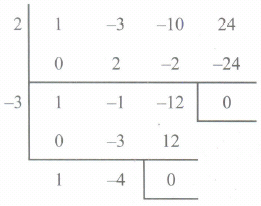
Thus (x - 2) (x + 3) (x - 4) are the factors.
ஃ x3 - 3x2 - 10x + 24 = (x - 2)(x + 3)(x - 4)
(ii) 2x2 - 3x2 - 3x + 2
Let p (x) = 2x3 - 3x2 - 3x + 2
Sum of all the co-efficients are
2 - 3 - 3 + 2 = 4 - 6 = -2 ≠ 0
ஃ (x - 1) is not a factor.
Sum of co-efficients of even powers of x with constant = -3 + 2 = - 1
Sum of co-efficients of odd powers of x = 2 - 3 = - 1
(-1) = (-1)
ஃ (x + 1) is a factor
Let us find the other factors using synthetic division
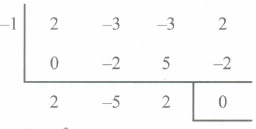
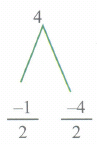
Quotient is 2x2- 5x + 2 = 2x - 4x - x + 2 = 2x (x - 2) - 1 (x - 2)
= (x - 2)(2x - 1)
ஃ 2x3- 3x2- 3x +2 = (x +1) (x - 2) (2x - 1)
(iii) -7x+ 3 + 4x3
Letp (x) = 4x3 + 0x2 - 7x + 3
Sum of the co-efficients are = 4 + 0 - 7 + 3
= 7 - 7 = 0
ஃ (x - 1) is a factor
Sum of co-efficients of even powers of x with constant = 0 + 3 = 3
Sum of co-efficients of odd powers of x with constant = 4 - 7 = -3
3 ≠ -3
ஃ (x + 1) is not a factor
Using synthetic division, let us find the other factors.
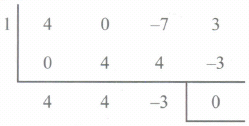
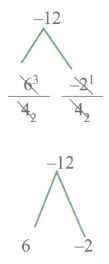
Quotient is 4x2 + 4x - 3
= 4x2+ 6x - 2x - 3
= 2x(2x + 3) -1(2x + 3)
= (2x + 3)(2x - 1)
ஃ The factors are (x -1), (2x + 3) and (2x - 1)
ஃ -7x + 3 + 4x3= (x+1)(2x+3)(2x-1)
(iv) x3 + x2 - 14x - 24
Let p(x) = x3 + x2 - 14x - 24
Sum of the co-efficients are 1 + 1-14 - 24 = -36 ≠ 0
ஃ (x - 1) is not a factor
Sum of co-efficients of even powers of x with constant = 1 - 24 = -23
Sum of co-efficients of odd powers of x = 1 - 14 = -3
-23 ≠ -13
ஃ (x + 1) is also not a factor
p(2) = 23 + 22 - 14 (2) - 24 = 8 + 4 - 28 - 24
= 12 - 52 ≠ 0, (x - 2) is a not a factor
p(-2) = (-2)3 + (-2)2 - 14 (-2) - 24
-8 + 4 + 28 - 24 = 32 - 32 = 0
ஃ (x + 2) is a factor
To find the other factors let us use synthetic division
x3+x2-14x-24
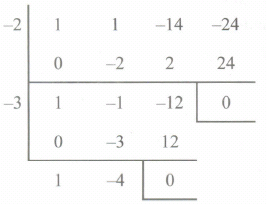
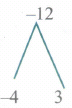
ஃ The factors are (x + 2),(x + 3),(x - 4)
ஃ x3+x2-14x - 24 = (x + 2)(x + 3)(x - 4)
(v) x3- 7x + 6
Let p (x) = x3+ 0x2-7x + 6
Sum of the co-efficients are = 1+0 -7+ 6 = 7-7 = 0
ஃ (x - 1) is a factor
Sum of co-efficients of even powers of x with constant = 0 + 6 = 6
Sum of coefficient of odd powers of x = 1 - 7 = - 7
6 ≠ -7
ஃ (x + 1) is not a factor
To find the other factors, let us use synthetic division.
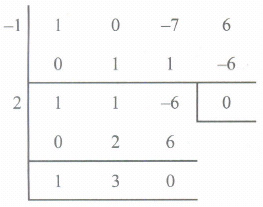
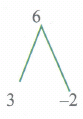
ஃ The factors are (x - 1), (x - 2), (x + 3)
ஃ x3 + 0x2 - 7x + 6 = (x - 1)(x - 2)(x + 3)
(vi) x3-10x2- x + 10
Let p(x) = x3-10x2- x + 10
Sum of the co-efficients = 1 - 0 - 1 + 10
= 11 -11 = 0
(x - 1) is a factor
Sum of co-efficients of even powers of x with constant = -10 + 10 = 0
Sum of co-efficients of odd powers of = 1 - 1 = 0
ஃ (x + 1) is a factor
Synthetic division
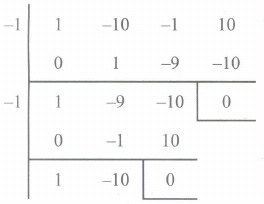
ஃ x3 + 10x2- x + 10 = (x - 1) (x + 1)(x -10)
4.
(i) x2+10x + 24 = x2+ 6x + 4x + 24
= x(x + 6) + 4(x + 6)
= (x + 6)(x + 4)

(ii) z2+ 4z -12
= z2+ 6z - 2z -12
= z(z + 6) -2(z + 6)
= (z + 6)(z - 2)

(iii) p2- 6p -16 = p2- 8p + 2p -16
= p(p - 8)+2(p - 8)
= (p - 8)(p + 2)

(iv) t2+ 72 -17t = t2-17t + 72
= t2- 9t - 8t + 72
= t(t - 9) - 8 (t - 9)
= (t - 9)(t - 8)

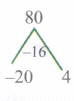
(v) y2 -16y- 80 = y2 - 20y + 4y - 80
= y(y - 20) + 4 (y - 20)
= (y - 20) (y + 4)
(vi) a2 + 10a - 600
= a2 + 30a - 20a - 600
= a(a + 30)- 20(a + 30)
= (a + 30)(a - 20)

5.
Compare with ax2+bx+c
we get, a = 2, b = -15, c = 27
product ac = 2\(\times\) 27 = 54 and sum b = -15
∴ we split the middle term as -6x and -9x
| Product of numbers ac = 54 |
Product of numbers b = -15 |
Product of numbers ac = 54 |
Product of numbers b = -15 |
| 1 \(\times\) 54 | 55 | -1 \(\times\) -54 | -55 |
| 2 \(\times\) 27 | 29 | -2 \(\times\) -27 | -29 |
| 3\(\times\) 18 | 21 | -3 \(\times\) -18 | -21 |
| 6 \(\times\) 9 | 15 | -6 \(\times\) -9 | -15 |
The required factors are -6 and -9
2x2-15x + 27 = 2x2- 6x - 9x + 27
=2x(x - 3) -9(x - 3)
=(x - 3)(2x - 9)
Therefore, (x - 3) and (2x - 9) are the factors of 2x2-15x + 27
6.
(i) 16x3y2 = \(2 \times 2 \times 2 \times 2 \times x^{3} y^{2}=2^{4} \times x^{3} \times y^{2}=2^{3} \times 2 \times x^{2} \times x \times y^{2}\)
24xy3z = \(2 \times 2 \times 2 \times 3 \times x \times y^{3} \times z=2^{3} \times 3 \times x \times y^{3} \times z=2^{3} \times 3 \times x \times y \times y^{2} \times z\)
Therefore, GCD = 23xy2
(ii) y3+1 = y3+13 = (y+1)(y2-y+1)
y2-1=y2-12 = (y+1)(y-1)
Therefore, GCD = (y+1)
(iii) 2x2-18 = 2(x2-9) = 2(x2-32) = 2(x+3)(x-3)
x2-2x-3 = x2-3x+x-3
= x(x-3)+1(x-3)
= (x-3)(x+1)
Therefore, GCD = (x-3)
(iv) (a-b), (b-c)3, (c-a)4
There is no common factor other than one.
Therefore, GCD = 1
7.
(i) am+bm+cm
am+bm+cm
m(a+b+c) factored form
(ii) a3-a2b
a2. a - a2. b group in pairs
a2 \(\times\) (a-b) factored form
(iii) 5a −10b −4bc +2ac
5a-10b+2ac-4bc
5(a-2b)+2c(a-2b)
(a-2b)(5+2c)
(iv) x + y −1−xy
x-1+y-xy
(x-1)+y(1-x)
(x-1)-y(x-1) [(a-b)= -(b-a)
(x-1)(1-y)
8.
(i) 982 = (100-2)3
(a-b)3 ≡ a3- 3a2b + 3ab2- b3
983 = (100 - 2)2 = 1003- 3\(\times\)1002\(\times\)2 + 3\(\times\)100\(\times\)22- 23
= 1000000 - 3\(\times\)10000\(\times\)2 + 300\(\times\)4 - 8
= 1000000 - 60000 +1200 - 8 =1001200 - 60008
= 941192
(ii) 10013= (1000 + 1)3
(a+b)3 ≡ a3+3a2b+3ab2+b3
(1000+1)3=10003+3(1000)\(\times\)12+13
= 1000,000,000 + 3,000,000 + 3000 + 1
= 1,003,003,001
9.
(x + a)(x + b)(x + c) = x3+14x2+ 59x + 70...(1)
(x + a)(x + b)(x + c) ≡ x3+ (a + b + c)x2+ (ab + bc + ca)x + abc...(2)
(i) Comparing (1) and (2)
We get, a + b + c =14
(ii) \(\frac{1}{a}+\frac{1}{b}+\frac{1}{c}=\frac{bc+ac+ab}{abc}=\frac{59}{70}\)
(iii) (a + b + c)2 = a2+ b2+ c2 + 2 ab + 2 bc + 2 ca
a2+ b2+ c2 = (a+b+c)2- 2(ab+bc+ca)
= 142-2(59) =196-118 = 78
(iv) \(\frac{a}{bc}+\frac{b}{ac}+\frac{c}{ab}=\frac{a^2+b^2+c^2}{abc}=\frac{78}{70}=\frac{39}{35}\)
10.
| S.no | Polynominal | Product | Degree of the resultant polynominal |
| 1 | \(p(x)=3{ x }^{ 3 }+2x-{ x }^{ 2 }+8\\ q(x)=7x+2\) | \(p(x)\times q(x)=(3x^{ 3 }+2x-{ x }^{ 2 }+8)(7x+2)\\ =21{ x }^{ 4 }+14{ x }^{ 2 }-{ 7x }^{ 3 }+56x+6{ x }^{ 3 }+4x-2x^{ 2 }+16\\ =21x^{ 4 }-x^{ 3 }+12x^{ 2 }+60x+16\) | 4 |
| 2 | \(r(y)=5{ y }^{ 3 }-3{ y }^{ 2 }+4\\ s(y)=9{ y }^{ 2 }-2y+6\) | \(r(y)\times s(y)=(5{ y }^{ 3 }-3y^{ 2 }+4)9y^{ 2 }-2y+6)\\ =45y^{ 5 }-10y^{ 4 }+30y^{ 3 }-27y^{ 4 }+6y^{ 3 }-18y^{ 2 }+36y^{ 2 }-8y+24\\ =45y^{ 5 }-37y^{ 4 }+36y^{ 3 }+18y^{ 2 }-8y+24\) | 5 |
| 3 | \(p(m)=8m-9\\ q(m)=9{ m }^{ 2 }-1+2m\) | \(p(m)\times qm=(8m-9)(9m^{ 2 }-1+2m)\\ =72m^{ 3 }-8m+16m^{ 2 }-81m^{ 2 }+9-18m\\ =72m^{ 2 }-65m^{ 2 }-26m+9\) | 3 |

9th Standard Syllabus & Materials
9th Standard
TN 9th Tamil உள்ளத்தின் சீர் - திருக்குறள் Important Questions And Answers Study Material - QB365 Set A
NEW9th Standard
TN 9th Tamil உள்ளத்தின் சீர் - மணிமேகலை Important Questions And Answers Study Material - QB365 Set A
NEW9th Standard
TN 9th Tamil உள்ளத்தின் சீர் - ஏறு தழுவுதல் Important Questions And Answers Study Material - QB365 Set A
NEW9th Standard
TN 9th Tamil உயிருக்கு வேர் - தண்ணீர் Important Questions And Answers Study Material - QB365 Set A



Tamilnadu Stateboard 9th Standard Subjects
Tamilnadu Stateboard Standards





