
 100% FREE ACCESS
9th Standard Syllabus & Materials
9th Standard
TN 9th Tamil உள்ளத்தின் சீர் -கற்கண்டு (இலக்கணம்) - தொடர் இலக்கணம், ஆகுபெயர் Important Questions And Answers Study Material - QB365 Set A
NEW9th Standard
TN 9th Tamil உள்ளத்தின் சீர் -விரிவானம் (துணைப்பாடம்) - தாய்மைக்கு வறட்சி இல்லை! Important Questions And Answers Study Material - QB365 Set A
NEW9th Standard
TN 9th Tamil உள்ளத்தின் சீர் -கவிதை பேழை (செய்யுள்) - மார்கழி பெருவிழா Important Questions And Answers Study Material - QB365 Set A
NEW9th Standard
TN 9th Tamil உயிருக்கு வேர்-இலக்கணம் - பகுபத உறுப்பிலக்கணம் Important Questions And Answers Study Material - QB365 Set A
NEW9th Standard
TN 9th Tamil அமுதென்று பேர் - இலக்கணம்-எழுத்து -அளபெடை Important Questions And Answers Study Material - QB365 Set A
NEW9th Standard
TN 9th Tamil அமுதென்று பேர்-துணைப்பாடம் - ஆறாம்திணை Important Questions And Answers Study Material - QB365 Set A

Published on: 13/05/2022
QB365 provides detailed and simple solution for every book back questions in class 9 Maths subject.It will helps to get more idea about question pattern in every book back questions with solution.
latest Book back QuestionsDownload Tamil Nadu 9th Standard Maths question papers, model tests, one-mark questions, important questions, and public exam papers in PDF format. Free study materials and answer keys for TN State Board students.
Questions + Answers key
Take MCQ Maths Test1.
The volume of a container is 1440 m3. Th e length and breadth of the container are 15 m and 8 m respectively. Find its height.
2.
Find the volume of a cuboid whose dimensions are
(i) length = 12 cm, breadth = 8 cm, height = 6 cm
(ii) length = 60 m, breadth = 25 m, height = 1.5 m
3.
1500 families were surveyed and following data was recorded about their maids at homes
| Type of maids | Only part time | Only full time | Both |
| Number of families | 860 | 370 | 250 |
A family is selected at random. Find the probability that the family selected has
(i) Both types of maids
(ii) Part time maids
(iii) No maids
4.
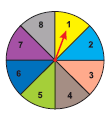
Frame two problems in calculating probability, based on the spinner shown here.
5.
What is the probability of drawing a King or a Queen or a Jack from a deck of cards?
6.
The dimensions of a cuboidal box are 6 m × 400 cm × 1.5 m. Find the cost of painting its entire outer surface at the rate of Rs. 22 per cm2.
7.
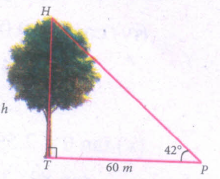
In the given figure, HT shows the height of a tree standing vertically. From a point P, the angle of elevation of the top of the tree
8.
Find the value of the following:
(i) sin65039' + cos24057' + tan10010'
(ii) tan70058' + cos15026' - sin84059'
9.
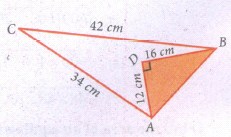
Find the area of the unshaded region.
.PNG)
10.
Verify the following equalities :
sin2600 + cos2600 = 1
11.
If \(\left( \frac { 3 }{ 2 } ,5 \right) ,\left( 7,\frac { -9 }{ 2 } \right) \)and\((\frac{13}{2},\frac{-13}{2})\) are mid-points of the sides of a triangle, then find the centroid of the triangle.
12.
Find the length of median through A of a triangle whose vertices are A(−1, 3), B(1, −1) and C(5, 1).
13.
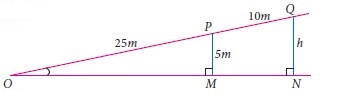
A boy standing at a point O finds his kite flying at a point P with distance OP = 25 m. It is at a height of 5m from the ground. When the thread is extended by 10 m from P, it reaches a point Q. What will be the height QN of the kite from the ground? (use trigonometric ratios)
14.
If cos \(\theta\) : sin\(\theta\) =1: 2, then find the value of = \(\frac { 8cos\theta -2sin\theta }{ 4cos\theta +2sin\theta } \)
15.
If cos A = \(\frac { 2x }{ 1+{ x }^{ 2 } } \) then find the values of sinA and tan A in terms of x.
16.
A line segment AB is increased along its length by 25% by producing it to C on the side of B. If A and B have the coordinates (−2,−3) and (2,1) respectively, then find the coordinates of C.
17.
Find the coordinates of a point P on the line segment joining A(1, 2) and B(6, 7) in such a way that AP = \(\frac{2}{5}\)AB
18.
If 2cos \(\theta\) = \(\sqrt { 3 } \), then find all the trigonometric ratios of angle \(\theta\)
19.
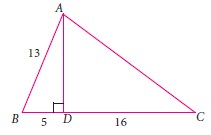
From the given figure, find the values of
(i) sin B
(ii) sec B
(iii) cot B
(iv) cos C
(v) tan C
(vi) cosec C
20.
From the given figure, find all the trigonometric ratios of angle \(\theta\)
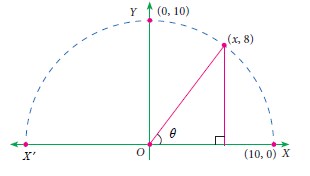
21.
Prove that the diagonals of the parallellogram bisect each other. [Hint: Take scale on both axes as 1 cm = a units]
22.
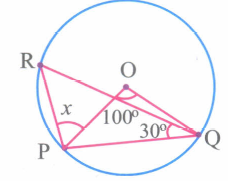
In the given figure, ㄥPOQ = 100o and ㄥPQR = 30o, then find ㄥRPO
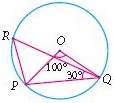
23.
The arch of a bridge has dimensions as shown, where the arch measure 2m at its highest point and its width is 6m. What is the radius of the circle that contains the arch?
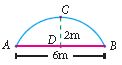
24.
Plot the following points in the coordinate plane and join them. What is your conclusion about the resulting figure?
(–5, 3) (–1, 3) (0, 3) (5, 3)
25.
Write down the abscissa and ordinate of the following.
(i) P
(ii) Q
(iii) R
(iv) S
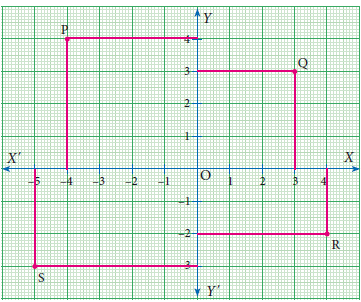
1.
V = l \(\times\) b \(\times\) h = 1440 m3
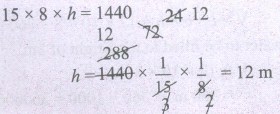
height = 12 m
2.
(i) l = 12 cm
b = 8 cm
h= 6 cm
Volume of the cuboid = lbh
= 12 \(\times\) 8 \(\times\) 6 cm3 = 576 cm3
(ii) l = 60 m
b = 25 m
h = 1.5 m
Volume of the cuboid = l b h = 60 \(\times\) 25\(\times\)1.5 m3 = 2250 m3
3.
Total number of families S = 1500
n(S) = 1569
Let P be the event of selecting a family having part time maids and F be the event of selecting a family having full time maids.
(i) Both types of maids Let P \(\cap\) F be the event of selecting a family having both types of maids.
Let (P \(\cap\) F) = 259
\(\mathrm{P}(\mathrm{P} \cap \mathrm{F})=\frac{\mathrm{n}(\mathrm{P} \cap \mathrm{F})}{\mathrm{n}(\mathrm{S})}=\frac{250}{1500}=\frac{1}{6}\)
(ii) Part time maids Part time maids = only part time maid + both
= 860 + 250 = 1110 '
n(P) = 1110
\(\mathrm{p}(\mathrm{P})=\frac{\mathrm{n}(\mathrm{P})}{\mathrm{n}(\mathrm{S})}=\frac{1110}{1500}=\frac{111}{150}\)
(iii) No maids Let (P \(\cup\) P)'be the event of choosing a family not having maids and (P u F) be the event of choosing a family having part time or fuli time or both maids.
n(P \(\cup\) F ) = only n(P) + only n(F) + n(p \(\cap\) p) = 850 + 370 + 250
n(P\(\cup\)F) = 1480
n(P\(\cup\)F)' = n(S)-n(P\(\cup\)F)
= 1500 - 1480
n(P \(\cup\) F)' = 20
\(\mathrm{P}(\mathrm{P} \cup \mathrm{F})^{\prime}=\frac{\mathrm{n}(\mathrm{P} \cup \mathrm{F})^{\prime}}{\mathrm{n}(\mathrm{S})}=\frac{20}{1500}=\frac{1}{75}\)
4.
(i) What is the probability that the spinner will not land on a multiple of 2?
(ii) What is the probability that the spinner will land on an odd number?
5.
Number of cards n(S) = 52
No. of King cards n(A) = 4
No. of Queen cards n(B) = 4
No. of Jack cards n(C) = 4
Probability of drawing a King card
\(\frac { n(A) }{ n(S) } =\frac { 4 }{ 52 } \)
Probability of drawing a Queen card
=\(\frac { n(B) }{ n(S) } =\frac { 4 }{ 52 } \)
Probability of drawing a Jack card
=\(\frac { n(C) }{ n(S) } =\frac { 4 }{ 52 } \)
∴ The Probability of drawing a King or a Queen or a Jack from a deck of cards
= p(A) + P(B)+ P(C) =\(\frac { 4 }{ 52 } +\frac { 4 }{ 52 } +\frac { 4 }{ 52 } =\frac { 4+4+4 }{ 52 } =\frac { 12 }{ 52 } =\frac { 3 }{ 13 } \).
6.
l \(\times\) b \(\times\) h = 6 m \(\times\) 400 cm \(\times\) 1.5 m
l = 6m, b = 4 m, h = 1.5 m
Total surface area of the cuboid = Outer surface area
= 2 (lb + bh + hI)
= 2 ((6 \(\times\) 4) + (4 \(\times\) 1.5) + (1.5 \(\times\) 6))
= 2 (24 + 6 + 9) = 2 (39) m2
Cost of painting 1 m2 = Rs. 22
Cost of painting 78 m2= 78 \(\times\) 22 = Rs. 1716
7.
\(tan\ {42 }^{ 0 }=\cfrac { h }{ 60 } =0.9004\)
h = 0.9004 \(\times\) 60 = 54.024 m
8.
(i) = 0.9111 + 0.9066 + 0.1793
= 1.9970
(ii) = 2.8982 + 0.9639 - 0.9962
= 3.8625 - 0.9962
= 2.8659
9.
By the Pythagoras theorem
AB2 = AD2 + DB2
= 122+162 = 144 + 256 = 400
AB = 20 cm
s = \(\frac { 34+20+42 }{ 2 } =\frac { 96 }{ 2 } \) = 48
∴ Area of the Δ ABC = \(\sqrt { s(s-a)(s-b)(s-c) } \)
= \(\sqrt { 48(48-34)(48-20)(48-42) } \)
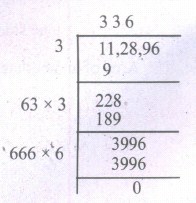
= \(\sqrt { 48\times 14\times 28\times 6 } =\sqrt { 112896 } \)
= \(\\ \sqrt { 336\times 336 } \) = 336 sq.cm
Area of the triangle ABD
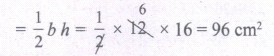
∴ Area of the unshaded region
= Area of Δ ABC - Area of Δ ABD
= 336 - 96 = 240 cm2.
10.
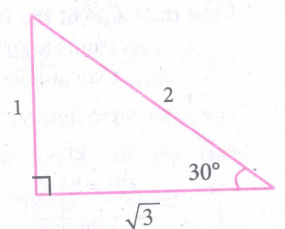
\({ \sin }^{ 2 }{ \tan }^{ 2 }+{ \cos }^{ 2 }{ 60 }^{ o }=\left( \cfrac { \sqrt { 3 } }{ 2 } \right) +\left( \cfrac { 1 }{ 2 } \right) ^{ 2 }=\cfrac { 3 }{ 4 } +\cfrac { 1 }{ 4 } =\cfrac { 4 }{ 4 } =1\)
11.
"The centroid of the triangle obtained by joining the mid points of the sides of a triangle is the same as the centroid of the original triangle."
\(\therefore\) The mid points of the sides of the triangle are given as
x1y1 , x2y, x3y3
\(\left( \frac { 3 }{ 2 } ,5 \right) \left( 7,\frac { -9 }{ 2 } \right) \left( \frac { 13 }{ 2 } ,\frac { -13 }{ 2 } \right) \)
\(\therefore\)Centroid \(=\left( \frac { { x }_{ 1 }+{ x }_{ 2 }+{ x }_{ 3 } }{ 3 } ,\frac { { y }_{ 1 }+{ y }_{ 2 }+{ y }_{ 3 } }{ 3 } \right) \)
\(=\left( \frac { \frac { 3 }{ 2 } +\frac { 7 }{ 1 } +\frac { 13 }{ 2 } }{ 3 } ,\frac { 5+\left( \frac { -9 }{ 2 } \right) +\frac { (-13) }{ 2 } }{ 3 } \right) =\left( \frac { \frac { 3+14+13 }{ 2 } }{ 3 } ,\frac { \frac { 10-9-13 }{ 2 } }{ 3 } \right) \)
\(=\left( \frac { \frac { 30 }{ 2 } }{ 3 } ,\frac { \frac { -12 }{ 2 } }{ 3 } \right) =\left( \frac { 15 }{ 3 } ,\frac { -6 }{ 3 } \right) =(5,-2)\)
12.
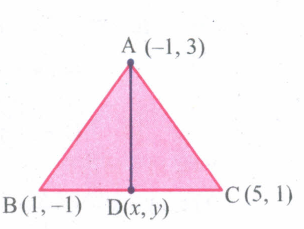
D (x, y) is the Mid point BC
\(\therefore \ D(x,y)=\left( \frac { 1+5 }{ 2 } ,\frac { -1+1 }{ 2 } \right) \)
\(=\left( \frac { 6 }{ 2 } ,\frac { 0 }{ 2 } \right) \)
= (3, 0)
AD is the median through A
Here A x2 y2 D x3 y3
(-1,3) (3,0)
\( \therefore\) Length of AD \(=\sqrt { { ({ x }_{ 2 }-{ x }_{ 1 }) }^{ 2 }+{ ({ y }_{ 2 }-{ y }_{ 1 }) }^{ 2 } } =\sqrt { { (3-(-1)) }^{ 2 }+{ (0-3) }^{ 2 } } \)
\(=\sqrt { { (3+1) }^{ 2 }+{ (-3) }^{ 2 } } =\sqrt { 16+9 } =\sqrt { 25 } =5\) units
13.
In the figure,
\(\triangle\)OPM, \(\triangle\)OQN are similar triangles. In similar triangles the sides are in the same proportional.
\(\cfrac { QN }{ PM } =\cfrac { QO }{ PO } \)
\(\cfrac { h }{ 5 } =\cfrac { 35 }{ 25 } \)
\(h=\cfrac { 5\times 35 }{ 25 } \)
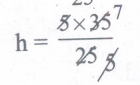
h = 7m
14.
\(cos\theta :sin\theta =1:2\)
\(\cfrac { cos\theta }{ sin\theta } =\cfrac { 1 }{ 2 } \)
\(cos\theta =\cfrac { 1 }{ 2 } sin\theta \)
\(\sin\theta =2 \cos\theta \)
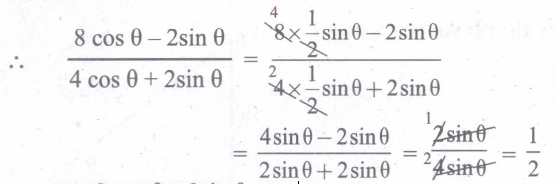
\(\therefore \cfrac { 8cos\theta -2sin\theta }{ 4cos\theta +2sin\theta } =\cfrac { 1 }{ 2 } \)
15.
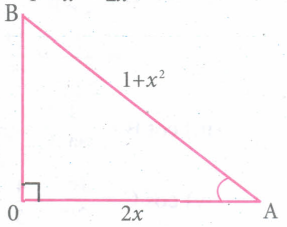
By the pythagoras theorem,
AB2 = OA2 + OB2
(1 + x2)2 = (2x)2 + OB2
OB2 = (1 +x2)2 - (2x)2 = 1+ x4 + 2x2 - 4x2 = 1+x4 - 2x2
OB2 = (1-x2)2 B
OB = (1-x2)
\(\therefore sin\ A=\cfrac { 1-{ x }^{ 2 } }{ 1+{ x }^{ 2 } } \)
\(tan\ A=\cfrac { 1-{ x }^{ 2 } }{ 2x } \)
16.
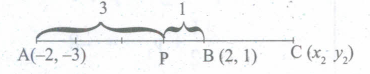
x1 y1 x2 y2
A(-2, -3) B(2, 1)
m : n = 3 : 1
The point P divides AB in the ratio 3 : 1
\(P(x,y)=\left( \frac { { mx }_{ 2 }+{ nx }_{ 1 } }{ m+n } ,\frac { { my }_{ 2 }+{ ny }_{ 1 } }{ m+n } \right) \)
\(=\left( \frac { 3\times 2+1\times -2 }{ 3+1 } ,\frac { 3\times 1+1\times -3) }{ 3+1 } \right) \)
\(=\left( \frac { 6-2 }{ 4 } ,\frac { 3-3 }{ 4 } \right) =\left( \frac { 4 }{ 4 } ,\frac { 0 }{ 4 } \right) =(1,0)\)
P is at 25% distance from B on its left and C is at 25% distance from B on its right
\(\therefore\) B is the mid point of PC
Mid point of \(\bar { PC } =\left( \frac { { x }_{ 1 }+{ x }_{ 2 } }{ 2 } ,\frac { { y }_{ 1 }+{ y }_{ 2 } }{ 2 } \right) \)
\((2,1)=\left( \frac { 1+{ x }_{ 2 } }{ 2 } ,\frac { 0+{ y }_{ 2 } }{ 2 } \right) \)
\(\frac { 1+{ x }_{ 2 } }{ 2 } =2\quad \frac { { y }_{ 2 } }{ 2 } =1\)
1 + x2 = 4 y2 = 2
⇒ x2 = 3, y2 = 2
∴ C(x2, y2) = (3, 2) is the solutions.
17.
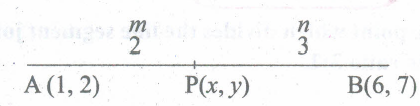
x1 y1 x2 y2
A(1, 2) B (6, 7)
\(=P(x,y)\left( \frac { { mx }_{ 2 }+{ nx }_{ 1 } }{ m+n } ,\frac { { my }_{ 2 }+{ ny }_{ 1 } }{ m+n } \right) \)
\(=\left( \frac { 2\times 6+3\times 1 }{ 2+3 } ,\frac { 2\times 7+3\times 2) }{ 2+3 } \right) \)
\(=\left( \frac { 12-3 }{ 5 } ,\frac { 14+6 }{ 5 } \right) =\left( \frac { 15 }{ 5 } ,\frac { 20 }{ 5 } \right) =(3,4)\)
18.
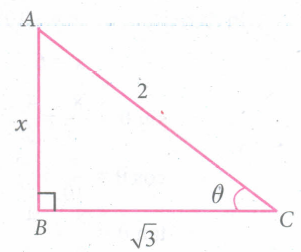
If \(2cos\theta =\sqrt { 3 } \)
\(cos\theta =\cfrac { \sqrt { 3 } }{ 2 } \)
\(x=\sqrt { { 2 }^{ 2 }-\sqrt { { 3 }^{ 2 } } } =\sqrt { 4-3 } =\sqrt { 1 } =1\)
\(\therefore sin\theta =\cfrac { 1 }{ 2 } \)
\(cos\theta =\cfrac { \sqrt { 3 } }{ 2 } \)
\(tan\theta =\cfrac { 1 }{ \sqrt { 3 } } \)
\(coseec\theta =2\)
\(sec\theta =\cfrac { 2 }{ \sqrt { 3 } } \)
\(cot\theta =\sqrt { 3 } \)
19.
(i) \(sinB=\cfrac { 12 }{ 13 } \)
(ii) \(secB=\cfrac { 1 }{ cosB } \)
= \(\cfrac { 1 }{ 5/3 } =\cfrac { 13 }{ 5 } \)
(iii) \(cotB=\cfrac { 1 }{ tanB } =\cfrac { 1 }{ 12/5 } =\cfrac { 5 }{ 2 } \)
(iv)
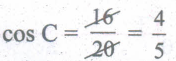
(v) \(\tan C=\cfrac { 12 }{ 16 } =\cfrac { 3 }{ 4 } \)
(vi) \(cosecC=\cfrac { 1 }{ sinC } =\cfrac { 1 }{ 12/20 } =\cfrac { 20 }{ 12 } =\cfrac { 5 }{ 3 } \)
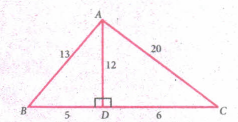
By the pythagoras theorem,
\(AD=\sqrt { { 13 }^{ 2 }-{ 5 }^{ 2 } } \)
= \(\sqrt { 169-25 } \)
= \(\sqrt { 144 } =12\)
AC =\(\sqrt { { 12 }^{ 2 }+{ 16 }^{ 2 } } \)
= \(\sqrt { { 144 }+{ 256 } } \)
= \(\sqrt { 400 } =20\)
20.
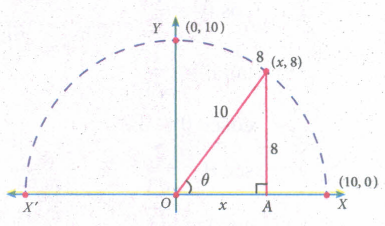
By the Pythagoras theorem
In \(\triangle\)OAB, \(x=\sqrt { { 10 }^{ 2 }-{ 8 }^{ 2 } } =\sqrt { 100-64 } =\sqrt { 36 } \)
\(sin\theta =\cfrac { 8 }{ 10 } =\cfrac { 4 }{ 5 } \)
\(cos\theta =\cfrac { 6 }{ 10 } =\cfrac { 3 }{ 5 } \)
\(tan\theta =\cfrac { 8 }{ 6 } =\cfrac { 4 }{ 3 } \)
\(cosec\theta =\cfrac { 10 }{ 8 } =\cfrac { 5 }{ 4 } \)
\(sec\theta =\cfrac { 10 }{ 6 } =\cfrac { 5 }{ 3 } \)
\(cot\theta =\cfrac { 6 }{ 8 } =\cfrac { 3 }{ 4 } \)
Study these thoroughly
\(sin\theta =\cfrac { Opp.side }{ Hypotenuse } \)
\(cos\theta =\cfrac { Adj.side }{ Hypotenuse } \)
\(tan\theta =\cfrac { Opp.side }{ Adj.side } \)
\(cosec\theta =\cfrac { Hypotenuse }{ Opp.side } \)
\(sec\theta =\cfrac { Hypotenuse }{ Opp.side } \)
\(cot\theta =\cfrac { Adj.side }{ Opp.side } \)
21.
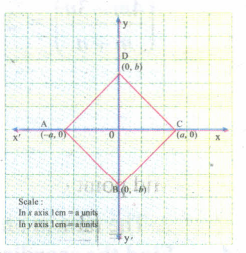
Mid point of Diagonal AC:
\(=\left( \frac { -a+a }{ 2 } ,\frac { 0+0 }{ 2 } \right) =\left( \frac { 0 }{ 2 } ,\frac { 0 }{ 2 } \right) =(0,0)\)
Mid point Diagonal of BD:
\(=\left( \frac { 0+0 }{ 2 } ,\frac { b+(-b) }{ 2 } \right) =\left( \frac { 0 }{ 2 } ,\frac { 0 }{ 2 } \right) =(0,0)\)
Mid point of AC = Mid point of BD
∴ Diagonals bisect each other
22.
In the figure\(\angle \)POQ = 1000
\(\angle \)PQR = 300
\(\angle \)PQR = \(\cfrac { 1 }{ 2 } \)\(\angle \)PQR = \(\cfrac { 1 }{ 2 } \)\(\times\)100 = 500
In\(\triangle \)OPQ = \(\angle \)OQP =\(\angle \)POQ = 1800
2\(\angle \)OPQ = 1800
2\(\angle \) OPQ = 800
\(\therefore \) \(\angle \)OPQ = 400
In \(\triangle \)PRQ,
\(\angle \)R+\(\angle \)P+\(\angle \)Q = 1800
500 + (40 + x) + 300 = 1800
(40 + x)0 = 1800 - 80 = 1000
x0 = 1000 - 400 = 600
\(\therefore \) \(\angle \)RPO = x = 600
23.
If CD 2 cm and R is the radius, i.e. OC = OA = OB = R
\(\therefore\) OD = OC - DC = R - 2 cm
since AB = 6 cm
\(\Rightarrow \) AD = DB = \(\cfrac { 6 }{ 2 } \) = 3 cm
In \(\triangle \)OBD,
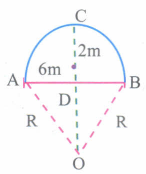
\(\Rightarrow \) OB2 = OD2 + BD2 (By Pythagoras theorem)
\(\Rightarrow \) R2 = (R - 2)2 + 32
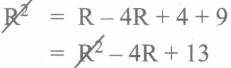
\(\Rightarrow \) 4R = 13
\(\Rightarrow \) R = \(\cfrac { 13 }{ 4 } \) = 3.25 cm
24.
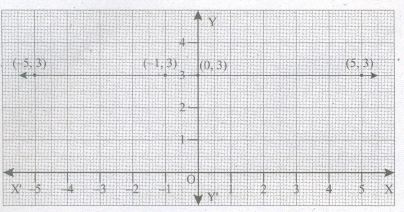
Straight line parellel to x-axis
25.
(i) P is (-4, 4) [-4 is abscissa and 4 is ordinate]
(ii) Q is (3, 3) [3 is abscissa and 3 is ordinate]
(iii) R is (4, -2) [4 is abscissa and -2 is ordinate]
(iv) S is (-5, -3) [-5 is abscissa and -3 is ordinate]

9th Standard Syllabus & Materials
9th Standard
TN 9th Tamil உள்ளத்தின் சீர் - திருக்குறள் Important Questions And Answers Study Material - QB365 Set A
NEW9th Standard
TN 9th Tamil உள்ளத்தின் சீர் - மணிமேகலை Important Questions And Answers Study Material - QB365 Set A
NEW9th Standard
TN 9th Tamil உள்ளத்தின் சீர் - ஏறு தழுவுதல் Important Questions And Answers Study Material - QB365 Set A
NEW9th Standard
TN 9th Tamil உயிருக்கு வேர் - தண்ணீர் Important Questions And Answers Study Material - QB365 Set A



Tamilnadu Stateboard 9th Standard Subjects
Tamilnadu Stateboard Standards





