
 100% FREE ACCESS
9th Standard Syllabus & Materials
9th Standard
TN 9th Tamil உள்ளத்தின் சீர் -கற்கண்டு (இலக்கணம்) - தொடர் இலக்கணம், ஆகுபெயர் Important Questions And Answers Study Material - QB365 Set A
NEW9th Standard
TN 9th Tamil உள்ளத்தின் சீர் -விரிவானம் (துணைப்பாடம்) - தாய்மைக்கு வறட்சி இல்லை! Important Questions And Answers Study Material - QB365 Set A
NEW9th Standard
TN 9th Tamil உள்ளத்தின் சீர் -கவிதை பேழை (செய்யுள்) - மார்கழி பெருவிழா Important Questions And Answers Study Material - QB365 Set A
NEW9th Standard
TN 9th Tamil உயிருக்கு வேர்-இலக்கணம் - பகுபத உறுப்பிலக்கணம் Important Questions And Answers Study Material - QB365 Set A
NEW9th Standard
TN 9th Tamil அமுதென்று பேர் - இலக்கணம்-எழுத்து -அளபெடை Important Questions And Answers Study Material - QB365 Set A
NEW9th Standard
TN 9th Tamil அமுதென்று பேர்-துணைப்பாடம் - ஆறாம்திணை Important Questions And Answers Study Material - QB365 Set A

Published on: 14/06/2021
QB365 provides detailed and simple solution for every book back questions in class 9 Maths subject.It will helps to get more idea about question pattern in every book back questions with solution.
Download Tamil Nadu 9th Standard Maths question papers, model tests, one-mark questions, important questions, and public exam papers in PDF format. Free study materials and answer keys for TN State Board students.
Questions + Answers key
Take MCQ Maths Test1.
Solve by cross-multiplication method
(i) 8x − 3y = 12 ; 5x = 2y + 7
(ii) 6x + 7y −11 = 0 ; 5x + 2y = 13
(iii) \(\frac { 2 }{ x } +\frac { 3 }{ y } =5;\frac { 3 }{ x } -\frac { 1 }{ y } +9=0\)
2.
Solve the system of linear equations x + 3y = 16 and 2x − y = 4 by substitution method.
3.
Verify A -(BUC) = (A-B)∩(A-C) using Venn diagrams.
4.
(i) Prove that (x - 1) is a factor of x3- 7x2 + 13x - 7
(ii) Prove that (x + 1) is a factor of x3 + 7x2 + 13x + 7
5.
Find the value of a and b if \(\frac { \sqrt { 7 } -2 }{ \sqrt { 7 } +2 } \) = a\(\sqrt{7}\) + b
6.
If A = {11,13,14,15,16,18}, B = {11,12,15,16,17,19}, and C = {13,15,16,17,18,20}, then verify \(A\cap (B\cup C)=(A\cap B)\cup (A\cap C)\).
7.
Verify A∩(B∪C)=(A∩B)∪(A∩C) using Venn diagrams.
8.
Write the following polynomials in standard form.
| S.No | Polynomial | Standard form |
|---|---|---|
| 1 | 5m4 -3m + 7m2 + 8 | |
| 2 | \(\frac { 2 }{ 3 } y+{ 8y }^{ 3 }-12+\sqrt { 5 } { y }^{ 2 }\) | |
| 3 | 12p2 -8p5 -10p4 -7 |
9.
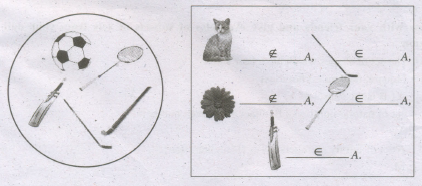
Insert the appropriate symbol ∈ (belongs to) or ∉ (does not belong to) in the blanks.
10.
Find the remainder when f(x) = x3 + 3x2 + 3x + 1 is divided by x+1.
11.
What is the remainder when x2018 + 2018 is divided by x–1
12.
Find the quotient and remainder of the following.
(–18z + 14z2 + 24z3 +18)÷(3z+4)
13.
Find the quotient and remainder of the following. (4x3 + 6x2 – 23x +18)÷(x+3)
14.
Find quotient and the remainder when f(x) is divided by g(x)
f(x) = x3 + 1, g(x) = x+1
15.
Find the quotient and the remainder when (5x2-7x+2) ÷ (x-1)
16.
Express the following decimal expression into rational numbers -\(21.21\overline {37}\)
17.
What must be subtracted from 2x4+4x2-3x+7 to get 3x3-x2+2x+1?
18.
Subtract the second polynomial from the first polynomial and find the degree of the resultant polynomial
h(z) = z5-6z4+z f(z) = 6z2+10z-7
19.
Subtract the second polynomial from the first polynomial and find the degree of the resultant polynomial
p(x) = 7x2+ 6x -1 q(x) = 6x - 9
20.
Rewrite the following polynomial in standard form.
\({ y }^{ 2 }+\sqrt { 5 } { y }^{ 3 }-11-\frac { 7 }{ 3 } y+{ 9y }^{ 4 }\)
21.
Rewrite the following polynomial in standard form.
\(\sqrt { 2 } x^{ 2 }-\frac { 7 }{ 2 } { x }^{ 4 }+x-5{ x }^{ 3 }\)
22.
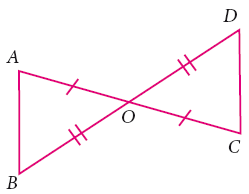
Consider the given pairs of triangles and say whether each pair is that of congruent triangles. If the triangles are congruent, say ‘how’; if they are not congruent say ‘why’ and also say if a small modification would make them congruent:
23.
Show that the following points A(3, 1), B(6,4) and C(8, 6) lies on a straight line.
24.
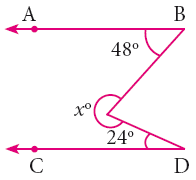
In the figure, AB is parallel to CD, find x
25.
If p(x) = 4x2-3x+2x3+5 and q(x) = x2+2x+4 find p(x)+q(x)
1.
(i) 8x- 3y = 12 ...(1)
5x-2y = 7 ..(2)
8x- 3y-12 = 0
5x-2y- 7 = 0
For cross multiplication method, we write the co-efficients as

\(\cfrac { x }{ (-3)(-7)(-2)(-12) } =\cfrac { y }{ (-12)(5)-(-7)(8) } =\cfrac { 1 }{ (8)(-2)-(5)(-3) } \)
\(\cfrac { x }{ 21-24 } =\cfrac { y }{ -60+56 } =\cfrac { 1 }{ -16+15 } \)
\(\cfrac { x }{ -3 } =\cfrac { y }{ -60+56 } =\cfrac { 1 }{ -16+15 } \)
\(\therefore \ \cfrac { x }{ 3 } =\cfrac { 1 }{ -1 } \ \cfrac { y }{ -4 } =\cfrac { 1 }{ -1 } \)
x = 3 , y = 4
\(\therefore\) Solutions: x = 3; y = 4
(ii) 6x+ 7y-11 = 0
5x+ 2y-13 = 0
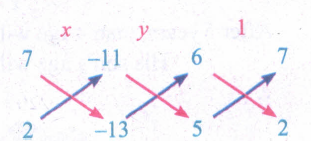
For cross multiplication method, we write the co-efficients as
\(\cfrac { x }{ -91-(-22) } =\cfrac { y }{ -55-(-68) } =\cfrac { 1 }{ 12-35 } \)
\(\cfrac { x }{ -91+22 } =\cfrac { y }{ -55+78 } =\cfrac { 1 }{ -23 } \)
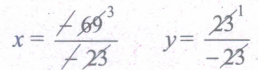
\(\cfrac { x }{ -69 } =\cfrac { y }{ 23 } =\cfrac { 1 }{ -23 } \)
\(\cfrac { x }{ -69 } =\cfrac { 1 }{ -23 } \quad \cfrac { y }{ 23 } =\cfrac { 1 }{ -23 } \)
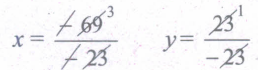
x = 3, y= -1
\(\therefore\) x = 3; y= -1
(iii)
\(\cfrac { 2 }{ x } +\cfrac { 3 }{ y } -5=0\)
\(\cfrac { 3 }{ x } -\cfrac { 1 }{ y } +9=0\)
In (1), (2) Put \(\cfrac { 1 }{ x } =a,\cfrac { 1 }{ y } =b\)
(1) \(\Rightarrow\) 2a + 3b - 5 = 0
(2) \(\Rightarrow\) 3a - b + 9 = 0
For cross multiplication method, we write the co-efficients as
\(\cfrac { a }{ (3)(9)-(-1)(-5) } =\cfrac { b }{ (-5)(3)-(9)(2) } =\cfrac { 1 }{ (2)(-1)-(3)(3) } \)
\(\cfrac { a }{ 27-5 } =\cfrac { b }{ -15-18 } =\cfrac { 1 }{ -2-9 } \)
\(\cfrac { a }{ 22 } =\cfrac { b }{ -33 } =\cfrac { 1 }{ -11 } \)
\(\therefore \ \cfrac { a }{ 22 } =\cfrac { 1 }{ -11 } \cfrac { b }{ -33 } =\cfrac { 1 }{ -11 } \)
a = -2 b = 3
\(a=\cfrac { 1 }{ x } =-2\quad b=\cfrac { 1 }{ y } =3\)
\(\therefore \ x=\cfrac { -1 }{ 2 } \ \ y=\cfrac { 1 }{ 3 } \)
solution \(\ x=\cfrac { -1 }{ 2 } \ \ y=\cfrac { 1 }{ 3 } \)
2.
Given x + 3y = 16 ... (1)
2x – y = 4 ... (2)
| Step 1 | Step 2 | Step 3 | Solution |
|---|---|---|---|
| From equation (2) 2x −y = 4 –y = 4–2x y = 2x − 4 ...(3) |
Substitute (3) in (1) x + 3y = 16 x + 3(2x − 4) = 16 x + 6x −12 = 16 7x = 28 x = 4 |
Substitute x = 4 in (3) y = 2x − 4 y = 2(4) − 4 y = 4 |
x = 4 and y = 4 |
3.
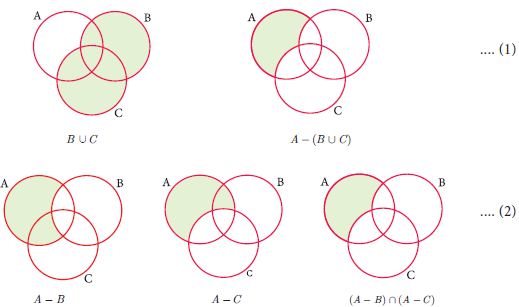
From (1) and (2), we get A -(BUC) = (A-B)∩(A-C). Hence it is verified.
4.
(i) Let p(x) = x3 - 7x + 13x - 7
Sum of coefficients = 1 − 7 + 13 − 7 = 0
Thus (x -1) is a factor of p (x)
(ii) Let q(x) = x3 + 7x2 + 13x + 7
Sum of coefficients of even powers of x with constant = 7 + 7 = 14
Sum of coefficients of odd powers of x = 1 + 13 = 14
Hence, (x + 1) is a factor of q (x)
5.
\(\frac { \sqrt { 7 } -2 }{ \sqrt { 7 } +2 } =a\sqrt{7}+b\)
L.H.S = \(\frac{\sqrt{7}-2\times\sqrt{7}-2}{\sqrt{7}+2\times\sqrt{7}-2}=\frac{(\sqrt{7}-2)^2}{\sqrt{7}^2-2^2}=\frac{\sqrt{7}^2-2\sqrt{7}\times2+2^2}{7-4}\)
=\(\frac{7-4\sqrt{7}+4}{3}=\frac{11-4\sqrt{7}}{3}=\frac{11}{3}-\frac{4\sqrt{7}}{3}\)
\(\frac{-4\sqrt{7}}{3}+\frac{11}{3}=a\sqrt{7}+b\)
ஃa √7=\(\frac{-4\sqrt{7}}{3}\)
a = \(\frac{-4}{3}\)
b = \(\frac{11}{3}\)
6.
A = {11,13,14,15,16,18}
B = {11,12,15,16,17,19}, C = {13,15,16,17,18,20}
(BUC) = {11,12,13,15,16,17,18,19,20}
A⋂(BUC) = {11,13,14,15,16,18}⋂{11,12,13,15,16,17,18,19,20}
= {11,13,15,16,18}...(1)
A⋂B = {11,15,16}; A⋂C = {13,15,16,18}
(A⋂B)U(A⋂C) = {11,13,15,16,18}...(2)
From (1) and (2) it is verified that A⋂(BUC) = (A⋂B)U(A⋂C).
7.
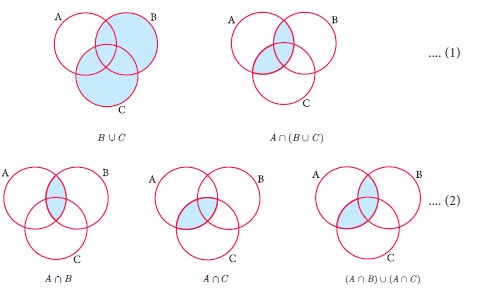
From (1) and (2), \(A\cap (B\cup C)=(A\cap B)\cup (A\cap C)\) is verified.
8.
| S.No | Polynomial | Standard form |
|---|---|---|
| 1 | 5m4 -3m + 7m2 + 8 | 5m4+7m2-3m +8 |
| 2 | \(\frac { 2 }{ 3 } y+{ 8y }^{ 3 }-12+\sqrt { 5 } { y }^{ 2 }\) | \({ 8y }^{ 3 }+\sqrt { 5 } { y }^{ 2 }+\frac { 2 }{ 3 } y-12\) |
| 3 | 12p2 -8p5 -10p4 -7 | -8p5-10p4 + 12p2- 7 |
9.
10.
f(x) = x3 + 3x2 + 3x + 1
f(–1) = (–1)3+3(–1)2+3(–1)+1
= –1+3–3+1 = 0
Hence, the remainder is 0
Hint:
g(x) = x+1
g(x) = 0
x +1 = 0
x = –1
11.
p(x) = x2018 + 2018
When it is divided by x - 1,
p( 1) = 12018+ 2018
= 1 + 2018
= 2019
The Remainder : 2019
12.
.png)
\(\therefore\) The Quotient: 8z2–6z+2
The Remainder: 10
13.
.png)
\(\therefore\) The Quotient: 4x2–6x–5
The Remainder : 33
14.
f(x) = x3 + 1, g(x) = x+1
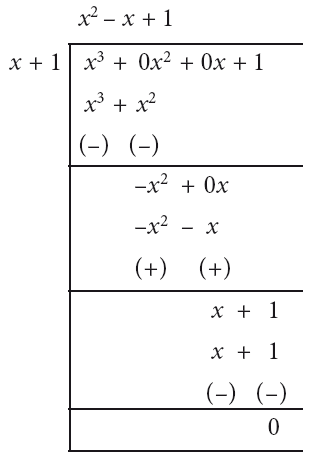
Quotient = x2 – x + 1 and Remainder = 0
15.
(5x2-7x+2) ÷ (x-1)
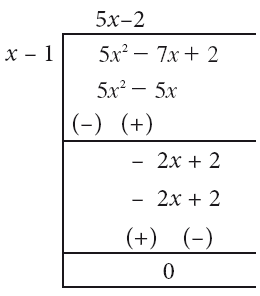
∴ Quotient = 5x–2 Remainder = 0
(i) \(\frac{5x^{2}}{x}=5x\)
(ii) 5x(x-1)=5x2-5x
(iii) \(-\frac{2x}{x}=-2\)
(iv) -2(x-1)=(-2x+2)
16.
Let x = -21.213777 ...... \(\rightarrow\) (1)
Here period of decimal is 4,multiply equation (1) by 10000
10000 x = -21213, 7.777 .............. (2)
(2) - (1)
9999 x = 212116.5640
\( x =\frac{-212116.5640}{9999} \)
\( x =\frac{-2121165640}{99990000} \)
\( =\frac{-190924}{9000}=\frac{-47731}{2250} \)
17.
2x4 + 4x2 - 3x + 7 - (3x3 - x2 + 2x + 1)
= 2x4 + 4x2 - 3x + 7 - 3x3 + x2 - 2x - 1
= 2x4 - 3x3 + 4x2 + x2 - 3x - 2x + 7 - 1
= 2x4 - 3x3 + 5x2 - 5x + 6
2x4 - 3x3 + 5x2 - 5x + 6 must be subtracted to get 3x3 - x2 + 2x + 1.
18.
h(z) - f(z) = z5 - 6z4 + z - (6z2 + 10z -7)
= z5 -6z4 + z - 6z2 - 10z + 7
= z5 -6z4 -6z2 + z - 10z + 7
= z5– 6z4– 6z2– 9z+ 7
The degree of the polynomial is 5
19.
p(x) - q(x) = 7x2 + 6x - 1 - (6x - 9)
= 7x2 + 6x - 1 - 6x + 9
= 7x2 + 6x - 6x - 1 + 9
= 7x2+8
The degree of the polynomial is 2
20.
The standard form is \({ 9y }^{ 4 }+\sqrt { 5 } { y }^{ 3 }+{ y }^{ 2 }-\frac { 7 }{ 3 } y-11\) or \(-11-\frac { 7 }{ 3 } y+{ y }^{ 2 }+\sqrt { 5 } { y }^{ 3 }+{ 9y }^{ 4 }\)
21.
The standard form is \(-\frac { 7 }{ 2 } { x }^{ 4 }-5{ x }^{ 3 }+\sqrt { 2 } { x }^{ 2 }+x\) or \(x+\sqrt { 2 } { x }^{ 2 }-{ 5x }^{ 3 }-\frac { 7 }{ 2 } { x }^{ 4 }\)
22.
In the given figure AC and BD bisect each other at O.
\(\therefore\) OA = OC (Given) ; OB = OD (Given)
\(\angle AOB=\angle COD\) (vertically opposite angles)
By SAS congruency
\(\triangle AOB\cong\triangle OCD\)
23.
Using the distance formula, we have
\(AB=\sqrt { \left( 6-3 \right) ^{ 2 }+\left( 4-1 \right) ^{ 2 } } =\sqrt { 9+9 } =\sqrt { 18 } =3\sqrt { 2 } \)
\(BC=\sqrt { \left( 8-6 \right) ^{ 2 }+\left( 6-4 \right) ^{ 2 } } =\sqrt { 4+4 } =\sqrt { 8 } =2\sqrt { 2 } \)
\(AC=\sqrt { \left( 8-3 \right) ^{ 2 }+\left( 6-1 \right) ^{ 2 } } =\sqrt { 25+25 } =\sqrt { 50 } =5\sqrt { 2 } \)
\(AB+BC=3\sqrt { 2 } +3\sqrt { 2 } =5\sqrt { 2 } =AC\)
Therefore the points lie on a straight line.
24.
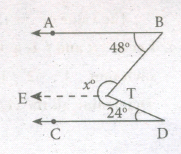
Draw TE || AB.
\(\angle ABT+\angle ETB=180^0(AB||TE)\)
\(48^0+\angle ETB=180^0\)
\(\angle ETB=180^0-48^0=132^0\)
Similarly \(\angle CDT+\angle DTE=180^0\)
\(24^0+\angle DTE=180^0\)
\(\therefore \angle DTE=180^0-24^0\) = 1560
\(\therefore \angle BTE+\angle ETD=132^0+156^0\) = 288°
x = 288°
25.
| Given Polynomial | Standard form |
| p(x) = 4x2-3x+2x3+5 | 2x3+4x2-3x+5 |
| q(x) = x2+2x+4 | x2+2x+4 |
| p(x)+q(x) = 2x3+5x2-x+9 | |
We see that p(x) + q(x) is also a polynomial. Hence the sum of any two polynomials is also a polynomial

9th Standard Syllabus & Materials
9th Standard
TN 9th Tamil உள்ளத்தின் சீர் - திருக்குறள் Important Questions And Answers Study Material - QB365 Set A
NEW9th Standard
TN 9th Tamil உள்ளத்தின் சீர் - மணிமேகலை Important Questions And Answers Study Material - QB365 Set A
NEW9th Standard
TN 9th Tamil உள்ளத்தின் சீர் - ஏறு தழுவுதல் Important Questions And Answers Study Material - QB365 Set A
NEW9th Standard
TN 9th Tamil உயிருக்கு வேர் - தண்ணீர் Important Questions And Answers Study Material - QB365 Set A



Tamilnadu Stateboard 9th Standard Subjects
Tamilnadu Stateboard Standards





