
 100% FREE ACCESS
9th Standard Syllabus & Materials
9th Standard
TN 9th Tamil உள்ளத்தின் சீர் -கற்கண்டு (இலக்கணம்) - தொடர் இலக்கணம், ஆகுபெயர் Important Questions And Answers Study Material - QB365 Set A
NEW9th Standard
TN 9th Tamil உள்ளத்தின் சீர் -விரிவானம் (துணைப்பாடம்) - தாய்மைக்கு வறட்சி இல்லை! Important Questions And Answers Study Material - QB365 Set A
NEW9th Standard
TN 9th Tamil உள்ளத்தின் சீர் -கவிதை பேழை (செய்யுள்) - மார்கழி பெருவிழா Important Questions And Answers Study Material - QB365 Set A
NEW9th Standard
TN 9th Tamil உயிருக்கு வேர்-இலக்கணம் - பகுபத உறுப்பிலக்கணம் Important Questions And Answers Study Material - QB365 Set A
NEW9th Standard
TN 9th Tamil அமுதென்று பேர் - இலக்கணம்-எழுத்து -அளபெடை Important Questions And Answers Study Material - QB365 Set A
NEW9th Standard
TN 9th Tamil அமுதென்று பேர்-துணைப்பாடம் - ஆறாம்திணை Important Questions And Answers Study Material - QB365 Set A

Published on: 14/06/2021
QB365 provides detailed and simple solution for every book back questions in class 9 Maths subject.It will helps to get more idea about question pattern in every book back questions with solution.
Download Tamil Nadu 9th Standard Maths question papers, model tests, one-mark questions, important questions, and public exam papers in PDF format. Free study materials and answer keys for TN State Board students.
Questions + Answers key
Take MCQ Maths Test1.
Find the value of the following:
\(\frac { cos70° }{ sin20° } +\frac { cos59° }{ sin31° } +\frac { cos\theta }{ sin\left( 90°-\theta \right) } -8 \cos^{ 2 }60°\)
2.
A farmer has a field in the shape of a rhombus. The perimeter of the field is 400 m and one of its diagonal is 120 m. He wants to divide the field into two equal parts to grow two different types of vegetables. Find the area of the field.
3.
Solve 2x = −7y + 5; −3x = −8y −11 by cross multiplication method.
4.
Find the values of the following:
(i) (cos 00 + sin 450 + sin 300)(sin 900 - cos 450 + cos 600)
(ii) tan2600 - 2tan2450 - cot2300 +2sin2300 + \(\frac { 3 }{ 4 } \) cosec2 450
5.
Draw the graph for the following
(i) y = 3x - 1
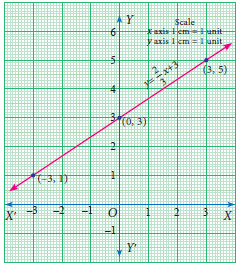
(ii) \(y=\left( \frac { 2 }{ 3 } \right) x+3\)
6.
Express the following rational numbers into decimal and state the kind of decimal expansion
(i) \(\frac { 2 }{ 7 } \)
(ii) \(-5\frac { 3 }{ 11 } \)
(iii) \(\frac { 22 }{ 3 } \)
(iv) \(\frac { 327 }{ 200 } \)
7.
A and B are two sets such that n(A – B) = 32 + x, n(B – A) = 5x and n(A∩B) = x. Illustrate the information by means of a Venn diagram. Given that n(A) = n(B), calculate the value of x.
8.
In a party of 45 people, each one likes tea or coffee or both. 35 people like tea and 20 people like coffee. Find the number of people who
(i) like both tea and coffee.
(ii) do not like Tea.
(iii) do not like coffee
9.
Factorise the following:
(i) x2+10x + 24
(ii) z2+ 4z -12
(iii) p2- 6p -16
(iv) t2+72 -17t
(v) y2-16 - 80
(vi) a2+10a - 600
10.
Verify x3+y3+z3-3xyz = \(\frac{1}{2}\)[x+y+z][(x-y)2+(y-z)2+(z-x)2]
11.
If both (x - 2) and \(\left( x-\frac { 1 }{ 2 } \right) \) are the factors of ax2+ 5x + b, then show that a = b.
12.
Arrange surds in descending order:
(i) \(\sqrt [ 3 ]{ 5 } ,\sqrt [ 9 ]{ 4 } ,\sqrt [ 6 ]{ 3 } \)
(ii) \(\sqrt [ 2 ]{ \sqrt [ 3 ]{ 5 } } ,\sqrt [ 2 ]{ \sqrt [ 3 ]{ 5 } } ,\sqrt [ 3 ]{ \sqrt [ 4 ]{ 7 } } ,\sqrt { \sqrt { 3 } } \)
13.
A survey was conducted among 200 magazine subscribers of three different magazines A, B and C. It was found that 75 members do not subscribe magazine A, 100 members do not subscribe magazine B, 50 members do not subscribe magazine C and 125 subscribe atleast two of the three magazines. Find
(i) Number of members who subscribe exactly two magazines.
(ii) Number of members who subscribe only one magazine
14.
A survey of 1000 farmers found that 600 grew paddy, 350 grew ragi, 280 grew corn, 120 grew paddy and ragi, 100 grew ragi and corn, 80 grew paddy and corn. If each farmer grew at least any one of the above three, then find the number of farmers who grew all the three.
15.
If A = {y : y =\(\frac { a+1 }{ 2 } \), a \(\in \) W and a ≤ 5}, B = {y : y =\(\frac { 2n-1 }{ 2 } \), n\(\in \)W and n < 5} and C =\(\left\{ -1,-\frac { 1 }{ 2 } ,1,\frac { 3 }{ 2 } ,2 \right\} \), then show that \(A-(B\cup C)=(A-B)\cap (A-C)\).
16.
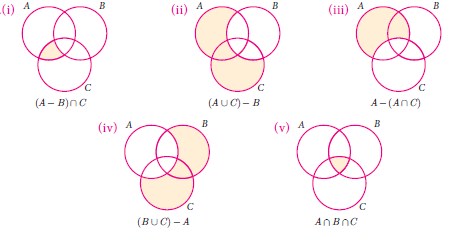
If A, B and C are overlapping sets, then draw Venn diagram for the following sets:
(i) (A-B)\(\cap \)C
(ii) (A\(\cup \)C)-B
(iii) A-(A\(\cap \)C)
(iv) (B\(\cup \)C)-A
(v) A\(\cap \)B\(\cap \)C
17.
The polynomial ax3 - 3x2 + 4 and 2x3 - 5x +a when divide by (x - 2) leave the remainders p and q respectively if p - 2q = 4 ; find the value of a.
18.
Without actual division , prove that f(x) = 2x4- 6x3 + 3x2 + 3x - 2 is exactly divisible by x2 – 3x + 2
19.
Verify that the following points taken in order form the vertices of a rhombus.
A (1, 1), B(2, 1),C (2, 2) and D(1, 2)
20.
Express the rational number \(\frac { 1 }{ 33 } \) in recurring decimal form by using the recurring decimal expansion of \(\frac { 1 }{ 11 } \). Hence write \(\frac{71}{33}\) in recurring decimal form
21.
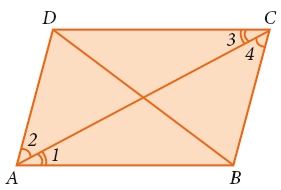
ABCD is a parallelogram Fig such that ∠BAD = 120o and AC bisects ∠BAD show that ABCD is a rhombus.
22.
Let A(2, 2), B(8, –4) be two given points in a plane. If a point P lies on the X- axis (in positive side), and divides AB in the ratio 1: 2, then find the coordinates of P.
23.
Find the product (4x – 5), (2x2 + 3x – 6).
24.
ΔABC and ΔDEF are two triangles in which AB = DF, ∠ACB = 70°, ∠ABC = 60°, ∠DEF = 70° and ∠EDF = 60°. Prove that the triangles are congruent.
25.
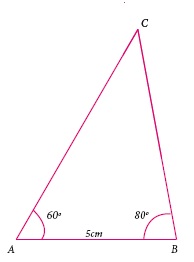
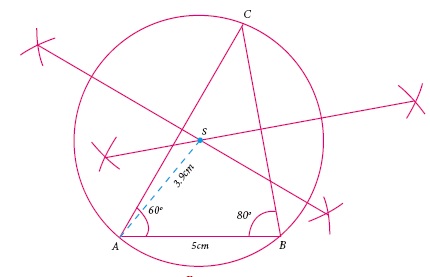
Construct the circumcentre of the ΔABC with AB = 5 cm, ㄥA = 600 and ㄥB = 800. Also draw the circumcircle and find the circumradius of the ΔABC.
1.
\(\frac { cos70° }{ sin20° } +\frac { cos59° }{ sin31° } +\frac { cos\theta }{ sin\left( 90°-\theta \right) } -8cos^{ 2 }60°\)
= \(\cfrac { cos\left( { 90 }^{ 0 }-{ 20 }^{ 0 } \right) }{ sin{ 20 }^{ 0 } } +\cfrac { cos\left( { 90 }^{ 0 }-{ 31 }^{ 0 } \right) }{ sin{ 31 }^{ 0 } } +\cfrac { cos\theta }{ cos\theta } -8\left( \cfrac { 1 }{ 2 } \right) ^{ 2 }\)
= \(\cfrac { { sin20 }^{ 0 } }{ { sin20 }^{ 0 } } +\cfrac { sin31^{ 0 } }{ sin{ 31 }^{ 0 } } +\cfrac { cos\theta }{ cos\theta } -8\left( \cfrac { 1 }{ 2 } \right) ^{ 2 }\)
= \(\cfrac { { sin20 }^{ 0 } }{ { sin20 }^{ 0 } } +\cfrac { sin31^{ 0 } }{ sin{ 31 }^{ 0 } } +\cfrac { cos\theta }{ cos\theta } -8\times \cfrac { 1 }{ 4 } =1+1+1-2=1\)
2.
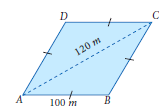
Let ABCD be the rhombus.
Its perimeter = 4 × side = 400 m
Therefore, each side of the rhombus = 100 m
Given the length of the diagonal AC = 120 m
In \(\triangle\)ABC, let a =100 m, b =100 m, c = 120 m
s = \(\frac{a+b+c}{2}=\frac{100+100+120}{2}\) = 160 m
Area of \(\triangle\)ABC =\(\sqrt{160(160-100)(160-100)(160-120)}\)
= \(\sqrt{160 \times 60\times 60 \times40}\)
= \(\sqrt{40 \times 2 \times \times2\times60\times60\times40}\)
= 40 × 2 × 60 = 4800 m2
Therefore, Area of the field ABCD = 2 × Area of \(\triangle\)ABC = 2 × 4800 = 9600 m2
3.
The given system of equations can be written as
2x + 7y − 5 = 0
−3x + 8y +11 = 0
For the cross multiplication method, we write the coefficients as
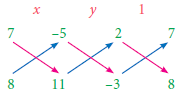
\(\frac { x }{ (7)(11)-(8)(-5) } =\frac { y }{ (-5)(-3)-(11)(2) } =\frac { 1 }{ (2)(8)-(-3)(7) } \)
\(\frac { x }{ 77+40 } =\frac { y }{ 15-22 } =\frac { 1 }{ 16+21 } \)
\(\frac { x }{ 117 } =\frac { y }{ -7 } =\frac { 1 }{ 37 } \)
\(\frac { x }{ 117 } =\frac { 1 }{ 37 } ,\frac { y }{ -7 } =\frac { 1 }{ 37 } \)
Hence the solution is \(\left( \frac { 117 }{ 37 } ,\frac { -7 }{ 37 } \right) \)
Verification:
2x + 7y -5 = 0 .....(1)
\(2\left( \frac { 117 }{ 37 } \right) +7\left( \frac { -7 }{ 37 } \right) -5=0\)
\(\frac { 234 }{ 57 } -\frac { 49 }{ 37 } -5=0\)
\(\frac { 185 }{ 37 } -5=0\)
5 - 5 =0 True
3x+8y+11 = 0 ...(2)
\(3\left( \frac { 117 }{ 37 } \right) +8\left( \frac { -7 }{ 37 } \right) +11=0\)
\(\frac { -351 }{ 37 } -\frac { 56 }{ 37 } +11=0\)
\(\frac { -407 }{ 37 } +11=0\)
-11 + 11 = 0 True
4.
(i) (cos00 + sin 450 + sin 300) (sin 900 - cos 450 + cos 600)
= \(\left[ 1+\frac { 1 }{ \sqrt { 2 } } +\frac { 1 }{ 2 } \right] \left[ 1-\frac { 1 }{ \sqrt { 2 } } +\frac { 1 }{ 2 } \right] \)
= \(\left[ \frac { 2\sqrt { 2 } +2+\sqrt { 2 } }{ 2\sqrt { 2 } } \right] \left[ \frac { 2\sqrt { 2 } -2+\sqrt { 2 } }{ 2\sqrt { 2 } } \right] =\left[ \frac { 3\sqrt { 2 } +2 }{ 2\sqrt { 2 } } \right] \left[ \frac { 3\sqrt { 2 } -2 }{ 2\sqrt { 2 } } \right] \)
= \(\frac { 18-4 }{ 4\left( \sqrt { 2 } \right) ^{ 2 } } =\frac { 14 }{ 4\times 2 } =\frac { 7 }{ 4 } \)
(ii) tan2600 - 2tan2450 - cot2300 +2sin2300 + \(\frac { 3 }{ 4 } \) cosec2450
= \(\left( \sqrt { 3 } \right) ^{ 2 }-2(1)^{ 2 }-\left( \sqrt { 3 } \right) ^{ 2 }+2\left( \frac { 1 }{ 2 } \right) ^{ 2 }+\frac { 3 }{ 4 } \left( \sqrt { 2 } \right) ^{ 2 }\)
= \(3-2-3+\frac { 1 }{ 2 } +\frac { 3 }{ 2 } \)
= -2 + \(\frac { 4 }{ 2 } \) = -2 + 2 = 0
5.
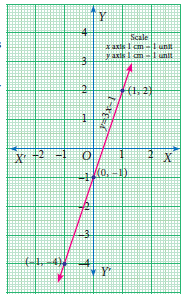
(i) Let us prepare a table to find the ordered pairs of points for the line y = 3x −1.
We shall assume any value for x, for our convenience let us take −1, 0 and 1.
When x = −1, y = 3(–1)–1 = –4
When x = 0, y = 3(0)–1 = –1
When x = 1, y = 3(1)–1 = 2
| x | -1 | 0 | 1 |
| y | -4 | -1 | 2 |
The points (x,y) to be plotted :
(−1, −4), (0, −1) and (1, 2).
(ii) Let us prepare a table to find the ordered pairs of points for the line y =\(\left( \frac { 2 }{ 3 } \right) x+3\)
Let us assume −3, 0, 3 as x values.
(why?)
When x = -3, \(y=\frac { 2 }{ 3 } (-3)+3=1\)
When x = 0, \(y=\frac { 2 }{ 3 } (0)+3=3\)
When x =3, \(y=\frac { 2 }{ 3 } (3)+3=5\)
| x | -3 | 0 | 3 |
| y | 1 | 3 | 5 |
The points (x, y) to be plotted: (-3, 1), (0, 3) and (3, 5).
6.
(i) \(2\over 7\) = 0.2857142....
= \(0.\overline {285714}\)
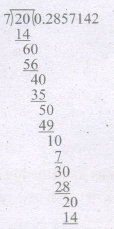
Non-terminating and recurring decimal expansion.
(ii) \(-5\frac { 3 }{ 11 } \) = -5.272....
= \(-5.\overline { 27 } \)
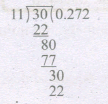
Non-terminating and recurring decimal expansion.
(iii) \(\frac { 22 }{ 3 } \) = 7.333...
= \(7.\overline { 3 } \)

Non-terminating and recurring decimal expansion.
(iv) \(\frac{327}{200}=\frac{327}{2\times 100}\)
= \(\frac{3.27}{2}\)
= 1.635
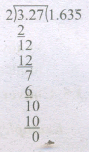
Terminating decimal expansion.
7.
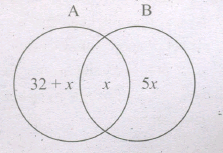
n(A - B) = 32 + x, n(B A) = 5x
n(A \(\cap\) B) = x
From the Venn diagram:
Given n(A) = n(B)
32 + x + x = x + 5x
32 + 2x = 6x
32 = 6x - 2x
32 = 4x
x = \({32\over 4}=8\)
The value of x = 8.
8.
Let the people who like tea be T.
Let the people who like coffee be C
By using formula
n(A ∪ B) = n(A) + n(B) – n(A ∩ B)
(i) n(T ∩ C) = n(T) + n(C) – n(T ∪ C) = 35 + 20 – 45 = 55 – 45 = 10
The number of people who like both coffee and tea = 10.
(ii) The number of people who do not like tea
n(T) = n(U) – n(T) = 45 – 35 = 10
(iii) The number of people who do not like coffee
n(C) = n(U) – n(C) = 45 – 20 = 25.
9.
(i) x2+10x + 24 = x2+ 6x + 4x + 24
= x(x + 6) + 4(x + 6)
= (x + 6)(x + 4)

(ii) z2+ 4z -12
= z2+ 6z - 2z -12
= z(z + 6) -2(z + 6)
= (z + 6)(z - 2)

(iii) p2- 6p -16 = p2- 8p + 2p -16
= p(p - 8)+2(p - 8)
= (p - 8)(p + 2)

(iv) t2+ 72 -17t = t2-17t + 72
= t2- 9t - 8t + 72
= t(t - 9) - 8 (t - 9)
= (t - 9)(t - 8)

(v) y2 -16y- 80 = y2 - 20y + 4y - 80
= y(y - 20) + 4 (y - 20)
= (y - 20) (y + 4)
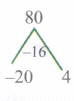
(vi) a2 + 10a - 600
= a2 + 30a - 20a - 600
= a(a + 30)- 20(a + 30)
= (a + 30)(a - 20)

10.
R.H.S = \(\frac{1}{2}(x+y+z)[(x-y)^2+(y-z)^2+(z-x)^2]\)
= \(\frac{1}{2}(x+y+z)[x^2-2xy+y^2+y^2-2yz+z^2-2zx+x^2]\)
= \(\frac{1}{2}[(x+y+z)[2x^2+2y^2+2z^2-2xy-2yz-2zx^2]]\)
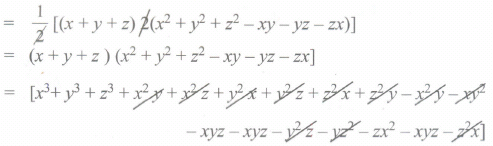
= x3+y3+z3-3xyz = L.H.S
Hence it is verified.
11.
Let P(x) = ax2+5x+b
(x-2) is a factor of P(x), if P(2) = 0
P(2) = a(2)2+5(2)+b = 0
4a +10+b = 0
4a+b = -10...(1)
\((x-\frac{1}{2})\) is a factor of P(x), if P\((\frac{1}{2})\) = 0
P\((\frac{1}{2})\) = a\((\frac{1}{2})^2\) + 5\((\frac{1}{2})\)+ b = 0
\(\frac{a}{4}+\frac{5}{2}+b=0\)
\(\frac{a}{4}+b=\frac{-5}{2}\)
\(\frac{a+4b}{4}=\frac{-5}{2}\)
2a + 8b = -20
a + 4b = -10...(2)
From (1) and (2)
4a + b = -10...(1)
a + 4b = -10...(2)
(1) and (2) ⇒ 4a + b = a + 4b
3a = 3b
a = b
Hence it is proved.
12.
(i) \(\sqrt [ 3 ]{ 5 } ,\sqrt [ 9 ]{ 4 } ,\sqrt [ 6 ]{ 3 } \)
\(5^{\frac{1}{3}}\)
ஃ The order of the surds \(\sqrt [ 3 ]{ 5 } ,\sqrt [ 9 ]{ 4 } ,\sqrt [ 6 ]{ 3 } \) are 3,9,6
\(4^{\frac{1}{9}}\)
\(3^{\frac{1}{6}}\) l.c.m of 3,9,6 is 18
ஃ \(\frac{1}{3}=\frac{1\times6}{3\times6}=\frac{6}{18}\)
\(\frac{1}{9}=\frac{1\times2}{9\times2}=\frac{2}{18};\frac{1}{6}=\frac{1\times3}{6\times3}=\frac{3}{18}\)
\((5^{\frac{1}{3}})=5^{\frac{6}{18}}=(15625)^{\frac{1}{18}}\)
\((4^{\frac{1}{9}})=4^{\frac{2}{18}}=(4^2)^{\frac{1}{18}}=16^{\frac{1}{18}}\)
\((3^{\frac{1}{6}})=3^{\frac{3}{18}}=(3^3)^{\frac{1}{18}}=27^{\frac{1}{18}}\)
ஃ The descending order of \(\sqrt [ 3 ]{ 5 } ,\sqrt [ 9 ]{ 4 } ,\sqrt [ 6 ]{ 3 } \) is \((15625)^{\frac{1}{18}}>(27)^{\frac{1}{18}}>16^{\frac{1}{18}}\) i.e., \(\sqrt { \sqrt { 3 } } >\sqrt [ 2 ]{ \sqrt [ 3 ]{ 5 } } >\sqrt [ 3 ]{ \sqrt [ 4 ]{ 7 } } \)
(ii) \(\sqrt [ 2 ]{ \sqrt [ 3 ]{ 5 } } ,\sqrt [ 2 ]{ \sqrt [ 3 ]{ 5 } } ,\sqrt [ 3 ]{ \sqrt [ 4 ]{ 7 } } ,\sqrt { \sqrt { 3 } } \)
The order of the surds \(\sqrt [ 2 ]{ \sqrt [ 3 ]{ 5 } } ,\sqrt [ 2 ]{ \sqrt [ 3 ]{ 5 } } ,\sqrt [ 3 ]{ \sqrt [ 4 ]{ 7 } } ,\sqrt[2] { \sqrt [2]{ 3 } } \) are 6, 12, 4
l.c.m of 6,12,4 is 12
\(\sqrt[2]{\sqrt[3]{5}}=5^{\frac{1}{6}}=5^{\frac{1\times2}{6\times2}}=5^{\frac{2}{12}}=(5^2)^{\frac{1}{12}}=25^{\frac{1}{12}}\)
\(\sqrt[3]{\sqrt[4]{\sqrt{7}}}=7^{\frac{1}{12}};\sqrt{\sqrt{3}}=3^{\frac{1}{4}}=3^{\frac{1\times3}{4\times3}}=3^{\frac{3}{12}}=(3^3)^{\frac{1}{12}}=27^{\frac{1}{12}}\)
ஃ The ascending order of the surds
\(\sqrt [ 2 ]{ \sqrt [ 3 ]{ 5 } } ,\sqrt [ 2 ]{ \sqrt [ 3 ]{ 5 } } ,\sqrt [ 3 ]{ \sqrt [ 4 ]{ 7 } } ,\sqrt { \sqrt { 3 } } \) is \(7^{\frac{1}{12}}<25^{\frac{1}{2}}<27^{\frac{1}{2}}\), that is \(\sqrt[3]{\sqrt[4]{7}}<\sqrt[2]{\sqrt[3]{5}}<\sqrt{\sqrt{3}}\)
13.
Total number of subscribers = 200
| Magazine | Do not subscribe | Subscribe |
| A | 75 | 125 |
| B | 100 | 100 |
| C | 50 | 150 |
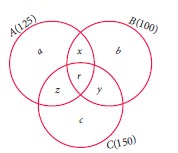
From the Venn diagram,
Number of members who subscribe only one magazine = a + b + c
Number of members who subscribe exactly two magazines = x + y + z
and 125 members subscribe atleast two magazines.
That is, x + y + z + r = 125 ..... (1)
Now, n(A U B U C) = 200, n(A) = 125, n(B) = 100, n(C) = 150, n(A∩B) = x + r
n(B∩C) = y + r, n(A∩C) = z + r, n(A∩B∩C) = r
We know that,
n(AUBUC) = n(A) + n(B) + n(C) – n(A∩B) – n(B∩C) – n(A∩C) + n(A∩B∩C)
200 = 125 + 100 + 150 – x – r – y – r – z – r + r
= 375 - (x + y + z + r) - r
= 375 -125 [∵ x + y + z + r = 125]
200 = 250 - r ⇒ r = 50
From (1) x + y + z + 50 = 125
We get, x + y + z = 75
Therefore, number of members who subscribe exactly two magazines = 75.
From Venn diagram, (a + b + c) + (x +y + z + r) = 200 ........ (2)
substitute (1) in (2)
a + b + c + 125 = 200
a + b + c = 75
Therefore, number of members who subscribe only one magazine = 75.
14.
a = 600 - (120 -x + x + 80 -x)
= 600 - (200 -x)
= 600 - 200 + x = 400 + x
b = 350 - (120 -x + x + 100 -x)
= 350 - (220 - x)
= 350 - 230 + x = 130 + x
c = 280 - (80 - x + x + 100 - x)
280 - (180 -x)
= 280 - 180 + x = 100 + x
Each farmer grew at least one of the above three, the number of farmers who grew all the three is x.
= a + b + c + 120 - x + 100 - x + 80 - x + x = 1000
400 + x + 130 + x + 100 + x + 120 - x + 100 - x + 80 - x + x = 1000
ஃ 930 + x = 1000
x = 1000 - 930 = 70
ஃ 70 farmers grew all the three crops.
15.
A = { y : y = \(\frac { a+1 }{ 2 } \), a\(\in \) W and a ≤ 5}
a = {0,1,2,3,4,5}
y = \(\frac{a+1}{2}=\frac{a+1}{2}=\frac{1}{2}\)
y = \(\frac{1+1}{2}=\frac{2}{2}=1\)
y = \(\frac{2+1}{2}=\frac{3}{2};y=\frac{3+1}{2}=\frac{4}{2}=2\)
y = \(\frac{4+1}{2}=\frac{5}{2};y=\frac{5+1}{2}=\frac{6}{2}=3\)
ஃ A = \(\{\frac{1}{2},1,\frac{3}{2},2,\frac{5}{2},3\}\)
B = { y : y = \(\frac{2n-1}{2}\), n∈W and n < 5}
n = {0,1,2,3,4}
y = \(\frac{2\times0-1}{2}=\frac{-1}{2}\)
y = \(\frac{2\times1-1}{2}=\frac{1}{2}; y=\frac{2\times2-1}{2}=\frac{3}{2}\)
y = \(\frac{2\times3-1}{2}=\frac{5}{2}; y=\frac{2\times4-1}{2}=\frac{7}{2}\)
ஃ B = \(\{-\frac{1}{2},\frac{1}{2},\frac{3}{2},\frac{5}{2},\frac{7}{2}\}\)
C = \(\{-1,-\frac{1}{2},1,\frac{3}{2},2\}\)
BUC = \(\{-1,-\frac{1}{2},\frac{1}{2},1,\frac{3}{2},2,\frac{5}{2},\frac{7}{2}\}\)
A-(BUC) = {3}...............(1)
A-B = {1,2,3}
A-C = \(\{\frac{1}{2},\frac{5}{2},3\}\)
(A-B)∩(A-C) = {3}...................(2)
From (1) and (2), it is verified that A-(BUC) = (A-B)∩(A-C)
16.
17.
p(x) = ax3 - 3x2 + 4
When it is divided by x - 2
p(2) = a(2)3 - 3(2)2 + 4
p = 8a-12 + 4
p = 8a- 8
q(x) = 2x3 - 5x + a
When it is divided by x - 2
q(2) = 2(2)3 - 5(2) + a
q = 16-10+a
q = 6+a
Given p - 2q = 4
8a - 8 - 2 (6 + a) = 4
8a- 8 -12 -2a = 4
6a-20 = 4
6a = 24
a = 24/6 = 4
The value of a = 4
18.
Let f(x) = 2x4- 6x3+3x2+3x-2
g(x) = x2 –3x + 2
= x2-2x-x+2
= x(x-2)-1(x-2)
= (x-2)(x-1)
we show that f(x) is exactly divisible by (x–1) and (x–2) using remainder theorem
f(1) = 2(1)4-6(1)3+3(1)2+3(1)-2
= 2 – 6 + 3 + 3 – 2 = 0
f(2) = 2(2)4-6(2)3+3(2)2+3(2)-2
= 32 – 48 + 12 + 6 – 2 = 0
f(x) is exactly divisible by (x – 1) (x – 2)
i.e., f(x) is exactly divisible by x2 –3x + 2
If p(x) is divided by (x -a) with the remainder p(a) = 0 , then (x -a) is a factor of p(x). Remainder Theorem leads to Factor Theorem.
19.
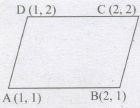
Distance = \(\sqrt { ({ x }_{ 2 }-{ x }_{ 1 })^{ 2 }+(y_{ 2 }-y_{ 1 })^{ 2 } } \)
AB = \(\sqrt { (2-1)^{ 2 }+(1-1)^{ 2 } } \)
= \(\sqrt { (1)^{ 2 }+(0)^{ 2 } } =\sqrt { 1 } =1\)
BC = \(\sqrt { (2-1)^{ 2 }+(2-1)^{ 2 } } \)
= \(\sqrt { (0)^{ 2 }+(1)^{ 2 } } =\sqrt { 1 } =1\)
CD =\(\sqrt { (1-2)^{ 2 }+(2-2)^{ 2 } } \)
= \(\sqrt { (-1)^{ 2 }+(0)^{ 2 } } =\sqrt { 1 } =1\)
AD =\(\sqrt { (1-1)^{ 2 }+(2-1)^{ 2 } } \)
= \(\sqrt { (0)^{ 2 }+(1)^{ 2 } } =\sqrt { 1 } =1\)
AB = BC = CD = AD =1
All the four sides are equal.
ABCD is a rhombus
20.
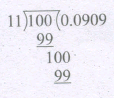
\(1\over 11\) = 0.0909 ......... = \(0.\overline{09}\)
\(\therefore \frac{1}{33}=\frac{1}{3}\times \frac{1}{11}\)
\(=\frac{1}{3}\times 0.0909.......\)
= 0.0303........ = \(0.\overline{03}\)
Also \(\frac{71}{33}=2\frac{5}{33}=2+\frac{5}{33}\)
\(=2+5\times \frac{1}{33}\)
= 2 + 5 \(\times\) \(0.\overline {03}\)
= 2 + (5 \(\times\) 0.030303 .......)
= 2 + 0.151515 .......
= 2 + \(0.\overline {15}\)
= \(2.\overline {15}\)
21.
Given ∠BAD = 120° and AC bisects ∠BAD
\(\angle{BAC}=\frac{1}{2}\times 120^{0}=60^{0}\)
∠1 = ∠2 = 60°
AD || BC and AC is the transversal
∠2 = ∠4 = 60°
Δ ABC is isosceles triangle [∴ ∠1 = ∠4 = 60 °]
⇒ AB = BC
Parallelogram ABCD is a rhombus.
22.
Given points are A(2, 2) and B(8, –4) and let P = (x, 0) [P lies on x axis]
By the distance formula
\(d=\sqrt{(x_2 -x_1)^2 +(y_2 -y_1)^2}\)
\(AP=\sqrt{(x-2)^2+(0-2)^2}=\sqrt{X^2-4x+4+4}=\sqrt{x^2 -4x+8}\)
\(BAP=\sqrt{(x-8)^2+(0+4)^2}=\sqrt{X^2-16x+64+16}=\sqrt{x^2 -16x+80}\)
Given, AP : PB = 1 : 2
i.e \(\frac{AP}{BP}=\frac{1}{2} (\therefore BP=PB)\)
2AP = BP
squaring on both sides
4AP2 = BP2
\(4(x^2 -16x+8)=(x^2-16x+80)\)
\(4x^2 -16x+32=x^2-16x+80\)
3x2- 48 = 0
3x2= 48
x2 = 16
x =\(\pm\)4
As the point P lies on x-axis (positive side), its x- coordinate cannot be –4.
Hence the coordinates of P is (4, 0)
23.
To multiply (4x – 5) and (2x2 + 3x – 6) distribute each term of the first polynomial to every term of the second polynomial. In this case, we need to distribute the terms 4x and –5. Then gather the like terms and combine them:

= 8x3+12x2-24x+10x2-15x+30
= 8x3 +2x2–39x +30
Aliter: You may also use the method of detached coefficients:
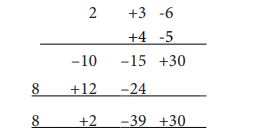
∴ (4x –5) (2x2+3x–6) = 8x3 + 2x2 – 39x + 30
24.
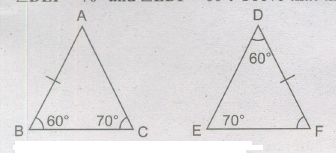
In \(\triangle ABC\angle B=60^0\ and\ \angle C=70^0\)
\(\therefore\angle A=180^0-(60^0+70^0)\)
\(=180^0-130^0\) = 500
In \(\triangle E=70^0\ and \angle D=60^0\)
\(\therefore \angle F=180^0-(70^0+60^0)\)
= 180° - 130° = 50°
\(\angle A=\angle F=50^0\)
\(\angle B=\angle D=60^0\)
\(\angle C=\angle E=70^0\)
By AAA congruency
\(\therefore\triangle ABC\cong\triangle FDE\)
25.
Step 1:
Draw the ΔABC with the given measurements.
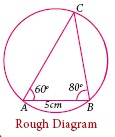
Step 2:
Construct the perpendicular bisector of any two sides (AC and BC) and let them meet at S which is the circumcentre.
Step 3:
S as centre and SA = SB = SC as radius, draw the Circumcircle to passes through A, B and C. Circumradius = 3.9 cm.

9th Standard Syllabus & Materials
9th Standard
TN 9th Tamil உள்ளத்தின் சீர் - திருக்குறள் Important Questions And Answers Study Material - QB365 Set A
NEW9th Standard
TN 9th Tamil உள்ளத்தின் சீர் - மணிமேகலை Important Questions And Answers Study Material - QB365 Set A
NEW9th Standard
TN 9th Tamil உள்ளத்தின் சீர் - ஏறு தழுவுதல் Important Questions And Answers Study Material - QB365 Set A
NEW9th Standard
TN 9th Tamil உயிருக்கு வேர் - தண்ணீர் Important Questions And Answers Study Material - QB365 Set A



Tamilnadu Stateboard 9th Standard Subjects
Tamilnadu Stateboard Standards





