
 100% FREE ACCESS
9th Standard Syllabus & Materials
9th Standard
TN 9th Tamil உள்ளத்தின் சீர் -கற்கண்டு (இலக்கணம்) - தொடர் இலக்கணம், ஆகுபெயர் Important Questions And Answers Study Material - QB365 Set A
NEW9th Standard
TN 9th Tamil உள்ளத்தின் சீர் -விரிவானம் (துணைப்பாடம்) - தாய்மைக்கு வறட்சி இல்லை! Important Questions And Answers Study Material - QB365 Set A
NEW9th Standard
TN 9th Tamil உள்ளத்தின் சீர் -கவிதை பேழை (செய்யுள்) - மார்கழி பெருவிழா Important Questions And Answers Study Material - QB365 Set A
NEW9th Standard
TN 9th Tamil உயிருக்கு வேர்-இலக்கணம் - பகுபத உறுப்பிலக்கணம் Important Questions And Answers Study Material - QB365 Set A
NEW9th Standard
TN 9th Tamil அமுதென்று பேர் - இலக்கணம்-எழுத்து -அளபெடை Important Questions And Answers Study Material - QB365 Set A
NEW9th Standard
TN 9th Tamil அமுதென்று பேர்-துணைப்பாடம் - ஆறாம்திணை Important Questions And Answers Study Material - QB365 Set A

Published on: 14/06/2021
QB365 provides detailed and simple solution for every book back questions in class 9 Maths subject.It will helps to get more idea about question pattern in every book back questions with solution.
Download Tamil Nadu 9th Standard Maths question papers, model tests, one-mark questions, important questions, and public exam papers in PDF format. Free study materials and answer keys for TN State Board students.
Questions + Answers key
Take MCQ Maths Test1.
Find the value of \(\theta\) if
(i) sin \(\theta\) = 0.9858
(ii) cos\(\theta\) = 07656
2.
Find the area of a quadrilateral ABCD whose sides are AB = 8cm, BC = 15 cm, CD = 12 cm, AD = 25 cm and  = 90°.
3.
Solve 3x − 4y = 10 and 4x + 3y = 5 by the method of cross multiplication.
4.
Find the points of trisection of the line segment joining (−2, −1) and (4, 8)
5.
Draw the graph for the following
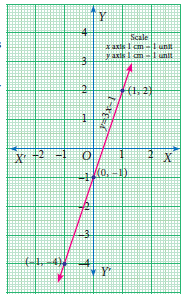
(i) y = 3x - 1
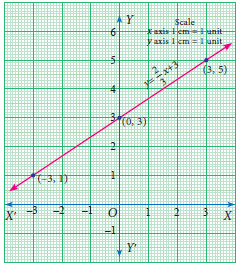
(ii) \(y=\left( \frac { 2 }{ 3 } \right) x+3\)
6.
Classify the numbers as rational or irrational
(i) \(\sqrt { 10 } \)
(ii) \(\sqrt { 49 } \)
(iii) 0.025
(iv) \(0.7\overline { 6 } \)
(v) 2.505500555...
(vi) \(\frac { \sqrt { 2 } }{ 2 } \)
7.
In a village of 100 families, 65 families buy Tamil newspapers and 55 families buy English newspapers. Find the number of families who buy
(i) Both Tamil and English newspapers.
(ii) Tamil newspapers only
(iii) English newspapers only.
8.
Find the quotient and remainder for the following using synthetic division:
(i) (x3+x2-7x-3) ÷ (x - 3)
(ii) (x3+2x2-x-4) ÷ (x + 2)
(ii) (3x3-2x2+7x-5) ÷ (x + 3)
(iv) (8x4-2x2+6x+5) ÷ (4x + 1)
9.
Factorise 2x2 + 15x - 27
10.
Factorise the following:
(i) am + bm + cm
(ii) a3- a2b
(iii) 5a -10b - 4bc + 2ac
(iv) x+y-1-xy
11.
Expand the following:
(i) (x+5)(x+6)(x+4)
(ii) (3x-1)(3x+2)(3x-4)
12.
Simplify the following using multiplication and division properties of surds:
(i) \(\sqrt { 3 } \times \sqrt { 5 } \times \sqrt { 2 } \)
(ii) \(\sqrt { 35 } \div \sqrt { 7 } \)
(iii) \(\sqrt [ 3 ]{ 27 } \times \sqrt [ 3 ]{ 8 } \times \sqrt [ 3 ]{ 125 } \)
(iv) \((7\sqrt { a } -5\sqrt { b } )(7\sqrt { a } +5\sqrt { b } )\)
(v) \(\left[ \sqrt { \frac { 225 }{ 729 } } -\sqrt { \frac { 25 }{ 144 } } \right] \div \sqrt { \frac { 16 }{ 81 } } \)
13.
Each student in a class of 35 plays atleast one game among chess, carrom and table tennis. 22 play chess, 21 play carrom, 15 play table tennis, 10 play chess and table tennis, 8 play carrom and table tennis and 6 play all the three games. Find the number of students who play (Hint: Use Venn diagram)
(i) chess and carrom but not table tennis
(ii) only chess
(iii) only carrom.
14.
Subtract the following polynomials and find the degree of the polynomial.
| Sl.No | Polynomial | Difference | Degree of the resultant polynomial |
|---|---|---|---|
| 1 | p(x) = 5x3 - 3x +x2 + 4 q(x) = 7x 4x2+ 2 |
||
| 2 | p(m) = 6m - 7 q(m) = 7m2 - 12 + 4m |
||
| 3 | p(x) = 4x2 - 6x3 - 4x + 6 q(x) = 8x3 + 2x2 - 2 |
||
| 4 | r(y) = 7y4 + 5y2 + 4y s(y) = 2y - 3y2 |
||
| 5 | p(m) = 12m3 -10m2 -7 q(m) = 7m3 + 5m2 - 3 |
15.
If the polynomials f(x) = ax3 + 4x2 + 3x –4 and g(x) = x3 – 4x + a leave the same remainder when divided by x–3, find the value of a. Also find the remainder.
16.
The area of a rectangle is x2 + 7x + 12. If its breadth is (x + 3), then find its length.
17.
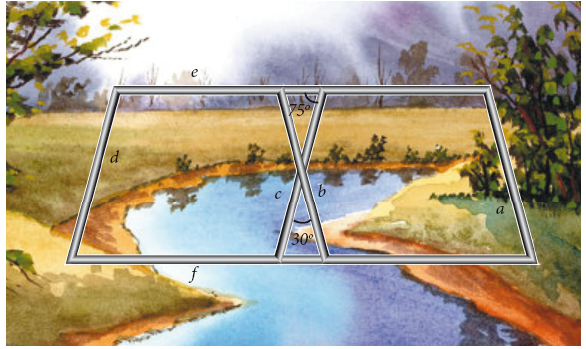
Iron rods a, b, c, d, e, and f are making a design in a bridge as shown in the figure. If a || b , c || d , e || f , find the marked angles between
(i) b and c
(ii) d and e
(iii) d and f
(iv) c and f
18.
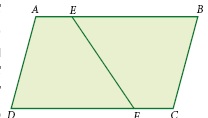
ABCD is a parallelogram such that AB is parallel to DC and DA parallel to CB. The length of side AB is 20 cm. E is a point between A and B such that the length of AE is 3 cm. F is a point between points D and C. Find the length of DF such that the segment EF divides the parallelogram in two regions with equal areas.
19.
Which type of quadrilateral satisfies the following properties?
(i) Both pairs of opposite angles are equal in size.
(ii) Both pairs of opposite sides are equal in length.
(iii) Each diagonal is an angle bisector.
(iv) The diagonals bisect each other.
(v) Each pair of consecutive angles is supplementary.
(vi) The diagonals are equal.
(vii) Can be divided into two congruent triangles.
20.
Represent \(3.4\bar { 5 } \) on the number line Upto 4 decimal places
21.
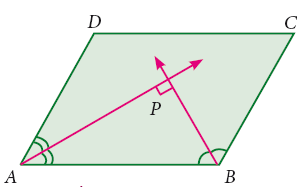
In a parallelogram ABCD, the bisectors of the consecutive angles ∠A and ∠B intersect at P. Show that ∠APB = 90o.
22.
Find any two irrational numbers between \(\sqrt { 2 } \) and \(\sqrt { 3 } \)
23.
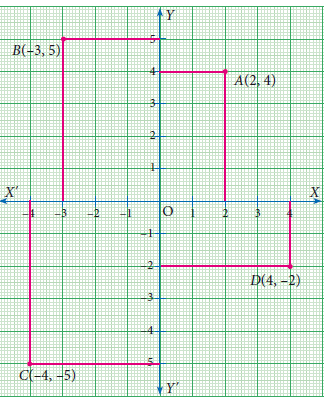
Plot the points A(2, 4), B(–3, 5), C(–4, –5), D(4, –2) in the Cartesian plane
24.
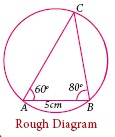
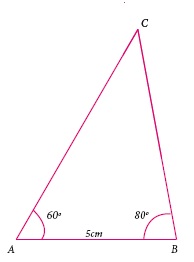
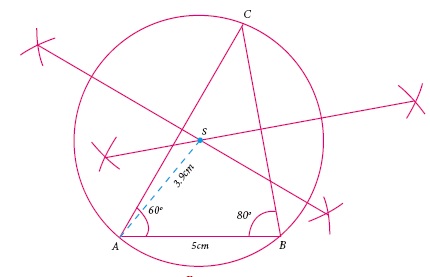
Construct the circumcentre of the ΔABC with AB = 5 cm, ㄥA = 600 and ㄥB = 800. Also draw the circumcircle and find the circumradius of the ΔABC.
25.
Draw a triangle ABC, where AB = 8 cm, BC = 6 cm and ㄥB = 700 and locate its circumcentre and draw the circumcircle.
1.
(i) sin \(\theta\) = 0.9858 = 0.9857 + 0.0001
From the sine table 0.9857 = 80o 18'
Mean difference 1 = 2′
0.9858 = sin 80020'
sin\(\theta\) = 0.9858 = sin 80020'
\(\theta\) = 80020'
(ii) cos \(\theta\) = 0.7656 = 0.7660 - 0.0004
From the natural cosine table
0.7660 = 40°0′
Mean difference 4 = 2′
0.7656 = 40°0′
cos \(\theta\) = 0.7656 = cos 40°2'
\(\theta\) = 40°2'
2.
In the quadrilateral ABCD, join one of the diagonals, say AC.
Area of \(\triangle\)ABC = \(\frac{1}{2}\)\(\times\) base \(\times\) height
=\(\frac{1}{2}\)\(\times\)8\(\times\)15\(\times\) 60 cm2
By Pythagoras theorem, in right angled triangle ABC,
AC2 = AB2 + BC2
= 82 +152 = 64 + 225 = 289 cm
Therefore, AC =\(\sqrt{289}\) =17cm
Now, for\(\triangle\)ACD, let us consider a = 17 cm, b =12 cm, c =25 cm
then, s = \(\frac{a+b+c}{2}=\frac{17+12+25}{2}=\frac{54}{2}\) = 27cm
.PNG)
Area of \(\triangle\)ACD =\(\sqrt { s(s-a)(s-b)(s-c) } \)
=\(\sqrt{27(27-17)(27-12)(27-25)}\)
=\(\sqrt{27\times10\times15\times2}\)
=\(\sqrt{3\times3\times3\times2\times5\times5\times3\times2}\)
= 3 × 3 × 2 × 5 = 90cm2
Therefore, Area of quadrilateral ABCD
=Area of \(\triangle\)ABC + Area of \(\triangle\)ACD
= 60 + 90 = 150 cm2
3.
The given system of equations are
3x − 4y = 10 \(\Rightarrow\) 3x − 4y −10 = 0 .....(1)
4x + 3y = 5 \(\Rightarrow\) 4x + 3y − 5 = 0 .....(2)
For the cross multiplication method, we write the co-efficients as
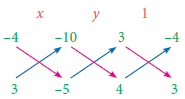
\(\frac { x }{ (-4)(-5)-(3)(-10) } =\frac { y }{ (-10)(4)-(-5)(3) } =\frac { 1 }{ (3)(3)-(4)(-4) } \)
\(\frac { x }{ (20)-(-30) } =\frac { y }{ (-40)-(-15) } =\frac { 1 }{ (9)-(-16) } \)
\(\frac { x }{ 20+30 } =\frac { y }{ -40+15 } =\frac { 1 }{ 9+16 } \)
\(\frac { x }{ 50 } =\frac { y }{ -25 } =\frac { 1 }{ 25 } \)
Therefore, we get \(x=\frac { 50 }{ 25 } ;y=\frac { -25 }{ 25 } \)
x = 2; y = -1
Thus the solution is x = 2, y = –1.
Verification :
3x–4y = 10 ...(1)
3(2)–4(–1) = 10
6 + 4 = 10
10 = 10 True
4x + 3y = 5 ...(2)
4(2) + 3(–1) = 5
8–3 = 5
5 = 5 True
4.
Let A(−2, −1) and B(4, 8) are the given points.
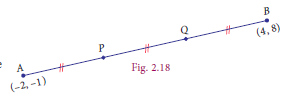
Let P(a,b) and Q(c,d) be the points of trisection of AB, so that AP = PQ = QB .
By the formula proved above,
P is the point.
\(\left( \frac { { x }_{ 2 }+{ 2x }_{ 1 } }{ 3 } ,\frac { { y }_{ 2 }+{ 2y }_{ 1 } }{ 3 } \right) =\left( \frac { 4+2(-2) }{ 3 } ,\frac { 8+2(-1) }{ 3 } \right) \) = (0, 2)
Q is the point
\(\left( \frac { { 2x }_{ 2 }+{ x }_{ 1 } }{ 3 } ,\frac { {2 y }_{ 2 }+{ y }_{ 1 } }{ 3 } \right) =\left( \frac { 2(4)-2 }{ 3 } ,\frac { 2(8)-1 }{ 3 } \right) \) = (2, 5)
5.
(i) Let us prepare a table to find the ordered pairs of points for the line y = 3x −1.
We shall assume any value for x, for our convenience let us take −1, 0 and 1.
When x = −1, y = 3(–1)–1 = –4
When x = 0 , y = 3(0)–1 = –1
When x = 1, y = 3(1)–1 = 2
| x | -1 | 0 | 1 |
| y | -4 | -1 | 2 |
The points (x,y) to be plotted :
(−1, −4), (0, −1) and (1, 2).
(ii) Let us prepare a table to find the ordered pairs of points for the line y =\(\left( \frac { 2 }{ 3 } \right) x+3\)
Let us assume −3, 0, 3 as x values.
(why?)
When x = -3, \(y=\frac { 2 }{ 3 } (-3)+3=1\)
When x = 0, \(y=\frac { 2 }{ 3 } (0)+3=3\)
When x =3, \(y=\frac { 2 }{ 3 } (3)+3=5\)
| x | -3 | 0 | 3 |
| y | 1 | 3 | 5 |
The points (x, y) to be plotted: (-3, 1), (0, 3) and (3, 5).
6.
(i) \(\sqrt { 10 } \) is an irrational number ( since 10 is not a perfect square number).
(ii) \(\sqrt { 49 } =7=\frac { 7 }{ 1 } \) a rational number(since 49 is a perfect square number).
(iii) 0.025 is a rational number (since it is a terminating decimal).
(iv) \(0.7\overline { 6 } \) = 0.7666…. is a rational number ( since it is a non – terminating and recurring decimal expansion).
(v) 2.505500555…. is an irrational number (since it is a non – terminating and non–recurring decimal).
(vi) \(\frac { \sqrt { 2 } }{ 2 } =\frac { \sqrt { 2 } }{ \sqrt { 2 } \times \sqrt { 2 } } =\frac { 1 }{ \sqrt { 2 } } \) is an irrational number ( since 2 is not a perfect square number).
7.
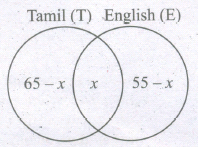
Let T be the set of families buy Tamil news Papers
Let E be the set of families buy English news Papers
n(TUE) = 100
n(T) = 65 and n(E) = 55
Let "X" be the number families buy both newspapers.
By using venn-diagram
From the venn-diagrarn we get
65 - x + x + 55 - x = 100
120 - x = 100
120 -100 = x
20 = x
(i) Families buy both newspapers = 20
(ii) Families buy Tamil newspapers only = 65 - x
= 65 - 20
= 45
(iii) Families buy English newspapers only = 55 - x
= 55 - 20
= 35.
8.
(i) (x3+x2-7x-3) ÷ (x-3)
Let p (x) = x3+x2-7x-3
q (x) = x - 3
To find the zero of x - 3 :
p(x) in standard form ((i.e.) descending order)
Co-efficients are 1 1 -7 -3
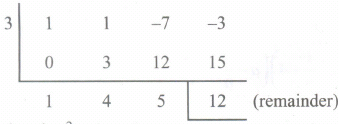
Quotient is: x2 +4x+5
Remainder is :12
(ii) (x3+2x2-x-4) ÷ (x+2)
p(x) = x3+2x2-x-4
Co-efficients are 1 2 -1 -4
To find zero of x+2, put x+2 = 0; x = -2
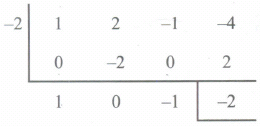
Quotient is: (x2-1)
Remainder is: -2
(iii) (3x3-2x2+7x-5) ÷ (x+3)
To find zero of the divisor (x + 3), put x + 3 = 0; x = - 3
Dividend in Standard form 3x3-2x2+7x-5
Co-efficients are 3 -2 7 -5
Synthetic Division
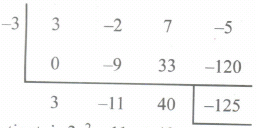
Quotient is: 3x2-11x+40
Remainder: is -125
(iv) (8x4-2x2+6x+5) ÷ (4x+1)
To find zero of the divisor 4x + 1, put 4x + 1 = 0; 4x = -1; x = \(-\frac{1}{4}\)
Dividend in Standard form 8x4-2x2+6x+5
Co-efficients are 8 0 -2 6 5
Synthetic Division
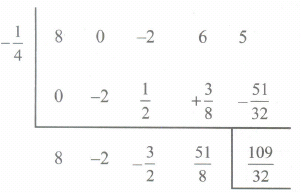
8x4-2x2+6x+5 = \((x+\frac{1}{4})(8x^3-2x^2-\frac{3x}{2}+\frac{51}{8})+\frac{109}{32}\)
=\(\frac{4x+1}{ ̶4̶}\times ̶4̶(2x^3-\frac{x^2}{2}-\frac{3x}{8}+\frac{51}{32})+\frac{109}{32}\)
= (4x+1)\((2x^3-\frac{x^2}{2}-\frac{3x}{8}+\frac{51}{32})+\frac{109}{32}\)
Quotient is: \(2x^2-{x^2\over2}-{3x\over8}+{51\over32}\)
Remainder is: \({109\over32}\)
9.
Compare with ax2 + bx + c
Here, a = 2, b = 15, c = −27
product ac = 2\(\times\)–27 = –54, sum b = 15
| Product of numbers ac = -54 |
Product of numbers b = 15 |
Product of numbers ac = -54 |
Product of numbers b = 15 |
| -1 \(\times\) 54 | 53 | 1 \(\times\) -54 | -53 |
| -2 \(\times\) 27 | 25 | 2 \(\times\) -27 | -25 |
| -3 \(\times\) 18 | 15 | 3\(\times\) -18 | -15 |
| -6 \(\times\) 9 | 3 | 6 \(\times\) -9 | -3 |
The required factors are –3 and 18
∴ we split the middle term as 18x and –3x
2x2 + 15x - 27 = 2x2 + 18x − 3x - 27
= 2x (x + 9) − 3(x + 9)
= (x + 9) (2x − 3)
Therefore, (x + 9) (2x − 3) and are the factors of 2x2 + 15x - 27
10.
(i) am+bm+cm
am+bm+cm
m(a+b+c) factored form
(ii) a3-a2b
a2. a - a2. b group in pairs
a2 \(\times\) (a-b) factored form
(iii) 5a −10b −4bc +2ac
5a-10b+2ac-4bc
5(a-2b)+2c(a-2b)
(a-2b)(5+2c)
(iv) x + y −1−xy
x-1+y-xy
(x-1)+y(1-x)
(x-1)-y(x-1) [(a-b)= -(b-a)
(x-1)(1-y)
11.
We know that (x +a)(x +b)(x +c) = x3 + (a +b +c)x2 + (ab +bc + ca) x +abc .....(1)
(i) (x+5)(x+6)(x+4)
= x3 + (5 + 6 + 4) x2+ (30 + 24 + 20) x + (5)(6)(4)
= x2 + 15x2+74x + 120
[Replace a by 5 b by 6 c by 4 in (1)]
(ii) (3x-1)(3x+2)(3x-4)
(3x)3+(-1+2-4)(3x)2+(-2-8+4)(3x)+(-1)(2)(-4)
= 27x3+(-3)9x2+(-6)(3x)+8
= 27x3- 27x2-18x + 8
[Repalce x by 3x, a by -1, b by 2, c by -4 in (1)]
12.
(i) \(\sqrt{3}\times\sqrt{5}\times\sqrt{2}=\sqrt{3\times5\times2}=\sqrt{30}\)
(ii) \(\sqrt{35}\div\sqrt{7}=\sqrt{\frac{35}{7}}=\sqrt{5}\)
(iii) \(\sqrt[3]{27}\times\sqrt[3]{8}\times\sqrt[3]{125}=\sqrt[3]{27\times8\times125}=\sqrt[3]{3^3\times2^3\times5^3}=3\times2\times5=30\)
(iv) \((7\sqrt{a}-5\sqrt{b})(7\sqrt{a}+5\sqrt{b})=(7\sqrt{a})^2-(5\sqrt{b})^2=49a-25b\) = 21\(\sqrt 3\)
(v) \([\sqrt{\frac{225}{729}}-\sqrt{\frac{25}{144}}]\div\sqrt{\frac{16}{81}}\)
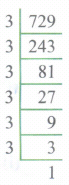
=\([\sqrt{\frac{15^2}{27^2}}-\sqrt{\frac{5^2}{12^2}}]\times\sqrt{\frac{9^2}{4^2}}\)
=\((\frac{15}{27}-\frac{5}{12})\times\frac{9}{4}=(\frac{5}{9}-\frac{5}{12})\times\frac{9}{4}\)
=\((\frac{20-15}{36})\times\frac{9}{4}=\frac{5}{ ̶3̶6̶}\times\frac{ ̶9̶}{4}=\frac{5}{16}\)
13.
A - Chess
B - Carrom
C - Table Tennis
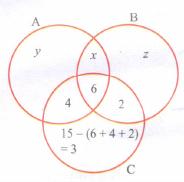
n(A) = 22
n(B) = 21
n(C) = 15
n(A⋂C) = 10
n(B∩C) = 8
n(A∩B∩C) = 6
y = 22 - (x + 6 + 4) = 22 - (x + 10)
= 22 - x - 10 = 12 - x
z = 21 - (x + 6 + 2) = 21 - (8 + x)
= 21 - 8 - x = 13 - x
y + z + 3 + x + 2 + 4 + 6 = 35

x = 40 - 35 = 5
(i) Number of students who pay only chess and Carrom but not table tennis = 5
(ii) Number of students who play only chess = 12 - x = 12 - 5 = 7
(iii) Number of students who play only carrom = 13 - x = 13 - 5 = 8
14.
| Sl.No | Polynomial | Difference | Degree of the resultant polynomial |
|---|---|---|---|
| 1 | p(x) = 5x3 - 3x +x2 + 4 q(x) = 7x 4x2+ 2 |
p(x) -q(x) = 5x3 + x2 - 3x + 4 0x3 -4x2 + 7x + 2 (-) (+) (-) (-) _________________ 5x3 + 5x2 - 10x + 2 |
3 |
| 2 | p(m) = 6m - 7 q(m) = 7m2 - 12 + 4m |
p(m) - q(m) = 0m2 + 6m - 7 7m2 + 43 - 12 (-) (-) (+) ________________ -7m2 + 2m + 5 |
2 |
| 3 | p(x) = 4x2 - 6x3 - 4x + 6 q(x) = 8x3 + 2x2 - 2 |
p(x) - q(x) = -6x3 + 4x2 - 4x + 6 8x3 + 2x2 + 0x - 2 (-) (-) (-) (+) _________________ -14x3 + 2x2 - 4x + 8 |
3 |
| 4 | r(y) = 7y4 + 5y2 + 4y s(y) = 2y - 3y2 |
r(y) - s(y) = 7y4 + 5y2 + 4y Oy4 - 3y2+ 2y (-) (+) (-) _______________ 7y4 +8y2 + 2y |
4 |
| 5 | p(m) = 12m3 -10m2 -7 q(m) = 7m3 + 5m2 - 3 |
p(m) -q(m) = 12m3 - 10m2 -7 (+) 7m3 + 5m2 - 3 _______________ 19m3 - 5m2 - 10 |
3 |
15.
Let f(x) = ax3 + 4x2 + 3x –4 and g(x) = x3 – 4x + a,When f(x) is divided by (x–3), the remainder is f(3).
Now f(3) =a(3)3 + 4(3)2 + 3(3) - 4
= 27a + 36 + 9 – 4
f(3) = 27a + 41 (1)
When g(x) is divided by (x–3), the remainder is g(3).
Now g(3) = 33 – 4(3) + a
= 27 – 12+ a
= 15 + a (2)
Since the remainders are same, (1) = (2)
Given that, f(3) = g(3)
That is 27a + 41 = 15 + a
27a – a = 15 – 41
26a = –26
\(a={-26\over 26}=-1\)
Substituting a = –1,in f(3), we get
f(3) =
= – 27 + 41
f(3) = 14
∴ The remainder is 14.
16.
Let the length of the reactangle be '' l ''
The Breadth of the reactangle = x + 3
Area of rectangle = Length \(\times\) breadth
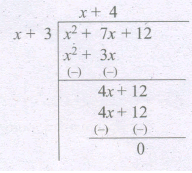
x2 + 7x + 12 = l (x + 3) or
l = \(\frac { { x }^{ 2 }+7x+12 }{ x+3 } \)
= \(\frac { \left( x+4 \right) \left( x+3 \right) }{ x+3 } =x+4\)
Length of the rectangle = x + 4
17.
(i) Angle between band c = 30° (vertically opposite angles)
(ii) Angle between d and e = 180° - 75° = 105° (sum of the adjacent angles of a parallelogram is 180°)
(iii) Angle between d and f = 75° (opposite angles of a parallelogram)
(iv) Angle between c and f = 180° - 75° = 105° (Adjacent angles of a parallelogram)
18.
Let DF be x.
FC = 20 - x (ABCD is a parallelogram AB = DC).
Given EF divides the parallelogram ABCD into two regions with equal area.
∴ Area of a trapezium ADFE = Area of a trapezium EBCF
(One pair of opposite sides are parallel)
\(\frac { 1 }{ 2 } \)h(AE + DF) = \(\frac { 1 }{ 2 } \)h(EB+FC)
\(\frac { 1 }{ 2 } \)h(3+x) = \(\frac { 1 }{ 2 } \)h(17+20-x)
3+x = 37-x
2x = 37 - 3 = 34
x = 34/2 = 17
Length of DF = 17 cm.
19.
(i) Both pairs of opposite angles are equal in size are square and rectangle.
(ii) Both pairs of opposite sides are equal in length are square and rhombus.
(iii) Each diagonal is an angle bisector of square and rectangle.
(iv) The diagonals of the following quadrilateral bisect each other: Parallelogram, rectangle, square, and rhombus.
(v) Each pair of consecutive angles is supplementary are square, rectangle, rhombus, parallelogram.
(vi) The diagonals are equal in case of square and rectangle.
(vii) Square, rectangle, rhombus, and parallelogram can be divided into two congruent triangles.
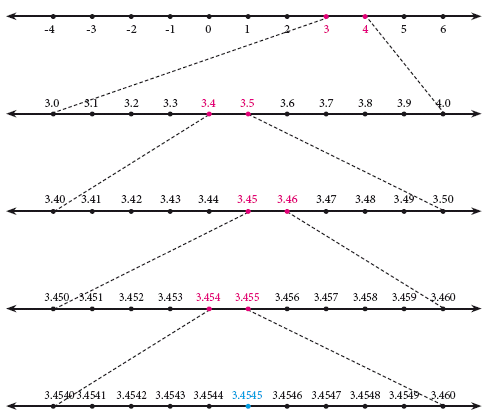
20.
\(3.4\bar { 5 } \) = 3.45454545...
= 3.4545 (correct to 4 decimal places)
The number lies between 3 and 4
21.
ABCD is a parallelogram AP and BP are bisectors of consecutive angles ∠A and ∠B.
Since the consecutive angles of a parallelogram are supplementary
∠A + ∠B = 1800
\(\frac{1}{2}\angle{A} +\frac{1}{2}\angle{B}=\frac{180^{0}}{2}\)
⇒ ∠PAB + ∠PBA = 90O
In ΔAPB,
∠PAB + ∠APB + ∠PBA = 180O (angle sum property of triangle)
∠APB = 180O – [∠PAB + ∠PBA]
= 180O – 90O = 90O
Hence Proved.
22.
\(\sqrt{2}=1.414\)
\(\sqrt{3}=1.732\)
The two irrational numbers between \(\sqrt{2}\) and \(\sqrt{3}\) are 1.514 and 1.632
23.
(i) To plot (2, 4), draw a vertical line at x = 2 and draw a horizontal line at y = 4. The intersection of these two lines is the position of (2, 4) in the Cartesian plane. Thus, the Point A (2, 4) is located in the I quadrant of Cartesian plane.
(ii) To plot (–3, 5), draw a vertical line at x = –3 and draw a horizontal line at y = 5. The intersection of these two lines is the position of (–3, 5) in the Cartesian plane. Thus, the Point B (–3, 5) is located in the II quadrant of Cartesian plane.
(iii) To plot (–4, –5), draw a vertical line at x = –4 and draw a horizontal line at y = -5. The intersection of these two lines is the position of (-4, 5) in the Cartesian plane. Thus, the Point C (–4, –5) is located in the III quadrant of Cartesian plane.
(iv) To plot (4, –2), draw a vertical line at x = 4 and draw a horizontal line at y = –2. The Intersection of these two lines is the position of (4,–2) in the Cartesian plane. Thus, the Point D (4,–2) is located in the IV quadrant of Cartesian plane
24.
Step 1:
Draw the ΔABC with the given measurements.
Step 2:
Construct the perpendicular bisector of any two sides (AC and BC) and let them meet at S which is the circumcentre.
Step 3:
S as centre and SA = SB = SC as radius, draw the Circumcircle to passes through A, B and C. Circumradius = 3.9 cm.
25.
Steps for construction:
Step 1: Draw the ΔABC with the given measures.
Step 2: Construct the perpendicular bisector of (AB and BC) any two sides and let them meet at S which is the circumcenter.
Step 3: With S as centre and SA = SB = SC as radius draw the circumcircle to passes through A, B and C.
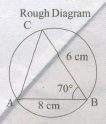
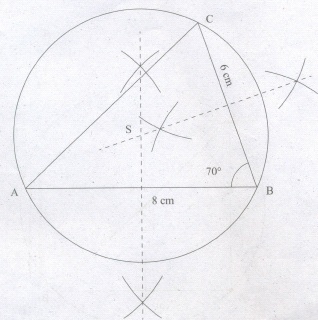
Circum radius = 4.3 cm.

9th Standard Syllabus & Materials
9th Standard
TN 9th Tamil உள்ளத்தின் சீர் - திருக்குறள் Important Questions And Answers Study Material - QB365 Set A
NEW9th Standard
TN 9th Tamil உள்ளத்தின் சீர் - மணிமேகலை Important Questions And Answers Study Material - QB365 Set A
NEW9th Standard
TN 9th Tamil உள்ளத்தின் சீர் - ஏறு தழுவுதல் Important Questions And Answers Study Material - QB365 Set A
NEW9th Standard
TN 9th Tamil உயிருக்கு வேர் - தண்ணீர் Important Questions And Answers Study Material - QB365 Set A



Tamilnadu Stateboard 9th Standard Subjects
Tamilnadu Stateboard Standards





