
 100% FREE ACCESS
9th Standard Syllabus & Materials
9th Standard
TN 9th Tamil உள்ளத்தின் சீர் -கற்கண்டு (இலக்கணம்) - தொடர் இலக்கணம், ஆகுபெயர் Important Questions And Answers Study Material - QB365 Set A
NEW9th Standard
TN 9th Tamil உள்ளத்தின் சீர் -விரிவானம் (துணைப்பாடம்) - தாய்மைக்கு வறட்சி இல்லை! Important Questions And Answers Study Material - QB365 Set A
NEW9th Standard
TN 9th Tamil உள்ளத்தின் சீர் -கவிதை பேழை (செய்யுள்) - மார்கழி பெருவிழா Important Questions And Answers Study Material - QB365 Set A
NEW9th Standard
TN 9th Tamil உயிருக்கு வேர்-இலக்கணம் - பகுபத உறுப்பிலக்கணம் Important Questions And Answers Study Material - QB365 Set A
NEW9th Standard
TN 9th Tamil அமுதென்று பேர் - இலக்கணம்-எழுத்து -அளபெடை Important Questions And Answers Study Material - QB365 Set A
NEW9th Standard
TN 9th Tamil அமுதென்று பேர்-துணைப்பாடம் - ஆறாம்திணை Important Questions And Answers Study Material - QB365 Set A

Published on: 12/06/2021
QB365 provides detailed and simple solution for every book back questions in class 9 Maths subject.It will helps to get more idea about question pattern in every book back questions with solution.
Download Tamil Nadu 9th Standard Maths question papers, model tests, one-mark questions, important questions, and public exam papers in PDF format. Free study materials and answer keys for TN State Board students.
Questions + Answers key
Take MCQ Maths Test1.
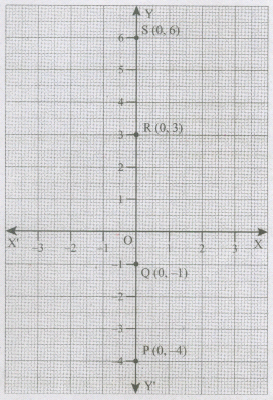
(i) Where do the following points lie?
P (0, -4), Q(0, -1), R(0, 3), S(0, 6).
(ii) Find the distance between the following points using coordinates given in question
(a) P and R
(b) Q and S
(iii) Draw the line diagram for the given above points.
2.
Verify that the following points taken in order form the vertices of a rhombus.
A (1, 1), B(2, 1),C (2, 2) and D(1, 2)
3.
Verify that the following points taken in order form the vertices of a rhombus.
A(3, –2), B (7, 6),C (–1, 2) and D (–5, –6)
4.
Show that (4, 3) is the centre of the circle passing through the points (9, 3), (7, –1), (–1, 3). Find the radius.
5.
Let A(2, 2), B(8, –4) be two given points in a plane. If a point P lies on the X- axis (in positive side), and divides AB in the ratio 1: 2, then find the coordinates of P.
6.
If the distance between the points (5,–2), (1, a), is 5 units, find the values of a.
7.
Plot the following points A(2, 2), B(–2, 2), C(–2, –1), D(2, –1) in the Cartesian plane. Discuss the type of the diagram by joining all the points taken in order
8.
Plot the points (–4, 3),(–3, 3),(–1, 3),(0, 3),(3, 3) in the Cartesian Plane. What can you say about the position of these points?
9.
Plot the following points (2, 0), (–5, 0), (3, 0), (–1, 0) in the Cartesian plane. Where do they lie?
10.
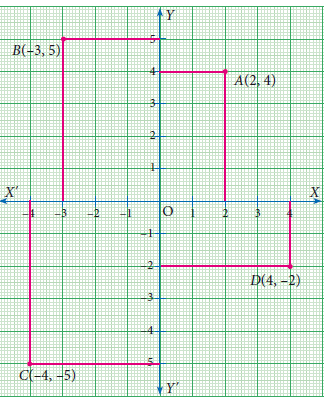
Plot the points A(2, 4), B(–3, 5), C(–4, –5), D(4, –2) in the Cartesian plane
1.
(i) The point P (0, -4), Q(0, -1), R(0, 3), S(0, 6) lies on the y-axis.
(ii) Distance = \(\sqrt{(x_2-x_1)^2+(y_2-y_1)^2}\)
(a) PR=\(\sqrt{(0-0)^2+(3+4)^2}\)
\(=\sqrt{0+7^2}=\sqrt{49}=7 \ uint\)
(b) QS =\(\sqrt{(0-0)^2+(6+1)^2}\)
\(=\sqrt{0+7^2}=\sqrt{49}=7 \ uint\)
2.
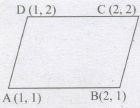
Distance = \(\sqrt { ({ x }_{ 2 }-{ x }_{ 1 })^{ 2 }+(y_{ 2 }-y_{ 1 })^{ 2 } } \)
AB = \(\sqrt { (2-1)^{ 2 }+(1-1)^{ 2 } } \)
= \(\sqrt { (1)^{ 2 }+(0)^{ 2 } } =\sqrt { 1 } =1\)
BC = \(\sqrt { (2-1)^{ 2 }+(2-1)^{ 2 } } \)
= \(\sqrt { (0)^{ 2 }+(1)^{ 2 } } =\sqrt { 1 } =1\)
CD =\(\sqrt { (1-2)^{ 2 }+(2-2)^{ 2 } } \)
= \(\sqrt { (-1)^{ 2 }+(0)^{ 2 } } =\sqrt { 1 } =1\)
AD =\(\sqrt { (1-1)^{ 2 }+(2-1)^{ 2 } } \)
= \(\sqrt { (0)^{ 2 }+(1)^{ 2 } } =\sqrt { 1 } =1\)
AB = BC = CD = AD =1
All the four sides are equal.
ABCD is a rhombus
3.
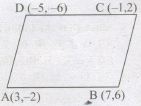
Distance =\(\sqrt { ({ x }_{ 2 }-{ x }_{ 1 })^{ 2 }+(y_{ 2 }-y_{ 1 })^{ 2 } } \)
AB = \(\sqrt { (7-3)^{ 2 }+(6+2)^{ 2 } } =\sqrt { (4)^{ 2 }+(8)^{ 2 } } \)
= \(\sqrt { 16+64 } =\sqrt { 80 } \)
BC = \(\sqrt { (-1-7)^{ 2 }+(2-6)^{ 2 } } =\sqrt { (-8)^{ 2 }+(-4)^{ 2 } } \)
= \(\sqrt { 64+16 } =\sqrt { 80 } \)
CD = \(\sqrt { (-5+1)^{ 2 }+(-6-2)^{ 2 } } =\sqrt { (-4)^{ 2 }+(-8)^{ 2 } } \)
= \(\sqrt { 16+64 } =\sqrt { 80 } \)
AD =\(\sqrt { (-5-3)^{ 2 }+(-6-2)^{ 2 } } =\sqrt { (-8)^{ 2 }+(-4)^{ 2 } } \)
= \(\sqrt { 64+16 } =\sqrt { 80 } \)
AB = BC = CD = AD = \(\sqrt { 80 } \)
All the four sides are equal
∴ ABCD is a rhombus
4.
Let P(4, 3), A(9, 3), B(7, –1) and C(–1, 3)
If P is the centre of the circle which passes through the points A, B, and C, then P is equidistant from A, B and C (i.e.) PA = PB = PC
By distance formula,
\(d=\sqrt{(x_2 -x_1)^2 +(y_2 -y_1)^2}\)
\(AP=PA =\sqrt{(4-9)^2+(3-3)^2}=\sqrt{(-5)^2+0}=\sqrt{25}=5\)
\(BP=PB =\sqrt{(4-7)^2+(3+1)^2}=\sqrt{(3)^2+(4)^2}=\sqrt{9+16}=\sqrt{25}=5\)
\(CP=CB =\sqrt{(4+1)^2+(3-3)^2}=\sqrt{(5)^2+0}=\sqrt{25}=5\)
PA = PB = PC, Radius = 5
Therefore P is the centre of the circle, passing through A, B and C
5.
Given points are A(2, 2) and B(8, –4) and let P = (x, 0) [P lies on x axis]
By the distance formula
\(d=\sqrt{(x_2 -x_1)^2 +(y_2 -y_1)^2}\)
\(AP=\sqrt{(x-2)^2+(0-2)^2}=\sqrt{X^2-4x+4+4}=\sqrt{x^2 -4x+8}\)
\(BAP=\sqrt{(x-8)^2+(0+4)^2}=\sqrt{X^2-16x+64+16}=\sqrt{x^2 -16x+80}\)
Given, AP : PB = 1 : 2
i.e \(\frac{AP}{BP}=\frac{1}{2} (\therefore BP=PB)\)
2AP = BP
squaring on both sides
4AP2 = BP2
\(4(x^2 -16x+8)=(x^2-16x+80)\)
\(4x^2 -16x+32=x^2-16x+80\)
3x2- 48 = 0
3x2= 48
x2 = 16
x =\(\pm\)4
As the point P lies on x-axis (positive side), its x- coordinate cannot be –4.
Hence the coordinates of P is(4, 0)
6.
The two given points are (5,-2), (1, a) and d = 5.
By distance formula
\(d=\sqrt { \left( { x }_{ 2 }-{ x }_{ 1 } \right) ^{ 2 }+\left( y_{ 2 }-y_{ 1 } \right) ^{ 2 } } \)
\(=\sqrt { \left( 1-5 \right) ^{ 2 }+\left( a+2 \right) ^{ 2 } } =5\)
\(=\sqrt { 16+\left( a+2 \right) ^{ 2 } } =5\)
16 + (a+2)2 = 25 (By squaring on both the sides)
(a+2)2 = 25–16
(a+2)2 = 9
(a+2) = \(\pm \) 3 (By taking the square root on both side)
a = –2 \(\pm \) 3
a = –2 + 3 (or) a = –2 –3
a = 1 or –5.
7.
| Point | A | B | C | D |
| Quadrant | I | II | III | IV |
Can you find the length, breadth and area of the rectangle?
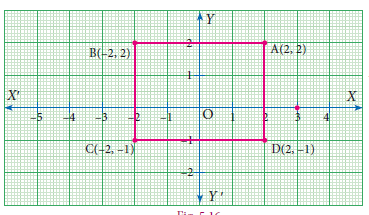
ABCD is a rectangle.
8.
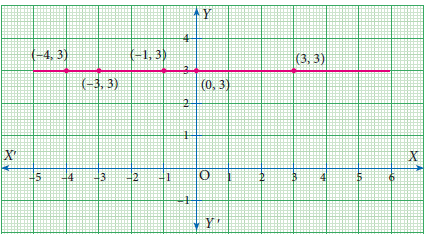
When you join these points, you see that they lie on a line which is parallel to x-axis.
9.
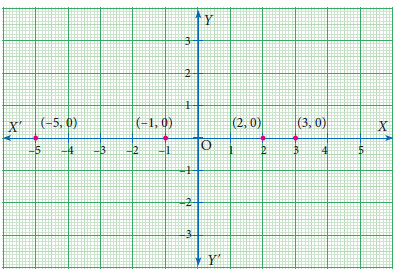
All points lie on x-axis.
10.
(i) To plot (2, 4), draw a vertical line at x = 2 and draw a horizontal line at y = 4. The intersection of these two lines is the position of (2, 4) in the Cartesian plane. Thus, the Point A (2, 4) is located in the I quadrant of Cartesian plane.
(ii) To plot (–3, 5), draw a vertical line at x = –3 and draw a horizontal line at y = 5. The intersection of these two lines is the position of (–3, 5) in the Cartesian plane. Thus, the Point B (–3, 5) is located in the II quadrant of Cartesian plane.
(iii) To plot (–4, –5), draw a vertical line at x = –4 and draw a horizontal line at y = -5. The intersection of these two lines is the position of (-4, 5) in the Cartesian plane. Thus, the Point C (–4, –5) is located in the III quadrant of Cartesian plane.
(iv) To plot (4, –2), draw a vertical line at x = 4 and draw a horizontal line at y = –2. The Intersection of these two lines is the position of (4,–2) in the Cartesian plane. Thus, the Point D (4,–2) is located in the IV quadrant of Cartesian plane

9th Standard Syllabus & Materials
9th Standard
TN 9th Tamil உள்ளத்தின் சீர் - திருக்குறள் Important Questions And Answers Study Material - QB365 Set A
NEW9th Standard
TN 9th Tamil உள்ளத்தின் சீர் - மணிமேகலை Important Questions And Answers Study Material - QB365 Set A
NEW9th Standard
TN 9th Tamil உள்ளத்தின் சீர் - ஏறு தழுவுதல் Important Questions And Answers Study Material - QB365 Set A
NEW9th Standard
TN 9th Tamil உயிருக்கு வேர் - தண்ணீர் Important Questions And Answers Study Material - QB365 Set A



Tamilnadu Stateboard 9th Standard Subjects
Tamilnadu Stateboard Standards





