
 100% FREE ACCESS
9th Standard Syllabus & Materials
9th Standard
TN 9th Tamil உள்ளத்தின் சீர் -கற்கண்டு (இலக்கணம்) - தொடர் இலக்கணம், ஆகுபெயர் Important Questions And Answers Study Material - QB365 Set A
NEW9th Standard
TN 9th Tamil உள்ளத்தின் சீர் -விரிவானம் (துணைப்பாடம்) - தாய்மைக்கு வறட்சி இல்லை! Important Questions And Answers Study Material - QB365 Set A
NEW9th Standard
TN 9th Tamil உள்ளத்தின் சீர் -கவிதை பேழை (செய்யுள்) - மார்கழி பெருவிழா Important Questions And Answers Study Material - QB365 Set A
NEW9th Standard
TN 9th Tamil உயிருக்கு வேர்-இலக்கணம் - பகுபத உறுப்பிலக்கணம் Important Questions And Answers Study Material - QB365 Set A
NEW9th Standard
TN 9th Tamil அமுதென்று பேர் - இலக்கணம்-எழுத்து -அளபெடை Important Questions And Answers Study Material - QB365 Set A
NEW9th Standard
TN 9th Tamil அமுதென்று பேர்-துணைப்பாடம் - ஆறாம்திணை Important Questions And Answers Study Material - QB365 Set A

Published on: 13/05/2022
QB365 provides detailed and simple solution for every book back questions in class 9 Maths subject.It will helps to get more idea about question pattern in every book back questions with solution.
latest Book back QuestionsDownload Tamil Nadu 9th Standard Maths question papers, model tests, one-mark questions, important questions, and public exam papers in PDF format. Free study materials and answer keys for TN State Board students.
Questions + Answers key
Take MCQ Maths Test1.
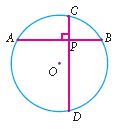
In the given figure, ㄥCAB = 25°, find ㄥBDC, ㄥDBA and ㄥCOB
2.
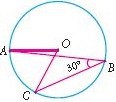
If O is the centre of the circle and ㄥABC = 30° then find ㄥAOC.
3.
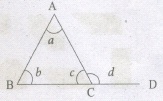
Take three different colour sheets; place on over the other and draw a triangle on the top sheet. Cut the sheets to get triangles of different colour which are identical. Mark the vertices and the angles as shown. Place the interior angles ㄥ1, ㄥ2 and ㄥ3 on a straight line, adjacent to each other, without leaving any gap. What can you say about the total measure of the three angles ㄥ1, ㄥ2 and ㄥ3?
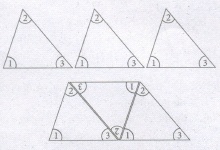
Can you use the same figure to explain the "Exterior angle property" of a triangle?
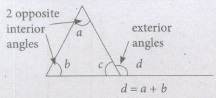
If a side of a triangle is stretched, the exterior angle so formed is equal to the sum of the two remote interior angles.
4.
Your friend draws a figure such as this on a piece of paper.
You don't know what it is, and stand at the board. She has to describe the figure to you so that you draw exactly the same figure on the board.
You both know rectangles, so it is easy to describe and draw a rectangle. The rest are not easy.
Can we describe any such shape we can ever think of, in a way that another person
hearing it can reproduce it exactly?
Yes, yes, yes! Now, isn't that exciting? The answer is so simple that it is breathtaking.
We describe different shapes by their properties.
5.
In a parallelogram ABCD, P and Q are the points on line DB such that PD = BQ show that APCQ is a parallelogram.
6.
Construct an equilateral triangle of side 6cm and locate its centroid and also its incentre. What do you observe from this?
7.
Construct the ΔPQR such that PQ = 5cm, PR= 6cm and ㄥQPR = 60° and locate its centroid.
8.
Draw the \(\triangle \)ABC , where AB = 6 cm, B = 110° and AC = 9 cm and construct the centroid.
9.
Draw and locate the centroid of the triangle ABC where right angle at A, AB = 4cm and AC = 3cm
10.
Construct the ΔLMN such that LM = 7.5cm, MN = 5cm and LN = 8cm. Locate its centroid.
1.
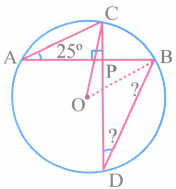
(i)\(\angle\)CAB = 250
\(\therefore\) \(\angle\)BDC = 250
(ii) \(\angle\)DBA = \(\angle\)DCA =180-(90+250)
= 1800 - 1150
= 65
(iii)\(\angle\)COB = 2\(\angle\)CAB = 2\(\times\)250 = 500
2.
Given ㄥABC = 300
ㄥAOC = 2ㄥABC
(The angle subtended by an arc at the centre is double the angle at any point on the circle)
= 2 x 300
= 600
3.
If a side is produced in a triangle, the angle formed is called an exterior angle.
Here BC, a side of ΔABC is produced, which lead to the formation of exterior angle ㄥACD.
Also BCD is a straight line ⇒ ㄥBCD is a straight angle.
ㄥBCD = 1800
ㄥc + ㄥd = 1800 ......(1)
Also in ΔABC ㄥa + ㄥb + ㄥc
From (1) and (2) we get,
ㄥa + ㄥb + ㄥc = ㄥc + ㄥd
∴ ㄥa + ㄥb =ㄥd
Hence, we conclude that the measure of exterior angle formed is equal to the sum of the measure of two opposite interior angles.
4.
To draw the different types of quadrilateral by giving the instructions using their properties.
Example:
(i) It is four sides closed diagram.
(ii) Opposite sides are parallel.
(iii) Four sides are equal in size.
(iv) Diagonals bisect each other at 90°.
(v) Diagonals are not equal.
The diagram represents as a rhombus
Like this for hexagon, parallelogram, Trapezium etc.
Any one must give the clues to draw the diagram.
At last they have to find what it represent.
5.
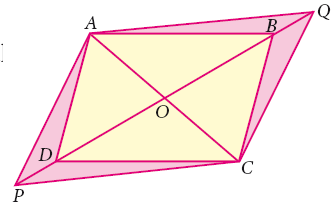
ABCD is a parallelogram.
OA = OC and
OB = OD (∴ Diagonals bisect each other)
now OB + BQ = OD + DP
OQ = OP and OA = OC
APCQ is a parallelogram.
6.
In an equilateral \(\triangle \) on side = 6 cm,
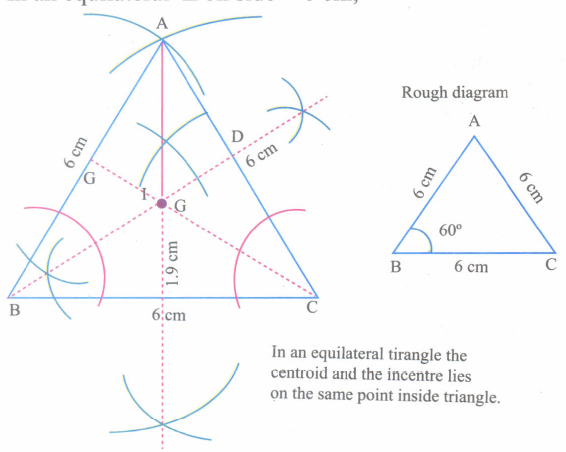
Construction :
Step 1: Draw ΔABC with equal sides of 6 cm length.
Step 2: Draw perpendicular bisectors of any two sides (BC and AC) to find the midpoints of BC and AC.
Step 3: Draw medians BD and CE. Let them meet at G.
Step 4: Draw angle bisectors of any two sides (ㄥB and ㄥC): Let them meet at I.
Step 5: G and I are concurrent point and G is the centroid, I is the incentre.
Step 6: In an equilateral triangle centroid and incentre lie on the same point.
7.
In PQR,
PQ = 5 cm,
PR = 6 cm
\(\angle \)QPR = 60°
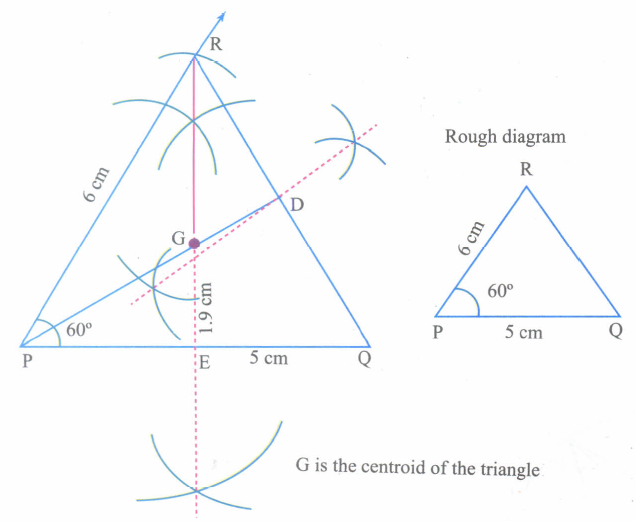
Construction :
Step 1: Draw △ PQR with the given measurement
Step 2: Draw perpendicular bisectors of any two sides (PQ and QR) to find the midpoints of PQ and QR.
Step 3: Draw medians PD and RE. Let them meet at G.
Step 4: G is the centroid of the given △PQR.
8.
In \(\triangle \)ABC, AB = 6 cm, ∠B= 110°, AC = 9 cm
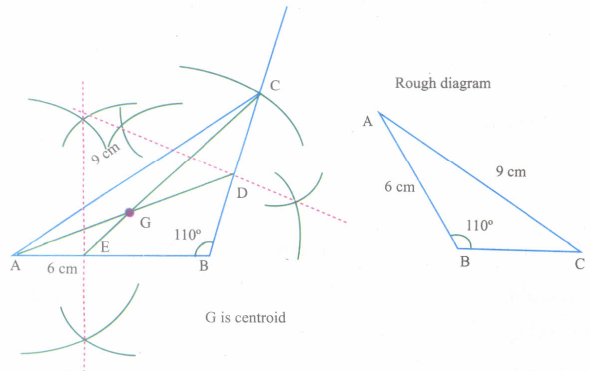
Construction :
Step 1: Draw \(\triangle \)ABC with AB = 6 cm, ∠B =110°, AC = 9 cm
Step 2: Draw perpendicular bisectors of any two sides (BC and AB) to find the midpoints of BC and AB.
Step 3: Construct medians AD and CE. Let them meet at G.
Step 4: G is the centroid of the given \(\triangle \)ABC.
9.
In \(\triangle \)ABC,
AB = 4 cm, AC = 3 cm, \(\angle\)A = 90°
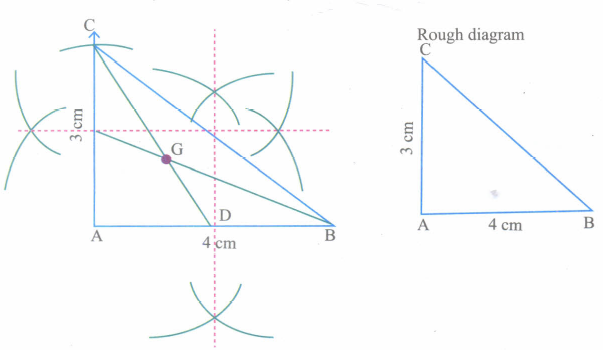
Construction :
Step 1: Draw \(\triangle \)ABC with AB = 4 cm, AC = 3 cm, \(\angle\)A = 90°
Step 2: Draw perpendicular bisectors of any two sides (AB and AC) to find the midpoints of AB and AC.
Step 3: Draw the medians CD and BE. Let them meet at G.
Step 4: G is the centroid of the given triangle.
10.
In \(\triangle \)LMN
LM = 7.5 cm,
MN = 5 cm,
LN = 8 cm
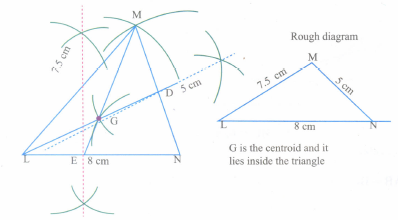
Construction :
Step 1: Draw \(\triangle \)LMN with LNM = 8 cm, MN = 5 cm, LM = 7.5 cm
Step 2: Construct perpendicular bisectors for any two sides (LN and MN) to find the midpoints of LM and MN.
Step 3: Draw the medians LD, ME. Let them meet at G.
Step 4: G is the centroid of the triangle LMN.

9th Standard Syllabus & Materials
9th Standard
TN 9th Tamil உள்ளத்தின் சீர் - திருக்குறள் Important Questions And Answers Study Material - QB365 Set A
NEW9th Standard
TN 9th Tamil உள்ளத்தின் சீர் - மணிமேகலை Important Questions And Answers Study Material - QB365 Set A
NEW9th Standard
TN 9th Tamil உள்ளத்தின் சீர் - ஏறு தழுவுதல் Important Questions And Answers Study Material - QB365 Set A
NEW9th Standard
TN 9th Tamil உயிருக்கு வேர் - தண்ணீர் Important Questions And Answers Study Material - QB365 Set A



Tamilnadu Stateboard 9th Standard Subjects
Tamilnadu Stateboard Standards





