
 100% FREE ACCESS
9th Standard Syllabus & Materials
9th Standard
TN 9th Tamil உள்ளத்தின் சீர் -கற்கண்டு (இலக்கணம்) - தொடர் இலக்கணம், ஆகுபெயர் Important Questions And Answers Study Material - QB365 Set A
NEW9th Standard
TN 9th Tamil உள்ளத்தின் சீர் -விரிவானம் (துணைப்பாடம்) - தாய்மைக்கு வறட்சி இல்லை! Important Questions And Answers Study Material - QB365 Set A
NEW9th Standard
TN 9th Tamil உள்ளத்தின் சீர் -கவிதை பேழை (செய்யுள்) - மார்கழி பெருவிழா Important Questions And Answers Study Material - QB365 Set A
NEW9th Standard
TN 9th Tamil உயிருக்கு வேர்-இலக்கணம் - பகுபத உறுப்பிலக்கணம் Important Questions And Answers Study Material - QB365 Set A
NEW9th Standard
TN 9th Tamil அமுதென்று பேர் - இலக்கணம்-எழுத்து -அளபெடை Important Questions And Answers Study Material - QB365 Set A
NEW9th Standard
TN 9th Tamil அமுதென்று பேர்-துணைப்பாடம் - ஆறாம்திணை Important Questions And Answers Study Material - QB365 Set A

Published on: 12/06/2021
QB365 provides detailed and simple solution for every book back questions in class 9 Maths subject.It will helps to get more idea about question pattern in every book back questions with solution.
Download Tamil Nadu 9th Standard Maths question papers, model tests, one-mark questions, important questions, and public exam papers in PDF format. Free study materials and answer keys for TN State Board students.
Questions + Answers key
Take MCQ Maths Test1.
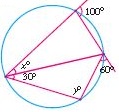
In the figure given, find the value of x° and y°.
2.
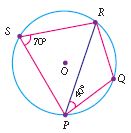
If PQRS is a cyclic quadrilateral in which ㄥPSR=70° and ㄥQPR = 40°, then find ㄥPRQ.
3.
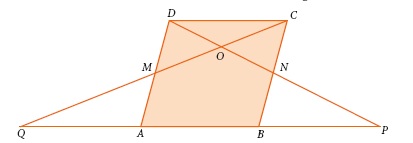
In parallelogram ABCD of the accompanying diagram, line DP is drawn bisecting BC at N and meeting AB (extended) at P. From vertex C, line CQ is drawn bisecting side AD at M and meeting AB (extended) at Q. Lines DP and CQ meet at O. Show that the area of triangle QPO is \(\frac { 9 }{ 8 } \) of the area of the parallelogram ABCD.
4.
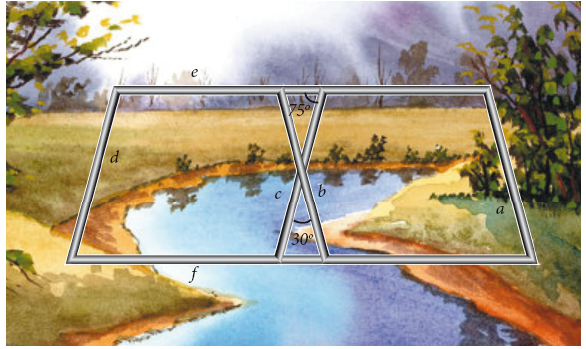
Iron rods a, b, c, d, e, and f are making a design in a bridge as shown in the figure. If a || b , c || d , e || f , find the marked angles between
(i) b and c
(ii) d and e
(iii) d and f
(iv) c and f
5.
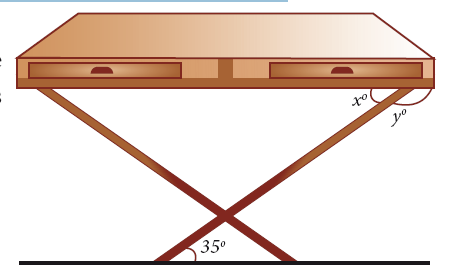
The legs of a stool make angle 35 ° with the floor as shown in the figure. Find the angles x and y.
6.
In a quadrilateral ABCD, ∠A = 72° and ∠C is the supplementary of ∠A. The other two angles are 2x–10 and x + 4. Find the value of x and the measure of all the angles.
7.
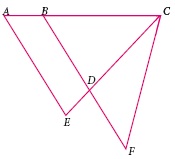
In the given Fig. if AB = 2, BC = 6, AE = 6, BF = 8, CE = 7, and CF = 7, compute the ratio of the area of quadrilateral ABDE to the area of ΔCDF(Use congruent property of triangles).
8.
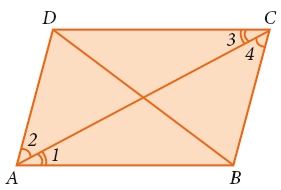
ABCD is a parallelogram Fig such that ∠BAD = 120o and AC bisects ∠BAD show that ABCD is a rhombus.
9.
Construct the incentre of ΔABC with AB = 6 cm, ㄥB = 65° and AC = 7 cm. Also draw the incircle and measure its radius.
10.
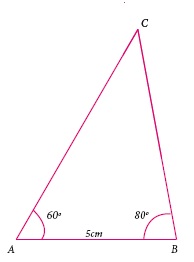
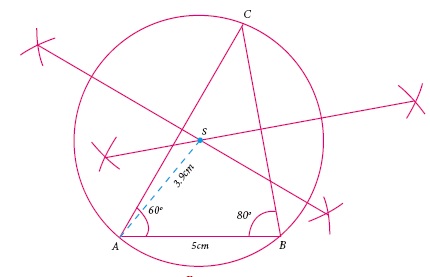
Construct the circumcentre of the ΔABC with AB = 5 cm, ㄥA = 600 and ㄥB = 800. Also draw the circumcircle and find the circumradius of the ΔABC.
1.
By the exterior angle property of a cyclic quadrilateral, we get, y°=100° and
x° + 30°= 600 and so x° = 30°
2.
PQRS is a cyclic quadrilateral
Given ㄥPSR = 70°
ㄥPSR+ㄥPQR = 180° (state reason________)
70° +ㄥPQR = 180°
ㄥPQR = 180°− 70°
ㄥPQR = 110°
In ΔPQR we have, ㄥPQR+ㄥPRQ+ㄥQPR = 180° (state reason_________)
110° +ㄥPRQ + 40° = 180°
ㄥPRQ = 180°− 150°
ㄥPRQ = 30°
3.
Draw OX perpendicular to QP
In ΔADP
MN = \(\frac { 1 }{ 2 } \)AP
In ΔBCQ
MN =\(\frac { 1 }{ 2 } \) QB
So, AP = BQ (or) AB+BP = AB+QA ∴ PB = QA
∴ QA = AB = BP (or) QP = QA + AB + BP = 3 AB
Area of ΔOQP =\(\frac { 1 }{ 2 } \)\(\times\) QP \(\times\) OX
\(=\frac{1}{2} \times 3 \mathrm{AB} \times \mathrm{OX} \)
\( =\frac{3}{2} \times \mathrm{AB} \times \mathrm{OX} \)
\(=\frac{3}{2} \mathrm{AB}(\mathrm{OY}+\mathrm{YX}) \)
\( =\frac{3}{2} \times \mathrm{AB} \times \mathrm{OY}+\frac{3}{2} \times \mathrm{AB} \times \mathrm{YX} \quad(\mathrm{AB}=\mathrm{MN}) \)
\(=\frac{3}{2} \times \mathrm{MN} \times \mathrm{OY}+\frac{3}{2} \times \mathrm{AB} \times \mathrm{YX} \)
\(=3 \text { Area of } \triangle \mathrm{OMN}+\frac{3}{2} \text { Area of ABNM } \)
= 3\(\left[ \frac { 1 }{ 4 } Area\quad MNCD \right] +\frac { 3 }{ 2 } \left[ \frac { 1 }{ 2 } Area\quad ABCD \right] \)
= \(\frac { 3 }{ 4 } \left[ \frac { 1 }{ 2 } Area\quad ABCD \right] +\frac { 3 }{ 4 } \left[ \frac { 1 }{ 2 } Area\quad ABCD \right] \)
= \(\frac { 3 }{ 8 } \) Area ABCD + \(\frac { 3 }{ 4 } \) Area ABCD
= Area ABCD \(\left[ \frac { 3 }{ 8 } +\frac { 3 }{ 4 } \right] \)
= Area ABCD \(\left[ \frac { 3+6 }{ 8 } \right] \)
= Hence area of \(\Delta\) QPO is \(\frac{9}{8}\) of the area of the parallelogram ABCD.
4.
(i) Angle between band c = 30° (vertically opposite angles)
(ii) Angle between d and e = 180° - 75° = 105° (sum of the adjacent angles of a parallelogram is 180°)
(iii) Angle between d and f = 75° (opposite angles of a parallelogram)
(iv) Angle between c and f = 180° - 75° = 105° (Adjacent angles of a parallelogram)
5.
\(\angle x=35^0\)(alternate angles are equal)
\(\angle y=180^0-x^0\)(angle of a straight line)
= 180° - 35°
= 145°
The value of \(\angle x=35^0 \)and \(\angle y=145^0\).
6.
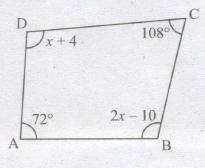
\(\angle A=72^0\)
\(\angle C=180^0-72^0\) (\(\angle A\) and \(\angle C\) are supplementary)
= 1080
\(\angle A+\angle B+\angle C+\angle D=360^0\) (Total angles of a quadrilateral)
72o+ 2x -10 +108o+ x + 4 = 360o
3x + 174o = 360o
3x = 360o-174o = 1860
\(x=\frac{186^0}{3}\)
x = 62o
The value of x = 62°
\(\angle B=2x-10\)
= 2(62o) -10
= 124o-10o = 114o
\(\angle D=x+4\)
= 62o+ 4 = 66o
The other angles are 72°, 114°, 108° and 66°.
7.
Given: AB = 2, BC = 6, AE = 6, BF = 8, CE = 7 and CF = 7
Consider ΔAEC and ΔBCF.
In ΔAEC, AE = 6, EC = 7 and AC = 8 (2 + 6 = 8)
In ΔBCF, BC = 6, CF = 1 and BF = 8
∴ ΔAEC ≅ BCF
∴ Area of ΔAEC = Area of ΔBCF (Two triangles are similar areas are equal)
Subtract area of ΔBDC on both sides we get,
Area of ΔAEC - Area of ΔBDC = Area of ΔBCF - Area of ΔBDC
Area of quadrilateral ABDE = Area of ΔCDF.
The answer is 1 : 1.
8.
Given ∠BAD = 120° and AC bisects ∠BAD
\(\angle{BAC}=\frac{1}{2}\times 120^{0}=60^{0}\)
∠1 = ∠2 = 60°
AD || BC and AC is the traversal
∠2 = ∠4 = 60°
Δ ABC is isosceles triangle [∴ ∠1 = ∠4 = 60 °]
⇒ AB = BC
Parallelogram ABCD is a rhombus.
9.
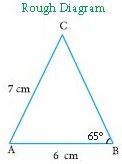
Step 1 : Draw the ΔABC with AB = 6cm, ㄥB = 65° and AC = 7cm
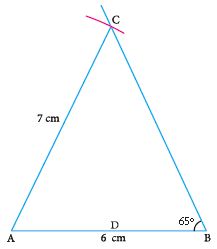
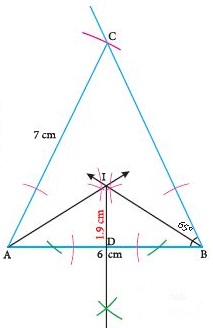
Step 2 : Construct the angle bisectors of any two angles (A and B) and let them meet at I.
Then I is the incentre of ΔABC. Draw perpendicular from I to any one of the side (AB) to meet AB at D
Step 3: With I as centre and ID as radius draw the circle. This circle touches all the sides of the triangle internally
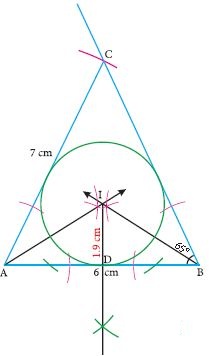
Step 4: Measure inradius
In radius = 1.9 cm
10.
Step 1:
Draw the ΔABC with the given measurements.
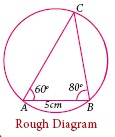
Step 2:
Construct the perpendicular bisector of any two sides (AC and BC) and let them meet at S which is the circumcentre.
Step 3:
S as centre and SA = SB = SC as radius, draw the Circumcircle to passes through A, B and C. Circumradius = 3.9 cm.

9th Standard Syllabus & Materials
9th Standard
TN 9th Tamil உள்ளத்தின் சீர் - திருக்குறள் Important Questions And Answers Study Material - QB365 Set A
NEW9th Standard
TN 9th Tamil உள்ளத்தின் சீர் - மணிமேகலை Important Questions And Answers Study Material - QB365 Set A
NEW9th Standard
TN 9th Tamil உள்ளத்தின் சீர் - ஏறு தழுவுதல் Important Questions And Answers Study Material - QB365 Set A
NEW9th Standard
TN 9th Tamil உயிருக்கு வேர் - தண்ணீர் Important Questions And Answers Study Material - QB365 Set A



Tamilnadu Stateboard 9th Standard Subjects
Tamilnadu Stateboard Standards





