
 100% FREE ACCESS
9th Standard Syllabus & Materials
9th Standard
TN 9th Tamil உள்ளத்தின் சீர் -கற்கண்டு (இலக்கணம்) - தொடர் இலக்கணம், ஆகுபெயர் Important Questions And Answers Study Material - QB365 Set A
NEW9th Standard
TN 9th Tamil உள்ளத்தின் சீர் -விரிவானம் (துணைப்பாடம்) - தாய்மைக்கு வறட்சி இல்லை! Important Questions And Answers Study Material - QB365 Set A
NEW9th Standard
TN 9th Tamil உள்ளத்தின் சீர் -கவிதை பேழை (செய்யுள்) - மார்கழி பெருவிழா Important Questions And Answers Study Material - QB365 Set A
NEW9th Standard
TN 9th Tamil உயிருக்கு வேர்-இலக்கணம் - பகுபத உறுப்பிலக்கணம் Important Questions And Answers Study Material - QB365 Set A
NEW9th Standard
TN 9th Tamil அமுதென்று பேர் - இலக்கணம்-எழுத்து -அளபெடை Important Questions And Answers Study Material - QB365 Set A
NEW9th Standard
TN 9th Tamil அமுதென்று பேர்-துணைப்பாடம் - ஆறாம்திணை Important Questions And Answers Study Material - QB365 Set A

Published on: 13/05/2022
QB365 provides detailed and simple solution for every book back questions in class 9 Maths subject.It will helps to get more idea about question pattern in every book back questions with solution.
latest Book back QuestionsDownload Tamil Nadu 9th Standard Maths question papers, model tests, one-mark questions, important questions, and public exam papers in PDF format. Free study materials and answer keys for TN State Board students.
Questions + Answers key
Take MCQ Maths Test1.
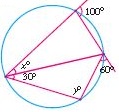
In the figure given, find the value of x° and y°.
2.
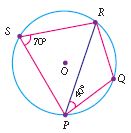
If PQRS is a cyclic quadrilateral in which ㄥPSR=70° and ㄥQPR = 40°, then find ㄥPRQ.
3.
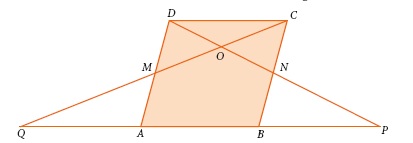
In parallelogram ABCD of the accompanying diagram, line DP is drawn bisecting BC at N and meeting AB (extended) at P. From vertex C, line CQ is drawn bisecting side AD at M and meeting AB (extended) at Q. Lines DP and CQ meet at O. Show that the area of triangle QPO is \(\frac { 9 }{ 8 } \) of the area of the parallelogram ABCD.
4.
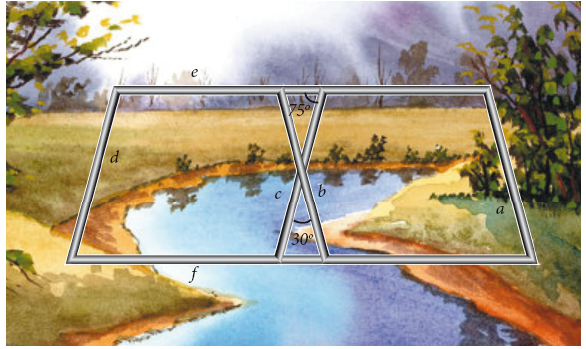
Iron rods a, b, c, d, e, and f are making a design in a bridge as shown in the figure. If a || b , c || d , e || f , find the marked angles between
(i) b and c
(ii) d and e
(iii) d and f
(iv) c and f
5.
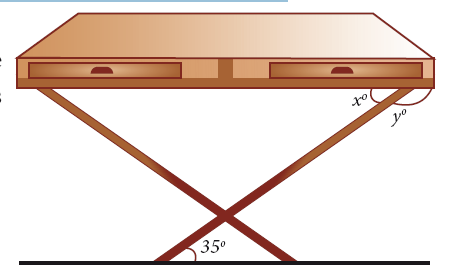
The legs of a stool make angle 35 ° with the floor as shown in the figure. Find the angles x and y.
6.
In a quadrilateral ABCD, ∠A = 72° and ∠C is the supplementary of ∠A. The other two angles are 2x–10 and x + 4. Find the value of x and the measure of all the angles.
7.
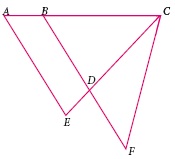
In the given Fig. if AB = 2, BC = 6, AE = 6, BF = 8, CE = 7, and CF = 7, compute the ratio of the area of quadrilateral ABDE to the area of ΔCDF(Use congruent property of triangles).
8.
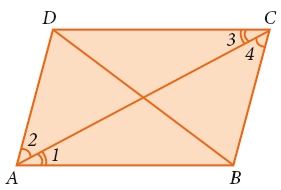
ABCD is a parallelogram Fig such that ∠BAD = 120o and AC bisects ∠BAD show that ABCD is a rhombus.
9.
Construct the incentre of ΔABC with AB = 6 cm, ㄥB = 65° and AC = 7 cm. Also draw the incircle and measure its radius.
10.
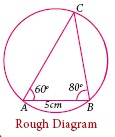
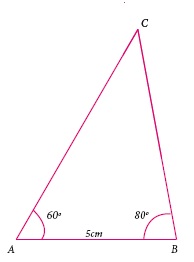
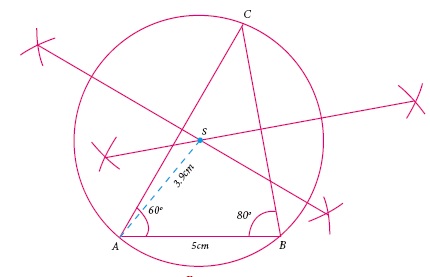
Construct the circumcentre of the ΔABC with AB = 5 cm, ㄥA = 600 and ㄥB = 800. Also draw the circumcircle and find the circumradius of the ΔABC.
1.
By the exterior angle property of a cyclic quadrilateral, we get, y°=100° and
x° + 30°= 600 and so x° = 30°
2.
PQRS is a cyclic quadrilateral
Given ㄥPSR = 70°
ㄥPSR+ㄥPQR = 180° (state reason________)
70° +ㄥPQR = 180°
ㄥPQR = 180°− 70°
ㄥPQR = 110°
In ΔPQR we have, ㄥPQR+ㄥPRQ+ㄥQPR = 180° (state reason_________)
110° +ㄥPRQ + 40° = 180°
ㄥPRQ = 180°− 150°
ㄥPRQ = 30°
3.
Draw OX perpendicular to QP
In ΔADP
MN = \(\frac { 1 }{ 2 } \)AP
In ΔBCQ
MN =\(\frac { 1 }{ 2 } \) QB
So, AP = BQ (or) AB+BP = AB+QA ∴ PB = QA
∴ QA = AB = BP (or) QP = QA + AB + BP = 3 AB
Area of ΔOQP =\(\frac { 1 }{ 2 } \)\(\times\) QP \(\times\) OX
\(=\frac{1}{2} \times 3 \mathrm{AB} \times \mathrm{OX} \)
\( =\frac{3}{2} \times \mathrm{AB} \times \mathrm{OX} \)
\(=\frac{3}{2} \mathrm{AB}(\mathrm{OY}+\mathrm{YX}) \)
\( =\frac{3}{2} \times \mathrm{AB} \times \mathrm{OY}+\frac{3}{2} \times \mathrm{AB} \times \mathrm{YX} \quad(\mathrm{AB}=\mathrm{MN}) \)
\(=\frac{3}{2} \times \mathrm{MN} \times \mathrm{OY}+\frac{3}{2} \times \mathrm{AB} \times \mathrm{YX} \)
\(=3 \text { Area of } \triangle \mathrm{OMN}+\frac{3}{2} \text { Area of ABNM } \)
= 3\(\left[ \frac { 1 }{ 4 } Area\quad MNCD \right] +\frac { 3 }{ 2 } \left[ \frac { 1 }{ 2 } Area\quad ABCD \right] \)
= \(\frac { 3 }{ 4 } \left[ \frac { 1 }{ 2 } Area\quad ABCD \right] +\frac { 3 }{ 4 } \left[ \frac { 1 }{ 2 } Area\quad ABCD \right] \)
= \(\frac { 3 }{ 8 } \) Area ABCD + \(\frac { 3 }{ 4 } \) Area ABCD
= Area ABCD \(\left[ \frac { 3 }{ 8 } +\frac { 3 }{ 4 } \right] \)
= Area ABCD \(\left[ \frac { 3+6 }{ 8 } \right] \)
= Hence area of \(\Delta\) QPO is \(\frac{9}{8}\) of the area of the parallelogram ABCD.
4.
(i) Angle between band c = 30° (vertically opposite angles)
(ii) Angle between d and e = 180° - 75° = 105° (sum of the adjacent angles of a parallelogram is 180°)
(iii) Angle between d and f = 75° (opposite angles of a parallelogram)
(iv) Angle between c and f = 180° - 75° = 105° (Adjacent angles of a parallelogram)
5.
\(\angle x=35^0\)(alternate angles are equal)
\(\angle y=180^0-x^0\)(angle of a straight line)
= 180° - 35°
= 145°
The value of \(\angle x=35^0 \)and \(\angle y=145^0\).
6.
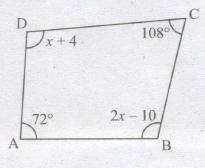
\(\angle A=72^0\)
\(\angle C=180^0-72^0\) (\(\angle A\) and \(\angle C\) are supplementary)
= 1080
\(\angle A+\angle B+\angle C+\angle D=360^0\) (Total angles of a quadrilateral)
72o+ 2x -10 +108o+ x + 4 = 360o
3x + 174o = 360o
3x = 360o-174o = 1860
\(x=\frac{186^0}{3}\)
x = 62o
The value of x = 62°
\(\angle B=2x-10\)
= 2(62o) -10
= 124o-10o = 114o
\(\angle D=x+4\)
= 62o+ 4 = 66o
The other angles are 72°, 114°, 108° and 66°.
7.
Given: AB = 2, BC = 6, AE = 6, BF = 8, CE = 7 and CF = 7
Consider ΔAEC and ΔBCF.
In ΔAEC, AE = 6, EC = 7 and AC = 8 (2 + 6 = 8)
In ΔBCF, BC = 6, CF = 1 and BF = 8
∴ ΔAEC ≅ BCF
∴ Area of ΔAEC = Area of ΔBCF (Two triangles are similar areas are equal)
Subtract area of ΔBDC on both sides we get,
Area of ΔAEC - Area of ΔBDC = Area of ΔBCF - Area of ΔBDC
Area of quadrilateral ABDE = Area of ΔCDF.
The answer is 1 : 1.
8.
Given ∠BAD = 120° and AC bisects ∠BAD
\(\angle{BAC}=\frac{1}{2}\times 120^{0}=60^{0}\)
∠1 = ∠2 = 60°
AD || BC and AC is the traversal
∠2 = ∠4 = 60°
Δ ABC is isosceles triangle [∴ ∠1 = ∠4 = 60 °]
⇒ AB = BC
Parallelogram ABCD is a rhombus.
9.
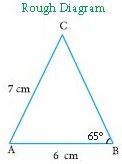
Step 1 : Draw the ΔABC with AB = 6cm, ㄥB = 65° and AC = 7cm
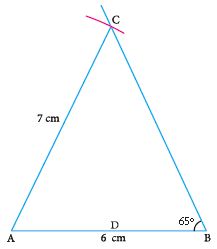
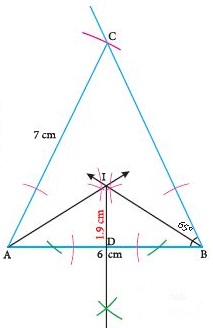
Step 2 : Construct the angle bisectors of any two angles (A and B) and let them meet at I.
Then I is the incentre of ΔABC. Draw perpendicular from I to any one of the side (AB) to meet AB at D
Step 3: With I as centre and ID as radius draw the circle. This circle touches all the sides of the triangle internally
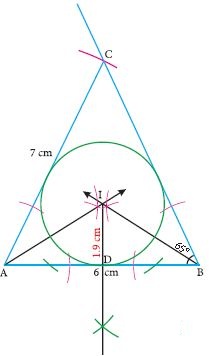
Step 4: Measure inradius
In radius = 1.9 cm
10.
Step 1:
Draw the ΔABC with the given measurements.
Step 2:
Construct the perpendicular bisector of any two sides (AC and BC) and let them meet at S which is the circumcentre.
Step 3:
S as centre and SA = SB = SC as radius, draw the Circumcircle to passes through A, B and C. Circumradius = 3.9 cm.

9th Standard Syllabus & Materials
9th Standard
TN 9th Tamil உள்ளத்தின் சீர் - திருக்குறள் Important Questions And Answers Study Material - QB365 Set A
NEW9th Standard
TN 9th Tamil உள்ளத்தின் சீர் - மணிமேகலை Important Questions And Answers Study Material - QB365 Set A
NEW9th Standard
TN 9th Tamil உள்ளத்தின் சீர் - ஏறு தழுவுதல் Important Questions And Answers Study Material - QB365 Set A
NEW9th Standard
TN 9th Tamil உயிருக்கு வேர் - தண்ணீர் Important Questions And Answers Study Material - QB365 Set A



Tamilnadu Stateboard 9th Standard Subjects
Tamilnadu Stateboard Standards





