
 100% FREE ACCESS
9th Standard Syllabus & Materials
9th Standard
TN 9th Tamil உள்ளத்தின் சீர் -கற்கண்டு (இலக்கணம்) - தொடர் இலக்கணம், ஆகுபெயர் Important Questions And Answers Study Material - QB365 Set A
NEW9th Standard
TN 9th Tamil உள்ளத்தின் சீர் -விரிவானம் (துணைப்பாடம்) - தாய்மைக்கு வறட்சி இல்லை! Important Questions And Answers Study Material - QB365 Set A
NEW9th Standard
TN 9th Tamil உள்ளத்தின் சீர் -கவிதை பேழை (செய்யுள்) - மார்கழி பெருவிழா Important Questions And Answers Study Material - QB365 Set A
NEW9th Standard
TN 9th Tamil உயிருக்கு வேர்-இலக்கணம் - பகுபத உறுப்பிலக்கணம் Important Questions And Answers Study Material - QB365 Set A
NEW9th Standard
TN 9th Tamil அமுதென்று பேர் - இலக்கணம்-எழுத்து -அளபெடை Important Questions And Answers Study Material - QB365 Set A
NEW9th Standard
TN 9th Tamil அமுதென்று பேர்-துணைப்பாடம் - ஆறாம்திணை Important Questions And Answers Study Material - QB365 Set A

Published on: 13/05/2022
QB365 provides detailed and simple solution for every book back questions in class 9 Maths subject.It will helps to get more idea about question pattern in every book back questions with solution.
latest Book back QuestionsDownload Tamil Nadu 9th Standard Maths question papers, model tests, one-mark questions, important questions, and public exam papers in PDF format. Free study materials and answer keys for TN State Board students.
Questions + Answers key
Take MCQ Maths Test1.
Classify the numbers as rational or irrational
(i) \(\sqrt { 10 } \)
(ii) \(\sqrt { 49 } \)
(iii) 0.025
(iv) \(0.7\overline { 6 } \)
(v) 2.505500555...
(vi) \(\frac { \sqrt { 2 } }{ 2 } \)
2.
Without actual division, find which of the following rational numbers have terminating decimal expansion
(i) \(\frac { 7 }{ 128 } \)
(ii) \(\frac { 21 }{ 15 } \)
(iii) \(4\frac { 9 }{ 35 } \)
(iv) \(\frac { 219 }{ 2200 } \)
3.
Represent the following numbers on the number line.
(i) 5.348
(ii) \(6.\bar { 4 } \) up to 3 decimal places
(iii) \(4.\overline { 73 } \) up to 4 decimal places
4.
Express the following rational numbers into decimal and state the kind of decimal expansion
(i) \(\frac { 2 }{ 7 } \)
(ii) \(-5\frac { 3 }{ 11 } \)
(iii) \(\frac { 22 }{ 3 } \)
(iv) \(\frac { 327 }{ 200 } \)
5.
Can you get a pure surd when you find
(i) the sum of two surds
(ii) the difference of two surds
(iii) the product of two surds
(iv) the quotient of two surds
Justify each answer with an example.
6.
Arrange surds in descending order:
(i) \(\sqrt [ 3 ]{ 5 } ,\sqrt [ 9 ]{ 4 } ,\sqrt [ 6 ]{ 3 } \)
(ii) \(\sqrt [ 2 ]{ \sqrt [ 3 ]{ 5 } } ,\sqrt [ 2 ]{ \sqrt [ 3 ]{ 5 } } ,\sqrt [ 3 ]{ \sqrt [ 4 ]{ 7 } } ,\sqrt { \sqrt { 3 } } \)
7.
Simplify the following using multiplication and division properties of surds:
(i) \(\sqrt { 3 } \times \sqrt { 5 } \times \sqrt { 2 } \)
(ii) \(\sqrt { 35 } \div \sqrt { 7 } \)
(iii) \(\sqrt [ 3 ]{ 27 } \times \sqrt [ 3 ]{ 8 } \times \sqrt [ 3 ]{ 125 } \)
(iv) \((7\sqrt { a } -5\sqrt { b } )(7\sqrt { a } +5\sqrt { b } )\)
(v) \(\left[ \sqrt { \frac { 225 }{ 729 } } -\sqrt { \frac { 25 }{ 144 } } \right] \div \sqrt { \frac { 16 }{ 81 } } \)
8.
Find the 5th root of 100000
9.
Find the 5th root of 243.
10.
Find the 5th root of 32
1.
(i) \(\sqrt { 10 } \) is an irrational number ( since 10 is not a perfect square number).
(ii) \(\sqrt { 49 } =7=\frac { 7 }{ 1 } \) a rational number(since 49 is a perfect square number).
(iii) 0.025 is a rational number (since it is a terminating decimal).
(iv) \(0.7\overline { 6 } \) = 0.7666…. is a rational number ( since it is a non – terminating and recurring decimal expansion).
(v) 2.505500555…. is an irrational number (since it is a non – terminating and non–recurring decimal).
(vi) \(\frac { \sqrt { 2 } }{ 2 } =\frac { \sqrt { 2 } }{ \sqrt { 2 } \times \sqrt { 2 } } =\frac { 1 }{ \sqrt { 2 } } \) is an irrational number ( since 2 is not a perfect square number).
2.
(i) \({7\over 128}={7\over 2^7}\)
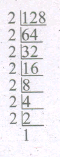
\(\therefore \frac{7}{128}\) has terminating decimal expansion.
(ii) \({21\over 15}={7\over 5}={7\over 5^1}\)
\(\therefore {21\over 15}\) has terminating decimal expansion.
(iii) \(4{9\over 35}={149\over 35}\)
\(={149\over 5\times 7}\) (It is not in the form of \(\frac{P}{2^m\times 5^n}\))
\(\therefore 4\frac{9}{35}\) has a non-terminating recurring decimal expansion.
(iv) \({219\over 2200}={219\over 2^3\times 5^2\times 11}\) (It is not in the form of \({P\over 2^m\times 5^n}\))
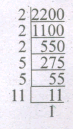
\(\therefore {219\over 2200}\) has a non-terminating recurring decimal expansion.
3.
(i) 5.348 lies between 5 and 6.
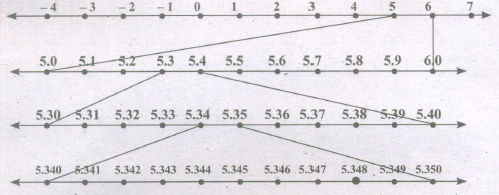
Steps of construction:
1. Divide the distance between 5 and 6 into 10 equal intervals.
2. Mark the point 5.3 which is the sixth from the left of 6 and 3 from the right of 5.
3. 5.34 lies between 5.30 and 5.40. Divide the distance into 10 equal intervals.
4. Mark the point 5.34 which is sixth from the left of 5.40
5. 5.348 lies between 5.34 and 5.35. Divide the distance into 10 equal intervals.
6. Mark a point 5.348 which is second from the left of 5.350 and seventh from the right of 5.340.
(ii) \(6.\overline{4}\) up to 3 decimal places.
\(6.\overline{4}\) = 6.4444 .......
\(6.\overline{4}\) = 6.444 (correct to 3 decimal places)
The number lies between 6 and 7.
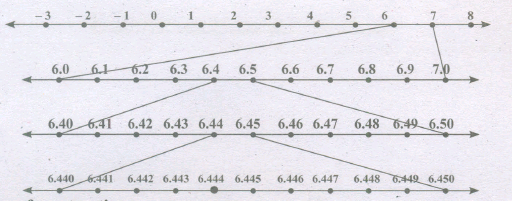
Steps of construction:
1. Divide the distance between 6 and 7 into 10 equal intervals.
2. Mark the point 6.4 which is the sixth from the left of 7 and fourth from the right of 6.
3. 6.44 lies between 6.4 and 6.5. Divide the distance into 10 equal intervals.
4. Mark the point 6.44 which is sixth from the left of 6.5 and fourth from the right of 6.40.
5. Mark the point 6.444 which is sixth from the left of 6.450 and fourth from the right of 6.440.
(iii) \(4.\overline{73}\) = 4.737373 ......
= 4.737374 (correct to 4 decimal places 4.7374 lies between 4 and 4)
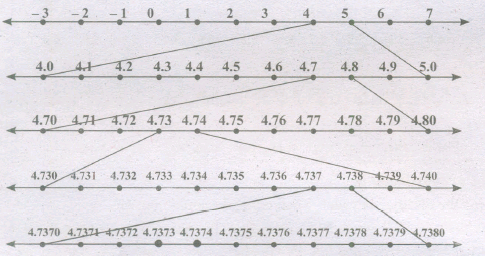
Steps of construction:
1. Divide the distance between 4 and 5 into 10 equal parts.
2. Mark the point 4.7 which is third from the left of 5 and seventh from the right of 4.
3. 4.73 lies between 4.7 and 4.8. Divide the distance into 10 equal intervals.
4. Mark the point 4.73 which is seventh from the left of 4.80 and third from the left of 4.70.
5. 4.737 lies between 4.73 and 4.74. Divide the distance into 10 equal intervals.
6. Mark the point 4.737 which is third from the left of 4.740 and seventh from the right of 4.730.
7. 4.7374 lies between 4.737 and 4.738. Divide the distance into 10 equal intervals.
8. Mark the point 4.7374 which is sixth from the left of 4.7380 and fourth from the right of 4.7370.
4.
(i) \(2\over 7\) = 0.2857142....
= \(0.\overline {285714}\)
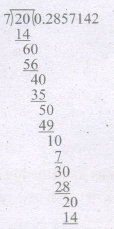
Non-terminating and recurring decimal expansion.
(ii) \(-5\frac { 3 }{ 11 } \) = -5.272....
= \(-5.\overline { 27 } \)
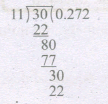
Non-terminating and recurring decimal expansion.
(iii) \(\frac { 22 }{ 3 } \) = 7.333...
= \(7.\overline { 3 } \)

Non-terminating and recurring decimal expansion.
(iv) \(\frac{327}{200}=\frac{327}{2\times 100}\)
= \(\frac{3.27}{2}\)
= 1.635
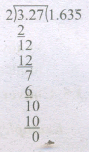
Terminating decimal expansion.
5.
(i) Yes \( \sqrt{3}+\sqrt{3} =2 \sqrt{3} =\sqrt{2^{2} \times 3} =\sqrt{12} \) pure surd
(ii) Yes \(2 \sqrt{5}-\sqrt{5}=\sqrt{5}\) pure surd
(iii) Yes \(\sqrt {5}\times\sqrt {7}=\sqrt {35}\), a pure surd
(iv) Yes, the quotient of two surds can be a pure surd. \(\frac{\sqrt{5}}{\sqrt{2}}=\sqrt{\frac{5}{2}}\)
6.
(i) \(\sqrt [ 3 ]{ 5 } ,\sqrt [ 9 ]{ 4 } ,\sqrt [ 6 ]{ 3 } \)
\(5^{\frac{1}{3}}\)
ஃ The order of the surds \(\sqrt [ 3 ]{ 5 } ,\sqrt [ 9 ]{ 4 } ,\sqrt [ 6 ]{ 3 } \) are 3,9,6
\(4^{\frac{1}{9}}\)
\(3^{\frac{1}{6}}\) l.c.m of 3,9,6 is 18
ஃ \(\frac{1}{3}=\frac{1\times6}{3\times6}=\frac{6}{18}\)
\(\frac{1}{9}=\frac{1\times2}{9\times2}=\frac{2}{18};\frac{1}{6}=\frac{1\times3}{6\times3}=\frac{3}{18}\)
\((5^{\frac{1}{3}})=5^{\frac{6}{18}}=(15625)^{\frac{1}{18}}\)
\((4^{\frac{1}{9}})=4^{\frac{2}{18}}=(4^2)^{\frac{1}{18}}=16^{\frac{1}{18}}\)
\((3^{\frac{1}{6}})=3^{\frac{3}{18}}=(3^3)^{\frac{1}{18}}=27^{\frac{1}{18}}\)
ஃ The descending order of \(\sqrt [ 3 ]{ 5 } ,\sqrt [ 9 ]{ 4 } ,\sqrt [ 6 ]{ 3 } \) is \((15625)^{\frac{1}{18}}>(27)^{\frac{1}{18}}>16^{\frac{1}{18}}\) i.e., \(\sqrt { \sqrt { 3 } } >\sqrt [ 2 ]{ \sqrt [ 3 ]{ 5 } } >\sqrt [ 3 ]{ \sqrt [ 4 ]{ 7 } } \)
(ii) \(\sqrt [ 2 ]{ \sqrt [ 3 ]{ 5 } } ,\sqrt [ 2 ]{ \sqrt [ 3 ]{ 5 } } ,\sqrt [ 3 ]{ \sqrt [ 4 ]{ 7 } } ,\sqrt { \sqrt { 3 } } \)
The order of the surds \(\sqrt [ 2 ]{ \sqrt [ 3 ]{ 5 } } ,\sqrt [ 2 ]{ \sqrt [ 3 ]{ 5 } } ,\sqrt [ 3 ]{ \sqrt [ 4 ]{ 7 } } ,\sqrt[2] { \sqrt [2]{ 3 } } \) are 6, 12, 4
l.c.m of 6,12,4 is 12
\(\sqrt[2]{\sqrt[3]{5}}=5^{\frac{1}{6}}=5^{\frac{1\times2}{6\times2}}=5^{\frac{2}{12}}=(5^2)^{\frac{1}{12}}=25^{\frac{1}{12}}\)
\(\sqrt[3]{\sqrt[4]{\sqrt{7}}}=7^{\frac{1}{12}};\sqrt{\sqrt{3}}=3^{\frac{1}{4}}=3^{\frac{1\times3}{4\times3}}=3^{\frac{3}{12}}=(3^3)^{\frac{1}{12}}=27^{\frac{1}{12}}\)
ஃ The ascending order of the surds
\(\sqrt [ 2 ]{ \sqrt [ 3 ]{ 5 } } ,\sqrt [ 2 ]{ \sqrt [ 3 ]{ 5 } } ,\sqrt [ 3 ]{ \sqrt [ 4 ]{ 7 } } ,\sqrt { \sqrt { 3 } } \) is \(7^{\frac{1}{12}}<25^{\frac{1}{2}}<27^{\frac{1}{2}}\), that is \(\sqrt[3]{\sqrt[4]{7}}<\sqrt[2]{\sqrt[3]{5}}<\sqrt{\sqrt{3}}\)
7.
(i) \(\sqrt{3}\times\sqrt{5}\times\sqrt{2}=\sqrt{3\times5\times2}=\sqrt{30}\)
(ii) \(\sqrt{35}\div\sqrt{7}=\sqrt{\frac{35}{7}}=\sqrt{5}\)
(iii) \(\sqrt[3]{27}\times\sqrt[3]{8}\times\sqrt[3]{125}=\sqrt[3]{27\times8\times125}=\sqrt[3]{3^3\times2^3\times5^3}=3\times2\times5=30\)
(iv) \((7\sqrt{a}-5\sqrt{b})(7\sqrt{a}+5\sqrt{b})=(7\sqrt{a})^2-(5\sqrt{b})^2=49a-25b\) = 21\(\sqrt 3\)
(v) \([\sqrt{\frac{225}{729}}-\sqrt{\frac{25}{144}}]\div\sqrt{\frac{16}{81}}\)
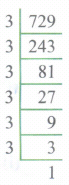
=\([\sqrt{\frac{15^2}{27^2}}-\sqrt{\frac{5^2}{12^2}}]\times\sqrt{\frac{9^2}{4^2}}\)
=\((\frac{15}{27}-\frac{5}{12})\times\frac{9}{4}=(\frac{5}{9}-\frac{5}{12})\times\frac{9}{4}\)
=\((\frac{20-15}{36})\times\frac{9}{4}=\frac{5}{ ̶3̶6̶}\times\frac{ ̶9̶}{4}=\frac{5}{16}\)
8.
\(\sqrt[5]{100000}=(100000)^{\frac{1}{5}}=(10^{ ̶5̶})^{\frac{1}{ ̶5̶}}=10\)
9.
\(\sqrt[5]{243}=243^{\frac{1}{5}}=(3^5)^{\frac{1}{5}}=3^{ ̶5̶\times\frac{1}{ ̶5̶}}=3\)
10.
\(\sqrt[5]{32}=32^{\frac{1}{5}}=(2^5)^{\frac{1}{5}}=2^{ ̶5̶\times\frac{1}{ ̶5̶}}=2\)

9th Standard Syllabus & Materials
9th Standard
TN 9th Tamil உள்ளத்தின் சீர் - திருக்குறள் Important Questions And Answers Study Material - QB365 Set A
NEW9th Standard
TN 9th Tamil உள்ளத்தின் சீர் - மணிமேகலை Important Questions And Answers Study Material - QB365 Set A
NEW9th Standard
TN 9th Tamil உள்ளத்தின் சீர் - ஏறு தழுவுதல் Important Questions And Answers Study Material - QB365 Set A
NEW9th Standard
TN 9th Tamil உயிருக்கு வேர் - தண்ணீர் Important Questions And Answers Study Material - QB365 Set A



Tamilnadu Stateboard 9th Standard Subjects
Tamilnadu Stateboard Standards





