
 100% FREE ACCESS
9th Standard Syllabus & Materials
9th Standard
TN 9th Tamil உள்ளத்தின் சீர் -கற்கண்டு (இலக்கணம்) - தொடர் இலக்கணம், ஆகுபெயர் Important Questions And Answers Study Material - QB365 Set A
NEW9th Standard
TN 9th Tamil உள்ளத்தின் சீர் -விரிவானம் (துணைப்பாடம்) - தாய்மைக்கு வறட்சி இல்லை! Important Questions And Answers Study Material - QB365 Set A
NEW9th Standard
TN 9th Tamil உள்ளத்தின் சீர் -கவிதை பேழை (செய்யுள்) - மார்கழி பெருவிழா Important Questions And Answers Study Material - QB365 Set A
NEW9th Standard
TN 9th Tamil உயிருக்கு வேர்-இலக்கணம் - பகுபத உறுப்பிலக்கணம் Important Questions And Answers Study Material - QB365 Set A
NEW9th Standard
TN 9th Tamil அமுதென்று பேர் - இலக்கணம்-எழுத்து -அளபெடை Important Questions And Answers Study Material - QB365 Set A
NEW9th Standard
TN 9th Tamil அமுதென்று பேர்-துணைப்பாடம் - ஆறாம்திணை Important Questions And Answers Study Material - QB365 Set A

Published on: 12/06/2021
QB365 provides detailed and simple solution for every book back questions in class 9 Maths subject.It will helps to get more idea about question pattern in every book back questions with solution.
Download Tamil Nadu 9th Standard Maths question papers, model tests, one-mark questions, important questions, and public exam papers in PDF format. Free study materials and answer keys for TN State Board students.
Questions + Answers key
Take MCQ Maths Test1.
If A = {-2,0,1,3,5}, B = {-1,0,2,5,6} and C = {-1,2,5,6,7} then show that A-(BUC) = (A-B)∩(A-C).
2.
In a group of 100 students, 85 students speak Tamil, 40 students speak English, 20 students speak French, 32 speak Tamil and English, 13 speak English and French and 10 speak Tamil and French. If each student knows atleast any one of these languages, then find the number of students who speak all these three languages.
3.
In a college, 240 students play cricket, 180 students play football, 164 students play hockey, 42 play both cricket and football, 38 play both football and hockey, 40 play both cricket and hockey and 16 play all the three games. If each student participate in atleast one game, then find
(i) the number of students in the college
(ii) the number of students who play only one game.
4.
If P = {x : x\(\in \)W and 0 < x < 10} Q = {x : x = 2n+1, n\(\in \)W and n < 5} and R = {2, 3, 5, 7, 11, 13} then verify P −(Q ⋂ R) = (P − Q) U (P − R).
5.
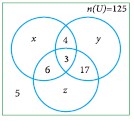
In the adjacent diagram, if n(U) = 125, y is two times of x and z is 10 more than x, then find the value of x,y and z.
6.
Verify \((A\cap B)'=A'\cup B'\) using Venn diagrams.
7.
If U = {4,7,8,10,11,12,15,16}, A = {7,8,11,12,} and B = {4,8,12,15}, then verify De Morgan’s Laws for complementation.
8.
Verify \(A-(B\cap C)=(A-B)\cup (A-C)\)using Venn diagrams.
9.
If K = {a,b,d e f } L = {b,c,d,g} and M = {a,b,c,d,h}, then find the following:
(i) K \(\cup \)(L \(\cap \) M)
(ii) K \(\cap \)(L \(\cup \) M)
(iii) (K\(\cup \)L)\(\cap \)(K\(\cup \)M)
(iv) (K\(\cap \)L)\(\cup \)(K\(\cap \)M)
10.
Out of 500 car owners investigated, 400 owned car A and 200 owned car B, 50 owned both A and B cars. Is this data correct?
1.
A = {-2,0,1,3,5}, B = {-1,0,2,5,6}
C = {-1,2,5,6,7}
BUC = {-1,0,2,5,6,7}
A-(BUC) = {-2,1,3}.............(1)
(A-B) = {-2,1,3}
(A-C) = {-2,0,1,3}
(A-B)∩(A-C) = {-2,1,3}............(2)
From (1) and (2), it is verified that
A-(BUC) = (A-B)⋂(A-C)
2.
Let A, B and C represent sets of students who speak Tamil, English and French respectively.
Given, n(AUBUC) = 100, n(A) = 85, n(B) = 40, n(C) = 20
n(A⋂B) = 32, n(B⋂C) = 13, n(A⋂C) = 10
We know that,
n(A U B U C) = n(A) + n(B) + n(C) - n(A⋂B) - n(B⋂C) - n(A⋂C) + n(A⋂B⋂C)
100 = 85 + 40 +20+ -32 -13-10 + n(A⋂B⋂C)
Then, n(A⋂B⋂C) = 100 - 90 = 10
Therefore, 10 students speak all the three languages
3.
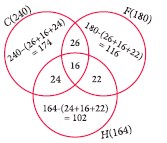
Let C, F and H represent sets of students who play Cricket, Football and Hockey respectively.
Then , n(C) = 240, n(F) = 180, n(H) = 164, n(C ∩ F) = 42,
n(F ∩ H) = 38, n(C ∩ H) = 40, n(C ∩ F ∩ H) = 16.
Let us represent the given data in a Venn diagram.
(i) The number of students in the college = 174 + 26 + 116 + 22 + 102 + 24 + 16 = 480
(ii) The number of students who play only one game = 174 + 116 + 102 = 392
4.
The roster form of sets P, Q and R are
P = {1,2, 3, 4,5,6,7,8,9}, Q = {1, 3,5,7,9} and R = {2, 3, 5,7,11,13}
First, we find (Q ⋂ R) = {3, 5, 7}
Then, P −(Q ⋂ R) = {1, 2, 4 ,6, 8, 9}........ (1)
Next, P–Q = {2, 4, 6, 8} and P–R = {1, 4, 6, 8, 9}
and so, (P −Q) U (P −R) = {1,2, 4, 6, 8, 9}............ (2)
Hence from (1) and (2), it is verified that P −(Q ∩ R) = (P −Q) U (P −R).
Finding the elements of set Q
Given, x = 2n + 1
n = 0 ⟶ x = 2(0) + 1 = 0 + 1 = 1
n = 1 ⟶ x = 2(1) + 1 = 2 + 1 = 3
n = 2 ⟶ x = 2(2) + 1 = 4 + 1 = 5
n = 3 ⟶ x = 2(3) + 1 = 6 + 1 = 7
n = 4 ⟶ x = 2(4) + 1 = 8 + 1 = 9
Therefore, x takes values such as 1, 3, 5, 7 and 9.
5.
n(U) = 125
y = 2x
z = x + 10
ஃ x + y + z + 4 + 17 + 6 + 3 + 5 = 125
x + 2x + x + 10 + 35 = 125
4x + 45 = 125
4x = 125 - 45
4x = 80
x = 20
ஃ y = 2x = 2 \(\times\) 20 = 40
z = x +10 = 20 + 10 = 30
Hence x = 20; y = 40; z = 30
6.
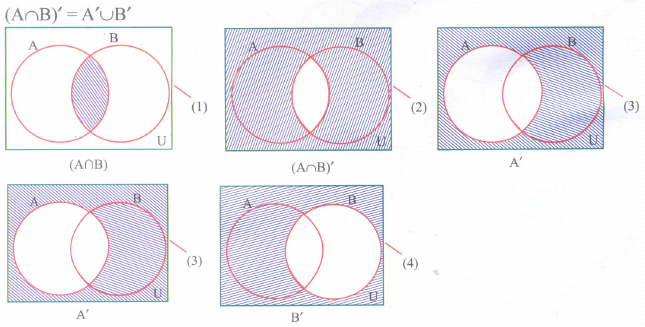
(2)=(5)
ஃ (A∩B)'=A'UB'
7.
U = {4,7,8,10,11,12,15,16}
A = {7,8,11,12,}, B = {4,8,12,15}
De Morgan's Laws for complementation.
(AUB)' = A' ∩ B'
AUB = {4, 7, 8, 11, 12, 15}
(AUB)' = {4, 7, 8,10,11,12,15, 16} - {4, 7, 8,11,12, 15} = {10, 16}...(1)
A' = {4, 10, 15,16}; B' = {7, 10, 11,16}
A'∩B' = {10,16}...(2)
From (1) and (2) it is verified that
(AUB)' = A'∩B'
8.
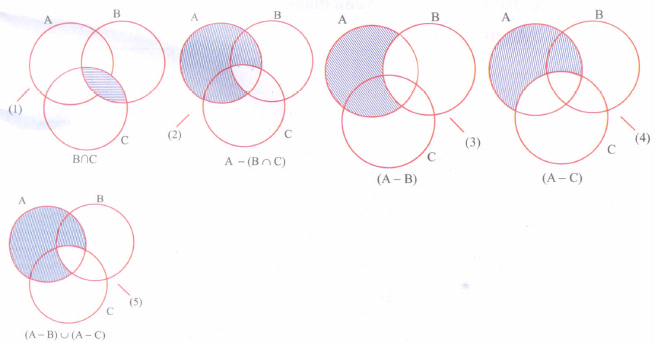
ஃ A-(B∩C)=(A-B)U(A-C)
Hence it is proved.
9.
K = {a,b,d,e,f}, L = {b,c,d,g} and M = {a,b,c,d,h}
(i) K\(\cup\)(L\(\cap \)M)
L\(\cap \) M = {b,c,d,g} \(\cap \) {a,b,c,d,h} = {b,c,d}
K\(\cup\)(L\(\cap \)M) = {a,b,d,e,f} \(\cup\) {b,c,d} = {a,b,c,d,e,f}
(ii) K∩(L\(\cup\)M)
L\(\cup\)M = {a,b,c,d,g,h}
K⋂(L \(\cup\) M) = {a,b,d,e,f) \(\cap \) {a,b,c,d,g,h} = {a,b,d}
(iii) (K \(\cup\) L) \(\cap \) (K\(\cup\)M)
K \(\cup\) L = {a,b,c,d,e,f,g}
K \(\cup\) M = {a,b,c,d,e,f,h}
(K \(\cup\) L) \(\cap \) (K \(\cup\) M) = {a,b,c,d,e,f}
(iv) (K \(\cap \) L) \(\cup\) (K \(\cap \) M)
(K \(\cap \) L) = {b,d}
(K \(\cap \) M) = {a,b,d}
(K \(\cap \) L) \(\cup\) (K \(\cap \) M) = {b,d} \(\cup\) {a,b,d} = {a,b,d}
10.
Let A be the set of people owned car A
Let B be the set of people owned car B
n( A) = 400, n(B) = 200, n(A \(\cap\) B) = 50
n(A \(\cup\) B) = 500 .........(1)
n(A) + n(B) - n(A \(\cap\) B) = 400 + 200 - 50
= 600 - 50
= 550 ...........(2)
From (1) and (2) we get
\(n(A\cup B)\ne n(A) +n(B)-n(A\cap B)\)
\(\therefore\) The given data is incorrect.

9th Standard Syllabus & Materials
9th Standard
TN 9th Tamil உள்ளத்தின் சீர் - திருக்குறள் Important Questions And Answers Study Material - QB365 Set A
NEW9th Standard
TN 9th Tamil உள்ளத்தின் சீர் - மணிமேகலை Important Questions And Answers Study Material - QB365 Set A
NEW9th Standard
TN 9th Tamil உள்ளத்தின் சீர் - ஏறு தழுவுதல் Important Questions And Answers Study Material - QB365 Set A
NEW9th Standard
TN 9th Tamil உயிருக்கு வேர் - தண்ணீர் Important Questions And Answers Study Material - QB365 Set A



Tamilnadu Stateboard 9th Standard Subjects
Tamilnadu Stateboard Standards





