
 100% FREE ACCESS
9th Standard Syllabus & Materials
9th Standard
TN 9th Tamil உள்ளத்தின் சீர் -கற்கண்டு (இலக்கணம்) - தொடர் இலக்கணம், ஆகுபெயர் Important Questions And Answers Study Material - QB365 Set A
NEW9th Standard
TN 9th Tamil உள்ளத்தின் சீர் -விரிவானம் (துணைப்பாடம்) - தாய்மைக்கு வறட்சி இல்லை! Important Questions And Answers Study Material - QB365 Set A
NEW9th Standard
TN 9th Tamil உள்ளத்தின் சீர் -கவிதை பேழை (செய்யுள்) - மார்கழி பெருவிழா Important Questions And Answers Study Material - QB365 Set A
NEW9th Standard
TN 9th Tamil உயிருக்கு வேர்-இலக்கணம் - பகுபத உறுப்பிலக்கணம் Important Questions And Answers Study Material - QB365 Set A
NEW9th Standard
TN 9th Tamil அமுதென்று பேர் - இலக்கணம்-எழுத்து -அளபெடை Important Questions And Answers Study Material - QB365 Set A
NEW9th Standard
TN 9th Tamil அமுதென்று பேர்-துணைப்பாடம் - ஆறாம்திணை Important Questions And Answers Study Material - QB365 Set A

Published on: 13/05/2022
QB365 provides detailed and simple solution for every Book back Questions in class 9 Science Subject. It will helps to get more idea about question pattern in every book back questions with solution.
latest Book back QuestionsDownload Tamil Nadu 9th Standard Science question papers, model tests, one-mark questions, important questions, and public exam papers in PDF format. Free study materials and answer keys for TN State Board students.
Questions + Answers key
Take MCQ Science Test1.
Calculate the mass of a proton, given its charge = + 1.60 \(\times\)10−19 C charge / mass = 9.58 \(\times\) 107 C kg-1
2.
Calculate the volume of oxygen required for the complete combustion of 20 cm3 of methane[CH4(g) +2O2⟶ CO2(g) +2H2O(g)]
3.
State the Gay Lussac’s law of combining volumes, explain with an illustration.
4.
Explain the postulates of Bohr’s atomic model.
5.
What conclusions were made from the observations of Gold foil experiment?
1.
\(Mass\quad =\quad \frac { Charge }{ Charge/mass } \)
\(=\frac { +1.60\times { 10 }^{ -19 } }{ 9.58\times { 10 }^{ 7 } } =1.670\quad \times \quad { 10 }^{ -27 }kg\)
2.
\({ CH }_{ 4 }(g)\quad +\quad { 2O }_{ 2 }(g)\quad \longrightarrow \quad { CO }_{ 2 }(g)\quad +\quad { 2H }_{ 2 }O(g)\\ \quad 1\quad \quad \quad \quad \quad \quad 2\quad \quad \quad \quad \quad \quad \quad \quad 1\quad \quad \quad \quad \quad \quad 2\\ volume\quad +\quad volume\quad \longrightarrow \quad volume\quad +\quad volume\\ \quad 1\times \quad \quad \quad \quad \quad 2\times \quad \quad \quad \quad \quad \quad 1\times \quad \quad \quad \quad \quad 2\times \\ 20{ cm }^{ 3 }\quad \quad +\quad 20{ cm }^{ 3 }\quad \longrightarrow \quad 20{ cm }^{ 3 }\quad \quad +\quad 20{ cm }^{ 3 }\\ 20{ cm }^{ 3 }\quad \quad +\quad 40c{ m }^{ 3 }\quad \longrightarrow \quad 20v{ cm }^{ 3 }\quad +\quad 40{ cm }^{ 3 }\)
3.
Gay Lussac's law of combining volumes.
Gay Lussac's law:
Whenever gases react together, the volumes of the reacting gases as well as the products if they are gases bear a simple whole number ratio provided all the volumes are measured-under similar conditions of temperature and pressure.
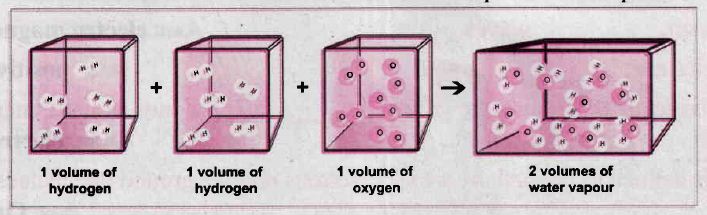
Hydrogen combines with oxygen to form water.
2H2 + 2O2 \(\longrightarrow \) 2H2O
(1 volume) + (2 volumes) \(\longrightarrow \) (2 volumes)
(1:2:2)
One volume of hydrogen react with two volumes of oxygen to form two volumes of water vapour.
The ratio by volume which gases, bears is 1.2:2 which is a simple number ratio.
4.
(i) In atoms, electrons revolve around the nucleus in certain special or permissible orbits known as discrete orbits or shells or energy levels.
(ii) While revolving in these discrete orbits the electrons do not radiate energy.
(iii) The circular orbits are numbered as 1, 2, 3, 4, ... or designated as K, L, M, N, shells. These numbers are referred to as principal quantum numbers (n)
(iv) K shell (n = 1) is closest to the nucleus and is associated with lowest energy. L, M, N, .... etc are the next higher energy levels. As the distance from the nucleus increases the energy of the shells also increases.
(v) The energy of each orbit or shell is a fixed quantity and the energy is quantized.
(vi) As the distance from the nucleus increases, the size of the orbits also increases.
(vii) Maximum number of electrons that can be accommodated in an energy level is given by 2n2 where n is the principal quantum number of the orbit.
(viii) When an electron absorbs energy, it jumps from lower energy level to higher energy level.
(ix) When an electron returns from higher energy level to lower energy level, it gives off energy.
5.
(i) Atom has a very small nucleus at the centre.
(ii) There is large empty space around the nucleus.
(iii) Entire mass of an atom is concentrated in a very small positively charged region which is called the nucleus.
(iv) Electrons are distributed in the vacant space around the nucleus.
(v) The electrons move in circular paths around the nucleus.

9th Standard Syllabus & Materials
9th Standard
TN 9th Tamil உள்ளத்தின் சீர் - திருக்குறள் Important Questions And Answers Study Material - QB365 Set A
NEW9th Standard
TN 9th Tamil உள்ளத்தின் சீர் - மணிமேகலை Important Questions And Answers Study Material - QB365 Set A
NEW9th Standard
TN 9th Tamil உள்ளத்தின் சீர் - ஏறு தழுவுதல் Important Questions And Answers Study Material - QB365 Set A
NEW9th Standard
TN 9th Tamil உயிருக்கு வேர் - தண்ணீர் Important Questions And Answers Study Material - QB365 Set A



Tamilnadu Stateboard 9th Standard Subjects
Tamilnadu Stateboard Standards





