
 100% FREE ACCESS
9th Standard Syllabus & Materials
9th Standard
TN 9th Tamil உள்ளத்தின் சீர் -கற்கண்டு (இலக்கணம்) - தொடர் இலக்கணம், ஆகுபெயர் Important Questions And Answers Study Material - QB365 Set A
NEW9th Standard
TN 9th Tamil உள்ளத்தின் சீர் -விரிவானம் (துணைப்பாடம்) - தாய்மைக்கு வறட்சி இல்லை! Important Questions And Answers Study Material - QB365 Set A
NEW9th Standard
TN 9th Tamil உள்ளத்தின் சீர் -கவிதை பேழை (செய்யுள்) - மார்கழி பெருவிழா Important Questions And Answers Study Material - QB365 Set A
NEW9th Standard
TN 9th Tamil உயிருக்கு வேர்-இலக்கணம் - பகுபத உறுப்பிலக்கணம் Important Questions And Answers Study Material - QB365 Set A
NEW9th Standard
TN 9th Tamil அமுதென்று பேர் - இலக்கணம்-எழுத்து -அளபெடை Important Questions And Answers Study Material - QB365 Set A
NEW9th Standard
TN 9th Tamil அமுதென்று பேர்-துணைப்பாடம் - ஆறாம்திணை Important Questions And Answers Study Material - QB365 Set A

Published on: 13/05/2022
QB365 provides detailed and simple solution for every Book back Questions in class 9 Science Subject. It will helps to get more idea about question pattern in every book back questions with solution.
latest Book back QuestionsDownload Tamil Nadu 9th Standard Science question papers, model tests, one-mark questions, important questions, and public exam papers in PDF format. Free study materials and answer keys for TN State Board students.
Questions + Answers key
Take MCQ Science Test1.
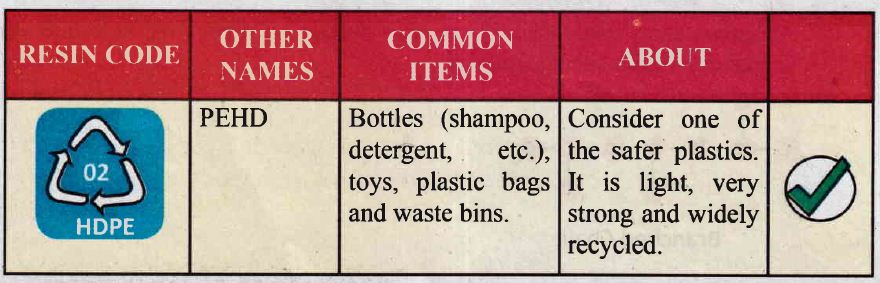
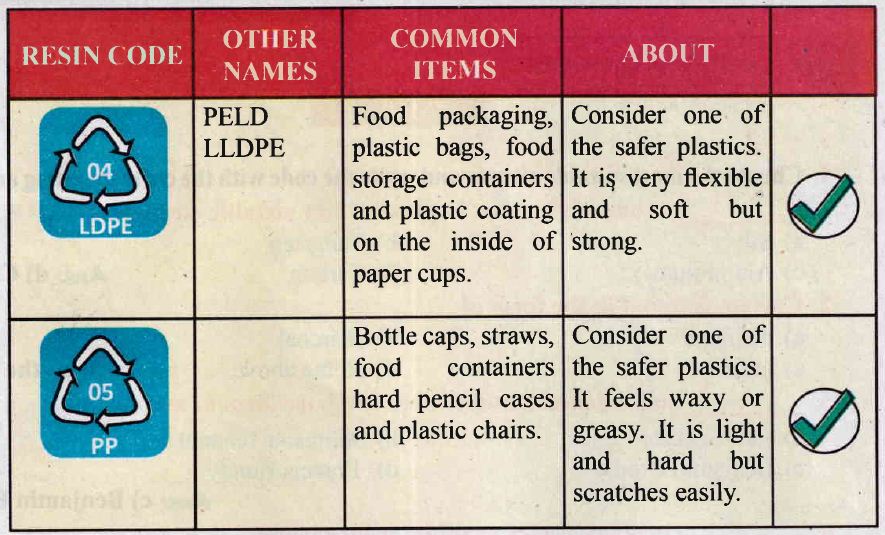
Name the three safer resin codes of plastics and describe their features.
2.
Describe the construction and working of mercury barometer.
3.
What are meristems? Describe the distribution and functions of various types of meristems.
4.
Plaster of Paris should be stored in a moisture proof container. why?
5.
List down the differences between Ionic and Covalent compounds.
6.
How are the home appliances connected in general, in series or parallel. Give reasons.
7.
Explain convection in daily life.
8.
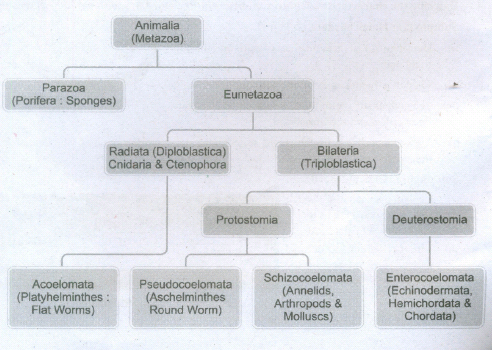
Outline the flow chart of invertebrate phyla
9.
How are vitamins useful to us? Tabulate the sources, deficiency diseases and symptoms of fat soluble vitamins
10.
What are the different steps involved in data processing?
11.
What conclusions were made from the observations of Gold foil experiment?
12.
A train travelling at a speed of 90 kmph. Brakes are applied so as to produce a uniform acceleration of ‒0.5 ms-2. Find how far the train will go before it is brought to rest?
13.
A car is fitted with a convex mirror of focal length 20 cm. Another car is 6 m away from the first car.
a) Find the position of the second car as seen in the mirror of the first
b) What is the size of the image if the second car is 2 m broad and 1.6 m high?
Focal length = 20 cm (convex mirror)
Object distance = -6m
= -600 cm
Image distance v =?
Calculation for position of image using mirror equation
14.
How will you find the thickness of a one rupee coin?
15.
Explain Tyndall effect and Brownian movement with suitable diagram.
1.
2.
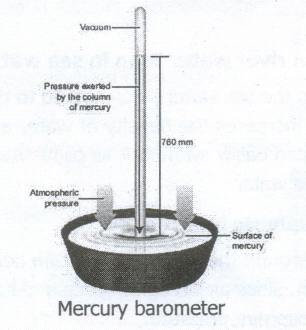
1. The instrument used to measure atmospheric pressure is called Barometer.
2. It consists of a long glass tube which is closed at one end, open at the other filled with mercury and turned upside down in a container of mercury.
3. This is done by closing the open end of the mercury filled tube with the thumb and then opening it after immersing it in to a trough of mercury.
4. The Barometer works by balancing the mercury in the glass tube against the outer air pressure.
5. If the air pressure increases, it pushes more of the mercury up into the tub and if the air pressure decreases, more of the mercury drains from the tube.
6. The space between mercury and closed end is vacuum, since vacuum cannot exert any pressure, the level of mercury in the tube provides a precise measure of air pressure, which is called atmospheric pressure.
7. This type of instrument can be used in a lab or weather station.
3.
Meristematic tissues are group of immature cells that are capable of undergoing cell division. They occur in zones where grown can take place in plants.
Types of Meristems:
| Type | Distribution | Function |
| I. Classification of meristems based on origin and development | ||
| a) Promeristem or primordial meristem | Tip of shoot and root | Divide to form primary meristerm |
| b) Primary meristem | Below the promeristem of shoot and root apex | Divide to form permanent tissues. |
| c) Secondary meristem | Derived from primary permanent tissues ego cork-cambium | Divide to form tissues during secondary growth |
| II. Classification of meristems based on position in the plant | ||
| a) Apical meristem | Apices or growing points of root, shoot | Bring about increase in length |
| b) Intercalary meristem | Lies between regron of permanent tissues. Eg. base of leaf | Forms branches |
| c) Lateral meristem | Arranged parallel to sides of ongin and divide radially | Form secondary permanent tissues and increase the thickness of the plant part. |
| III. Classification of meristems based on function | ||
| a) Protoderm meristem | Outermost layer of the young growing region | Forms epidermal tissues |
| b) Procambium meristem | Vascular bundle | Gives rise to vascular tissues |
| c) Ground meristem | Ground tissue system | Forms ground tissues like pith, cortex etc., |
| IV. Classification of meristems based on Plane of division | ||
| a) Mass meristem | Cortext and pith | Cell division occurs in all planes leading to increase in volume. |
| b) Rib or file meristem | Cells divide III one plane only | Formation of filaments ego algae |
| c) Plate meristem | Cells divide III two planes | Increase III the area of an organ ego Leaf formation. |
4.
Plaster of paris should be stored in a moisture-proof container as it absorbs water from moisture present in air and turn into hard substance (Gypsum).
5.
| S.No | Ionic Compounds | Covalent Compounds |
| 1. | Formed by the transfer of electrons from a metal to a non-metal atom. | Formed by sharing of electrons between non-metal atoms. |
| 2. | Strong electrostatic force of attraction between cations and anions | Mutual sharing of electrons and so weak force of attraction between atoms. |
| 3. | Solids at room temperature. | Gases, liquids and soft solids |
| 4. | Conducts electricity in molten state or in solutions | Non-conductors of electricity |
| 5. | Have high melting and boiling points | Have low melting and boiling points. |
| 6. | Soluble in polar solvents. | Soluble in non-polar solvents |
| 7. | Hard and brittle | Soft and waxy. |
| 8. | Undergo ionic reaction which are fast and instantaneous. | Undergo molecular reactions which are slow. |
6.
In a household electric circuit, different home appliances are connected in parallel to one another due to the following reasons:
(i) The appliances can be operated independently. If one appliance is switched off, others remain unaffected.
(ii) Each appliance gets the same constant voltage.
(iii) In parallel connection of electrical appliances, the overall resistance of the circuit is reduced due to which the current from the power supply is high.
7.
Hot air balloons:
Air molecules at the bottom of the balloon get heated by a heat source and rise. As the warm air rises, cold air is pushed downward and it is also heated. When the hot air is trapped inside the balloon, it rises.
Breezes:
During day time, the air in contact with the land becomes hot and rises. Now the cool air over the surface of the sea replaces it. It is called sea breeze. During night time, air above the sea is warmer. As the warmer air over the surface of the sea rises, cooler air above the land moves towards the sea. It is called land breeze.
Winds:
Air flows from area of high pressure to area of low pressure. The warm air molecules over hot surface rise and create low pressure. So, cooler air with high pressure flows towards low pressure area. This causes wind flow.
Chimneys:
Tall chimneys are kept in kitchen and industrial furnaces. As the hot gases and smoke are lighter, they rise up in the atmosphere.
8.
9.
Vitamins are vital nutrients, required in minute amounts to perform special functions to maintain a healthy body. It is deficiency in the food it cause many diseases.
| Vitamins | Sources | Deficiency disorders | Symptoms |
|
Vitamin A |
Carrot, papaya leaf vegetable, egg yolk, liver |
Xerophthalmia Nyctalopia(night blindness) |
Dryness of cornea unable to see in the night (dim light) scaly skin |
| Vitamin D |
Egg, liver, diary products, fish, synthesized by the sunlight |
Rickets(in children) |
Bow legs, defective ribs development of pigeon chest. |
| Vitamin E | Wheat wheat, vegetable oil, meat, milk | Sterility in rats, Reproductive abnormalities |
Sterility |
| Vitamin K |
Leafy vegetables, soyabeans, milk | Blood clotting is prevented | Excessive bleeding due to delayed blood clotting. |
10.
Data processing has six steps. They are:
Data collection
Data storage
Data sorting
The data processing
Data analysis
Data presentation and conclusions
11.
(i) Atom has a very small nucleus at the centre.
(ii) There is large empty space around the nucleus.
(iii) Entire mass of an atom is concentrated in a very small positively charged region which is called the nucleus.
(iv) Electrons are distributed in the vacant space around the nucleus.
(v) The electrons move in circular paths around the nucleus.
12.
Speed of the train = 90 kmph
Speed of the train = \(\frac { 90000 }{ 3600 } \)
Speed of the train =\(\frac { 900 }{ 36 } \)=25
Speed of the train = 25 m/s.
V = 25 m/s
a = - 0.5 ms-2
Displacement = \(\frac { V }{ a } =\frac { 25 }{ 0.5 } =\frac { 25 }{ -0.5 } \) = 50 seconds
S = ut + \(\frac { 1 }{ 2 } \)at2
= 25 x 50 - \(\frac { 1 }{ 2 } \) x 0.5 x 502 = 1250 - 625
Distance covered by the train before it is brought to rest = 625 m/s.
13.
\(\frac { 1 }{ f } =\frac { 1 }{ u } +\frac { 1 }{ v } \)
\(\frac { 1 }{ 20 } =\frac { 1 }{ -600 } +\frac { 1 }{ v } \)
\(\frac { 1 }{ v } =\frac { 1 }{ 20 } -\frac { 1 }{ -600 } \)
= \(\frac { 1 }{ 20 } +\frac { 1 }{ 600 } \)
\(\frac { 1 }{ v } =\frac { 30+1 }{ 600 } =\frac { 31 }{ 600 } \)
\(v=\frac { 600 }{ 31 } \)
= 19.35 cm
b) Size of the image
\(m=\frac { -v }{ u } \)
= \(-\frac { v }{ (-u) } =\frac { -600 }{ 31 } \times \frac { 1 }{ -600 } \)
m=\(\frac { 1 }{ 31 } \)
Breadth of image =\(\frac { 1 }{ 31 } \)\(\times\)200 cm= 6.45 cm
Height of image = \(\frac { 1 }{ 31 } \) \(\times\)160 cm= 5.16 cm
14.
The thickness of coin (one rupee) is finding with the help of screw gauge:
1. Determine the pitch, least count and the zero error of the screw gauge.
2. Place the coin between two studs.
3. Rotate the head until the coin is held firmly but no tightly with the help of the ratchat.
4. Note the reading of a pitch scale crossed by the head scale and the head scale (PSR) division that coincides with the pitch scale axis (HSC).
5. The thickness of the coin is given by PSR + (HSR + ZC) x LC. Repeat the experiment for the different position of the coin.
6. Tabulate the reading.
7. The average of the reading given the thickness of the coin.
| S.No | PSR Cmm | HSC | HSC ± ZC | = PSR + (HSC x LC) |
| 1 | 1 | 33 | 33 | 1 + (33 x 0.01) = 1.33 |
| 2 | 1 | 32 | 32 | 1 + (32 x 0.01) =1.32 |
| 3 | 1 | 34 | 34 | 1 + (34 x 0.01) = 1.34 |
| Average = 1.33 |
The thickness of one rupee coin is = 1.33 mm.
15.
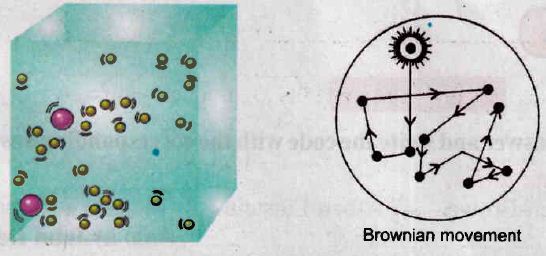
Brownian movement:
When colloidal solution are viewed under powerful microscope, it can be seen that colloidal particles are moving constantly and rapidly in zig-zag directions. The Brownian movement of colloidal particles is due to the unbalanced bombardment of the particles by the molecules of dispersion medium.
Example: Motion of pollen grains in water.
Tyndall effect:
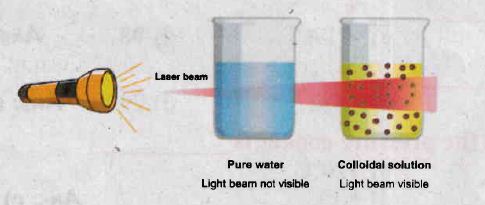
Tyndall (1869) observed that when a strong beam of light is focused on a colloidal solution the path of the beam becomes visible. This phenomenon is known as Tyndall effect and the illuminated path is called Tyndall cone. This phenomenon is not observed in case of true solution.
Example: When fine beam of light pass through the true solution, the light is invisible but the enters the colloidal solution the light is visible.

9th Standard Syllabus & Materials
9th Standard
TN 9th Tamil உள்ளத்தின் சீர் - திருக்குறள் Important Questions And Answers Study Material - QB365 Set A
NEW9th Standard
TN 9th Tamil உள்ளத்தின் சீர் - மணிமேகலை Important Questions And Answers Study Material - QB365 Set A
NEW9th Standard
TN 9th Tamil உள்ளத்தின் சீர் - ஏறு தழுவுதல் Important Questions And Answers Study Material - QB365 Set A
NEW9th Standard
TN 9th Tamil உயிருக்கு வேர் - தண்ணீர் Important Questions And Answers Study Material - QB365 Set A



Tamilnadu Stateboard 9th Standard Subjects
Tamilnadu Stateboard Standards





