
 100% FREE ACCESS
9th Standard Syllabus & Materials
9th Standard
TN 9th Tamil உள்ளத்தின் சீர் -கற்கண்டு (இலக்கணம்) - தொடர் இலக்கணம், ஆகுபெயர் Important Questions And Answers Study Material - QB365 Set A
NEW9th Standard
TN 9th Tamil உள்ளத்தின் சீர் -விரிவானம் (துணைப்பாடம்) - தாய்மைக்கு வறட்சி இல்லை! Important Questions And Answers Study Material - QB365 Set A
NEW9th Standard
TN 9th Tamil உள்ளத்தின் சீர் -கவிதை பேழை (செய்யுள்) - மார்கழி பெருவிழா Important Questions And Answers Study Material - QB365 Set A
NEW9th Standard
TN 9th Tamil உயிருக்கு வேர்-இலக்கணம் - பகுபத உறுப்பிலக்கணம் Important Questions And Answers Study Material - QB365 Set A
NEW9th Standard
TN 9th Tamil அமுதென்று பேர் - இலக்கணம்-எழுத்து -அளபெடை Important Questions And Answers Study Material - QB365 Set A
NEW9th Standard
TN 9th Tamil அமுதென்று பேர்-துணைப்பாடம் - ஆறாம்திணை Important Questions And Answers Study Material - QB365 Set A

Published on: 13/05/2022
QB365 provides detailed and simple solution for every Book back Questions in class 9 Science Subject. It will helps to get more idea about question pattern in every book back questions with solution.
latest Book back QuestionsDownload Tamil Nadu 9th Standard Science question papers, model tests, one-mark questions, important questions, and public exam papers in PDF format. Free study materials and answer keys for TN State Board students.
Questions + Answers key
Take MCQ Science Test1.
Give an account of different types of fish ponds used for rearing fishes.
2.
Explain the various types of viruses with examples.
3.
What are the conditions in a dry habitat to which plants develop adaptations? List out the adaptations of xerophytes?
4.
Write a note on orbital velocity.
5.
Explain how does SONAR work?
6.
Explain the structure of kidney and the steps involved in the formation of urine
7.
Write any five uses of salts.
8.
Discuss in brief about the properties of Coordinate covalent compounds.
9.
Explain two types of transformer.
10.
List the safety features while handling with electricity.
11.
What are the changes of state in water? Explain.
12.
Sudha met with a fire accident. What kind of drug(s), she must take?
13.
When a carbon fuel burns in less aerated room, it is dangerous to stay there. Why?
14.
If you put one ice cube in a glass of water and another in a glass of alcohol, what would you observe? Explain your observations.
1.
Fish farm requires different types of pond for the various developmental stages of fish growth, they are
a) Breeding pond:
Healthy and sexually mature male and female fishes are collected and introduced in this pond for breeding. The eggs released by the female are fertilized by the sperm and fertilized eggs float in water as frothy mass.
b) Hatching pits:
The fertilized eggs are transferred to hatching pits for hatching.
c) Nursery ponds:
The hatchlings are transferred from hatching pits after 2 to 7 days. The hatchlings grow into fry and are cultured in these ponds for about 60 days with proper feeding till they reach 2 - 2.5 cm in length.
d) Rearing ponds:
Rearing ponds are used to culture the fry. The fish fry are transferred from nursery pond to rearing ponds and are maintained for about three months till they reach 10 to 15 cm in length. In these rearing ponds, the fry develops into fingerlings.
e) Stocking pond:
The stocking pond is also called as culture pond or production pond. These ponds are used to rear fingerlings upto the markable size. Before releasing the fingerlings the pond is manured with organic manure and inorganic fertilizers.
2.
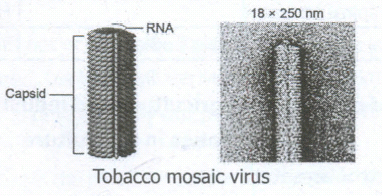
Viruses are categorized as
i) Plant virus:
Virus that infect plants,
eg: Tobacco mosaic virus, cauliflower mosaic virus, Potato virus.
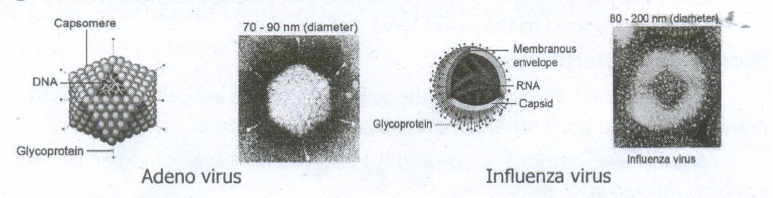
ii) Animal virus:
Virus that infect animals
eg: Adenovirus, Retrovirus(HIV), Influenza virus
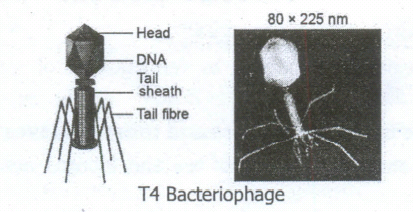
iii) Bacteriophages:
Virus that infect bacterial cells.
eg: T4 Bacteriophage
3.
Xerophytes:
Plants that grow in dry habitat are called xerophytes. They develop special structured and physiological characteristics to meet the following conditions.
i) To absorb as much water as they can get from the surroundings.
ii) To retain water in their organs for very long time.
iii) To reduce transpiration rate.
iv) To reduce consumption of water.
Adaptations of xerophytes:
1. They have well developed roots, Roots grow very deep and reach the layer where water in available as in allotropic.
2. They store water in succulent water storing parenchymatous tissues. eg: Opuntia, Aloe vera.
3. They have small sized leaves with waxy coating ego Acacia. In some plants leaves are modified into spines eg: Opuntia.
4. Some of the xerophytes complete their life cycle within a very short period when sufficient moisture is available.
4.
1. Artificial satellites are made to revolve in an orbit at a height of few hundred kilometers. At this altitude, the friction due to air is negligible.
2. The satellite is carried by a rocket to the desired height and released horizontally with a high velocity, so that it remains moving in a nearly circular orbit.
3. The horizontal velocity that has to be imparted to a satellite at the determined height so that it makes a circular orbit around the planet is called orbital velocity.
4. The orbital velocity of the satellite depends on its altitude above Earth.
5. Nearer the object to the earth, the faster is the required orbital velocity.
6. The orbital speed and distance permit the satellite to make one revolution in 24 hours. Since earth also rotates once in 24 hours, a satellite stays in a fixed position relative to a point on earth's surface. Because the satellite stays over the same spot all the time, this kind of orbit is called 'geostationary'.
Orbital velocity can be calculated using the following formula.
V = \(\sqrt {\frac {GM }{R + h }}\)
Where
G - gravitational constant (6.673 x 10⁻¹¹ Nm2 kg-2)
M - Mass of the earth (5.972 x 1024kg)
R - Radius of the earth (6371 km)
h - height of the satellite from the surface of the earth.
5.
1. SONAR stands for Sound Navigation and Ranging.
2. It is a device that uses ultrasonic waves to measure the distance, direction and speed of underwater objects.
3. It consists of a transmitter and a detector and is installed at the bottom of the boats and ships.
4. The transmitter produces and transmits ultrasonic waves.
5. These waves travel through water and after striking the object on seabed, get reflected back and are sensed by a detector.
6. The detector converts the ultrasonic waves into electrical signals which are appropriately interpreted.
7. The distance of the object that reflected the sound wave can be calculated by knowing the speed of sound in water and the time interval between transmission and reception of the ultrasound.
8. Let the time interval between transmission and reception of ultrasound signals be 't' and the speed of sound through sea water be 2d/t = v. This method is called echo ranging.
9. SONAR technique is used to determine the depth of the sea and to locate underwater hills, valleys, submarine icebergs etc.,
6.
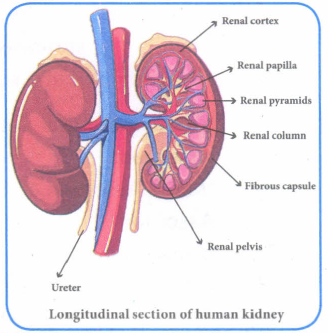
Kidneys:
(i) Kidneys are bean-shaped organs reddish brown in colour.
(ii) The kidneys lie on either side of the vertebral column in the abdominal cavity attached to the dorsal body wall.
(iii) The right kidney is placed lower than the left kidney as the liver takes up much space on the right side.
(iv) Each kidney is about 11 cm long, 5 cm wide and 3 cm thick.
(v) Internally the kidney consists of an outer dark region, the cortex and an inner lighter region,the medulla.
(vi) The medulla consists of multitubular concial masses called the medullary pyramids or renal pyramids whose base are adjecent to cortex.
(vii) On the inner concave side of each kidney,a notch called hilum is present through which blood vessels and nerves enter in and the urine leaves through the ureter.
Process of Urine formatiom:
The process of urine formation includes the following three stages.
(i) Glomerular filtration
(ii) Tubular reabsorption and
(iii) Tublar secretion
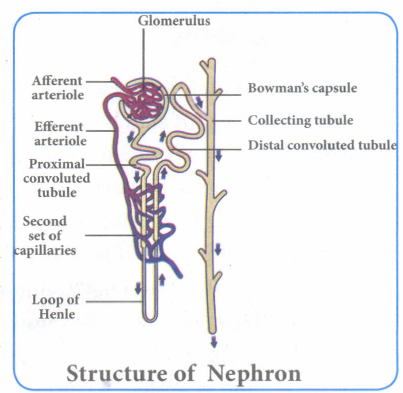
Glomerular filtration: Urine formation begins with the filtration of blood through epithelial walls of the glomerulus and Bowman's capsule. The filtrate is called as the glomerular filtrate. Both essential and non-essential substances present in the blood are filtered.
Tublar reabsorption: The filtrate in the proximal tubule consists of essential substances such as glucose, amino acids, vitamins, sodium, potassium, bicarbonates and water that are reabsorbed into the blood by a process of selective reabsorption.
Tubular secretion: Substances such as H+ or K+ ions are secreted into the tubule. Certain substances like potassium and a large number of drugs like penicillin and aspirin are passed into the filtrate in the distal convoluted tubule. This tubular filtrate is finally known as urine, which is hypertonic in man. Finally the urine passes into collecting ducts to the pelvis and through the ureter into the urinary bladder by urethral peristalsis (waves of constriction in the ureters). When the urinary bladder is full the urine is expelled out through the urethra. This process is called micturition
7.
Common Salt (NaCl) :
It is used in our daily food and used as a preservative.
Washing Soda (Sodium Carbonate - Na2CO3) :
(i) It is used in softening hard water.
(ii) It is used in glass, soap and paper industries.
Baking Soda (Sodium bicarbonate -NaHCO3) :
(i) It is used in making of baking powder which is a mixture of baking soda and tartaric acid.
(ii) It is used in soda-acid fire extinguishers.
(iii) Baking powder is used to make cakes and bread, soft and spongy.
(iv) It neutralizes excess acid in the stomach and provides relief.
Bleaching powder (Calcium Oxychloride - CaOCI2) :
(i) It is used as disinfectant.
(ii) It is used in textile industry for bleaching cotton and linen.
Plaster of Paris (Calcium Sulphate Hemihydrate - CaSO4 .1/2 H2O) :
(i) It is used for plastering bones
(ii) It is used for making casts for statues.
8.
The compounds containing coordinate covalent bonds are called coordinate compounds.
(a) Physical state - These compounds exist as gases, liquids or solids.
(b) Electrical conductivity - Like covalent compounds, co-ordinate compounds also do not contain charged particles (ions), so they are bad conductors of electricity.
(c) Melting point - These compounds have melting and boiling points higher than those of purely covalent compounds but lower than those of purely ionic compounds.
(d) Solubility - Insoluble in polar solvents like water but are soluble in non-polar solvents like benzene, CCI4, and toluene.
(e) Reactions - Coordinate covalent compounds undergo molecular reactions which are slow.
9.
Depending upon the number of turns in the primary and secondary coils, we can step-up or step-down the voltage in the secondary coil.
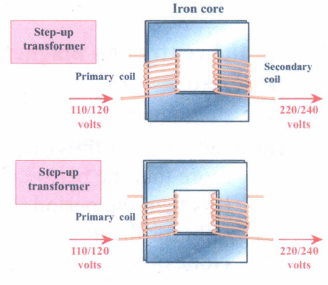
Step up transformer: The transformer used to change a low alternative voltage to a high alternating voltage is called a step up transformer. ie (Vs>Vp ). In a step up transformer, the number of turns in the secondary coil is more than the number of turns in the primary coil (Ns > Np).
Step down transformer: The transformer used to change a high alternating voltage to a low alternating voltage is called a step down transformer (Vs < Vp). In a step down transformer, the number of turns in the secondary coils are less than the number of turns in the primary coil (Ns N
10.
Ground connection:
The metal bodies of all the electrical appliances are to be connected to the ground by means of a third wire apart from the two wires used for electrical connection.
Trip switch:
It is an electromechanical device which does not allow a current beyond a particular value by automatically switching off the connection.
Fuse:
A fuse is another safety mechanism which works on joule heating principle.
11.
The process of changing of a substance from one physical state to another at a definite temperature is defined as change of state.
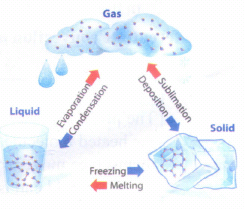
For example, water molecules are in liquid state at normal temperature. When water is heated to 100oC, it becomes steam which is a gaseous state of matter. On reducing the temperature of the steam it becomes water again. If we reduce the temperature further to 0oC, it becomes ice which is a solid state of water. Ice on heating, becomes water again. Thus, water changes its state when there is a change in temperature. There are different such processes in the change of state in matter. The figure shows various processes of change state.
12.
Sudha must take drugs like analgesics because it is the compounds which relieve all sorts of pains without the loss of consciousness.
13.
All the materials are burned by the help of oxygen. The carbon content is less in the less aerated room. So the carbon fuel is added to the atmosphere due to incomplete combustion of fuels, it forms carbon monoxide. It will affect our health. So carbon fuel burnt in less aerated room is dangerous.
14.
When we put the ice cube in a glass of water it will float because density of ice cube is lesser than water. So it will float.
When we put the ice cube in a glass of alcohol it will sink because density of ice cube is greater than alcohol. So it will sink.
Density of water = 1 g cm-3
Density of ice cube = 0.917 g cm-3
Density of alcohol = 0.789 g cm-3

9th Standard Syllabus & Materials
9th Standard
TN 9th Tamil உள்ளத்தின் சீர் - திருக்குறள் Important Questions And Answers Study Material - QB365 Set A
NEW9th Standard
TN 9th Tamil உள்ளத்தின் சீர் - மணிமேகலை Important Questions And Answers Study Material - QB365 Set A
NEW9th Standard
TN 9th Tamil உள்ளத்தின் சீர் - ஏறு தழுவுதல் Important Questions And Answers Study Material - QB365 Set A
NEW9th Standard
TN 9th Tamil உயிருக்கு வேர் - தண்ணீர் Important Questions And Answers Study Material - QB365 Set A



Tamilnadu Stateboard 9th Standard Subjects
Tamilnadu Stateboard Standards





