
 100% FREE ACCESS
9th Standard Syllabus & Materials
9th Standard
TN 9th Tamil உள்ளத்தின் சீர் -கற்கண்டு (இலக்கணம்) - தொடர் இலக்கணம், ஆகுபெயர் Important Questions And Answers Study Material - QB365 Set A
NEW9th Standard
TN 9th Tamil உள்ளத்தின் சீர் -விரிவானம் (துணைப்பாடம்) - தாய்மைக்கு வறட்சி இல்லை! Important Questions And Answers Study Material - QB365 Set A
NEW9th Standard
TN 9th Tamil உள்ளத்தின் சீர் -கவிதை பேழை (செய்யுள்) - மார்கழி பெருவிழா Important Questions And Answers Study Material - QB365 Set A
NEW9th Standard
TN 9th Tamil உயிருக்கு வேர்-இலக்கணம் - பகுபத உறுப்பிலக்கணம் Important Questions And Answers Study Material - QB365 Set A
NEW9th Standard
TN 9th Tamil அமுதென்று பேர் - இலக்கணம்-எழுத்து -அளபெடை Important Questions And Answers Study Material - QB365 Set A
NEW9th Standard
TN 9th Tamil அமுதென்று பேர்-துணைப்பாடம் - ஆறாம்திணை Important Questions And Answers Study Material - QB365 Set A

Published on: 16/06/2021
QB365 provides detailed and simple solution for every Book back Questions in class 9 Science Subject. It will helps to get more idea about question pattern in every book back questions with solution.
Download Tamil Nadu 9th Standard Science question papers, model tests, one-mark questions, important questions, and public exam papers in PDF format. Free study materials and answer keys for TN State Board students.
Questions + Answers key
Take MCQ Science Test1.
What is water recycling? Explain the conventional wastewater recycling treatment methods?
2.
How does a bat adapt itself to its habitat?
3.
What are the conditions in a dry habitat to which plants develop adaptations? List out the adaptations of xerophytes?
4.
Explain carbon cycle with the help of a flow chart?
5.
Describe the processes involved in the water cycle.
1.
Water recycling is reusing treated wastewater for beneficial purposes such as agricultural and landscape irrigation, industrial processes, flushing in toilets and ground water recharge.
Conventional waste water treatment involves the following stages:
Primary treatment:
Primary treatment involves temporary holding of the wastewater in a tank. The heavy solids get settled at the bottom while oil, grease and lighter solids float over the surface. The settled and floating materials are removed. The remaining liquid may be sent for secondary treatment.
Secondary treatment:
Secondary treatment is used to remove the biodegradable dissolved organic matter. This is performed in the presence of oxygen by aerobic microorganisms. The microorganisms must be separated from treated water waste by sedimentation.
After separating the sediments of biological solids, the remaining liquid is discharged for tertiary treatment.
Tertiary treatment:
It involves removal of inorganic constituents such as nitrogen, phosphorus and microorganisms. The fine colloidal particles in the sewage water are precipitated by adding chemical coagulants like alum or ferric sulphate.
2.
Bats adaptations to its habitat:
1. Bats are the only mammals that can fly.
2. Bats live in caves. Caves provide them protection during the day from most predators and the temperature here is very stable.
3. Apart from caves, bats also live in trees hollowed logs and rock crevices. They are extremely important to humans as they reduce insect population and help to pollinate plants.
Nocturnality:
Bats are active at night, as flight requires a lot of energy during day. Their thin, black wing membrane may cause excessive heat absorption during the day, this may lead to dehydration.
Flight adaptation:
1. Its modified forelimbs serve as wings. The bones in the wings of the bats are elongated fingers and are connected by the flaps of skin on either side of the body known as patagia.
2. Tail supports and controls movement during flight, muscles are well developed and highly powerful and achieve in beating of wings.
3. Tendons of hind limbs provide a tight grasp when the animals are suspended upside down at rest.
Hibernation:
1. Hibernation is a state inactivity in which the body temperature drops with a lowered metabolic rate during winter.
2. Bats let their internal temperature reduce when they are resting.
3. They go to a state of decreased activity to conserve energy.
Echolocation:
1. Bats give out high-frequency sounds, ie. ultrasonic sounds.
2. These sounds are reflected back from its prey and perceived by the ear. Bats use these echoes to locate and identify the prey.
3.
Xerophytes:
Plants that grow in dry habitat are called xerophytes. They develop special structured and physiological characteristics to meet the following conditions.
i) To absorb as much water as they can get from the surroundings.
ii) To retain water in their organs for very long time.
iii) To reduce transpiration rate.
iv) To reduce consumption of water.
Adaptations of xerophytes:
1. They have well developed roots, Roots grow very deep and reach the layer where water in available as in allotropic.
2. They store water in succulent water storing parenchymatous tissues. eg: Opuntia, Aloe vera.
3. They have small sized leaves with waxy coating ego Acacia. In some plants leaves are modified into spines eg: Opuntia.
4. Some of the xerophytes complete their life cycle within a very short period when sufficient moisture is available.
4.
1. Carbon occurs in various forms on earth. Charcoal, diamond and graphite are elemental forms of carbon. Combined forms of carbon include carbon monoxide, carbon dioxide and carbonate salts. All living organisms are made up of carbon containing molecules like proteins and nucleic acids.
2. The atmospheric carbon dioxide enters into the plants through the process of photosynthesis to form carbohydrates.
3. From plants, it is passed on to herbivores and carnivores. During respiration, plants and animals release carbon into atmosphere in the form of carbon dioxide.
4. Carbon dioxide is also returned to the atmosphere through decomposition of dead organic matter, burning fossil fuels and volcanic activities.
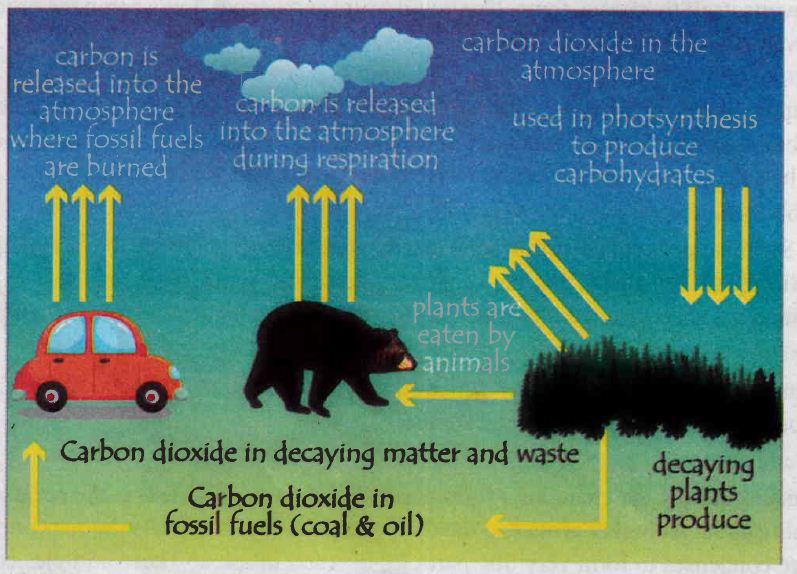
Planting more trees to reduce carbondioxide constant in the atmosphere.
5.
The water cycle involves a series of inter connected pathways involving both the biotic and abiotic components of the biosphere.
Water continuously moves between living organisms, such as plants and non-living things such as clouds, rivers and oceans.
The steps involved in the water cycle are as follows,
1. Evaporation:
Water evaporates from the surface of the earth and water bodies such as the oceans, seas, lakes, ponds and rivers turn into water vapour.
2. Sublimation:
Ice sheets and ice caps from north and south poles and ice caps on mountains, get converted into water vapour directly, without converting into liquid.
3. Transpiration:
It is the process by which plants release water vapour into the atmosphere through stomata in leaves and stems.
4. Condensation:
At higher altitudes, the temperature is low the water vapour present there condenses to form very tiny particles of water droplets. These particles come close together to form clouds and fog.
5. Precipitation:
Due to change in wind or temperature, clouds combine to make bigger droplets, and pour down as precipitation (rain). It includes drizzle, rain, snow and hail.
6. Run off:
As the water pours down, it runs over the surface of earth. Runoff water combines to form channels, rivers, lakes and ends up into seas and oceans.
7.Infiltration:
Some of the precipitated water moves deep into the soil, then it moves down and increases the ground water level.
8. Percolation:
Some of the precipitated water flows through soil and porous or fractured rock.

9th Standard Syllabus & Materials
9th Standard
TN 9th Tamil உள்ளத்தின் சீர் - திருக்குறள் Important Questions And Answers Study Material - QB365 Set A
NEW9th Standard
TN 9th Tamil உள்ளத்தின் சீர் - மணிமேகலை Important Questions And Answers Study Material - QB365 Set A
NEW9th Standard
TN 9th Tamil உள்ளத்தின் சீர் - ஏறு தழுவுதல் Important Questions And Answers Study Material - QB365 Set A
NEW9th Standard
TN 9th Tamil உயிருக்கு வேர் - தண்ணீர் Important Questions And Answers Study Material - QB365 Set A



Tamilnadu Stateboard 9th Standard Subjects
Tamilnadu Stateboard Standards





