
 100% FREE ACCESS
9th Standard Syllabus & Materials
9th Standard
TN 9th Tamil உள்ளத்தின் சீர் -கற்கண்டு (இலக்கணம்) - தொடர் இலக்கணம், ஆகுபெயர் Important Questions And Answers Study Material - QB365 Set A
NEW9th Standard
TN 9th Tamil உள்ளத்தின் சீர் -விரிவானம் (துணைப்பாடம்) - தாய்மைக்கு வறட்சி இல்லை! Important Questions And Answers Study Material - QB365 Set A
NEW9th Standard
TN 9th Tamil உள்ளத்தின் சீர் -கவிதை பேழை (செய்யுள்) - மார்கழி பெருவிழா Important Questions And Answers Study Material - QB365 Set A
NEW9th Standard
TN 9th Tamil உயிருக்கு வேர்-இலக்கணம் - பகுபத உறுப்பிலக்கணம் Important Questions And Answers Study Material - QB365 Set A
NEW9th Standard
TN 9th Tamil அமுதென்று பேர் - இலக்கணம்-எழுத்து -அளபெடை Important Questions And Answers Study Material - QB365 Set A
NEW9th Standard
TN 9th Tamil அமுதென்று பேர்-துணைப்பாடம் - ஆறாம்திணை Important Questions And Answers Study Material - QB365 Set A

Published on: 16/06/2021
QB365 provides detailed and simple solution for every Book back Questions in class 9 Science Subject. It will helps to get more idea about question pattern in every book back questions with solution.
Download Tamil Nadu 9th Standard Science question papers, model tests, one-mark questions, important questions, and public exam papers in PDF format. Free study materials and answer keys for TN State Board students.
Questions + Answers key
Take MCQ Science Test1.
The radius of curvature of a convex mirror is 40 cm. Find its focal length
2.
State and verify laws of refraction using a glass slab.
3.
a) Draw ray diagrams to show how the image is formed using a concave mirror, when the position of object is i) at C ii) between C and F iii) between F and P of the mirror.
b) Mention in the diagram the position and nature of image in each case.
4.
The speed of light in water is 2.25 × 10⁸ ms-1. If the speed of light in vacuum is 3 × 10⁸ ms-1, calculate the refractive index of water.
5.
A concave mirror produces three times magnified real image of an object placed at 7 cm in front of it. Where is the image located?
1.
\(Radius\ of\ curvature=40cm\\ focal\quad length=?\\ R=2f\\ 40=2\times f\\ f=\frac { 40 }{ 2 } =20cm\\ Focal\ length=20cm\)
2.
The laws of refraction of light : The incident ray, the refracted ray and the normal to the interface of two transparent media at the point of incidence, all lie in the same plane. The ratio of the sine of the angle of incidence to the sine of the angle of refraction is a constant for a light of given colour and for the given pair of media. This law is also known as Snell's law of refraction.
If i is the angle of incidence and r is the angle of refraction, then
\(\frac { \sin { i } }{ \sin { r } } =constant\)
Verification of laws of refraction :
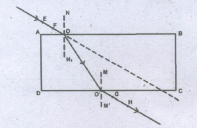
(1) Fix a sheet of white paper on a drawing board using drawing pins.
(2) Place a rectangular glass slab over the sheet in the middle. Draw the outline of the slab with a pencil. Let us name the outline as ABCD. Take four identical pins.
(3) Fix two pins. Say E and F, vertically such that the line joining the pins is inclined to the edge AB.
(4) Look for the images of the pins E and F through the opposite edge. Fix two other pins, say G and H, such that these pins and the images of E and F lie on a straight line.
(5) Remove the pins and the slab.
(6) Join the prints of the pins E and F and let it meet AB at O. Let EF meet AB at O. Similarly, join the prints of the pins G and H and Let it meet HG at O'. Join o and O'. Also produce EF as shown by a dotted line in Figure.
(7) Draw a perpendicular NN' to AB at O and another perpendicular MM' to CD at O'. In this activity, you will note that, the light ray has changed its direction at points O and O'. Note that both the points O and O' lie on surfaces separating two transparent media. The light ray has entered from air to glass and has bent towards the normal that is from a rarer to denser medium.
(8) The light ray has emerged from glass to air that is from a denser medium to a rarer medium. The light here has bent away from the normal. Compare the angle of incidence with the angle of refraction at both refracting surfaces AB and CD.
(9) In Figure, EO is the incident ray OO' the refracted ray and O'H the emergent ray. You may observe that the emergent ray is parallel to the direction of the incident ray.
(10) The extent of bending of the ray of light at the opposite parallel faces AB (air-glass interface) and CD (glass-air-interface) of the rectangular glass slab is equal and opposite. This is why the ray emerges parallel to the incident ray.
3.
(a) (i) At the centre of Curvature C
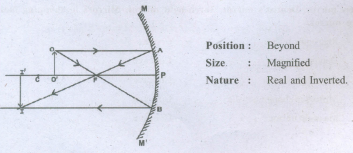
(ii) Between C and F
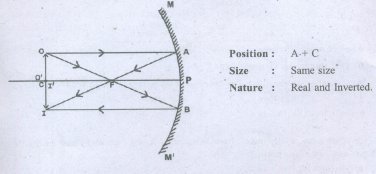
(iii) Between the focus F and the pole P of the mirror.
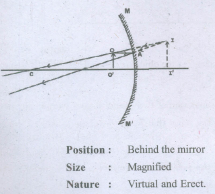
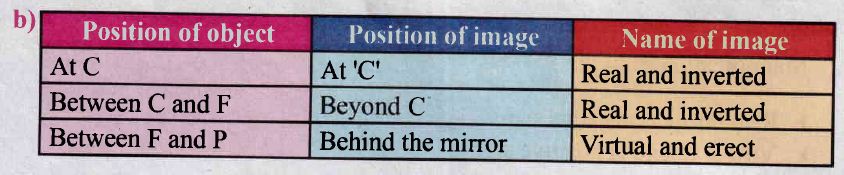
4.
Speed of light in water \(=2.25 \times 10^{8} \mathrm{~ms}^{-1}\)
Speed of light in vacuum \(=3 \times 10^{8} \mathrm{~ms}^{-1}\)
(\(\mu\)) Refractive index of water =?
\(\mu =\frac{\text { Speed of light in vacuum }}{\text { Speed of light in water }} \)
\(=\frac{3 \times \not10^{-8}}{2.25 \times \not10^{-8}}=\frac{3}{2.25} \)
\(\mu\) = 1.33
5.
Distance of object = 7 cm
Magnified real image = distance of object x 3 times
= 7 x 3 = 21 cm
Location: In front of the mirror because it is concave mirror.

9th Standard Syllabus & Materials
9th Standard
TN 9th Tamil உள்ளத்தின் சீர் - திருக்குறள் Important Questions And Answers Study Material - QB365 Set A
NEW9th Standard
TN 9th Tamil உள்ளத்தின் சீர் - மணிமேகலை Important Questions And Answers Study Material - QB365 Set A
NEW9th Standard
TN 9th Tamil உள்ளத்தின் சீர் - ஏறு தழுவுதல் Important Questions And Answers Study Material - QB365 Set A
NEW9th Standard
TN 9th Tamil உயிருக்கு வேர் - தண்ணீர் Important Questions And Answers Study Material - QB365 Set A



Tamilnadu Stateboard 9th Standard Subjects
Tamilnadu Stateboard Standards





