
 100% FREE ACCESS
9th Standard Syllabus & Materials
9th Standard
TN 9th Tamil உள்ளத்தின் சீர் -கற்கண்டு (இலக்கணம்) - தொடர் இலக்கணம், ஆகுபெயர் Important Questions And Answers Study Material - QB365 Set A
NEW9th Standard
TN 9th Tamil உள்ளத்தின் சீர் -விரிவானம் (துணைப்பாடம்) - தாய்மைக்கு வறட்சி இல்லை! Important Questions And Answers Study Material - QB365 Set A
NEW9th Standard
TN 9th Tamil உள்ளத்தின் சீர் -கவிதை பேழை (செய்யுள்) - மார்கழி பெருவிழா Important Questions And Answers Study Material - QB365 Set A
NEW9th Standard
TN 9th Tamil உயிருக்கு வேர்-இலக்கணம் - பகுபத உறுப்பிலக்கணம் Important Questions And Answers Study Material - QB365 Set A
NEW9th Standard
TN 9th Tamil அமுதென்று பேர் - இலக்கணம்-எழுத்து -அளபெடை Important Questions And Answers Study Material - QB365 Set A
NEW9th Standard
TN 9th Tamil அமுதென்று பேர்-துணைப்பாடம் - ஆறாம்திணை Important Questions And Answers Study Material - QB365 Set A

Published on: 16/06/2021
QB365 provides detailed and simple solution for every Book back Questions in class 9 Science Subject. It will helps to get more idea about question pattern in every book back questions with solution.
Download Tamil Nadu 9th Standard Science question papers, model tests, one-mark questions, important questions, and public exam papers in PDF format. Free study materials and answer keys for TN State Board students.
Questions + Answers key
Take MCQ Science Test1.
You are now familiarised with various plant and animal tissues. Point out any five differences between these tissues.
2.
Give one reason for the following
a. Blood is fluid connective tissue
b. Skeletal muscles contain contractile proteins
c. Heart muscles are involuntary in nature
3.
Write about the elements of Xylem.
4.
What are permanent tissues? Describe the different types of simple permanent tissue.
5.
Which are not true cells in the blood? Why?
1.
| S.No | Plant tissues | Animal tissues |
| 1. | Plants are autotrophic and hence tissues are maintained easily | Animal tissues need more energy since animals are heterotrophic |
| 2. | Tissues are differentiated into meristematic and permanent tissues. | Differentiation of this kind is not seen in animal tissues |
| 3. | Plant tissues continue to grow throughout life because of meristems. | Growth is not seen after maturity in animals. Only repair of damaged cells occur. |
| 4. | Plant tissues are simple. | Animal tissues, are more complex since specialised organ systems are seen in animals |
| 5. | Lot of dead supportive tissues are seen in plants | Living tissues are- only abundant in animals. |
2.
(a) Blood is a connective tissue since it has cells lying in a matrix. Plasma is the matrix containing erythrocytes, leucocytes and platelets. It is considered to be a fluid connective tissue since bulk of the tissue is the fluid plasma and blood cells move in the fluid matrix. This helps blood to transport substances to different parts of the body.
(b) The skeletal muscles are attached to bones and are responsible for the body movements. They undergo rapid contraction during movements. The movement of the body and limbs are brought about by the contraction and relaxation of contractile proteins present in muscle cells.
(c) Heart muscles are cardiac muscles which is a contractile tissue. The contraction of cardiac muscle is involuntary and rhythmic. Heart is the main pumping organ of the circulatory system of our body and blood circulation is required for transport of respiratory gases, and nutrients. Therefore heart has to function effectively and actively at all times. Hence the heart muscles are involuntary and cannot be controlled by our will.
3.
Xylem:
(i) Xylem is a conducting tissue which conducts water, mineral nutrients upward from root to leaves.
(ii) Xylem is composed of different kinds of elements. They are (1) xylem tracheids (2) xylem fibres (3) xylem vessels and (4) xylem parenchyma
(1) Xylem tracheids
(i) They are elongated or tube-like dead cells with hard, thick and lignified walls.
(ii) Their ends are tapering, blunt or chisel-like and devoid of protoplast. They have large lumen without any content.
(iii) Their function is conduction of water and providing mechanical support to the plant.
(2) Xylem fibres
(i) These cells are elongated, lignified and pointed at both the ends.
(ii) Xylem fibres help in conduction of water and nutrients from root to the leaf and also provide mechanical support to the plant.
(3) Xylem vessels
(i) They are long cylindrical, tube like structures with lignified walls and wide central lumen.
(ii) These cells are dead as these do not have protoplast.
(iii) They are arranged in longitudinal series in which the partitioned walls (transverse walls) are perforated, and so the entire structure looks-like a water pipe.
(iv) Their main function is transport of water and minerals from root to leaf, and also to provide mechanical strength.
(4) Xylem parenchyma
Its cells are living and thin walled. The main function of xylem parenchyma is to store starch and fatty substances.
4.
Permanent tissues:
(i) Permanent tissues are those in which, growth has stopped either completely or for the time being. At times, they become meristematic partially or wholly.
(ii) Permanent tissues are of two types namely (a) simple tissue and (b) complex Simple tissue: Simple tissue are homogeneous - composed of structurally and functionally similar cells. Eg: Parenchyma, collenchyma and sclerenchyma.
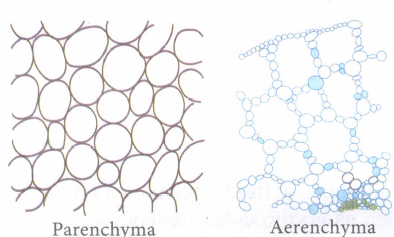
Parenchyma
(i) Parenchyma are simple permanent tissues composed of living cells.
(ii) Parenchyma cells are thin walled, oval, rounded or polygonal in shape with well developed spaces among them.
(iii) In aquatic plants, parenchyma possesses intercellular air spaces, and is named as aerenchyma.
(iv) When exposed to light, parenchyma cells may develop chloroplasts and are known as chlorenchyma.
Functions:
Parenchyma may store water in many succulent and xerophytic plants. It also serves the functions of storage of food reserves, absorption, buoyancy, secretion etc
Collenchyma :
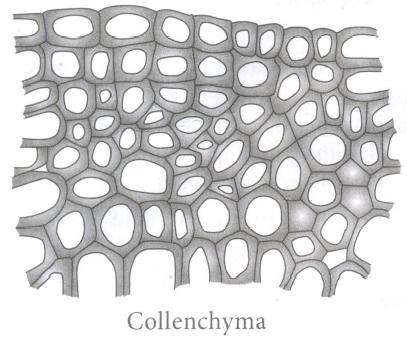
(i) Collenchyma is a living tissue found beneath the epidermis.
(ii) Cells are elongated with unevenly thickened non-lignified walls. Cells have rectangular oblique or tapering ends and persistent protoplast.
(iii) They possess thick primary non-lignified walls.
Functions:
They provide mechanical support for growing organs.
Sclerenchyma :
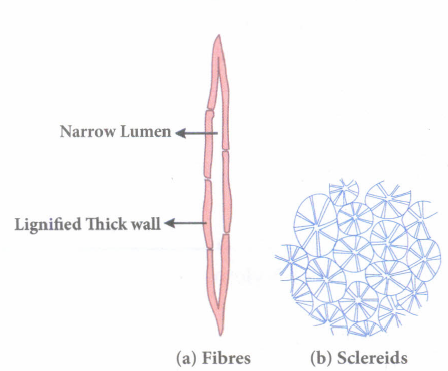
(i) Sclerenchyma consists of thick walled cells which are often lignified,
(ii) Sclerenchyma cells are dead and do not possess living protoplasts at maturity. Sclerenchyma cells are grouped into (i) fibres and (ii) sclereids.
(iii) Fibres are elongated sclerenchymatous cells, usually with pointed ends. Their walls are lignified. Fibres are abundantly found in many plants. Eg., Jute.
Sclereids:
(i) Sclereids are widely distributed in plant body. They are usually broad, may occur in single or in groups.
(ii) Sclereids are isodiametric, with lignified walls. Pits are prominent and seen along the walls.
(iii) Lumen is filled with wall materials. Sclereids are also common in fruits and seeds.
5.
Red blood cell and platelets are not true cells in the blood, because they lack of nucleus.

9th Standard Syllabus & Materials
9th Standard
TN 9th Tamil உள்ளத்தின் சீர் - திருக்குறள் Important Questions And Answers Study Material - QB365 Set A
NEW9th Standard
TN 9th Tamil உள்ளத்தின் சீர் - மணிமேகலை Important Questions And Answers Study Material - QB365 Set A
NEW9th Standard
TN 9th Tamil உள்ளத்தின் சீர் - ஏறு தழுவுதல் Important Questions And Answers Study Material - QB365 Set A
NEW9th Standard
TN 9th Tamil உயிருக்கு வேர் - தண்ணீர் Important Questions And Answers Study Material - QB365 Set A



Tamilnadu Stateboard 9th Standard Subjects
Tamilnadu Stateboard Standards





