
 100% FREE ACCESS
9th Standard Syllabus & Materials
9th Standard
TN 9th Tamil உள்ளத்தின் சீர் -கற்கண்டு (இலக்கணம்) - தொடர் இலக்கணம், ஆகுபெயர் Important Questions And Answers Study Material - QB365 Set A
NEW9th Standard
TN 9th Tamil உள்ளத்தின் சீர் -விரிவானம் (துணைப்பாடம்) - தாய்மைக்கு வறட்சி இல்லை! Important Questions And Answers Study Material - QB365 Set A
NEW9th Standard
TN 9th Tamil உள்ளத்தின் சீர் -கவிதை பேழை (செய்யுள்) - மார்கழி பெருவிழா Important Questions And Answers Study Material - QB365 Set A
NEW9th Standard
TN 9th Tamil உயிருக்கு வேர்-இலக்கணம் - பகுபத உறுப்பிலக்கணம் Important Questions And Answers Study Material - QB365 Set A
NEW9th Standard
TN 9th Tamil அமுதென்று பேர் - இலக்கணம்-எழுத்து -அளபெடை Important Questions And Answers Study Material - QB365 Set A
NEW9th Standard
TN 9th Tamil அமுதென்று பேர்-துணைப்பாடம் - ஆறாம்திணை Important Questions And Answers Study Material - QB365 Set A

Published on: 13/05/2022
QB365 provides detailed and simple solution for every Book back Questions in class 9 Science Subject. It will helps to get more idea about question pattern in every book back questions with solution.
latest Book back QuestionsDownload Tamil Nadu 9th Standard Science question papers, model tests, one-mark questions, important questions, and public exam papers in PDF format. Free study materials and answer keys for TN State Board students.
Questions + Answers key
Take MCQ Science Test1.
Explain the working of human ear with diagram.
2.
Explain how does SONAR work?
3.
List the applications of sound.
4.
Verify experimentally the laws of reflection of sound.
5.
Describe with diagram, how compressions and rarefactions are produced.
1.
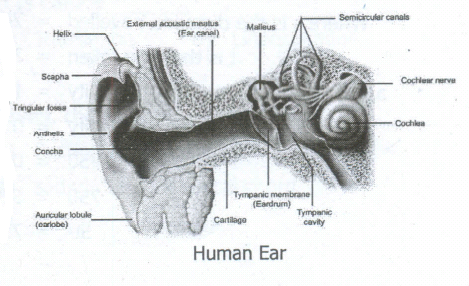
1. Sound from the surroundings is collected by the outer ear, called as 'pinna' .
2. The collected sound passes through the auditory canal.
3. At the end of the ear is eardrum or tympanic membrane.
4. When a compression of the medium reaches the eardrum the pressure on the outside of the membrane increases and forces the eardrum inward.
5. Similarly the eardrum moves outward when a rarefaction reaches it.
6. In this way the eardrum vibrates.
7. The vibrations are amplified several times by three bones called as the hammer, anvil and stirrup in the middle ear.
8. The middle ear transmits the amplified pressure variations received from the sound wave to the inner ear.
9. In the inner ear the pressure variations are turned into electrical signals by 'cochlea'
10. These electrical signals are sent to the brain via the auditory nerve and the brain interprets them as sound.
2.
1. SONAR stands for Sound Navigation and Ranging.
2. It is a device that uses ultrasonic waves to measure the distance, direction and speed of underwater objects.
3. It consists of a transmitter and a detector and is installed at the bottom of the boats and ships.
4. The transmitter produces and transmits ultrasonic waves.
5. These waves travel through water and after striking the object on seabed, get reflected back and are sensed by a detector.
6. The detector converts the ultrasonic waves into electrical signals which are appropriately interpreted.
7. The distance of the object that reflected the sound wave can be calculated by knowing the speed of sound in water and the time interval between transmission and reception of the ultrasound.
8. Let the time interval between transmission and reception of ultrasound signals be 't' and the speed of sound through sea water be 2d/t = v. This method is called echo ranging.
9. SONAR technique is used to determine the depth of the sea and to locate underwater hills, valleys, submarine icebergs etc.,
3.
1. Musical instruments such as shehnai, trumpets and Nathaswaram, Megaphones, loudspeakers use the property of reflection of sound to guide most of the sound waves from the source in the forward direction towards the audience.
2. In stethoscopes, sound produced in the body reaches doctor's ears by multiple reflection of sound that happen in the connecting tube.
3. Echo is used to find the distance between two distant objects.
4. Ultrasound is used in examining inner parts of the body and also in marine surveying.
5. Ultrasound is used in cleaning technology, to detect cracks and flaws to form the image of the heart through 'echocardiography'.
6. Ultrasound is employed to break stones formed in the kidney.
7. 'SONAR' is a device that uses ultrasonic waves to measure the distance, direction and speed of the underwater objects.
8. In Electrocardiogram (ECG) the sound variation produced by the heart is converted into electrical signals, which represents the electrical activity of the heart muscle.
4.
The Laws of reflection of sound are:
1. The angle in which the sound is incident is equal to the angle in which sound is reflected.
2. Direction of incident sound, direction of the reflected sound and the normal are in the same plane.
Experimental verification:
1. Take two identical pipes, the pipes can be made using chart paper also.
2. The length of the pipes should be sufficiently long.
3. Arrange them on the table near the wall or keep a hard plywood at one end of the pipes and soft wood in the middle of the two pipes as shown in the figure.
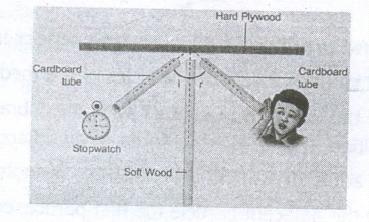
4. keep a clock near the open end of one of the pipes and try to hear the sound of the clock through the other pipe. Adjust the position of the pipes so that we can best hear the sound of the clock.
5. Now measure the angle of incidence and angle of reflection.
6. It is observed that for every angle of incidence, say 30°, 35°, 40°, the angle of reflection is same as 30°, 35° and 40°.
7. Thus it is proved that angle of incidence is equal to the angle of reflection and direction of incident and reflected sounds and normal lie in the same plane.
5.
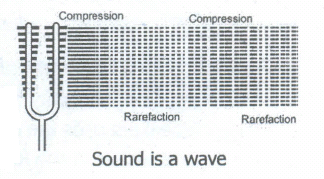
1. When a vibrating body moves forward it pushes and compresses the air in front of it creating a region of high pressure. This region is called Compression. This compression starts to move away from the vibrating object.
2. When a vibrating body moves backwards, it creates a region of low pressure called rarefaction. As the object is in a to and fro movement or oscillates rapidly a series of compressions and rarefactions is created in the air.
3. This makes the sound wave to propagate in the air.
4. compressions are the regions where particles are crowded together creating high pressure region. And rarefactions are the regions, where the particles are spread apart creating low pressure region.

9th Standard Syllabus & Materials
9th Standard
TN 9th Tamil உள்ளத்தின் சீர் - திருக்குறள் Important Questions And Answers Study Material - QB365 Set A
NEW9th Standard
TN 9th Tamil உள்ளத்தின் சீர் - மணிமேகலை Important Questions And Answers Study Material - QB365 Set A
NEW9th Standard
TN 9th Tamil உள்ளத்தின் சீர் - ஏறு தழுவுதல் Important Questions And Answers Study Material - QB365 Set A
NEW9th Standard
TN 9th Tamil உயிருக்கு வேர் - தண்ணீர் Important Questions And Answers Study Material - QB365 Set A



Tamilnadu Stateboard 9th Standard Subjects
Tamilnadu Stateboard Standards





