
 100% FREE ACCESS
9th Standard Syllabus & Materials
9th Standard
TN 9th Tamil உள்ளத்தின் சீர் -கற்கண்டு (இலக்கணம்) - தொடர் இலக்கணம், ஆகுபெயர் Important Questions And Answers Study Material - QB365 Set A
NEW9th Standard
TN 9th Tamil உள்ளத்தின் சீர் -விரிவானம் (துணைப்பாடம்) - தாய்மைக்கு வறட்சி இல்லை! Important Questions And Answers Study Material - QB365 Set A
NEW9th Standard
TN 9th Tamil உள்ளத்தின் சீர் -கவிதை பேழை (செய்யுள்) - மார்கழி பெருவிழா Important Questions And Answers Study Material - QB365 Set A
NEW9th Standard
TN 9th Tamil உயிருக்கு வேர்-இலக்கணம் - பகுபத உறுப்பிலக்கணம் Important Questions And Answers Study Material - QB365 Set A
NEW9th Standard
TN 9th Tamil அமுதென்று பேர் - இலக்கணம்-எழுத்து -அளபெடை Important Questions And Answers Study Material - QB365 Set A
NEW9th Standard
TN 9th Tamil அமுதென்று பேர்-துணைப்பாடம் - ஆறாம்திணை Important Questions And Answers Study Material - QB365 Set A

Published on: 15/06/2021
QB365 provides detailed and simple solution for every book back questions in class 9 Social Science subject.It will helps to get more idea about question pattern in every book back questions with solution.
Download Tamil Nadu 9th Standard Social Science question papers, model tests, one-mark questions, important questions, and public exam papers in PDF format. Free study materials and answer keys for TN State Board students.
Questions + Answers key
Take MCQ Social Science Test
1.
Colonel Pennycuick.
2.
What was the background for the storming of Bastille Prison?
3.
Point out the significance of “the Boston Tea Party”.
4.
What are the components of remote sensing?
5.
What are the components of a map?
6.
Name the different methods to represent the Earth.
7.
Mention the important functions of the Village Panchayat.
8.
Name the taxes levied by the Village Panchayat.
9.
List the four destinations and the percentage of migrants from Tamil Nadu
10.
Name four districts in Tamil Nadu which record low number of migration.
11.
Write any two ways of how the locals and the government restored Palk Bay.
12.
Democracy in Nepal
13.
Unitary and federal forms of government.
14.
On what factors does crop cultivation depend? List out the factors on which crop cultivation depend.
15.
Who monitors the quantity and quality of ground water?
16.
Narrate the given food web of Arctic Tundra in your own words.
17.
What is an ecosystem?
18.
How are Cyclones classified?
19.
How is the atmospheric Pressure measured?
20.
What is insolation?
21.
Define atmosphere.
22.
Hammurabi Code is an important legal document. Explain.
23.
The Egyptians excelled in art and architecture Illustrate.
24.
Enumerate the distinctive characteristics of Neanderthals.
25.
Discuss how the age of speculation made humans become conscious and knowledgeable.
1.
(i) Pennycuick was an army engineer and civil servant who also served as a member of the Madras legislative council.
(ii) He decided to divert the west flowing Periyar river draining into the Arabian sea to the east, so that it could irrigate lakhs of acres of dry land dependent on the Vaigai river.
(iii) Though Pennycuick and other British engineers went ahead with the construction braving nature's fury and the dangers of poisonous insects and wild animals, the construction was disrupted by relentless rain.
(iv) Since he could not get adequate funds from the British government, Pennycuick went to England and sold his family property to mobilise money to fund the project which was completed in 1895.
(v) The Mullai Periyar Dam continues to irrigate agricultural lands in Theni, Dindigul, Madurai, Sivagangai and Ramanathapuram districts.
2.
(i) The critical moment came after the king shut out the commoners and the latter assembled in the Tennis-court and took an oath that they would not disperse until they found a way out to their problems.
(ii) The king tried to use force but his own soldiers refused to obey his orders.
(ii) King Louis then intrigued to get foreign regiments to shoot down his own people.
(iii) This provoked the people to rise in revolt in Paris on 14 July 1789.
(iv) They stormed the Bastille prison and set free all the prisoners.
(v) The fall of Bastille was the first great turning point in the French revolution.
3.
(i) The British Parliament repeated the Townshend Acts. But it retained the tax on tea.
(ii) This harmed the local tea trade and so it was decided to boycott this tea. In many places the colonists obstructed the import of tea.
(iii) In NewYork and Philadelphia ships carrying tea were blocked.
(iv) In December 1773, a group of men disguised themselves as Native Americans boarded the Cargo vessels and threw the tea overboard which was hailed as the Boston Tea party.
(v) It was a challenge which led to war between the rebellious colonies and England.
4.
Components of remote sensing are
(i) Energy source
(ii) Transmission path
(iii) Target
(iv) Sensor
5.
A map should include the following components namely, the title, scale, direction, grid reference, projection, legend, conventional signs and symbols
6.
(i) A map is the basic tool of a geographer. It illustrates the earth's surface clearly and effectively through a combination of drawings, words and symbols.
(ii) A map projection is a way of showing the spherical shaped earth on a flat piece of paper.
(iii) A map projection is a systematic transformation of the latitudes and longitudes oflocation from the surface of a sphere or an ellipsoid into locations on a plane.
(iv) A Globe is a spherical model of earth. Globe Serve similar purposes to maps but unlike maps do not disturb the surface that they portray except to scale it down. A globe of earth is called terrestrial globe.
7.
Important functions of the Village Panchayat are
(i) Supply of drinking water
(ii) Maintenance of street lights
(iii) Maintenance of Road
(iv) Maintenance of village libraries
(v) Maintenance of small bridges
(vi) Maintenance of drainage
(vii) Maintenance of burial grounds
(viii) Granting permission to housing plots
(ix) Construction of group houses
(x) Cleaning of streets
(xi) Maintenance of common lavatory facilities
8.
The village panchayats levy the following taxes such as, Property tax, Professional tax, House tax, Taxes on connecting drinking water, Land tax and Taxes levied on shops.
9.
(i) Of the total migrants who go to foreign countries, nearly 20% have chosen to go to Singapore.
(ii) 18 % have gone to United Arab Emirates.
(iii) 16 % to Saudi Arabia.
(iv) 13 % to United States of America.
(v) Malaysia, Kuwait, Oman, Quatar, Australia and England are also refered as important destinations for migrants from Tamil Nadu, in 2015
10.
Cuddalore, Karur, Tiruvannamalai, Velur, Namakkal, Salem, Dindigul, Krishnagiri, Nilgiris and Dharmapuri districts record low incidence of emigrants.
11.
(i) Saplings of native species of plants and trees are being grown planet and cared for
(ii) Live colonies of coral from the Gulf of Mannar Biosphere Reserve are being transplanted to Palk Bay. The existing mangroves and the region are being mapped and the way land is used around the mangrove is being studied.
(iii) Along with awareness programmes, the communities are also being provided with livelihood training, so they can earn an income in more ways than just fishing.
12.
April Revolution and democracy in Nepal.
i) On April 2006, the leaders of Nepal vibrant pre-democracy civil society movement "Seven Party Alliance" (SPA) called for a million strong demonstration.
ii) It was stage at seven different points along the Ring road encircling the capital Kathmandu.
iii) People demanded end to the autocratic rule of monarchy and restoration of total democracy.
iv) The king Gyanendra stopped down paring the way for democracy in Nepal.
13.
| S.No | Unitary form of government | Federal form of government |
|---|---|---|
| 1 | Only one level of government or sub units | Two levels of government |
| 3 | Mostly single citizenship | Dual citizenship |
| 4 | Subunits cannot operate independently | Federal units are answerable to central government |
| 5 | No division of power. | Division of power. |
| 6 | Centralisation of power. | Decentralisation of power. |
14.
The crop cultivation depends on the amount of land being cultivated, productivity of crops, source of water weather, rainfall etc.
15.
(i) The Union Water Board is constantly monitoring the level and nature of ground water.
(ii) This continuous monitoring has categorized the Panchayat Union in terms of the amount of groundwater used.
16.
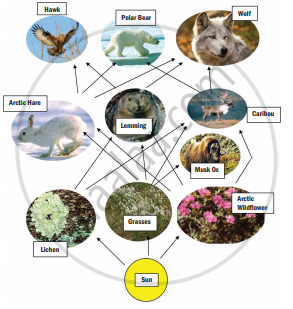
It is a well-balanced food web. This region gets slanting sunrays means very little sunlight in which lichens, grasses, and wildflowers grow and form the first trophic level as a producer. In the second trophic level herbivores who depend on the producers for survival like Arctic Hare, Musk ox, Lemming is the primary consumers. Carnivores who eat the herbivore are-Hawk, Polar Bear and Wolf. They are above the herbivores in a food pyramid. They are secondary consumers.
17.
(i) An ecosystem is a community, where all living organisms live and interact with one another and also with their non-living environment such as land, soil, air, water etc.
(ii) Ecosystems range in size from the smallest units (Eg: bark of a tree) that can sustain life to the global ecosystem or ecosphere. (Eg: Cropland, Pond ecosystem, Forest ecosystem, Desert ecosystem etc.).
(iii) Biosphere harbours all ecosystems on the earth and sustains life forms including mankind.
18.
Cyclones can be classified into
(i) Tropical cyclones
(ii) Temperate cyclones
(iii) Extra Tropical cyclones
19.
The atmospheric pressure is measured with a mercury barometer and the unit of measurement is millibar (mb).
20.
The amount of heat received from the sun in the form of short waves is called insulation (or) incoming Solar Radiation
21.
(i) The blanket of air that surrounds the Earth is called the atmosphere.
(ii) It is held close to the earth by gravitational attraction.
(iii) Atmosphere plays on important role in predicting weather phenomenon.
(iv) It is a mixture of gases, water vapour and dust particles in different proportion.
22.
(i) Hammurabi Code is an important legal document that specifies the laws related to various crimes.
(ii) It has 282 provisions specifying cases related to family rights, trade, slavery, taxes and wages.
(iii) It is carved on a stone, which portrays Hammurabi as receiving the code from the Sun god Shamash.
(iv) It was a compilation of old laws based on retributive principles.
(v) The 'eye for eye' and 'tooth for tooth' form of justice is used in the Hammurabi Code.
23.
1. The Numerous sculpture, paintings and carvings attest to the artistic skills of Egyptians.
2. Their writing is also a form of art.
3. Giza pyramids are considered to be one of the wonders of the world.
4. These monuments display the engineering, architectural and human resource management skills of the Egyptians.
24.
(i) The people of Middle Palaeo lithic culture were called Neanderthals.
(ii) They buried the dead people systematically.
(iii) They were the first human ancestors to mourn death properly and bury the dead.
(iv) They did not have needles, sewn clothes and warm houses essential for survival in colder climates.
25.
1. In the course of evolution, humans became conscious and knowledgeable.
2. They turned curious and began to think and ask questions.
3. At first, they considered nature as God.
4. They worshipped sun, moon and various natural forces about which they developed their own understanding.

9th Standard Syllabus & Materials
9th Standard
TN 9th Tamil உள்ளத்தின் சீர் - திருக்குறள் Important Questions And Answers Study Material - QB365 Set A
NEW9th Standard
TN 9th Tamil உள்ளத்தின் சீர் - மணிமேகலை Important Questions And Answers Study Material - QB365 Set A
NEW9th Standard
TN 9th Tamil உள்ளத்தின் சீர் - ஏறு தழுவுதல் Important Questions And Answers Study Material - QB365 Set A
NEW9th Standard
TN 9th Tamil உயிருக்கு வேர் - தண்ணீர் Important Questions And Answers Study Material - QB365 Set A



Tamilnadu Stateboard 9th Standard Subjects
Tamilnadu Stateboard Standards




