
 100% FREE ACCESS
9th Standard Syllabus & Materials
9th Standard
TN 9th Tamil உள்ளத்தின் சீர் -கற்கண்டு (இலக்கணம்) - தொடர் இலக்கணம், ஆகுபெயர் Important Questions And Answers Study Material - QB365 Set A
NEW9th Standard
TN 9th Tamil உள்ளத்தின் சீர் -விரிவானம் (துணைப்பாடம்) - தாய்மைக்கு வறட்சி இல்லை! Important Questions And Answers Study Material - QB365 Set A
NEW9th Standard
TN 9th Tamil உள்ளத்தின் சீர் -கவிதை பேழை (செய்யுள்) - மார்கழி பெருவிழா Important Questions And Answers Study Material - QB365 Set A
NEW9th Standard
TN 9th Tamil உயிருக்கு வேர்-இலக்கணம் - பகுபத உறுப்பிலக்கணம் Important Questions And Answers Study Material - QB365 Set A
NEW9th Standard
TN 9th Tamil அமுதென்று பேர் - இலக்கணம்-எழுத்து -அளபெடை Important Questions And Answers Study Material - QB365 Set A
NEW9th Standard
TN 9th Tamil அமுதென்று பேர்-துணைப்பாடம் - ஆறாம்திணை Important Questions And Answers Study Material - QB365 Set A

Published on: 15/06/2021
QB365 provides detailed and simple solution for every book back questions in class 9 Social Science subject.It will helps to get more idea about question pattern in every book back questions with solution.
Download Tamil Nadu 9th Standard Social Science question papers, model tests, one-mark questions, important questions, and public exam papers in PDF format. Free study materials and answer keys for TN State Board students.
Questions + Answers key
Take MCQ Social Science Test
1.
Mention the two natural advantages that India had in cotton weaving.
2.
Write about the military expeditions of Malik Kafur.
3.
How was Feudalism organized in the Middle Ages?
4.
Contribution of Arabs to Science and Technology
5.
Write about St. Sophia Cathedral
6.
What do you know of the Carthaginian leader Hannibal?
7.
Attempt an account of slavery in Rome.
8.
Scientists use GPS to measure the rate of Tectonic Plate movements. Discuss.
9.
Highlight the steps taken by Ashoka to spread Buddhism.
10.
What do you know of Ajathasatru?
11.
Agriculture was one of the main sources of subsistence in Sangam Age. Give reasons
12.
How important are coins as a source of evidence for the study of Sangam Age?
13.
What are wave cut platforms?
14.
Define :
a) Moraine
b) Drumlin
c) Esker
15.
What are ox-bow lakes?
16.
What do you mean by biological weathering?
17.
Agriculture, despite a sharp decline in Gross Domestic Product, continues to be the largest employer in Tamil Nadu. Give reason
18.
Why are children and old age (above 60 years) are not considered for computation of workforce?
19.
Why human resources is considered as the foremost resource of any country?
20.
What are the indicators of development?
21.
Distinguish between two-party system and the multi-party system.
22.
Explain the electoral system in India.
23.
Mention the forms of democracy.
24.
Discuss the multi-party system.
25.
Write in detail what kind of environmental problems you face in your locality.
1.
(i) The first was that cotton grew in almost all parts of India, so that the basic raw material was easily available.
(ii) Second, the technology of producing a permanent colour on cotton using vegetable dyes was known from very early times in India.
(iii) Indigo was the most important dye crop that was grown in India.
2.
The first ten years of the 1300 AD(CE) Alauddin Khalji's slave and commander Malik Kafur was sent on military expedition to south India.
3.
(i) The king, supposed to represent God on earth was at the head of the feudal regime.
(ii) Immediately after him were the great nobles, known as dukes, counts, earls.
(iii) The king gives the land to the land lords.
(iv) The land lords get the land and accept to fight for the king.
(v) The land lords divide the land and distribute it to the viscounts or barons.
(vi) Last in this order were the knights, whose fiefs could not be divided.
(vii) At the bottom were the villeins or serfs.
4.
(i) Arabs were more interested in scholarly pursuits.
(ii) They had a scientific spirit of inquiry.
(iii) In some subjects like medicine and mathematics, they learnt much from India.
(iv) Many Arab students went to Takshashila, which was still a great university for specialized medicine.
(v) Sanskrit books on medicine and other subjects were translated into Arabic.
(vi) In medicine and surgery, Arab physicians and surgeons earned a great reputation.
5.
(i) St. Sophia Cathedral was built in mid-sixth century AD (CE).
(ii) It was the most magnificent building in Europe.
(iii) It was known for its innovative architectural techniques.
(iv) This Cathedral was turned into a mosque by the Ottoman Turks when they captured Constantinople.
6.
(i) Carthage sent a general named Hannibal.
(ii) He defeated the Roman army and made a great part of Italy a desert.
(iii) In the second Punic War, Fabius confronted Hannibal and defeated him in the Battle of Zama.
(iv) Pursued by the Roman army, Hannibal ended his life by poisoning himself.
7.
(i) Prisoners of war were enslaved in Rome.
(ii) Big landlords bought slaves cheaply and used them to cultivate their estate.
(iii) The slave population grew and by the 1st century BC(BCE) there were two million.
(iv) Slave labour led to the impoverishment of free labour.
(v) Many poor peasants had to abandon their children who also ended up in the slave markets.
8.
GPS works by sending radio signals from satellites to ground stations. The distance between the satellites and station is recorded. Over time, these distances change slightly. Scientists can measure the rate of Tectonic Plate movements by recording the time it takes for ground stations to move a given distance.
9.
1. Ashoka became an ardent Buddhist after meeting the Buddhist monk Upagupta and propounded his Dharma.
2. The only true conquest he proclaimed is the conquest of self and the conquest of men's hearts by the dhamma or dharma.
3. He sent his son Mahendra and his daughter Sanghamitra to Ceylon to spread his messege of Dharma there.
10.
1. Ajathasatru, the son of Bimbisara is said to have murdered his father and ascended the throne in 493 BCE.
2. He expanded his territery through military conquests.
3. He strengthened the Rajagriha fort and also built another fort at Pataligrama on the Ganges.
11.
1. Agriculture was one of the main soures of subsistence.
2. Both wet and dry land farming were practiced.
3. In the riverine and tank-irrigated areas, paddy was cultivated.
4. Millets were cultivated in dry lands.
12.
(i) Coins as a medium of exchange were introduced for the first time in the Sangam Age.
(ii) The coins of the Cheras, the Cholas and the Pandyas, punch-marked coins, and Roman coins form another important source of evidence from the Sangam Age.
(iii) Sometimes coins were protected as a precious wealth.
13.
Flat surface found at the foot of the sea cliffs are called as wave cut platforms, wave cut platform is also referred as beach, shelf, terrace and plain.
14.
Moraine:
(i) Landforms formed by the glacial deposits of valley (or) continental glaciers are termed as moraines.
(ii) They are of various shapes and sizes, like ground, terminal and lateral moraines, etc.
Drumlin: Drumlins are deposits of glacial moraines that resemble giant inverted teaspoons (or) half cut eggs.
Esker: Long narrow ridges composed of boulders gravel and sand deposited by streams of melting water which run parallel to a glacier are called eskers.
15.
(i) Meanders in due course of time become almost a complete circle with narrow necks
(ii) This is turn gets abandoned and forms a lake.This is called an Ox-bow lake
16.
Biological weathering occurs due to the penetration and expansion of plant roofs, earth worms, burrowing animals (rabbits, rats) and same human activities.
17.
Agriculture, despite a sharp decline in gross domestic product, continues to be the largest employer in Tamil. Nadu. This is because the non-agriculture sectors are yet to generate enough employment to affect a shift of labour force.
18.
(i) Persons who are less than 15 years are considered as children and person who have crossed 60 years are old people.
(ii) They are excluded as they are not physically fit to undertake productive occupation.
19.
(i) Human resource is necessary for the progress of any country.
(ii) It refers to the collective abilities of people which can be utilised in the production sector.
(iii) It is invested with good education and health.
(iv) Therefore investment in education and health can result in a high rate of returns in the future.
20.
The major indicators to measure the level of economic development are
1. Net National Product (NNP),
2. Per Capita Income (PCI),
3. Purchasing Power Parity (PPP),
3. Human Development Index (HDI).
21.
| Two party system | Multi-party system |
|---|---|
| Two party system in which only two major parties exist, for example, USA, UK. | Multi-party system in which there are more than two political parties, for example India, Srilanka, France and Italy. |
22.
(i) India is a socialist, secular democratic, republic and the largest democracy in the world.
(ii) The electoral system in India has been adapted from the system followed in the United Kingdom.
(iii) Indian constitution provides for an Independent Election Commission in order to ensure free and fair election in the country.
(iv) It consists of a Chief Election Commissioner and two Election Commissioners.
23.
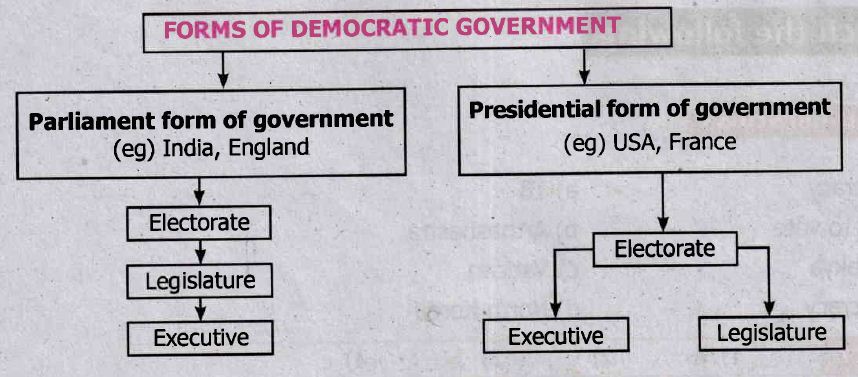
24.
Merits:
(i) In a huge population country all the people can be represented by multiple parties.
(ii) Particular groups can form their own parties.
(iii) People will have multiple options to vote.
Demerits:
(i) Votes will be scattered.
(ii) It will develop groupsism.
(iii) When there is absolute majority there will be coalition government.
25.
In my locality i found the following environmental problems:
1. Air pollution: As there are a number of vehicles in my area the air pollution in very high Whenever I walk on the road, I could smell the carbon dust emitted from the vehicle.
2. Water pollution: Previously we could get clear water from our taps. Now the water is muddy and polluted.
3. Soil Pollution: Because of the incrase of air pollution we could find the soil polluted in our area.

9th Standard Syllabus & Materials
9th Standard
TN 9th Tamil உள்ளத்தின் சீர் - திருக்குறள் Important Questions And Answers Study Material - QB365 Set A
NEW9th Standard
TN 9th Tamil உள்ளத்தின் சீர் - மணிமேகலை Important Questions And Answers Study Material - QB365 Set A
NEW9th Standard
TN 9th Tamil உள்ளத்தின் சீர் - ஏறு தழுவுதல் Important Questions And Answers Study Material - QB365 Set A
NEW9th Standard
TN 9th Tamil உயிருக்கு வேர் - தண்ணீர் Important Questions And Answers Study Material - QB365 Set A



Tamilnadu Stateboard 9th Standard Subjects
Tamilnadu Stateboard Standards




