
 100% FREE ACCESS
9th Standard Syllabus & Materials
9th Standard
TN 9th Tamil உள்ளத்தின் சீர் -கற்கண்டு (இலக்கணம்) - தொடர் இலக்கணம், ஆகுபெயர் Important Questions And Answers Study Material - QB365 Set A
NEW9th Standard
TN 9th Tamil உள்ளத்தின் சீர் -விரிவானம் (துணைப்பாடம்) - தாய்மைக்கு வறட்சி இல்லை! Important Questions And Answers Study Material - QB365 Set A
NEW9th Standard
TN 9th Tamil உள்ளத்தின் சீர் -கவிதை பேழை (செய்யுள்) - மார்கழி பெருவிழா Important Questions And Answers Study Material - QB365 Set A
NEW9th Standard
TN 9th Tamil உயிருக்கு வேர்-இலக்கணம் - பகுபத உறுப்பிலக்கணம் Important Questions And Answers Study Material - QB365 Set A
NEW9th Standard
TN 9th Tamil அமுதென்று பேர் - இலக்கணம்-எழுத்து -அளபெடை Important Questions And Answers Study Material - QB365 Set A
NEW9th Standard
TN 9th Tamil அமுதென்று பேர்-துணைப்பாடம் - ஆறாம்திணை Important Questions And Answers Study Material - QB365 Set A

Published on: 15/06/2021
QB365 provides detailed and simple solution for every book back questions in class 9 Social Science subject.It will helps to get more idea about question pattern in every book back questions with solution.
Download Tamil Nadu 9th Standard Social Science question papers, model tests, one-mark questions, important questions, and public exam papers in PDF format. Free study materials and answer keys for TN State Board students.
Questions + Answers key
Take MCQ Social Science Test
1.
What were the effects of Industrial Revolution of England on India?
2.
Explain the process of colonisation in Africa
3.
Suppose you are in a room of a strong building without any furniture when and earthquake occurs. What would you do to protect yourself from the earthquake?
4.
During and earthquake, why should we exit through staircase and not use elevators?
5.
Imagine you are a cartographer. Draw the map of your area.
6.
Bhuvan has tremendous uses for scientists, policy makers and the general public. Justify.
7.
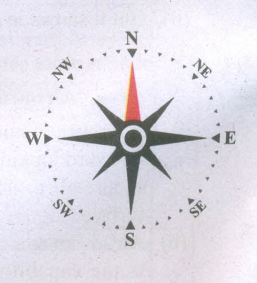
Write a note on directions with relevant diagram.
8.
Describe the major problems & challenges faced by the local self governments.
9.
Write in details about the salient features of the 73rd & 74th Constitutional Amendment Act (1992).
10.
Analyse the educational qualification of migrants from Tamil Nadu in 2015.
11.
Elucidate about some of the interesting findings on migration in Tamil Nadu.
12.
State the aims of migration policies.
13.
Write about the merits of unitary form of government.
14.
Discuss about the source of irrigation for agriculture.
15.
What will happen if the seas and oceans contain only fresh water?
16.
What are the divisions of money supply?
17.
How does the National Human Rights Commission protect our rights?
18.
Explain the commercial developments in Medieval India.
19.
Who were the Mongols? How did they rule China?
20.
Discuss merits and demerits of democracy.
21.
Distinguish between the Public sector and the Private sector.
22.
What are the functions of political parties?
23.
How are cyclones formed? How are they classified?
24.
What is your opinion about democracy in India?
25.
Give a detailed account on the three orders of land forms
1.
1. In the first quarter of eighteenth century, in the context of Indian cotton manufactures flooding in England, a law was enacted prohibiting the use of Indian calicoes and silk.
2. The invention of flying shuttle by John Kay and the inventions of Hargreaves, Arkwright and Crompton within thirty years accelerated the process of spinning and weaving.
3. When the British established their foot hold in Bengal as a territorial power the loot from Bengal and the Carnatic provided the required capital and helped accomplish industrial revolution in England.
4. The weavers of Bengal suffered at the hands of the Company's officials and their agents insisted on payment of a transist duty for the commodities they carried from one place to another and later for cultivation of commercial crops required for British industries in England
5. The Engtish deliberately destroyed Indian industry by dumping Indian markets with their machine made cheap cotton piece goods.
6. Because of loss of market for hand - woven cotton goods. India lost her old industrial position and became an exporter of raw material.
7. By the first quarter of the nineteenth century the export of Dacca muslin to England stopped.
8. Even the export of raw cotton from India had steadily dwindled owing to the competition from U.S.A.
9. Weavers who were eking out an independent livelihood were thrown out of employment because of flooding of British factory made cheap cotton fabrics in Indian markets.
10. To escape starvation deaths, peasants and artisans had to move out of the country opting to work on plantations in British Empire Colonies as indentured labours under wretched service and living conditions.
2.
(i) Until the last quarter of the nineteenth century Africa, South of the Sahara was almost unknown to the outside world.
(ii) The interior of Africa was unexplored.
(iii) After 1875 European penetration and colonisation began on a large scale.
(iv) European colonisation of Africa was thus accomplished smoothly without any out1break of war against major European powers.
(v) This invasion, occupation, colonisation and annexation of African territories by Europen powers between 1881 and 1914, the era of Imperialism is called the scramble for Africa.
or the partition of Africa.
3.
4.
5.
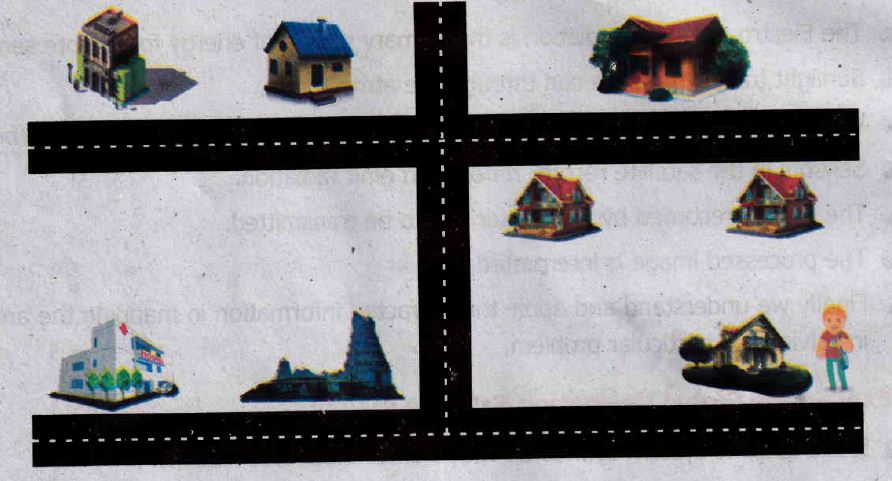
6.
(i) Bhuvan (Sanskrit for Earth) is a free internet based computer application launched by the Indian Space Research Organization (ISRO) on August 12th 2009.
(ii) It enables visualization ofIndian Remote Sensing (IRS) images taken over a year ago, by ISRO's seven satellites, including CartoSat-l and CartoSat-2.
(iii) Using Bhuvan connected to Internet, one can explore places of interest, scenes of events in the news or parts around the world they may never visit in person, by either entering the names of places or co-ordinates (latitudes and longitudes).
(iv) Bhuvan has tremendous uses for scientists, academicians, policy makers or the general
7.
(i) Maps are drawn normally with north orientation.
(ii) North direction in a map is always towards the North Pole of the earth.
(iii) If you position yourself looking at the North Pole, on your right will be the east; your left will be the west; at your back, will be south.
(iv) These four main directions are called the cardinal directions.
(v) Direction is usually indicated on a map by a North-South line, with the North direction represented by an arrow head.
(vi) The memory technique to recalt cardinal direction is the sentence.
| Never | Eat | Soggy | Wheaties |
| North | East | South | West |
8.
Problems and challenges facing the local self governments.
(i) Local self governments are the crucial basis for our democracy.
(ii) The Constitutional status of local self governments adds more significance to their functioning.
(iii) There are a few critical concerns in the working of local self governments in India.
(iv) Major problems and challenges may be mentioned as below.
1. Lack of clear demarcation of powers and functions of local bodies.
2. Allocation of funds and needs assessment are not matched.
3. Combined with accountability, the local self governments demand for more autonomy and economic freedom may be addressed.
4. Role of caste, class and religion in decision making at the local self governments.
5. Poor accountability of elected members and officials at the grassroots of democracy.
9.
Salient features of the 73m and 74th Constitutional Amendment Act (1992)
(i) Panchayats and Municipalities will be "Institutions of Self Government".
(ii) Basic Units of Democratic System - Grama Sabhas (Villages) and Ward Committees (Municipalities) comprising all the adult members registered.
(iii) Three tier system of panchayats at village, intermediate block/taluk/mandal and district levels. Smaller states with population below 2 million only two tiers.
(iv) Seats at all levels filled by direct election.
(v) Seats reserved for SCs and STs at all levels in proportionon to their population.
(vi) One third of the total number of seats-reserved for women. One third of the seats reserved for SCs and STs also reserved for women. One third officers of Chair persons at all levels reserved for women.
(vii) Uniform five year term and election to constitute new bodies to be completed before the expiry of the term. In the event of dissolution, elections compulsorily within six months.
10.
(i) In Tamil Nadu the study reveals that in 2015 about 7% were illiterates, 30% had completed schooling ie class 10;10% had completed class 12, 15% had under gone vocational training. 11% were graduates, 12% were professionally qualified and 11% were postgraduates.
(ii) The study clearly reveals various occupation undertaken by migrants which refers to highly skilled occupation on the one hand and low skilled occupation on the other with large number of semi-skilled occupations in between.
11.
(i) Change in population occurs due to births, deaths and migration.
(ii) Almost everyone keeps moving most of the time, it is not easy to define which of these moves have to be classified as migratory moves.
(iii) According to the census of 2011 the population was 7.2 crore in Tamil Nadu.
(iv) 3.13 crore people were counted as migrants.
(v) The mobility of population in rural areas is greater than in urban areas.
(vi) Mobility is usually associated with male rather than female.
(vii) The poorer sections of the people migrate for survival but migrations from better off sections is to improve their living standards
(viii) Of the International migrants 15% are women while 85% are men.
12.
To reduce the volume of migration:
1. As a large part of migration is a reflection of poverty and insecurity faced by large sections of the rural people, the focus of intervention has to be in rural areas.
2. Rural development policies to reduce poverty and insecurity would be essential to reduce migration.
To redirect the migrant streams:
1. Redirection of migrant stream accured from cities is a desirable policy option.
2. This policy can help in reducing spatial inequalities by suitable strategies.
3. This can develope a more dispersed pattern of urbanisation.
13.
Merits of unitary form of government
(i) Suitable for small countries.
(ii) There is no conflict of authority and responsibility.
(iii) A unitary government will make prompt decisions and take speedy action.
(iv) A unitary government is less expensive.
(v) Amendments to the constitution are easy.
(vi) There is unity, uniformity of law, policy and administration.
14.
(i) There are no perennials rivers in Tamilnadu.
(ii) Tamil Nadu receives the required water from northeast and southwest monsoon.
(iii) When the south west monsoon rains are high in the catchment areas of cauvery River in Karanataka, dams there get filled and inturn cauvery River in Tamil Nadu gets water.
(iv) Northeast monsoon is a major source of water for Tamil Nadu.
(v) The northeast monsoon rains are stored in reservoirs, lakes and tanks for cultivation.
(iv) We see that agriculture in Tamil Nadu is dependent on ground water.
15.
(i) All of the organisms in the sea are adapted to salt water. If they were suddenly immersed in fresh water, too much water would diffuse into their bodies and they would die.
(ii) The global ecosystem would collapse, and the oceans and atmosphere would eventually revert to their composition before the evolution of photosynthesis: Almost no oxygen and lots of carbon dioxide.
(iii) The ocean currents will be completely disturbed. Hence it will trigger profound climatic changes at the global scale.
16.
Money supply is divided into four.
M1 = Currency held with the public + cash Reserves in commercial and Co-operative banks + cash reserves in the RBI.
M2 = M1 + Money saved in Post office and bank savings Accounts
M3 = M1+ Time Deposits in Commercial and co-operative banks
M4 = M3 + Post office savings Money
17.
National Human Rights Commission:
(i) The National Human Rights Commission is an autonomous body constituted in 1993.
(ii) It consists of a chairman and few other members.
(iii) NHRC is responsible for the protection and promotion of human rights in India defined by the Act as rights relating to life, liberty, equality and dignity of the individual guaranteed by the Constitution or embodied in the international covenants.
Functions of NHRC:
(i) To inquire into the violation of human rights or negligence in the prevention of such violation by a Public servant.
(ii) To intervene in court proceedings relating to human rights.
(iii) To undertake and promote research in the field of human rights.
(iv) To engage in human rights education among various sections of society.
(v) To encourage the effects of NGOs and institutions working in the field of human rights.
18.
COMMERCE:
(i) The large manufacturing sector essentially produced goods for exchange, and not for setf-use.
(ii) Therefore, India had an extensive network of trade for marketing these goods, barter was the medium of exchange.
COMMERCIAL CENTRES:
(i) Big cities were usually major commercial centres, with bazaars and shops.
(ii) These cities were also intermediate points in inter-regional trade since they were connected by a network of roads to other centres in other parts of the country.
(iii) In addition to such overland trade, smaller ships and boats were used in coastal trade along both the western and eastern coasts of the country.
MARITIME TRADE:
(i) Maritime trade across the Indian Ocean, extending from China in the east to Africa in the west, had flourished for many centuries.
(ii) India was an integral part of this maritime. This was partly due to its geographical location in the middle of the Indian Ocean.
MAJOR COMMERCIAL PORTS:
| Surat, Golkonda | Gujarat |
| Masulipatnam | Andhra |
| Chittagong | Bengal |
| Pulicat (Pazhaverkadu) | Coromandal Coast |
| Calicut, Nagapatnam | Kerala |
EXPORTS:
Textile, pepper, precious stones diamond, iron and steel are the important export goods of India.
IMPORT:
Silk, Chinese ceramics, gold, spices, aromatic woods and camphor and ivory are the important import goods of India.
19.
MONGOLS:
1. Mongols were nomads. They came into Europe from the Steppes of Asiatic Russia.
2. They were herdsmen.
3. The Mongols were experts in warfare and produced a remarkable chief, Chengiz Khan.
MONGOLS RULE IN CHINA:
1. After the end of Sung dynasty the Mongols established their rule in the name of Yuan dynasty
2. The Mongols, who over ran Persia and the whole of Central Asia, did not spare China either.
3. Mangu Khan became the Great Khan in 1252 who appointed Kublai Khan the Governor of China.
4. The Mongol presence from one end of Eurasia to the other played a key role in spreading Chinese technological advances to the less developed societies in the west.
5. Though the Mongol court in Beijing impressed a foreigner like Marco polo, the poverty of peasantry continued.
6. Finally, the leader of "Red Turbans" Chu Yuan Chang took the Mongol capital Beijing and proclaimed himself emperor in 1369.
20.
(i) Democracy is the government of the people by the people and for the people.
(ii) People can elect the leader of their choice.
(iii) All the people can enjoy equal rights.
21.
| S.No | Public Sector | Private Sector |
| 1 | Service motive | Profit motive |
| 2 | Government owns the assets | Private individuals own the assets |
| 3 | Wages are paid by the government | Wages are paid by the owner of private enterprises. |
| 4. | NIC, SAIL, BSNL. | TVS motors, Ashok Leyland, TATA Steal. |
22.
(i) Parties contest elections. In most democracies, elections are fought mainly among the candidates put up by political parties.
(ii) Parties put forward their policies and programmes before the electorate to consider and choose.
(iii) Parties playa decisive role in making laws for a country. Formally, laws are debated and passed in the legislature.
(iv) Parties form and run the governments.
(v) Those parties that lose in the elections play the role of the Opposition to the party or a group of coalition parties in power, by voicing different views and criticising the government for its failures or wrong policies.
(vi) Parties shape public opinion. They raise and highlight issues of importance.
(vii) Parties function as the useful link between people and the government machinery.
23.
The term cyclone is a Greek word meaning "coil of a snake". Cyclones are centres of low pressure where, winds from the surrounding high pressure area converge towards the centre in a spiral form. Due to the rotation of the earth, the cyclonic winds in the northern hemisphere move in anti clock wise direction, where as they move in clockwise direction in the southern hemisphere.
Cyclones can be classified into Tropical cyclones, Temperate cyclones and Extra tropical cyclones.
Tropical cyclones: Tropical cyclones develop in the Inter tropical convergence zone [ITCZ]. They are formed due to the differential heating of land and sea. Tropical cyclones are known as 'cyclones' in Indian ocean, 'typhoons' in the western pacific ocean, 'hurricanes' in the Atlantic and eastern Pacific ocean, 'baguios' in Phillipines and 'willy willy' in Australia. Tropical cyclones often cause heavy loss of life and property on the coasts and become weak after reaching the landmasses.
Temperate cyclones: Temperate cyclones are formed along a front where hot and cold air masses meet in mid-latitudes between 35° and 65°N and S. Temperate cyclones do not become weak like the tropical cyclones on reaching the land. Temperate cyclone commonly occurs over the North Atlantic Ocean, North West Europe, Mediterranean basin. Mediterranean basin's temperate cyclones extend up to Russia and India in winter. In India it is as called western disturbances.
Extra tropical cyclones: Extra tropical cyclones occur in the latitudes between 30° and 60° in both the hemispheres. They are also called as mid-latitude cyclones. They collect energy from temperature differences which are found in higher latitudes. Extra tropical cyclones produce mild showers to heavy gales, thunderstorms, blizzards, and tornadoes.
24.
(i) India has a Parliamentary form of democracy.
(ii) The Indian Parliament comprises the elected representatives of people.
(iii) It makes the laws for the country.
(iv) The participation of people in the decision making and the consent of citizens are the two important elements of Parliamentary form of government in India.
(v) India is the largest democratic country in the world.
(vi) Democracy in India works on five basic principles.
(vii) These are sovereign, socialist, secular, democratic and republic.
(viii) Every citizen of India who is not less than 18 years of age can exercise their right to vote in India.
(ix) There is no descrimination based on a person's caste, creed, religion, gender and education when it comes to providing the right to vote.
25.
Major land forms:
(i) First order landforms : Continents & Oceans
(ii) Second order landforms : Mountains, Plateaus, and plains minor land forests
(iii) Third order landforms : Deltas, Fjords coasts, Sand dunes, Beaches, Valleys, Cirques, Mushroom rocks, Limestone rocks.
First order land forms:
Continents:
(i) It is a very large area of land.
(ii) One of the seven large land masses on the earth's surface, surrounded by sea. Asia, Africa, Europe, North America, South America, Australia and Antarctica.
Oceans: A very large expanse of sea, Atlantic ocean, Arctic ocean, Pacific ocean, Indian ocean and Antarctic ocean.
Second order land forms: Mountains, Plateaus and Plains.
Mountains: A large natural elevation of the earth's surface, rising abruptly from the surrounding level. e.g., Himalayas.
Plateaus: An area of fairly level high ground. e.g., Tibetean plateau.
Plains: A large area of flat land. e.g., Coastal plains.
Third order land forms: Deltas, Fjords, Sand dunes, Beaches, Valleys, Cirques, Mushroom rocks; Limestone rocks.
Deltas: A triangular shaped low lying area formed by the river at its mouth is called Delta.
Fjords: These are glacial valleys that are partly submerged in the sea.
Sand Dunes: In deserts, huge amount of sand gets deposited. These mounds (or) hills of sand are called sand dunes.
Beaches: Sand and gravel are moved and deposited by waves along the shore to form Beaches.
Valleys: A low area ofland between hills (or) mountains typically with a river (or) stream flowing through it.
Cirques: The glacier erodes the steep side walls of the mountain and farms bowl shaped arm chair. It is termed as cirque.
Mushroom rocks: By the constant wearing down action of wind the bottom of the rock gets eroded away to form a mushroom like structure. This is called Mushroom rock (or) Pedestal rock.
Limestone rocks: The underground water creates distinct landforms in limestone regions called Karst Topography. It consists of calcite, argonite.

9th Standard Syllabus & Materials
9th Standard
TN 9th Tamil உள்ளத்தின் சீர் - திருக்குறள் Important Questions And Answers Study Material - QB365 Set A
NEW9th Standard
TN 9th Tamil உள்ளத்தின் சீர் - மணிமேகலை Important Questions And Answers Study Material - QB365 Set A
NEW9th Standard
TN 9th Tamil உள்ளத்தின் சீர் - ஏறு தழுவுதல் Important Questions And Answers Study Material - QB365 Set A
NEW9th Standard
TN 9th Tamil உயிருக்கு வேர் - தண்ணீர் Important Questions And Answers Study Material - QB365 Set A



Tamilnadu Stateboard 9th Standard Subjects
Tamilnadu Stateboard Standards




