
 100% FREE ACCESS
9th Standard Syllabus & Materials
9th Standard
TN 9th Tamil உள்ளத்தின் சீர் -கற்கண்டு (இலக்கணம்) - தொடர் இலக்கணம், ஆகுபெயர் Important Questions And Answers Study Material - QB365 Set A
NEW9th Standard
TN 9th Tamil உள்ளத்தின் சீர் -விரிவானம் (துணைப்பாடம்) - தாய்மைக்கு வறட்சி இல்லை! Important Questions And Answers Study Material - QB365 Set A
NEW9th Standard
TN 9th Tamil உள்ளத்தின் சீர் -கவிதை பேழை (செய்யுள்) - மார்கழி பெருவிழா Important Questions And Answers Study Material - QB365 Set A
NEW9th Standard
TN 9th Tamil உயிருக்கு வேர்-இலக்கணம் - பகுபத உறுப்பிலக்கணம் Important Questions And Answers Study Material - QB365 Set A
NEW9th Standard
TN 9th Tamil அமுதென்று பேர் - இலக்கணம்-எழுத்து -அளபெடை Important Questions And Answers Study Material - QB365 Set A
NEW9th Standard
TN 9th Tamil அமுதென்று பேர்-துணைப்பாடம் - ஆறாம்திணை Important Questions And Answers Study Material - QB365 Set A

Published on: 12/02/2020
9th Standard Mathematics All Chapter Important Creative Questions-I- 2019-2020
Download Tamil Nadu 9th Standard Maths question papers, model tests, one-mark questions, important questions, and public exam papers in PDF format. Free study materials and answer keys for TN State Board students.
Questions + Answers key
Take MCQ Maths Test1.
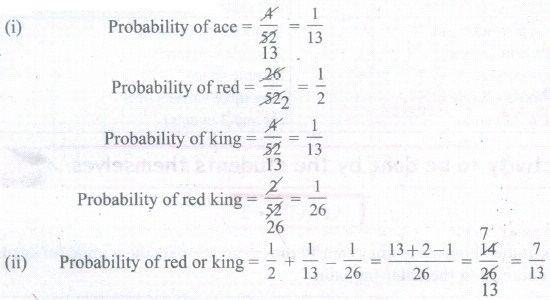
One card is drawn from a pack of 52 cards, each of the 52 cards being equally likely to be drawn. Find the probability that the card drawn is
(i) an ace,
(ii) either red card or king.
2.
Find the value of \(\cfrac { cos{ 63 }^{ 0 }20' }{ sin{ 26 }^{ 0 }40' } \)
3.
Find the surface area of a cube whose edge is
(i) 27 cm
(ii) 3 cm
(iii) 6 cm
(iv) 2.1 cm
4.
Find the coordinates of the point which divides the line segment joining the points (3, 1) and (5, 13) internally in the ratio 3 : 5.
5.
A company manufactures 10,000 Laptops in 6 months. In that 25 of them are found to be defective. When you choose one Laptop from the manufactured, what is the probability that selected Laptop is a good one.
6.
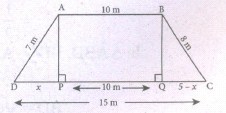
The parallel sides of a trapezium are 15 m and 10 m long and its non-parallel sides are 8 m and 7 m long. Find the area of the trapezium.
7.
Akshaya has 2 rupee coins and 5 rupee coins in her purse. If in all she has 80 coins totalling Rs. 220, how many coins of each kind does she have.
8.
Evaluate:
(i) sin 300 +cos 300
(ii) tan 600 cot 600
(iii) \(\frac { tan45° }{ tan30°+tan60° } \)
(iv) sin2 450 +cos2 450
9.
Using section formula, show that the points A(7, −5), B(9, −3) and C(13, 1) are collinear.
10.
Represent the following as decimal form
(i) \(\frac { -4 }{ 11 } \)
(ii) \(\frac { 11 }{ 75 } \)
11.
Factorise the following : 64m3 + 27n3
12.
Express the surds in the simple form \(\sqrt { 27 } \)
13.
Evaluate : \(\left( \cfrac { 1 }{ 9 } \right) ^{ -3 }\)
14.
In a circle, AB and CD are two parallel chords with centre 0 and radius 5 cm such that AB = 8 cm and CD = 6 cm determine the distance between the chords?
15.
The chord of length 32 cm is drawn at the distance of 12 cm from the centre of the circle. Find the radius of the circle
16.
The mean weight of 4 members of a family is 60 kg. Three of them have the weight 56kg, 68kg and 72 kg respectively. Find the weight of the fourth member.
17.
In a rice mill, seven labours are receiving the daily wages of Rs. 500, Rs. 600, Rs. 600, Rs. 800, Rs. 800, Rs. 800 and Rs. 1000, find the modal wage
18.
Two circles of radii 5 cm and 3 cm intersect at two points and the distance between their centres is 4 cm. Find the length of the common chord
19.
Use a fractional index to write: \(\sqrt{5}\)
20.
If A =\(\left\{ -\frac { 1 }{ 2 } ,0,\frac { 1 }{ 4 } ,\frac { 3 }{ 4 } ,2 \right\} \), B =\(\left\{ 0,\frac { 1 }{ 4 } ,\frac { 3 }{ 4 } ,2,\frac { 5 }{ 2 } \right\} \) and C =\(\left\{ -\frac { 1 }{ 2 } .\frac { 1 }{ 4 } ,1,2,\frac { 5 }{ 2 } \right\} \), then verify \(A\cap (B\cap C)=(A\cap B)\cap C\) .
21.
Let U= {x : -3 : < x < 4} A = {-1,2,3} B = {0,1,2,3} C = {-3,-2,-1,0,1,2}. Find (i) A' UB' (ii) (A ∩ B)' (iii) (A ⋂ C)'
22.
If A = {1,2,3} B = {3,5,6} C = {3,4,7}. Find
(i) A-(B U C)
(ii) BΔC
(iii) AΔB
23.
Verify whether the following are zeros of the polynomial indicated against them, or not.
p(x) = (x+3) (x-4), x = -3, x = 4
24.
Identify which ones are trapeziums and which are not.

25.
From the given Venn diagram, write the elements of
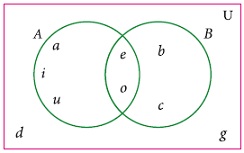
(i) A
(ii) B
(iii) A – B
(iv) B – A
(v) A′
(vi) B′
(vii) U
26.
The number of bricks each measuring 50 cm × 30 cm × 20 cm that will be required to build a wall whose dimensions are 5 m × 3 m × 2 m is _______.
1000
2000
3000
5000
27.
A collection of one or more outcomes of an experiment is called _______.
Event
Outcome
Sample point
None of the above
28.
If the sides of a triangle are 3 cm, 4 cm and 5 cm, then the area is _______.
3 cm2
6 cm2
9 cm2
12 cm2
29.
The probability of all possible outcomes of a random experiment is always equal to _______.
One
Zero
Infinity
Less than one
30.
The value of tan 1° tan 2° tan 3°...tan 89° is ________.
0
1
2
\(\frac { \sqrt { 3 } }{ 2 } \)
31.
The value of \(\frac { tan15° }{ cot75° } \) is
cos 900
sin 300
tan 450
cos 300
32.
The mid-point of the line joining (−a, 2b) and (−3a,−4b) is ______.
(2a, 3b)
(−2a, −b)
(2a, b)
(−2a, −3b)
33.
For any three sets, P,Q,R\(\left( P\cap Q \right) ^{ ' }\)
\({ P }^{ ' }\cup { Q }^{ ' }\)
\(P\cup Q\)
\({ P }^{ ' }\)
\({ Q }^{ ' }\)
34.
If U = {x : x\(\in \)W and x < 20}, A = {2,4,6,8}, B = {6,8,12,14} then\(\left[ n\left( A\cup B^{ ' } \right) \right] \)
15%
20%
10%
5%
35.
(a-b-c)2 is equal to________
(a+b+c)2
(a+b+c)2
(-a + b + c)2
(a+b+c)2
36.
If x - 2 is a factor of q(x), then the remainder is___________
q(-2)
x - 2
0
-2
37.
Which of the following has a factor?
x2 + 2x
(x - 1)2
(x + 1)2
(x2 - 22)
38.
Rationalising the denominator \(\cfrac { 1 }{ \sqrt [ 3 ]{ 3 } } \) ___________
3
\(\cfrac { { 3 }^{ \frac { 2 }{ 3 } } }{ 3 } \)
\(\sqrt { 3 } \)
\(\sqrt [ 3 ]{ 3 } \)
39.
\(\sqrt [ 5 ]{ 21 } \times 6\sqrt { 10 } \)
\(30\sqrt { 210 } \)
30
\(\sqrt { 210 } \)
\(210\sqrt { 30 } \)
40.
If sum of two opposite angles of a cyclic quadrilateral is_________
45°
90°
180°
360°
41.
Find the mean of the prime factors of 165 _____________
5
11
13
55
42.
The mean of the first 10 prime numbers is _______________
12.6
12.7
12.8
12.9
43.
If the mean of five observations x, x+2, x+4, x+6, x+8, is 11, then the mean of first three observations is __________
9
11
13
15
44.
For which set of numbers do the mean, median and mode all have the same values?
2,2,2,4
1,3,3,3,5
1,1,2,5,6
1,1,2,1,5
45.
For which set of numbers do the mean, median and mode all have the same values?
2, 2, 2, 4
1, 3, 3, 3, 5
1, 1, 2, 5, 6
1, 1, 2, 1, 5
46.
A particular observation which occurs maximum number of times in a given data is called its _______.
Frequency
range
mode
Median
47.
In the figure, PQRS and PTVS are two cyclic quadrilaterals, If ㄥQRS = 100°, then ㄥTVS = ______.
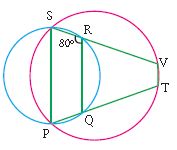
80°
100°
70°
90°
48.
The GCD of x4-y4 and x2-y2 is _______.
x4-y4
x2-y2
(x+y)2
(x+y)4
49.
When written with a rational denominator, the expression \(\frac { 2\sqrt { 3 } }{ 3\sqrt { 2 } } \) can be simplified as ________.
\(\frac { \sqrt { 2 } }{ 3 } \)
\(\frac { \sqrt { 3 } }{ 2 } \)
\(\frac { \sqrt { 6 } }{ 3 } \)
\(\frac{2}{3}\)
50.
\(\sqrt{27}\)+\(\sqrt{12}\) = ________.
\(\sqrt{39}\)
5\(\sqrt{6}\)
5\(\sqrt{3}\)
3\(\sqrt{5}\)
51.
If n(A U B U C) = 100, n(A) = 4x, n(B) = 6x, n(C) = 5x, n(A ∩ B) = 20, n(B ⋂C) = 15, n(A C) = 25 and n(A ⋂ B ⋂ C) = 10 , then the value of x is ________.
10
15
25
30
52.
The coefficient of \({ x }^{ 2 }\ and\ x\ in\ 2{ x }^{ 3 }-5{ x }^{ 2 }+6x-3\) are respectively ____________
2, -5
2, 6
-5, 6
-5, -3
53.
Which of the following is a formula to find the sum of interior angles of a quadrilateral of n-sides?
\(\frac { n }{ 2 } \) \(\times\) 180
\(\left( \frac { n+1 }{ 2 } \right) \)1800
\(\left( \frac { n-1 }{ 2 } \right) \)180o
(n-2)180o
54.
In a parallelogram \(\angle{A}:\angle{B}=1:2\) Then ∠A ............
30°
60°
45°
90°
55.
What is the name of a regular polygon of six sides?
Square
Equilateral triangle
Regular hexagon
Regular octagon
56.
The set {x: x ∈ A, x ∈ B, x ∉ A ∩ B} is___________.
A ∩ B
A U B
A - B
A Δ B
57.
The value of \(\bar { 0.03 } \) +\(\bar { 0.03 } \) is ___________.
\(\bar { 0.09 } \)
\(\bar { 0.09 } \)
\(\bar { 0.09 } \)
0
58.
The diagonal of a square formed by the points (1, 0), (0, 1), (-1, 0) and (0, - 1) is_______________
2
4
\(\sqrt{2}\)
8
59.
The point which is on y-axis with ordinate - 5 is _____________
(0, -5)
(-5,0)
(5,0)
(0,5)
60.
The point (0, -3) lies on _______________
+ ve x-axis
+ ve y-axis
- ve x-axis
- ve y-axis
61.
The centre of a circle is (0, 0). One end point of a diameter is (5, -1), then ______________
\(\sqrt{24}\)
\(\sqrt{37}\)
\(\sqrt{26}\)
\(\sqrt{17}\)
62.
If P( –1, 1), Q( 3, -4), R( 1, -1), S(-2, -3) and T( -4, 4) are plotted on a graph paper, then the points in the fourth quadrant are ______.
P and T
Q and R
only S
P and Q
63.
x3 – x2 is a …………..
monomial
binomial
trinomial
constant polynomial
64.
Which of the following is correct?
{7} ∈ {1,2,3,4,5,6,7,8,9,10}
7 ∈ {1,2,3,4,5,6,7,8,9,10}
7 ∉ {1,2,3,4,5,6,7,8,9,10}
{7} \(\nsubseteq \) {1,2,3,4,5,6,7,8,9,10}
65.
If the diagonal of a rhombus are equal, then the rhombus is a ________.
Parallelogram but not a rectangle
Rectangle but not a square
Square
Parallelogram but not a square
66.
In an office, where 42 staff members work, 7 staff members use cars, 20 staff members use two-wheelers and the remaining 15 staff members use cycles. Find the relative frequencies.
67.
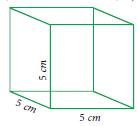
Find the Total Surface Area and Lateral Surface Area of the cube, whose side is 5 cm.
68.
Evaluate:
(i) \(\frac { sin\ 49° }{ cos\ 41° } \)
(ii) \(\frac { sec\ 63° }{ cosec\ 27° } \)
69.
If U = {x : x ∈ Z, -2 ≤ x ≤ 10}, A = {x : x = 2p +1, p ∈ Z, -1 ≤ p ≤ 4}, B = {x : x = 3q + 1, q ∈ Z, -1 ≤ q < 4} verify De Morgan’s laws for complementation.
70.
Show that \(\sqrt [ 3 ]{ 2 } >\sqrt [ 5 ]{ 3 } \)
71.
The following are scores obtained by 11 players in a cricket match 7, 21, 45, 12, 56, 35, 25, 0, 58, 66, 29. Find the median score.
72.
The arithmetic mean of 6 values is 45 and if each value is increased by 4, then find the arithmetic mean of new set of values
73.
(i) Prove that (x - 1) is a factor of x3- 7x2 + 13x - 7
(ii) Prove that (x + 1) is a factor of x3 + 7x2 + 13x + 7
74.
What must be subtracted from \({ y }^{ 4 }+{ 2y }^{ 3 }-3y+8\quad to\quad get\quad { y }^{ 4 }-{ 2y }^{ 3 }+6?\)
75.
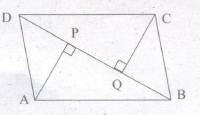
ABCD is a parallelogram and AP and CQ are perpendicular from vertex A and C on diagonal BD. Show that
(i) ΔAPB ≅ ΔCQD
(ii) AP = CQ
76.
In a class there are 40 students. 26 have opted for Mathematics and 24 have opted for Science. How many student have opted for Mathematics and Science.
77.
Three vertices of a rectangle are (3, 2), (-4, 2) and (-4, 5). Plot the points and find the coordinates of the fourth vertex.
78.
Express the following decimal expression into rational numbers \(17.2\overline { 15 } \)
79.
The abscissa of a point A is equal to its ordinate, and its distance from the point B(1, 3) is 10 units, What are the coordinates of A?
80.
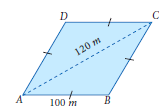
A farmer has a field in the shape of a rhombus. The perimeter of the field is 400 m and one of its diagonal is 120 m. He wants to divide the field into two equal parts to grow two different types of vegetables. Find the area of the field.
81.
Factorise 2x3- x2 - 12x - 9 into linear factors
82.
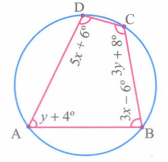
Find the angle of the given cyclic quadrilateral ABCD in the figure.
83.
Find the Arithmetic Mean of the following data using Step Deviation Method
| Age | 15-19 | 20-24 | 25-29 | 30-34 | 35-39 | 40-44 |
| No.of persons | 4 | 20 | 38 | 24 | 10 | 9 |
84.
In the class, weight of students is measured for the class records. Calculate mean weight of the students using direct method.
| Weight in kg | 15-25 | 25-35 | 35-45 | 45-55 | 55-65 | 56-75 |
| No.of students | 4 | 11 | 19 | 14 | 0 | 2 |
85.
Represent \(-\frac { 2 }{ 11 } ,-\frac { 5 }{ 11 } and-\frac { 9 }{ 11 } \)on the number line.
86.
Find any three rational numbers between \(\frac { 1 }{ 2 } \) and \(\frac { 1 }{ 5 } \)
87.
Fill in the blanks with appropriate cardinal numbers
| S.No | n(A) | n(B) | n(AUB) | n(A∩B) | n(A-B) | n(B-A) |
|---|---|---|---|---|---|---|
| 1 | 30 | 45 | 65 | |||
| 2 | 20 | 55 | 10 | |||
| 3 | 50 | 65 | 25 | |||
| 4 | 30 | 43 | 70 |
88.
Show that the given points (1, 1), (5, 4), (-2, 5) are the vertices of an isosceles right angled triangle.
89.
Construct \(\triangle\)ABC in which AB = BC = 8 cm and \(\angle \)B =70o. Locate its incentre and draw the incircle
90.
Draw and locate the centroid of the triangle ABC where right angle at A, AB = 4cm and AC = 3cm
1.
2.
\(\cfrac { cos{ 63 }^{ 0 }20' }{ sin{ 26 }^{ 0 }40' } =\cfrac { cos63^{ 0 }20' }{ cos{ 63 }^{ 0 }20' } =1\)
3.
(i) TSA = 6a2 = 6 \(\times\) 272 = 6 \(\times\) 729 = 4374 cm2
(ii) TSA = 6a2 = 6 \(\times\)32 = 54 cm2
(iii) TSA = 6a2 = 6 \(\times\) 62 = 6 \(\times\) 36 = 216 cm2
(iv) TSA = 6a2 = 6 \(\times\) 2.12 = 6 \(\times\) 4.41 = 26.46 cm2
4.
\(\left( \frac { 5(3)+3(5) }{ 5+3 } ,\frac { 5(1)+3(13) }{ 5+3 } \right) =\left( \frac { 15+15 }{ 8 } ,\frac { 5+39 }{ 8 } \right) =\left( \frac { 30 }{ 8 } ,\frac { 44 }{ 8 } \right) =\left( \frac { 15 }{ 4 } ,\frac { 11 }{ 2 } \right) \)
5.
Total n(S) = 10,000
Defective n(A) = 25
Number of defective laptop is 25
Number of good laptop is = 10000 - 25 = 9975
Let A be the event of choosing a good laptop. n(A) = 9975
\(\mathrm{P}(\mathrm{A})=\frac{\mathrm{n}(\mathrm{A})}{\mathrm{n}(\mathrm{S})}=\frac{9975}{10000}\)
P(A) = 0.9975
Probability of getting a good laptop is 0.9975
6.
In the figure AP 丄 CD and BQ 丄 CD
⇒ PQ = AB = 10, AP = BQ = h
Assume DP = x ⇒ QC = 15 - (10 + x)
= 15 - 10 - x = 5 - x
In Δ ADP, AP2 = 72- x2= 49 - x2
In Δ BQC, BQ2 = 82- (5 - x)2 = 64 - (25 - 10x + x2) .
= 64 - 25 + 10x - x2
=39 - x2+ 10x
Equating AP2 = BQ2
49 - x2 = 39 - x2 + 10x
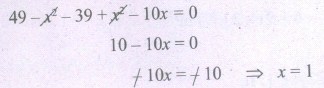
⇒ AP=\(\sqrt { { 7 }^{ 2 }-{ x }^{ 2 } } =\sqrt { 49-1^{ 2 } } =\sqrt { 48 } \)
∴ Area of the trapezium = \(\frac{1}{2}\) h(a+b) sq.units
=\(\frac { 1 }{ 2 } \times \sqrt { 48 } \times (10+15)=\frac { 1 }{ 2 } \times \sqrt { 3\times 16 } \times 25\)
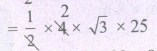
= 2 \(\times\) 25 \(\times\) 1.732 = 86.6 m2
7.
Let the number of 2 rupee coins be x
Let the number of 5 rupee coins be y
x+y = 80
2x+ 5y = 220
x +y- 80 = 0
2x + 5y - 220 = 0
For cross multiplication method, we write the co-efficients as
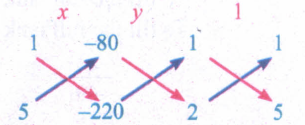
\(\cfrac { x }{ -220 } =\cfrac { y }{ -160+220 } =\cfrac { 1 }{ 5-2 } \)
\(\cfrac { x }{ 180 } =\cfrac { y }{ 60 } =\cfrac { 1 }{ 3 } \)
\(\therefore \ \cfrac { x }{ 180 } =\cfrac { 1 }{ 3 } \ \ \cfrac { y }{ 60 } =\cfrac { 1 }{ 3 } \)
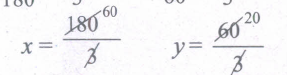
x = 60 y = 20
\(\therefore\) No. of 2 rupee coins = 60
No. of 5 rupee coins = 20
8.
(i)sin 300 + cos 300 = \(\frac { 1 }{ 2 } +\frac { \sqrt { 3 } }{ 2 } =\frac { 1+\sqrt { 3 } }{ 2 } \)
(ii) tan 600 cot 600 = \(\sqrt { 3 } \times \frac { 1 }{ \sqrt { 3 } } =1\)
(iii) \(\frac { tan45° }{ tan30°+tan60° } \) = \(\frac { 1 }{ \frac { 1 }{ \sqrt { 3 } } +\frac { \sqrt { 3 } }{ 1 } } =\frac { 1 }{ \frac { 1+\left( \sqrt { 3 } \right) ^{ 2 } }{ \sqrt { 3 } } } =\frac { 1 }{ \frac { 1+3 }{ \sqrt { 3 } } } = \frac { \sqrt { 3 } }{ 4 } \)
(iv) sin2450 + cos2450 = \(\left( \frac { 1 }{ \sqrt { 2 } } \right) ^{ 2 }+\left( \frac { 1 }{ \sqrt { 2 } } \right) ^{ 2 }=\frac { 1^{ 2 } }{ \left( \sqrt { 2 } \right) ^{ 2 } } +\frac { 1^{ 2 } }{ \left( \sqrt { 2 } \right) ^{ 2 } } =\frac { 1 }{ 2 } +\frac { 1 }{ 2 } =1\)
9.
x1 y1 x2 y2
A(7, -5) B(9, -3)
\(\bar { AB } =\sqrt { { ({ x }_{ 2 }-{ x }_{ 1 }) }^{ 2 }+{ ({ y }_{ 2 }-{ y }_{ 1 }) }^{ 2 } } \)
\(=\sqrt { { (9-7) }^{ 2 }+{ (-3-(-5)) }^{ 2 } } =\sqrt { { 2 }^{ 2 }+{ (-3+5) }^{ 2 } } =\sqrt { 4+4 } \)
\(=\sqrt { 8 } =\sqrt { 4\times 2 } =2\sqrt { 2 } \)
\(\bar { BC } =\sqrt { { (13-7 })^{ 2 }+{ (1-(-5)) }^{ 2 } } =\sqrt { { 4 }^{ 2 }+{ 4 }^{ 2 } } =\sqrt { 16+16 } \)
\(=\sqrt { 32 } =\sqrt { 16\times 2 } =4\sqrt { 2 } \)
\(\bar { AC } =\sqrt { { (13-7) }^{ 2 }+{ (1-(-5)) }^{ 2 } } \)
\(=\sqrt { { 6 }^{ 2 }+{ 6 }^{ 2 } } =\sqrt { 36+36 } \)
\(=\sqrt { { 6 }^{ 2 }+{ 6 }^{ 2 } } =\sqrt { 36+36 } \)
\(2\sqrt { 2 } +4\sqrt { 2 } =6\sqrt { 2 } \)
∴ AB + BC = AC, Here B is the common Point
∴ A, B, C are collinear
10.
(i) \(\frac { -4 }{ 11 } \)
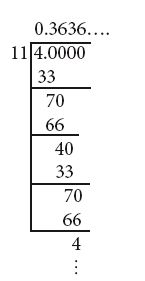
Thus we see that \(\frac { -4 }{ 11 } =-0.\overline { 36 } \)
(ii) \(\frac { 11 }{ 75 } \)
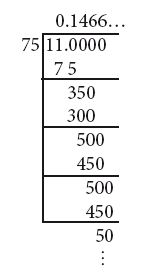
Thus we see that \(\frac { 11 }{ 75 } =0.14\overline { 6 } \)
A rational number can be expressed by
(i) either a terminating
(ii) or a non-terminating and recurring (repeating) decimal expansion.
The converse of this statement is also true. That is, if the decimal expansion of a number is terminating or non-terminating and recurring, then the number is a rational number.
11.
64m3 + 27n3 = (4m)3 + (3n)3
= (4m + 3n) ((4m)2 - (4m) (3n) + (3n)2) [\(\because \) a3 + b3 = (a+b) (a2 - ab + b2)]
= (4m + 3n)(16m2 - 12mn + 9n2)
12.
\(\sqrt { 27 } \) =\(\sqrt { 3\times 3\times 3 } =\sqrt [ 3 ]{ 3 } \)
13.
\(\left( \cfrac { 1 }{ 9 } \right) ^{ -3 }\)=\(\cfrac { 1 }{ \left( \cfrac { 1 }{ 9 } \right) ^{ 3 } } =\cfrac { 1 }{ \left( \cfrac { 1 }{ 729 } \right) } =729\)
14.
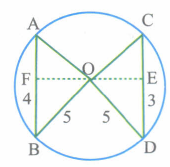
The distance between the two chord
FE = OF + OE
OE = \(\sqrt { { 5 }^{ 2 }-3^{ 2 } } =\sqrt { 25-9 } \)
= \(\sqrt { 16 } \) = 4 cm
OF = \(\sqrt { { 5 }^{ 2 }-{ 4 }^{ 2 } } =\sqrt { 25-16 } =\sqrt { 9 } \) = 3 cm
\(\therefore\) DE = 4 cm + 3 cm = 7 cm
Distance between the chord is 7 cm.
15.
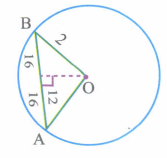
Radius of the circle =\(\sqrt { { 16 }^{ 2 }+{ 12 }^{ 2 } } \)
=\(\sqrt { 256+144 } \)
=\(\sqrt { 400 } =\sqrt { 20\times 20 } =20\)
16.
\(\bar { x } =60kg\)
\(\bar { x } =\cfrac { \Sigma x }{ n } =\cfrac { 56+68+72+x }{ 4 } =60\)
196 + x = 260
x = 240-196
\(\therefore \) The weight of the fourth number = 44 kg
17.
In the given data Rs. 800 occurs thrice. Hence the mode is Rs. 800
18.
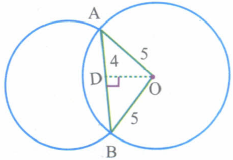
OD = DP =\(\cfrac { 4cm }{ 2 } \) = 2 cm
AD = BD =\(\sqrt { { 5 }^{ 2 }-{ 4 }^{ 2 } } \)
= \(\sqrt { 25-19 } \)
= \(\sqrt { 9 } \)
= 3 cm
\(\therefore\) The length of the common chord AB = AD + BD = (3 + 3) cm = 6 cm
19.
\({ 5 }^{ \frac { 1 }{ 2 } }\)
20.
Now, \((B\cap C)=\left\{ \frac { 1 }{ 4 } ,2,\frac { 5 }{ 2 } \right\} \)
\(A\cap (B\cap C)=\left\{ \frac { 1 }{ 4 } ,2 \right\} \) .......(1)
Then, \(A\cap B=\left\{ 0,\frac { 1 }{ 4 } ,\frac { 3 }{ 4 } ,2 \right\} \)
\((A\cap B)\cap C=\left\{ \frac { 1 }{ 4 } ,2 \right\} \) .......(2)
From (1) and (2), it is verified that
\((A\cap B)\cap C=A\cap (B\cap C)\).
21.
(i) {-3,-2,-1,0,1,4} (ii) {-3,-2,-1,0,1,4} (iii) {-3,-2,0,1,3,4}
22.
(i) {1,2}
(ii) {4,5,6,7}
(iii) {1,2,5,6}
23.
p(x) = (x + 3)(x - 4); x = -3, x = 4
p( -3) = (- 3 + 3)(- 3 - 4)
= (0) (-7) = 0
p(4) = (4+3) (4-4)
= (7) (0) = 0
\(\therefore\) -3 and 4 are the zeros of the polynomial.
24.
It is not a trapezium
25.
(i) A = {a, e, i, o, u}
(ii) B = {b, c, e, o}
(iii) A – B = {a, i, u}
(iv) B – A = {b, c}
(v) A′ = {b, c, d, g}
(vi) B′ = {a, d, g, i, u}
(vii) U = {a, b, c, d, e, g, i, o, u}.
26.
(a)
1000
27.
(a)
Event
28.
(b)
6 cm2
29.
(a)
One
30.
(b)
1
31.
(c)
tan 450
32.
(b)
(−2a, −b)
33.
(a)
\({ P }^{ ' }\cup { Q }^{ ' }\)
34.
(b)
20%
35.
(d)
(a+b+c)2
36.
(c)
0
37.
(a)
x2 + 2x
38.
(b)
\(\cfrac { { 3 }^{ \frac { 2 }{ 3 } } }{ 3 } \)
39.
(a)
\(30\sqrt { 210 } \)
40.
(c)
180°
41.
(c)
13
42.
(d)
12.9
43.
(a)
9
44.
(b)
1,3,3,3,5
45.
(b)
1, 3, 3, 3, 5
46.
(c)
mode
47.
(a)
80°
48.
(b)
x2-y2
49.
(c)
\(\frac { \sqrt { 6 } }{ 3 } \)
50.
(c)
5\(\sqrt{3}\)
51.
(a)
10
52.
(c)
-5, 6
53.
(d)
(n-2)180o
54.
(b)
60°
55.
(c)
Regular hexagon
56.
(d)
A Δ B
57.
(c)
\(\bar { 0.09 } \)
58.
(a)
2
59.
(a)
(0, -5)
60.
(d)
- ve y-axis
61.
(c)
\(\sqrt{26}\)
62.
(b)
Q and R
63.
(b)
binomial
64.
(b)
7 ∈ {1,2,3,4,5,6,7,8,9,10}
65.
(c)
Square
66.
Total number of staff members = 42
The relative frequencies:
Car users \(=\frac { 7 }{ 42 } =\frac { 1 }{ 6 } \)
Two-wheeler users \(=\frac { 20 }{ 42 } =\frac { 10 }{ 21 } \)
Cycle users \(=\frac { 15 }{ 42 } =\frac { 5 }{ 14 } \)
67.
The side of the cube (a) = 5 cm
Total Surface Area = 6a2 = 6(52) = 150 sq. cm
Lateral Surface Area = 4a2 = 4(52) = 100 sq. cm
68.
(i) \(\frac { sin\ 49° }{ cos\ 41° } \)
sin 490 = sin(900 - 410) = cos 410, since 490 + 410 = 900 (complementary),
Hence on substituting sin 49o = cos41o we get, \( \frac { cos\ 41° }{ cos\ 41° } \)= 1
(ii) \(\frac { sec\ 63° }{ cosec\ 27° } \)
sec63o = sec (90o- 27o) = cosec27o, here, 63o and 27o are complementary angles
we have \(\frac { sec\ 63° }{ cosec\ 27° } =\frac { cosec\ 27° }{ cosec\ 27° } =1\)
69.
Given U = {−2,−1,0,1,2,3,4,5,6,7,8,9,10},
A = {−1,1,3,5,7,9} and B = {−2,1,4,7,10}
Law (i) \(\left( A\cup B \right)' =A'\cap B'\)
Now, AUB = {-2,-1,1,3,4,5,7,9,10}
\(\left( A\cup B \right) '\)= {0,2,6,8} ............... (1)
Then, A'= {-2,0,2,4,6,8,10} and B' = {-1,0,2,3,5,6,8,9}
\(A'\cap B'\) = {0,2,6,8} ........... (2)
From (1) and (2), it is verified that \(\left( A\cup B \right) =A'\cap B'\)
Law (ii) \(\left( A\cap B \right) '=A'\cup B'\)
Now, \(A\cap B\) = {1,7}
\((A\cap B)'\) = {-2,-1,0,2,3,4,5,6,8,9,10} ........ (3)
Then \(A'\cup B'\) = { -2, -1,0,2,3,4,5,6,8,9,10} ......... (4)
From (3) and (4), it is verified that \(\left( A\cap B \right) '=A'\cup B'\)
70.
\(\sqrt [ 3 ]{ 2 } =\sqrt [ 15 ]{ { 2 }^{ 5 } } =\sqrt [ 15 ]{ 32 } \)
\(\sqrt [ 5 ]{ 3 } =\sqrt [ 15 ]{ 3^{ 3 } } =\sqrt [ 15 ]{ 27 } \)
\(\sqrt [ 15 ]{ 32 } >\sqrt [ 5 ]{ 3 } \)
Therefore, \(\sqrt [ 3 ]{ 2 } >\sqrt [ 5 ]{ 3 } \)
71.
Let us arrange the values in ascending order.
0, 7, 12, 21, 25, 29, 35, 45, 56, 58, 66
The number of values = 11 which is odd
Median \(=\left(11+1\over2\right)^{th}\)value
\(=\left(12\over2\right)^{th}\) = 6th value = 29
72.
Let x1, x2, x3, x4, x5, x6 be the given set of values then \({\sum^6_{i=1}\over6}=45\)
If each value is increased by 4, then the mean of new set of values is
New A.M \(\bar X={\sum^6_{i=1}(x_i+4)\over6} \)
\(={(x_1+4)+(x_2+4)+(x_3+4)+(x_4+4)+(x_5+4)+(x_6+4)\over6}\)
\(={\sum^6_{i=1}(x_i+24)\over6}={\sum_{i=1}^6x_i\over6}+4\)
\(\bar X=45+4=49\)
73.
(i) Let p(x) = x3 - 7x + 13x - 7
Sum of coefficients = 1 − 7 + 13 − 7 = 0
Thus (x -1) is a factor of p (x)
(ii) Let q(x) = x3 + 7x2 + 13x + 7
Sum of coefficients of even powers of x with constant = 7 + 7 = 14
Sum of coefficients of odd powers of x = 1 + 13 = 14
Hence, (x + 1) is a factor of q (x)
74.
Let A be the required number to be subtracted
(y4 + 2y3 - 3y2 + 8) - A = y4 - 2y3 + 6
y4 + 2y3 - 3y2 + 8 - (y4 - 2y3 + 6) = A
y4 + 2y3 - 3y2 + 8 - y4 + 2y3 - 6 = A
4y3-3y2+2 = A
Hence 4y3-3y2+2 must be subtracted.
75.
(i) In ΔAPB and ΔCQD we have
∠APB = ΔCQD (90o each)
AB = CD (opposite sides of parallelogram ABCD)
∠ABP = ∠CDQ (AB II CD and AD is a transversal)
Using ASA congruency we have,
∠APB ≅ ΔCQD
(ii) Since ΔAPB ≅ ΔCQD
∴ Their corresponding parts are equal.
∴ AP = CQ.
76.
Let M be the set of students opting for Mathematics.
Let S be the set of students opting for Science.
n (M U S) = 40, n (M) = 26, n (S) = 24
n (M U S) = n (M) + n (S) - n (M ∩ S)
40 = 26 + 24 - n (M ∩ S)
n (M ∩ S) = 26 + 24 - 40
= 50 - 40 = 10
∴ Number of students opted for Mathematics and Science = 10
77.
(3, 5)
78.
Let x = 17.2151515 ...... (1)
Here period of decimal is 3, multiply equation (1) by 1000
1000 x = 17215.151515
(2) - (1)
999x = 17197.936
\( x=\frac{17197.936}{999} \\ x=\frac{17197936}{999000} \\ x=\frac{5681}{330} \)
79.
Let the point A be (a, a), B is (1, 3)
Distance AB = 10 (Given)
By distance formula \(\sqrt { (a-1)^{ 2 }+(a-3)^{ 2 } } =10\)
Simplifying
2a2- 8a + 10 = 100
a2- 4a - 45 = 0
(a - 9)(a + 5) = 0
⇒ a = -5 ; A = (-5,-5)
a = 9 ; A = (9,9)
80.
Let ABCD be the rhombus.
Its perimeter = 4 × side = 400 m
Therefore, each side of the rhombus = 100 m
Given the length of the diagonal AC = 120 m
In \(\triangle\)ABC, let a =100 m, b =100 m, c = 120 m
s = \(\frac{a+b+c}{2}=\frac{100+100+120}{2}\) = 160 m
Area of \(\triangle\)ABC =\(\sqrt{160(160-100)(160-100)(160-120)}\)
= \(\sqrt{160 \times 60\times 60 \times40}\)
= \(\sqrt{40 \times 2 \times \times2\times60\times60\times40}\)
= 40 × 2 × 60 = 4800 m2
Therefore, Area of the field ABCD = 2 × Area of \(\triangle\)ABC = 2 × 4800 = 9600 m2
81.
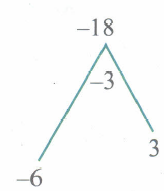
Let p (x) 2x3 - x2 - 12x - 9
Sum of the co-efficients = 2 - 1- 12- 9 = -20 \(\neq \) 0
Hence x-1 is not a factor
Sum of co-efficients of even powers with constant = -1 - 9 = -10
Sum of co-efficients of odd powers = 2 - 12= -10
Hence x + 1 is a factor of x.
Now we use synthetic division to find the other factors.
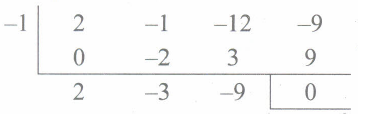
Then p (x) = (x + 1)(2x2 - 3x - 9)
Now 2x2 - 3x - 9 = 2x2 - 6x + 3x - 9 = 2x (x - 3) + 3 (x - 3)
= (x - 3)(2x + 3)
Hence 2x3 - x2 - 12x - 9 (x + 1) (x - 3) (2x + 3)
82.
\(\angle\)In the cyclic quadrilateral \(\angle\) A+\(\angle\)C = 180o
y + 4o + 3yo + 8o = 180o
4yo + 12o = 80o
4yo = 180o -12o = 168
y =\(\cfrac { 168 }{ 4 } \) = 42
\(\angle\)B + \(\angle\)D = 180o
8x + 12 = 180o
8x = 180o - 12o = 168
x = \(\cfrac { 168 }{ 8 } \) = 21o
\(\therefore\) \(\angle\)A = y + 4o = 42o + 4o = 46o
\(\angle\)C = 3y + 8 = 3 \(\times\) 42 + 8 = 126 + 8 = 134o
\(\angle\)B = 3x + 6 = 3 \(\times\) 21 + 6 = 63 + 6 = 69o
\(\angle\)D = 5x + 6 = 5 \(\times\) 21 + 6
= 105 + 6 = 111o
83.
Step Deviation Method
\(\bar { x } =A+\left[ \frac { \Sigma fd }{ \Sigma f } \times c \right] \) Where \(d=\frac { x-A }{ c } \)
Let Assumed mean A = 32
Class Interval c = 45
| Age Class Interval | x | Mid x | No.of person f | d=\(\cfrac{x-A}{c}\) | fd |
| 15-19 | 14.5-19.5 | 17 | 4 | -3 | -12 |
| 20-24 | 19.5-24.5 | 22 | 20 | -2 | -40 |
| 25-29 | 24.5-29.5 | 27 | 38 | -1 | -38 |
| 30-34 | 29.5-34.5 | 32 | 24 | 0 | 0 |
| 35-39 | 34.5-39.5 | 37 | 10 | 1 | 10 |
| 40-44 | 39.5-44.5 | 42 | 9 | 2 | 18 |
| \(\Sigma f=105\) | \(\Sigma fd=-62\) |
Mean \(\bar { x } =A+\left[ \cfrac { \Sigma fd }{ \Sigma f } \times c \right] \)
\(=32+\left[ \cfrac { -62 }{ 105 } \times 5 \right] \)
= 32 + (-2.952)
= 29.05
84.
| Weight in kgs(x) | Number of students(f) | Mid value of x | fx |
| 15-25 | 4 | 20 | 80 |
| 25-35 | 11 | 30 | 330 |
| 35-45 | 19 | 40 | 760 |
| 45-55 | 14 | 50 | 700 |
| 55-65 | 0 | 60 | 0 |
| 65-75 | 2 | 70 | 140 |
| \(\Sigma{f}=50\) | 2010 |

85.

To represent \(-\frac { 2 }{ 11 } ,-\frac { 5 }{ 11 } and-\frac { 9 }{ 11 } \)on the number line we make 11 markings each being equal distance \(\frac { 1 }{ 11 } \) on the left of 0.
The point A represents \(\left( -\frac { 2 }{ 11 } \right) \) , the point B represents\(\left( -\frac { 2 }{ 11 } \right) \) and the point C represents \(\left( -\frac { 9 }{ 11 } \right) \)
86.
Rational between \(\frac { 1 }{ 2 } \) and \(\frac { 1 }{ 5 } \) = \(\frac { 1 }{ 2 } \left( \frac { 1 }{ 2 } +\frac { 1 }{ 5 } \right) \)
=\(\frac { 1 }{ 2 } \left( \frac { 1 }{ 2 } +\frac { 1 }{ 5 } \right) \)
= \(\frac { 1 }{ 2 } \left( \frac { 1 }{ 2 } +\frac { 1 }{ 5 } \right) \)
Rational numbers between\(\frac { 1 }{ 2 } \) and \(\frac { 7 }{ 20 } \)
=\(\frac { 1 }{ 2 } \left( \frac { 10+7 }{ 20 } \right) \)
=\(\frac { 17 }{ 40 } \)
Rational number between \(\frac { 1 }{ 2 } \) and \(\frac { 7 }{ 20 } \) =\(\frac { 1 }{ 2 } \left( \frac { 1 }{ 2 } \times \frac { 17 }{ 40 } \right) \)
=\(\frac { 1 }{ 2 } \left( \frac { 20+17 }{ 40 } \right) \)
=\(\frac { 37 }{ 80 } \)
Thus the rational numbers are \(\frac { 7 }{ 20 } ,\frac { 17 }{ 40 } and\frac { 37 }{ 80 } \)
87.
| S.No | n(A) | n(B) | n(AUB) | n(A∩B) | n(A-B) | n(B-A) |
|---|---|---|---|---|---|---|
| 1 | 30 | 45 | 65 | 10 | 20 | 35 |
| 2 | 20 | 45 | 55 | 10 | 10 | 35 |
| 3 | 50 | 65 | 90 | 25 | 25 | 40 |
| 4 | 30 | 43 | 70 | 3 | 27 | 40 |
88.
Let A(1, 1), B(5, 4) and C(-2, 5)
Distance =\(\sqrt{(x_2-x_1)^2+(y_2-y_1)^2}\)
AB =\(\sqrt{(5-1)^2+(4-1)^2}\)
\(=\sqrt{4^2+3^2}=\sqrt{16+9}=\sqrt{25}=5\)
BC =\(\sqrt{(-2-5)^2+(5-4)^2}\)
\(=\sqrt{(-7)^2+1^2}=\sqrt{49+1}=\sqrt{50}\)
AC =\(\sqrt{(-2-1)^2+(5-1)^2}\)
\(=\sqrt{(-3)^2+4^2}=\sqrt{9+16}=\sqrt{25}=5\)
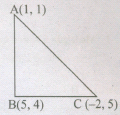
AB = 5, AC = 5,
\(\therefore\) ABC is an isosceles triangle .................(1)
BC2 = AB2 + AC2
50 = 25 + 25\(\Rightarrow\) 50 = 50
\(\therefore\) \(\angle\)A = 90° ...................(2)
From (1) and (2) we get ABC is an isosceles right angle triangle.
89.
In \(\triangle\)ABC, AB = BC = 8 cm, \(\angle\)B = 70°.
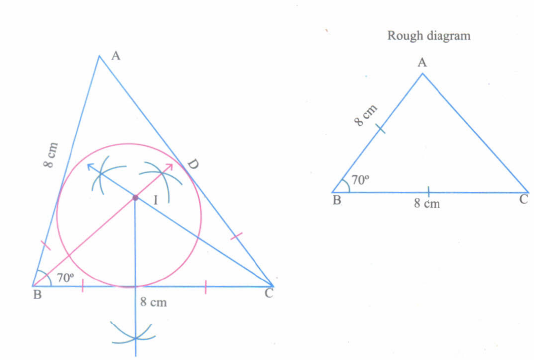
Construction :
Step 1: Draw \(\triangle\)ABC with BC = 8 cm, \(\angle\)B = 70°. AB = 8.
Step 2: Construct the angle bisectors of any two angles (B and C) and let them meet at I. Then I is the incentre of \(\triangle\)ABC. Draw perpendicular from I to anyone of the side (BC) to meet BC at D.
Step 3: With I as centre and ID as radius draw a circle. This circle touches all the sides of the triangle internally.
90.
In \(\triangle \)ABC,
AB = 4 cm, AC = 3 cm, \(\angle\)A = 90°
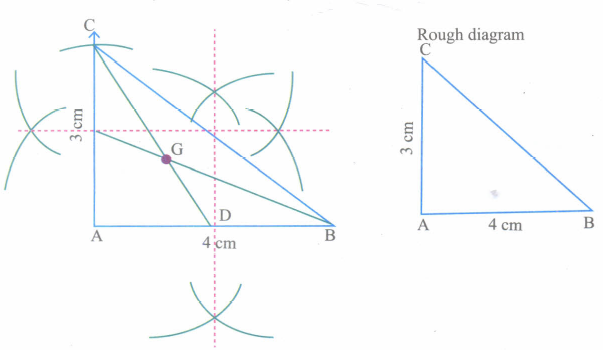
Construction :
Step 1: Draw \(\triangle \)ABC with AB = 4 cm, AC = 3 cm, \(\angle\)A = 90°
Step 2: Draw perpendicular bisectors of any two sides (AB and AC) to find the midpoints of AB and AC.
Step 3: Draw the medians CD and BE. Let them meet at G.
Step 4: G is the centroid of the given triangle.

9th Standard Syllabus & Materials
9th Standard
TN 9th Tamil உள்ளத்தின் சீர் - திருக்குறள் Important Questions And Answers Study Material - QB365 Set A
NEW9th Standard
TN 9th Tamil உள்ளத்தின் சீர் - மணிமேகலை Important Questions And Answers Study Material - QB365 Set A
NEW9th Standard
TN 9th Tamil உள்ளத்தின் சீர் - ஏறு தழுவுதல் Important Questions And Answers Study Material - QB365 Set A
NEW9th Standard
TN 9th Tamil உயிருக்கு வேர் - தண்ணீர் Important Questions And Answers Study Material - QB365 Set A



Tamilnadu Stateboard 9th Standard Subjects
Tamilnadu Stateboard Standards





