
 100% FREE ACCESS
9th Standard Syllabus & Materials
9th Standard
TN 9th Tamil உள்ளத்தின் சீர் -கற்கண்டு (இலக்கணம்) - தொடர் இலக்கணம், ஆகுபெயர் Important Questions And Answers Study Material - QB365 Set A
NEW9th Standard
TN 9th Tamil உள்ளத்தின் சீர் -விரிவானம் (துணைப்பாடம்) - தாய்மைக்கு வறட்சி இல்லை! Important Questions And Answers Study Material - QB365 Set A
NEW9th Standard
TN 9th Tamil உள்ளத்தின் சீர் -கவிதை பேழை (செய்யுள்) - மார்கழி பெருவிழா Important Questions And Answers Study Material - QB365 Set A
NEW9th Standard
TN 9th Tamil உயிருக்கு வேர்-இலக்கணம் - பகுபத உறுப்பிலக்கணம் Important Questions And Answers Study Material - QB365 Set A
NEW9th Standard
TN 9th Tamil அமுதென்று பேர் - இலக்கணம்-எழுத்து -அளபெடை Important Questions And Answers Study Material - QB365 Set A
NEW9th Standard
TN 9th Tamil அமுதென்று பேர்-துணைப்பாடம் - ஆறாம்திணை Important Questions And Answers Study Material - QB365 Set A

Published on: 12/02/2020
9th Standard Mathematics Important Creative Questions for all chapters -II- 2019-2020
Download Tamil Nadu 9th Standard Maths question papers, model tests, one-mark questions, important questions, and public exam papers in PDF format. Free study materials and answer keys for TN State Board students.
Questions + Answers key
Take MCQ Maths Test1.
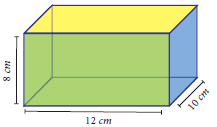
The length, breadth and height of a cuboid is 120 mm, 10 cm and 8 cm respectively. Find the volume of 10 such cuboids.
2.
Team I and Team II play 10 cricket matches each of 20 overs. Their total scores in each match are tabulated in the table as follows:
| Match numbers | 1 | 2 | 3 | 4 | 5 | 6 | 7 | 8 | 9 | 10 |
| Team I | 200 | 122 | 111 | 88 | 156 | 184 | 99 | 199 | 121 | 156 |
| Team II | 143 | 123 | 156 | 92 | 164 | 72 | 100 | 201 | 98 | 157 |
What is the relative frequency of Team I winning?
3.
Find the value of
(i) sin 38036' + tan 12012'
(ii) tan 60025' - cos 49020'
4.
In a mathematics class, 20 children forgot to bring their rulers,17 children forgot to bring their pencil and 5 children forgot to bring both ruler and pencil. Then find the number of children
(i) who forgot to bring only pencil
(ii) who forgot to bring only ruler
(iii) in the class
5.
Show that (x-3) is a factor of x3 + 9x2 - x - 105
6.
Multiply \(\sqrt [ 4 ]{ 400 } \) and \(\sqrt [ 4 ]{ 567 } \)
7.
Find the median of the given data: 36, 44, 86, 31, 37, 44, 86, 35, 60, 51
8.
Express in scientific notation:
(i) 9768854
(ii) 0.04567891
(iii) 72006865.48
9.
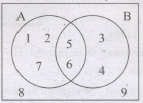
From the venn-diagram, list the following:
(i) A
(ii) B
(iii) A ∩ B
(iv) AU B
(v) A-B
(vi) B-A
(vii) (A - B) ∩ (B - A)
10.
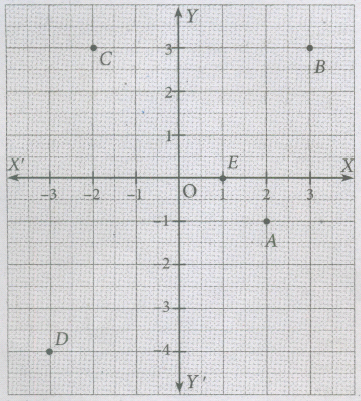
Observe the given graph and complete the following table:
| Points | Quadrant | Ordered Pair |
| A | IV | |
| B | (3,3) | |
| C | (-2,3) | |
| D | III |
11.
Find the quotient and remainder of the following. (4x3 + 6x2 – 23x +18)÷(x+3)
12.
Show that the following points taken in order form the vertices of a parallelogram.
A(–3, 1), B(–6, –7), C (3, –9) and D(6, –1)
13.
Express the following decimal expression into rational numbers. \(0.\overline { 24 } \)
14.
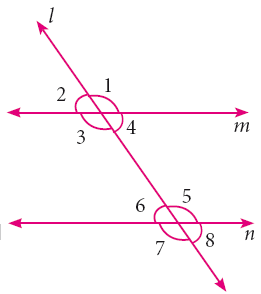
Let m || n and l is a transversal Such that ∠1 : ∠2 = 11 : 7. Determine all the eight angles.
15.
Find the value of sin 3x. sin 6x. sin 9x when x = 10°
16.
If sin\(\theta\) = \(\cfrac { a }{ \sqrt { \left( { a }^{ 2 }+{ b }^{ 2 }+{ c }^{ 2 }+2bc \right) } } \), then show that (b + c) sin \(\theta\) = (a) cos \(\theta\)
17.
Find the area of a quadrilateral whose sides are PQ = 15 cm, QR = 8 cm, RS = 25 m.
18.
Find the centroid of the triangle whose vertices are (2, -5), (5, 11) and (9, 9)
19.
If A (10, 11) and B (2 ,3) are the coordinates of end points of diameter of circle. Then find the centre of the circle.
20.
In a football match, a goalkeeper of a team can stop the goal, 32 times out of 40 attempts tried by a team. Find the probability that the opponent team can convert the attempt into a goal.
21.
Find the length of median through A of a triangle whose vertices are A(−1, 3), B(1, −1) and C(5, 1).
22.
Evaluate : 10 -4
23.
Find the mode for the set of values 17, 18, 20, 20, 21, 21, 22, 22.
24.
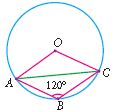
In figure ㄥABC = 1200, where A, B and C are points on the circle with centre O. Find ㄥOAC?
25.
Show that \(\sqrt [ 3 ]{ 7 } >\sqrt [ 4 ]{ 5 } \) .
26.
Write the following in the form of 4n:
8
27.
Identify the following sets as null set or singleton set.
B = The set of all even natural numbers which are not divisible by 2
28.
Which of the following expressions are polynomials. If not give reason: \(\sqrt { 5 } x^{ 2 }+\sqrt { 3 } x+\sqrt { 2 } \)
29.
The total surface area of a cuboid with dimension 10 cm × 6 cm × 5 cm is _______.
280 cm2
300 cm2
360 cm2
600 cm2
30.
The probability of an event cannot be _______.
Equal to zero
Greater than zero
Equal to one
Less than zero
31.
The value of \(\frac { sin{ 29 }^{ 0 }31' }{ cos{ 60 }^{ 0 }29' } \) is
0
2
1
-1
32.
In what ratio does the point Q(1, 6) divide the line segment joining the points P(2, 7) and R(−2, 3) ______.
1 :2
2 :1
1 :3
3 :1
33.
In a town 30% like only coffee, 20% like only tea,10% like only like,15% like only any two of them, 5% only like all the three. What is the percentage of people who like none them.
15%
20%
10%
5%
34.
Zero of (7+4x) is_______
\(\cfrac { 4 }{ 7 } \)
\(\cfrac { -7 }{ 4 } \)
7
4
35.
The distance between the longest chord of a circle and the centre is________
1
0
2
5
36.
For which set of number do the mean,median and mode all have the same valuas?
2,2,2,4
1,3,3,3,5
1,1,2,5,6
1,1,2,1,5
37.
A particular observation which occurs maximum number of times in a given data is called its _______.
Frequency
range
mode
Median
38.
The GCD of ak, ak+1, ak+5 where, k∈N _________
ak
ak+1
ak+5
1
39.
\(\frac { \sqrt [ 3 ]{ 18 } }{ \sqrt [ 3 ]{ 2 } } \) is same as _____________
3
\(\sqrt [ 3 ]{ 9 } \)
9
\(\sqrt [ 6 ]{ 3 } \)
40.
If a number has a non-terminating and non-recurring decimal expansion, then it is______________ .
a rational number
a natural number
an irrational number
an integer
41.
The centre of a circle is (0, 0). One end point of a diameter is (5, -1), then ______________
\(\sqrt{24}\)
\(\sqrt{37}\)
\(\sqrt{26}\)
\(\sqrt{17}\)
42.
If A = {x, y, z} then the number of non-empty subsets of A is ________.
8
5
6
7
43.
Find the quotient and remainder when 5x3 + 7x2 + 3x + 2 is divided by 3x + 2
44.
Find the quotient and remainder for the following using synthetic division:
(i) (x3+x2-7x-3) ÷ (x - 3)
(ii) (x3+2x2-x-4) ÷ (x + 2)
(ii) (3x3-2x2+7x-5) ÷ (x + 3)
(iv) (8x4-2x2+6x+5) ÷ (4x + 1)
45.
Which type of quadrilateral satisfies the following properties?
(i) Both pairs of opposite angles are equal in size.
(ii) Both pairs of opposite sides are equal in length.
(iii) Each diagonal is an angle bisector.
(iv) The diagonals bisect each other.
(v) Each pair of consecutive angles is supplementary.
(vi) The diagonals are equal.
(vii) Can be divided into two congruent triangles.
46.
Construct \(\triangle\)ABC in which AB = BC = 8cm and \(\angle \)B =70o. Locate its in centre and draw the incircle
1.
Since both breadth and height are given in cm, it is necessary to convert the length also in cm.
So we get, l = 120 mm = \(\frac{120}{10}\) = 12cm and take b = 10 cm, h = 8 cm as such.
Volume of a cuboid = l × b × h
= 12 ×10 × 8
= 960 cm3
Volume of 10 such cuboids= 10 × 960
= 9600 cm3
2.
In this experiment, each trial is a match where Team I faces Team II.
We are concerned about the winning status of Team I.
There are 10 trials in total; out of which Team I wins in the 1st, 6th and 9th matches.
The relative frequency of Team I winning the matches = \(\frac { 3 }{ 10 } \)or 0.3
3.
(i) sin 38036' + tan 12012'
sin 38036' = 0.6239
tan12012' = 0.2162
sin 38036' + tan 12012' = 0.8401
(ii) tan 60025' - cos 49020'
tan 60025' = 1.7603 + 0.0012 = 1.7615
cos 49020' = 0.6521 - 0.0004 = 0.6517
tan 60025' - cos 49020' = 1.1098
4.
Let R be the set of children forgotten their rulers.
Let P be the set of children forgotten their pencil.
n(R) = 20, n(P) = 17, n(R\(\cap \)P) = 5
By using venn-diagram
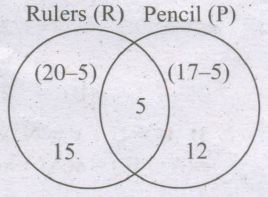
From the venn -diagram we get
(i) Number of children forgotten only pencil = 12
(ii) Number of children forgotten only ruler 15
(iii) Total number of children in the class 15 + 5 + 12 = 32
5.
Let p(x)= x3 + 9x2 - x - 105
By factor theorem,x-3 is a factor of p(x),if p(3) = 0
p(3) = 33 + 9(3)3 - 3 - 105
= 27 + 81 - 3 -105
= 108-108
p(3) = 0
Therefore,x-3 is a factor of x3 + 9x2 - x - 105
6.
\(\sqrt [ 4 ]{ 400 } \times \sqrt [ 4 ]{ 567 } \) =\(\left( \sqrt [ 4 ]{ 2\times 2\times 2\times 2\times 5\times 5 } \right) \left( \sqrt [ 3 ]{ 3\times 3\times 3\times 3\times 7 } \right) \)
= \(\left( 2\times \sqrt [ 4 ]{ 25 } \right) \times \left( 3\times \sqrt [ 4 ]{ 7 } \right) =6\times \left( \sqrt [ 4 ]{ 25 } \times \sqrt [ 4 ]{ 7 } \right) \)
= \(6\times \left( \sqrt [ 4 ]{ 25 } \times \sqrt [ 4 ]{ 7 } \right) =6\times \sqrt [ 4 ]{ 25\times 7 } =6\sqrt [ 4 ]{ 175 } \)
7.
36, 44, 86, 31, 37, 44, 86, 35, 60, 51
Ascending order 31, 35, 36, 37, 44, 44, 51, 60, 86, 86
The number of values = 10, which is an even number
\(\therefore\) Median = Average of \(\left( \cfrac { 10 }{ 2 } \right) ^{ th }\) and \(\left( \cfrac { 10 }{ 2 } +1 \right) ^{ th }\) Value
= Average of 5th and 6th values
=\(\cfrac{44+44}{2}=\cfrac{88}{2}\)
8.
(i) 
The decimal point is to be moved six places to the left. Therefore n = 6.
(ii) 
The decimal point is to be moved two places to the right. Therefore n = −2
(iii) 
The decimal point is to be moved seven places to the left. Therefore n = 7
9.
(i) A = {1,2,5,6,7}
(ii) B = {3,4,5,6}
(iii) A ∩ B = {5,6}
(iv) A U B = {1,2,3,4,5,6,7}
(v) A-B = {1,2,7}
(vi) B - A = {3,4}
(vii) (A-B) ∩ (B -A) = { }.
10.
| Points | Quadrant | Ordered Pair |
| A | IV | (2, -1) |
| B | I | (3,3) |
| C | II | (-2,3) |
| D | III | (-3,- 4) |
11.
.png)
\(\therefore\) The Quotient: 4x2–6x–5
The Remainder : 33
12.
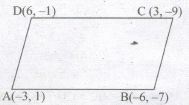
Distance =\(\sqrt { ({ x }_{ 2 }-{ x }_{ 1 })^{ 2 }+(y_{ 2 }-y_{ 1 })^{ 2 } } \)
AB =\(\sqrt { (-6+3)^{ 2 }+(-7-1)^{ 2 } } \)
= \(\sqrt { (-3)^{ 2 }+(-8)^{ 2 } } =\sqrt { 9+64 } =\sqrt { 73 } \)
BC = \(\sqrt { (3+6)^{ 2 }+(-9+7)^{ 2 } } \)
= \(\sqrt { { 9 }^{ 2 }+(-2)^{ 2 } } =\sqrt { 81+4 } =\sqrt { 85 } \)
CD = \(\sqrt { (6-3)^{ 2 }+(-1+9)^{ 2 } } \)
= \(\sqrt { (3)^{ 2 }+({ 8 })^{ 2 } } =\sqrt { 9+64 } =\sqrt { 73 } \)
AD = \(\sqrt { (6+3)^{ 2 }+(-1-1)^{ 2 } } \)
= \(\sqrt { (9)^{ 2 }+(-2)^{ 2 } } =\sqrt { 81+4 } =\sqrt { 85 } \)
AB = CD =\(\sqrt { 73 } \) and BC = AD = \(\sqrt { 85 } \)(Opposite sides are equal)
∴ ABCD is a parallelogram.
13.
Let x = 0.242424..... \(\rightarrow\) (1)
100 x = 24.2424 ...... \(\rightarrow\) (2)
(2) - (1) \(\Rightarrow\) 100x - x = 24.2424
99x = 24
x = \(24\over 99\) (or) \(8\over 33\)
x = \(8\over 33\)
14.
\(\angle 1:\angle 2=11:7\)
\(\angle 1+\angle 2=180^0\) (Angle of a straight line)
Divide 180° in the ratio 11 : 7
Total ratio 11 + 7 = 18
\(\angle 1=\frac{11}{18}\times180^0=110^0\)
\(\angle 2=\frac{7}{18}\times180^0=70^0\)
\(\angle 3=\angle 1=110^0\)(Vertically opposite angles)
\(\angle 4=\angle 2=70^0\)(Vertically opposite angles)
\(\angle 5=\angle 1=110^0\)(Corresponding angles)
\(\angle 6=\angle 2=70^0\)(Corresponding angles)
\(\angle 7=\angle 5=110^0\)(Vertically opposite angles)
\(\angle 8=\angle 6=70^0\)(Vertically opposite angles )
\(\therefore\) ∠1 = 110°, ∠2 = 70°, ∠3 = 110°, ∠4 = 70°, ∠5 = 110°, ∠6 = 70°, ∠ 7 = 110° ∠8 = 70°.
15.
sin 3 (10°) sin 6 (10°) sin 9 (10°)
= \(\cfrac { 1 }{ 2 } \times \cfrac { \sqrt { 3 } }{ 2 } \times 1=\cfrac { \sqrt { 3 } }{4 } \)
16.
,Adjacent side = \(\sqrt { { a }^{ 2 }+{ b }^{ 2 }+{ c }^{ 2 }+2bc-{ a }^{ 2 } } \)
= \(\sqrt { \left( b+c \right) ^{ 2 } } =b+c\)
\(\therefore\) \((b+c)sin\theta =\alpha cos\theta \)
\(\left( b+c \right) \times \cfrac { a }{ \sqrt { \left( { a }^{ 2 }+{ b }^{ 2 }+{ c }^{ 2 }+2bc \right) } } =a\times \cfrac { b+c }{ \sqrt { { a }^{ 2 }+{ b }^{ 2 }+{ c }^{ 2 }+2bc } } \)
17.
PR =\(\sqrt { 225+64 } =\sqrt { 289 } \) = 17 cm
s = \(\frac { 15+17+18 }{ 2 } \) = 20 cm
Area of Δ PQR = \(\\ \sqrt { 20\times 5\times 12\times 3 } =\sqrt { 5\times 4\times 5\times 4\times 3\times 3 } \)=60
ΔPRS
Area = \(\sqrt { 27(27-17)(27-25)(27-12) } =\sqrt { 27\times 10\times 2\times 15 } \)
=\(\sqrt { 3\times 3\times 3\times 5\times 2\times 2\times 5\times 3 } \)=9 x 5 x 2 =90
Total area = 90 + 60 =150 cm2.
18.
\(G\left( \frac { { x }_{ 1 }+{ x }_{ 2 }+{ x }_{ 3 } }{ 3 } ,\frac { { y }_{ 1 }+{ y }_{ 2 }+{ y }_{ 3 } }{ 3 } \right) =\left( \frac { 2+5+9 }{ 3 } ,\frac { -5+11+9 }{ 9 } \right) =\left( \frac { 16 }{ 3 } ,5 \right) \)
19.
Centre of the circle \(=\left( \frac { 10+2 }{ 2 } ,\frac { 11+3 }{ 2 } \right) =(6,7)\)
20.
Total no. of attempts n(S) = 40
Total no. of attempts by A team n(A) = 32
Total no. of attempts by the opponent team B = n(B) = 40 - 32 = 8
P(B) = \(\frac { n(B) }{ n(S) } =\frac { 8 }{ 40 } =\frac { 1 }{ 5 } \).
21.
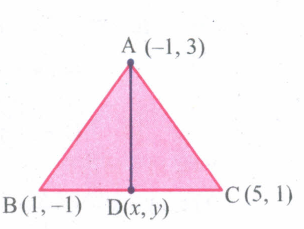
D (x, y) is the Mid point BC
\(\therefore \ D(x,y)=\left( \frac { 1+5 }{ 2 } ,\frac { -1+1 }{ 2 } \right) \)
\(=\left( \frac { 6 }{ 2 } ,\frac { 0 }{ 2 } \right) \)
= (3, 0)
AD is the median through A
Here A x2 y2 D x3 y3
(-1,3) (3,0)
\( \therefore\) Length of AD \(=\sqrt { { ({ x }_{ 2 }-{ x }_{ 1 }) }^{ 2 }+{ ({ y }_{ 2 }-{ y }_{ 1 }) }^{ 2 } } =\sqrt { { (3-(-1)) }^{ 2 }+{ (0-3) }^{ 2 } } \)
\(=\sqrt { { (3+1) }^{ 2 }+{ (-3) }^{ 2 } } =\sqrt { 16+9 } =\sqrt { 25 } =5\) units
22.
10-4 = \(\cfrac { 1 }{ { 10 }^{ 4 } } =\cfrac { 1 }{ 1000 } =0.0001\)
23.
In this example, three values 20, 21, 22 occur two times each. There are three modes for the given data!
24.
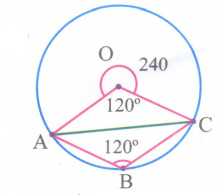
reflex \(\angle\)AOC = 2\(\angle\)ABC = 2 \(\times\)1200 = 2400
\(\therefore \)\(\angle\)AOC = 3600 - 2400 = 1200
Hence\(\angle\)OAC+\(\angle\)OCA = 1800 - 1200 = 600
\(\Rightarrow\) 2\(\angle \)AOC = 600
\(\Rightarrow\) \(\angle\)OAC=\(\cfrac { { 60 }^{ 0 } }{ 2 } \) = 300 [ \(\because \) \(\angle \)OAC =\(\angle \) OCA]
25.
\(\sqrt [ 3 ]{ 7 } =\sqrt [ 12 ]{ { 7 }^{ 4 } } =\sqrt [ 12 ]{ 2401 } \)
\(\sqrt[4]{5}=5^{\frac{1}{4}}=5^{\frac{3}{12}}=\sqrt[12]{5^{3}}=\sqrt[12]{125}\)
\(\sqrt [ 12 ]{ 2401 } >\sqrt [ 12 ]{ 125 } \)
Therefore, \(\sqrt [ 3 ]{ 7 } >\sqrt [ 4 ]{ 5 } \)
26.
8 = 41\(\times\)\({ 4 }^{ \frac { 1 }{ 2 } }\) = \(4^{1+\frac{1}{2}}=4^{\frac{3}{2}}\)
27.
The set B is a Null set
28.
\(\sqrt { 5 } x^{ 2 }+\sqrt { 3 } x+\sqrt { 2 } \) is a polynomial
Non negative integral power.
29.
(a)
280 cm2
30.
(d)
Less than zero
31.
(c)
1
32.
(c)
1 :3
33.
(b)
20%
34.
(b)
\(\cfrac { -7 }{ 4 } \)
35.
(b)
0
36.
(b)
1,3,3,3,5
37.
(c)
mode
38.
(a)
ak
39.
(b)
\(\sqrt [ 3 ]{ 9 } \)
40.
(c)
an irrational number
41.
(c)
\(\sqrt{26}\)
42.
(d)
7
43.
P (x) = 5x3 + 7x2 + 3x + 2
d(x) = 3x + 2
Standard form of p (x) = 5x3 + 7x2 + 3x + 2
and d (x) = 3x + 2
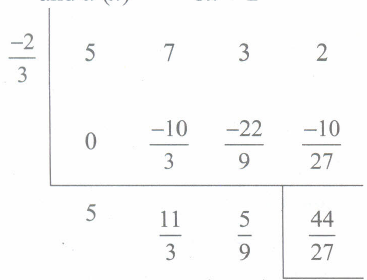
5x3 + 7x2 + 3x + 2 = \(\left( x+\cfrac { 2 }{ 3 } \right) \left( 5{ x }^{ 2 }-{ \cfrac { 11 }{ 3 } x+\cfrac { 5 }{ 9 } } \right) +\cfrac { 44 }{ 27 } =\left( \cfrac { 3x+2 }{ 3 } \right) \left( 5x2-\cfrac { 11 }{ 3 } x+\cfrac { 5 }{ 9 } \right) +\cfrac { 44 }{ 27 } \)
= \(\left( \cfrac { 3x+2 }{ 3 } \right) 3\left( \cfrac { 5 }{ 3 } { x }^{ 2 }-\cfrac { 11 }{ 9 } x+\cfrac { 5 }{ 27 } \right) +\cfrac { 44 }{ 27 } \)
= \(\left( 3x+2 \right) \left( \cfrac { 5 }{ 3 } { x }^{ 2 }-\cfrac { 11 }{ 9 } x+\cfrac { 5 }{ 27 } \right) +\cfrac { 44 }{ 27 } \)
Hence the quotient \(\cfrac { 5 }{ 3 } { x }^{ 2 }-\cfrac { 11 }{ 9 } x+\cfrac { 5 }{ 21 } \) and remainder IS \(\cfrac { 44 }{ 27 } \)
44.
(i) (x3+x2-7x-3) ÷ (x-3)
Let p (x) = x3+x2-7x-3
q (x) = x - 3
To find the zero of x - 3 :
p(x) in standard form ((i.e.) descending order)
Co-efficients are 1 1 -7 -3
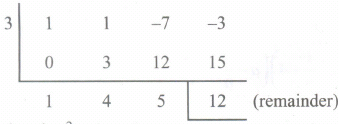
Quotient is: x2 +4x+5
Remainder is :12
(ii) (x3+2x2-x-4) ÷ (x+2)
p(x) = x3+2x2-x-4
Co-efficients are 1 2 -1 -4
To find zero of x+2, put x+2 = 0; x = -2
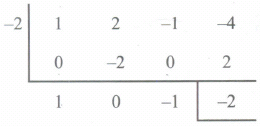
Quotient is: (x2-1)
Remainder is: -2
(iii) (3x3-2x2+7x-5) ÷ (x+3)
To find zero of the divisor (x + 3), put x + 3 = 0; x = - 3
Dividend in Standard form 3x3-2x2+7x-5
Co-efficients are 3 -2 7 -5
Synthetic Division
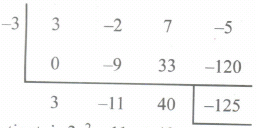
Quotient is: 3x2-11x+40
Remainder: is -125
(iv) (8x4-2x2+6x+5) ÷ (4x+1)
To find zero of the divisor 4x + 1, put 4x + 1 = 0; 4x = -1; x = \(-\frac{1}{4}\)
Dividend in Standard form 8x4-2x2+6x+5
Co-efficients are 8 0 -2 6 5
Synthetic Division
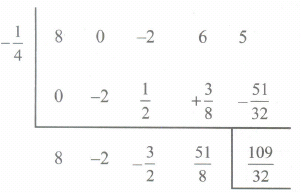
8x4-2x2+6x+5 = \((x+\frac{1}{4})(8x^3-2x^2-\frac{3x}{2}+\frac{51}{8})+\frac{109}{32}\)
=\(\frac{4x+1}{ ̶4̶}\times ̶4̶(2x^3-\frac{x^2}{2}-\frac{3x}{8}+\frac{51}{32})+\frac{109}{32}\)
= (4x+1)\((2x^3-\frac{x^2}{2}-\frac{3x}{8}+\frac{51}{32})+\frac{109}{32}\)
Quotient is: \(2x^2-{x^2\over2}-{3x\over8}+{51\over32}\)
Remainder is: \({109\over32}\)
45.
(i) Both pairs of opposite angles are equal in size are square and rectangle.
(ii) Both pairs of opposite sides are equal in length are square and rhombus.
(iii) Each diagonal is an angle bisector of square and rectangle.
(iv) The diagonals of the following quadrilateral bisect each other: Parallelogram, rectangle, square, and rhombus.
(v) Each pair of consecutive angles is supplementary are square, rectangle, rhombus, parallelogram.
(vi) The diagonals are equal in case of square and rectangle.
(vii) Square, rectangle, rhombus, and parallelogram can be divided into two congruent triangles.
46.
In \(\triangle\)ABC, AB = BC = 8 cm, \(\angle\)B = 70°.
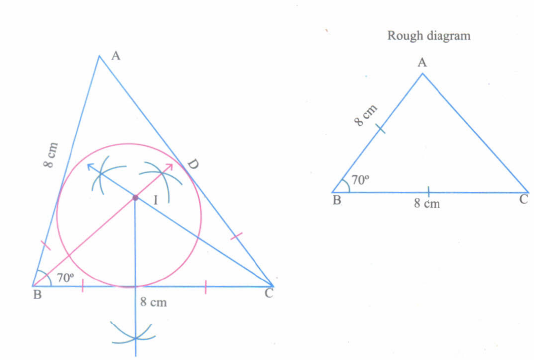
Construction :
Step 1: Draw \(\triangle\)ABC with BC = 8 cm, \(\angle\)B = 70°. AB = 8.
Step 2: Construct the angle bisectors of any two angles (B and C) and let them meet at I. Then I is the incentre of \(\triangle\)ADC. Draw perpendicular from I to anyone of the side (BC) to meet BC at D.
Step 3: With I as centre and ID as radius draw a circle. This circle touches all the sides of the triangle internally.

9th Standard Syllabus & Materials
9th Standard
TN 9th Tamil உள்ளத்தின் சீர் - திருக்குறள் Important Questions And Answers Study Material - QB365 Set A
NEW9th Standard
TN 9th Tamil உள்ளத்தின் சீர் - மணிமேகலை Important Questions And Answers Study Material - QB365 Set A
NEW9th Standard
TN 9th Tamil உள்ளத்தின் சீர் - ஏறு தழுவுதல் Important Questions And Answers Study Material - QB365 Set A
NEW9th Standard
TN 9th Tamil உயிருக்கு வேர் - தண்ணீர் Important Questions And Answers Study Material - QB365 Set A



Tamilnadu Stateboard 9th Standard Subjects
Tamilnadu Stateboard Standards





