
 100% FREE ACCESS
9th Standard Syllabus & Materials
9th Standard
TN 9th Tamil உள்ளத்தின் சீர் -கற்கண்டு (இலக்கணம்) - தொடர் இலக்கணம், ஆகுபெயர் Important Questions And Answers Study Material - QB365 Set A
NEW9th Standard
TN 9th Tamil உள்ளத்தின் சீர் -விரிவானம் (துணைப்பாடம்) - தாய்மைக்கு வறட்சி இல்லை! Important Questions And Answers Study Material - QB365 Set A
NEW9th Standard
TN 9th Tamil உள்ளத்தின் சீர் -கவிதை பேழை (செய்யுள்) - மார்கழி பெருவிழா Important Questions And Answers Study Material - QB365 Set A
NEW9th Standard
TN 9th Tamil உயிருக்கு வேர்-இலக்கணம் - பகுபத உறுப்பிலக்கணம் Important Questions And Answers Study Material - QB365 Set A
NEW9th Standard
TN 9th Tamil அமுதென்று பேர் - இலக்கணம்-எழுத்து -அளபெடை Important Questions And Answers Study Material - QB365 Set A
NEW9th Standard
TN 9th Tamil அமுதென்று பேர்-துணைப்பாடம் - ஆறாம்திணை Important Questions And Answers Study Material - QB365 Set A

Published on: 12/02/2020
9th Standard Mathematics All Chapter Important Annual Questions-I- 2019-2020
Download Tamil Nadu 9th Standard Maths question papers, model tests, one-mark questions, important questions, and public exam papers in PDF format. Free study materials and answer keys for TN State Board students.
Questions + Answers key
Take MCQ Maths Test1.
When a dice is rolled, find the probability to get the number greater than 4?
2.
(i) If cosec A = sec 340, then find A
(ii) If tan B = cot 470, then find B.
3.
Three different triangular plots are available for sale in a locality. Each plot has a perimeter of 120 m. The side lengths are also given:
| Shape of plot | Perimeter | Length of sides |
| Right angled triangle | 120 m | 30 m, 40 m, 50 m |
| Acute angled triangle | 120 m | 35 m, 40 m, 45 m |
| Equilateral triangle | 120 m | 40 m, 40 m, 40 m |
Help the buyer to decide which among these will be more spacious.
4.
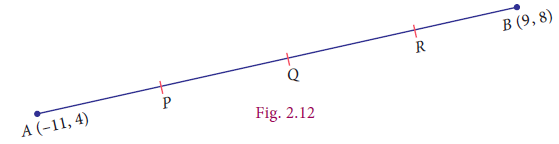
Find the points which divide the line segment joining A(−11, 4) and B(9, 8) into four equal parts.
5.
Expand : (x + 2 y + 3z)2
6.
Simplify;\(\sqrt { 44 } +\sqrt { 99 } -\sqrt { 275 } \)
7.
If A = {x : x ∈ Z, -2 < x ≤ 4}, B = {x : x ∈ W, x ≤ 5}, C = {-4,-1,0,2,3,4}, then verify A∪(B∩C)=(A∪B)∩(A∪C).
8.
If the mean of the following data is 20.2, then find the value of p
| Marks | 10 | 15 | 20 | 25 | 30 |
| No.of students | 6 | 8 | p | 10 | 6 |
9.
Represent the following numbers in scientific notation:
(i) (300000)2 \(\times\) (20000)4
(ii) (0.000001)11 ÷ (0.005)3
(iii) \( \{ (0.00003 ) ^{ 6 }\times (0.00005)^{ 4 }\} \div \{ (0.009)^{ 3 }\times (0.05)^{ 2 }\} \)
10.
In a class there are 40 students. 26 have opted for Mathematics and 24 have opted for Science. How many student have opted for Mathematics and Science.
11.
Express the following decimal expression into rational numbers \(17.2\overline { 15 } \)
12.
Subtract the second polynomial from the first polynomial and find the degree of the resultant polynomial
h(z) = z5-6z4+z f(z) = 6z2+10z-7
13.
Calculate the distance between the points A (7, 3) and B which lies on the x-axis whose abscissa is 11.
14.
The total surface area of a cuboid with dimension 10 cm × 6 cm × 5 cm is _______.
280 cm2
300 cm2
360 cm2
600 cm2
15.
The probability of all possible outcomes of a random experiment is always equal to _______.
One
Zero
Infinity
Less than one
16.
The value of tan 1° tan 2° tan 3°...tan 89° is ________.
0
1
2
\(\frac { \sqrt { 3 } }{ 2 } \)
17.
Which of the following statement is true for the equation 2x + 3y = 15
the equation has unique solution
the equation has two solution
the equation has no solution
the equation has infinite solutions
18.
\(\left[ n\left( A\cup B\cup C \right) ^{ ' } \right] \)=_______
\(n\left( A\cap B\cap C \right) \)
\(n\left( U \right) -n\left( A\cup B\cup C \right) \)
n(U)
\(\Phi \)
19.
\(\sqrt [ 3 ]{ 192 } +\sqrt [ 3 ]{ 24 } \)
\(3\sqrt [ 3 ]{ 6 } \)
\(6\sqrt [ 3 ]{ 3 } \)
\(\sqrt [ 3 ]{ 216 } \)
\(\sqrt [ 6 ]{ 216 } \)
20.
The mean of the first 10 prime numbers is _______________
12.6
12.7
12.8
12.9
21.
The mean of a set of numbers is \(\bar X\). If each number is multiplied by z, the mean is _______.
\(\bar X + z\)
\(\bar X-z\)
z\(\bar X\)
\(\bar X\)
22.
\(\frac { \sqrt [ 3 ]{ 18 } }{ \sqrt [ 3 ]{ 2 } } \) is same as _____________
3
\(\sqrt [ 3 ]{ 9 } \)
9
\(\sqrt [ 6 ]{ 3 } \)
23.
The value of the polynomial f(x) = 6x - 3x2+9 when x = -1 is _____________________
0
1
2
3
24.
The point of concurrency of the medians of a triangle is known as __________
circumcentre
incentre
orthocentre
centroid
25.
On which quadrant does the point (-4, 3) lie?
I
II
III
IV
26.
Point (0, –7) lies ________
on the x-axis
in the II quadrant
on the y-axis
in the IV quadrant
27.
If U = {x | x ∈ N, x < 10} and A = {x | x ∈ N, 2 ≤ x < 6} then (A′)′ is –––––––––.
{1, 6, 7, 8, 9}
{1, 2, 3, 4}
{2, 3, 4, 5}
{ }
28.
Factorise 2x3- x2 - 12x - 9 into linear factors
29.
Factorise the following:
(i) x2+10x + 24
(ii) z2+ 4z -12
(iii) p2- 6p -16
(iv) t2+72 -17t
(v) y2-16 - 80
(vi) a2+10a - 600
30.
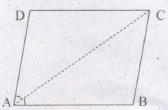
Diagonal AC of a parallelogram ABCD bisects ∠A. Show that
(i) it bisects ∠C also
(ii) ABCD is a rhombus.
31.
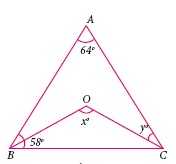
In the given Fig, ∠A = 64° , ∠ABC = 58°. If BO and CO are the bisectors of ∠ABC and ∠ACB respectively of ΔABC, find x° and y°.
32.
Find the value of \(\cfrac { cos{ 63 }^{ 0 }20' }{ sin{ 26 }^{ 0 }40' } \)
33.
Find the value of \(\frac{\tan 25^{\circ}}{\cot 65^{\circ}}+\frac{\sin 40^{\circ}}{\cos 50^{\circ}}\)
34.
Find the TSA and LSA of a cuboid whose length, breadth and height are 10 cm, 12 cm and 14 cm respectively.
35.
Find the centroid of the triangle whose vertices are (2, -5), (5, 11) and (9, 9)
36.
A car travels, at an uniform speed. At 2 pm it is at a distance of 5 km at 6 pm it is at a distance of 120 km. Using section formula, find at what distance it will reach 2 midnight.
37.
What is the probability of drawing a King or a Queen or a Jack from a deck of cards?
38.
Find the length of median through A of a triangle whose vertices are A(−1, 3), B(1, −1) and C(5, 1).
39.
Give any two rational numbers lying between 0.5151151115…. and 0.5353353335…
40.
Convert the following rational numbers into decimal
(i) \(3\over 4\)
(ii) \(5\over 8\)
(iii) \(9\over 25\)
41.
A set of numbers consists of five 4’s, four 5’s, nine 6’s, and six 9’s. What is the mode.
42.
Two circles of radii 5 cm and 3 cm intersect at two points and the distance between their centres is 4 cm. Find the length of the common chord
43.
If \({ x }^{ 2 }+\frac { 1 }{ { x }^{ 2 } } \)= 23, then find the value of \(x+\frac { 1 }{ x } \) and \({ x }^{ 3 }+\frac { 1 }{ { x }^{ 3 } } \) .
44.
Express the following in the form of \(\frac { p }{ q } \) where p and q are integers and q \(\neq \)0.
(a)\(\overline { 0.6 } \)
(b) \(\overline { 0.47 } \)
(c) \(\overline { 0.001 } \)
45.
Which of the following sets are equivalent or unequal or equal sets?
G = {x : x is a prime number and 3 < x < 23}
H = {x : x is a divisor of 18}
46.
Construct the ΔLMN such that LM = 7.5cm, MN = 5cm and LN = 8cm. Locate its centroid.
1.
Sample space S = {1, 2, 3, 4, 5, 6}
Let E be the event of getting a number greater than 4
E = {5, 6}
\(P(E)=\frac { Number\ of\ favourable\ outcomes }{ Total\ number\ of\ outcomes } \)
\(P(E)=\frac { n(E) }{ n(S) } =\frac { 2 }{ 6 } =0.333...\)
2.
(i) We know that cosec A = sec(900 A)
sec(900 - A) sec(340)
900 - A =340
We get A = 90° − 34°
A = 560
(ii) We know that tan B = cot(900 - B)
cot(900 - B) = cot 470
900 - B = 470
We get B = 90° − 47°
B = 430
3.
For clarity, let us draw a rough figure indicating the measurements:
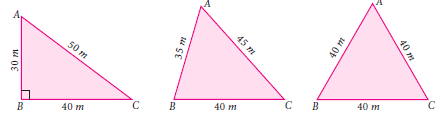
(i) The semi-perimeter of Fig.1, s \(\frac{30+40+50}{2}\)= 60 m
Fig. 2, s = \(\frac{35+40+45}{2}\) = 60 m
Fig. 3, s = \(\frac{40+40+40}{2}\) = 60 m
Note that all the semi-perimeters are equal.
(ii) Area of triangle using Heron’s formula:
In fig. 1, Area of triangle = \(\sqrt { 60(60-30)(60-40)(60-50) } \)
= \(\sqrt { 60\times 30\times 20\times 10 } \)
= \(\sqrt { 30\times 2\times 30\times 2\times 10\times 10 } \)
= 600 m2
In fig. 2, Area of triangle = \(\sqrt { 60(60-35)(60-40)(60-45) } \)
= \(\sqrt { 60\times 25\times 20\times 15 } \)
= \(\sqrt { 20\times 3\times 5\times 5\times 20\times 3 \times 5 } \)
= 300\(\sqrt{5}\) (since \(\sqrt{5}\) = 2.236)
= 670.8 m2
In fig. 3, Area of triangle = \(\sqrt { 60(60-40)(60-40)(60-40) } \)
= \(\sqrt { 60\times 22\times 20\times 20 } \)
= \(\sqrt { 3\times 20\times 20\times 20\times 20 } \)
= 400\(\sqrt{3}\) (since \(\sqrt{3}\) = 1.732)
= 692.8 m2
We find that though the perimeters are same, the areas of the three triangular plots are different. The area of triangle in fig. 3 is the greatest among these; the buyer can be suggested to choose this since it is more spacious.
4.
Let P, Q, R be the points on the line segment joining A(−11, 4) and B(9, 8) such that AP = PQ = QR = RB .
Here Q is the mid-point of AB, P is the mid-point of AQ and R is the mid-point of QB.
Q is the mid-point of AB =\(\left( \frac { -11+9 }{ 2 } ,\frac { 4+8 }{ 2 } \right) =\left( \frac { -2 }{ 2 } ,\frac { 12 }{ 2 } \right) \)= (-1, 6)
P is the mid-point of AQ =\(\left( \frac { -11-1 }{ 2 } ,\frac { 4+6 }{ 2 } \right) =\left( \frac { -12 }{ 2 } ,\frac { 10 }{ 2 } \right) \) = (-6, 5)
R is the mid-point of QB =\(\left( \frac { -1+9 }{ 2 } ,\frac { 6+8 }{ 2 } \right) =\left( \frac { 8 }{ 2 } ,\frac { 14 }{ 2 } \right) \) = (4, 7)
Hence the points which divide AB into four equal parts are P(–6, 5), Q(–1, 6) and R(4, 7).
5.
We know that,
(a + b + c)2= a2 +b2 +c2 + 2ab + 2bc + 2ca
Substituting a = x, b = 2y and c = 3z
(x +2y +3z)2 = x2 + (2y)2 + (3z)2 + 2(x)(2y) + 2(2y)(3z) + 2(3z)(x)
= x2 + 4y2 + 9z2 + 4xy + 12y2 + 6zx
6.
\(\sqrt { 44 } +\sqrt { 99 } -\sqrt { 275 } \) = \(\sqrt { 4\times 11 } +\sqrt { 9\times 11 } -\sqrt { 11\times 25 } \)
= \(\left( 2\sqrt { 11 } +3\sqrt { 11 } \right) -5\sqrt { 11 } =5\sqrt { 11 } -5\sqrt { 11 } =0\)
7.
A = {x : x ∈ Z, -2 < x ≤ 4} = {-1,0,1,2,3,4}
B = {x : x ∈ W, x ≤ 5} = {0,1,2,3,4,5}
C = {-4,-1,0,2,3,4}
AU(B⋂C)
B⋂C = {0,1,2,3,4,5} ∩ {-4,-1,0,2,3, 4} = {0,2, 3, 4}
AU(B∩C)
B⋂C = {0,1,2,3,4,5} ∩ {-4,-1,0,2,3,4} = {0,2,3,4}
AU(B⋂C) = {-1,0,1,2,3,4} U (0,2,3,4}
= {-1,0,1,2,3,4}........(1)
(A∩B)U(A∩C)
A⋂B = {0,1,2,3,4}
A⋂C = {-1,0,2,3,4}
(A⋂B)⋃(A⋂C) = {0,1,2,3,4} U {-1,0,2,3,4}
= {-1,0,1,2,3,4}..........(2)
From (1) and (2), it is verified that
AU(B∩C) = (AUB)∩(A⋃C)
8.
\(\bar { x } =20.2\)
\( \bar{x}=\cfrac{\Sigma fx}{\Sigma f}\)
\(=\cfrac { 10\times 6+15\times 8+20p+25\times 10+30\times 6 }{ 6+8+p+10+6 } \)
\(20.2=\cfrac { 60+120+20p+250+180 }{ 30+p } \)
(30+p)20.2 = 610+20 p
606+20.2p = 610+20 p
20.2 p-20 p = 610-606 = 4
0.2 p = 4
\(\Rightarrow \) \(p=\cfrac { 4\times 10 }{ 0.2\times 10 } =\cfrac { 40 }{ 2 } =20\)
9.
(i) \( (300000)^{2} \times(20000)^{4}\)
\(=\left(3.0 \times 10^{5}\right)^{2} \times\left(2.0 \times 10^{4}\right)^{4} \)
\(=3^{2} \times 10^{10} \times 2^{4} \times 10^{16} \)
\(=9 \times 16 \times 10^{10+16} \)
\(=144 \times 10^{26} \)
\(=1.44 \times 10^{28} \)
(ii) (0.000001)11 ÷ (0.005)3
\( =\left(1.0 \times 10^{-6}\right)^{11} \div\left(5.0 \times 10^{-3}\right)^{3} \)
\( =\frac{1.0 \times 10^{-66}}{125.0 \times 10^{9}} \)
\( =\frac{1000.0 \times 10^{-69}}{125.0 \times 10^{-9}} \)
\( =8.0 \times 10^{-69} \times 10^{9} \)
\( =8.0 \times 10^{-60} \)
(iii) \(\left\{(0.00003)^{6} \times(0.00005)^{4}\right\} \div\left\{(0.009)^{3} \times(0.05)^{2}\right\}\)
=\(\frac{(3.0\times10^{-5})^6\times(5.0\times10^{-5})^4}{(9.0\times10^{-3})^3\times(5.0\times10^{-2})^2}\)
=\(\frac{3^6\times10^{-30}\times5^4\times10^{20}}{9^3\times10^{-9}\times5^{2}\times10^{-4}}=\frac{3^6\times5^4\times10^{-30-20}}{(3^{2})^3\times10^{-9-4}\times5^{2}}=\frac{ ̶3̶^6̶\times5^4\times10^{-50}}{ ̶3̶^6̶\times5^2\times10^{-13}}\)
\( =5^{4-2} \times 10^{-50+13} \)
\(=5^{2} \times 10^{-37} \)
\(=25 \times 10^{-37} \)
\(=2.5 \times 10^{1} \times 10^{-37}\)
\(=2.5 \times 10^{-36} \)
10.
Let M be the set of students opting for Mathematics.
Let S be the set of students opting for Science.
n (M U S) = 40, n (M) = 26, n (S) = 24
n (M U S) = n (M) + n (S) - n (M ∩ S)
40 = 26 + 24 - n (M ∩ S)
n (M ∩ S) = 26 + 24 - 40
= 50 - 40 = 10
∴ Number of students opted for Mathematics and Science = 10
11.
Let x = 17.2151515 ...... (1)
Here period of decimal is 3, multiply equation (1) by 1000
1000 x = 17215.151515
(2) - (1)
999x = 17197.936
\( x=\frac{17197.936}{999} \\ x=\frac{17197936}{999000} \\ x=\frac{5681}{330} \)
12.
h(z) - f(z) = z5 - 6z4 + z - (6z2 + 10z -7)
= z5 -6z4 + z - 6z2 - 10z + 7
= z5 -6z4 -6z2 + z - 10z + 7
= z5– 6z4– 6z2– 9z+ 7
The degree of the polynomial is 5
13.
Since B is on the x-axis, the y-coordinate of B is 0.
So, the coordinates of the point B is (11, 0)
By the distance formula the distance between the points A (7, 3), B (11, 0) is
\(d=\sqrt { \left( { x }_{ 2 }-{ x }_{ 1 } \right) ^{ 2 }+\left( y_{ 2 }-y_{ 1 } \right) ^{ 2 } } \)
\(AB=\sqrt { \left( 11-7 \right) ^{ 2 }+\left( 0-3 \right) ^{ 2 } } \)
\(=\sqrt { \left( 4 \right) ^{ 2 }+\left( -3 \right) ^{ 2 } } =\ \sqrt { 16+9 } =\sqrt { 25 } =5\)
14.
(a)
280 cm2
15.
(a)
One
16.
(b)
1
17.
(d)
the equation has infinite solutions
18.
(b)
\(n\left( U \right) -n\left( A\cup B\cup C \right) \)
19.
(b)
\(6\sqrt [ 3 ]{ 3 } \)
20.
(d)
12.9
21.
(c)
z\(\bar X\)
22.
(b)
\(\sqrt [ 3 ]{ 9 } \)
23.
(a)
0
24.
(d)
centroid
25.
(b)
II
26.
(c)
on the y-axis
27.
(c)
{2, 3, 4, 5}
28.
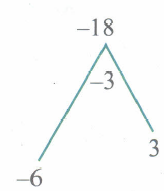
Let p (x) 2x3 - x2 - 12x - 9
Sum of the co-efficients = 2 - 1- 12- 9 = -20 \(\neq \) 0
Hence x-1 is not a factor
Sum of co-efficients of even powers with constant = -1 - 9 = -10
Sum of co-efficients of odd powers = 2 - 12= -10
Hence x + 1 is a factor of x.
Now we use synthetic division to find the other factors.
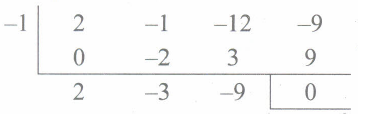
Then p (x) = (x + 1)(2x2 - 3x - 9)
Now 2x2 - 3x - 9 = 2x2 - 6x + 3x - 9 = 2x (x - 3) + 3 (x - 3)
= (x - 3)(2x + 3)
Hence 2x3 - x2 - 12x - 9 (x + 1) (x - 3) (2x + 3)
29.
(i) x2+10x + 24 = x2+ 6x + 4x + 24
= x(x + 6) + 4(x + 6)
= (x + 6)(x + 4)

(ii) z2+ 4z -12
= z2+ 6z - 2z -12
= z(z + 6) -2(z + 6)
= (z + 6)(z - 2)

(iii) p2- 6p -16 = p2- 8p + 2p -16
= p(p - 8)+2(p - 8)
= (p - 8)(p + 2)

(iv) t2+ 72 -17t = t2-17t + 72
= t2- 9t - 8t + 72
= t(t - 9) - 8 (t - 9)
= (t - 9)(t - 8)

(v) y2 -16y- 80 = y2 - 20y + 4y - 80
= y(y - 20) + 4 (y - 20)
= (y - 20) (y + 4)
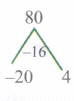
(vi) a2 + 10a - 600
= a2 + 30a - 20a - 600
= a(a + 30)- 20(a + 30)
= (a + 30)(a - 20)

30.
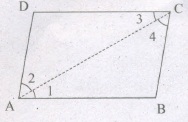
We have a parallelogram ABCD in which diagonals AC bisect ㄥA.
ㄥDAC = ㄥBAC
(i) To prove that AC bisects ∠C
∵ ABCD is a parallelogram
∴ AB II DC and AC is a transversal
∴ ㄥ1 = ㄥ3 (Alternate interior angle) .........(1)
.Also BC II AD and AC is a transversal.
∴ ㄥ2 = ㄥ4 (Alternate interior angle) ...........(2)
But AC bisects ㄥA
∴ ㄥ1 = ㄥ2
From (1), (2) and (3) we get
ㄥ3 = ㄥ4
∴ AC bisects ㄥC.
(ii) To prove that ABCD is a rhombus.
In ΔABC, we have ㄥ1 = ㄥ4 [ ∵ ㄥ1 = ㄥ2 = ㄥ4]
∴ BC = AB (side opposite to equal angles are equal) (4)
Similarly AD = DC ....... (5)
But ABCD is a parallelogram AB = DC (Opposite sides of a parallelogram) .......(6)
From (4), (5) and (6) we have AB = BC = CD = DA.
Thus ABCD is a rhombus.
31.
In the given \(\triangle ABC\)
\(\angle A=64^0\ and\ \angle B=58^0\)
\(\angle C=180^0-(64^0+58^0)\)
= 180° - 122°
= 58°
Since OC is the bisector of \(\angle C\)
\(y=\frac{58^0}{2}=29^0\)
Given \(\triangle OBC\)
\(\angle OBC=\frac{58^0}{2}=29^0\)
\(\angle OCB=29^0\)
\(\therefore\angle BOC=180^0-(29^0+29^0)\)
x = 180° - 58°
x = 122°
\(\angle x=122^0\ and\ \angle y=29^0\).
32.
\(\cfrac { cos{ 63 }^{ 0 }20' }{ sin{ 26 }^{ 0 }40' } =\cfrac { cos63^{ 0 }20' }{ cos{ 63 }^{ 0 }20' } =1\)
33.
\( \frac{\tan 25^{\circ}}{\cot 65^{\circ}}+\frac{\sin 40^{\circ}}{\cos 50^{\circ}} \)
\(= \frac{\tan \left(90^{\circ}-65^{\circ}\right)}{\cot 65^{\circ}}+\frac{\sin \left(90^{\circ}-50^{\circ}\right)}{\cos 50^{\circ}} \)
\(= \frac{\cot 65^{\circ}}{\cot 65^{\circ}}+\frac{\cos 50^{\circ}}{\cos 50^{\circ}}=1+1=2 \)
34.
TSA = 2 (lb + bh + lh)
= 2 (10 \(\times\)12 + 12 \(\times\) 14 +10 \(\times\) 14)
= 2 (120 + 168 + 140)
= 856 cm2
LSA = 2 (bh + lh)
= 2 (12 \(\times\) 14 + 10 \(\times\) 14)
= 2 (168 + 140)
= 2 (308) = 616 cm2.
35.
\(G\left( \frac { { x }_{ 1 }+{ x }_{ 2 }+{ x }_{ 3 } }{ 3 } ,\frac { { y }_{ 1 }+{ y }_{ 2 }+{ y }_{ 3 } }{ 3 } \right) =\left( \frac { 2+5+9 }{ 3 } ,\frac { -5+11+9 }{ 9 } \right) =\left( \frac { 16 }{ 3 } ,5 \right) \)
36.
\(120=\frac { 8(50)+4(y) }{ 12 } \)
1440 = 400 + 4y
4y = 1040
\(y=\frac { 1040 }{ 4 } =260\ km\)
37.
Number of cards n(S) = 52
No. of King cards n(A) = 4
No. of Queen cards n(B) = 4
No. of Jack cards n(C) = 4
Probability of drawing a King card
\(\frac { n(A) }{ n(S) } =\frac { 4 }{ 52 } \)
Probability of drawing a Queen card
=\(\frac { n(B) }{ n(S) } =\frac { 4 }{ 52 } \)
Probability of drawing a Jack card
=\(\frac { n(C) }{ n(S) } =\frac { 4 }{ 52 } \)
∴ The Probability of drawing a King or a Queen or a Jack from a deck of cards
= p(A) + P(B)+ P(C) =\(\frac { 4 }{ 52 } +\frac { 4 }{ 52 } +\frac { 4 }{ 52 } =\frac { 4+4+4 }{ 52 } =\frac { 12 }{ 52 } =\frac { 3 }{ 13 } \).
38.
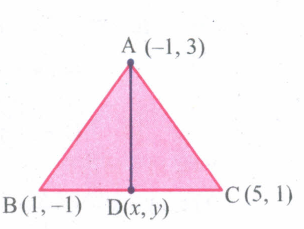
D (x, y) is the Mid point BC
\(\therefore \ D(x,y)=\left( \frac { 1+5 }{ 2 } ,\frac { -1+1 }{ 2 } \right) \)
\(=\left( \frac { 6 }{ 2 } ,\frac { 0 }{ 2 } \right) \)
= (3, 0)
AD is the median through A
Here A x2 y2 D x3 y3
(-1,3) (3,0)
\( \therefore\) Length of AD \(=\sqrt { { ({ x }_{ 2 }-{ x }_{ 1 }) }^{ 2 }+{ ({ y }_{ 2 }-{ y }_{ 1 }) }^{ 2 } } =\sqrt { { (3-(-1)) }^{ 2 }+{ (0-3) }^{ 2 } } \)
\(=\sqrt { { (3+1) }^{ 2 }+{ (-3) }^{ 2 } } =\sqrt { 16+9 } =\sqrt { 25 } =5\) units
39.
Two rational numbers between the given two irrational numbers are 0.5152 and 0.5352
40.
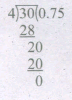
(i) \(3\over 4\) = 0.75
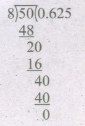
(ii) \(5\over 8\) = 0.625
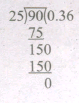
(iii) \(9\over 25\) = 0.36
41.
| Size of item | 4 | 5 | 6 | 9 |
|---|---|---|---|---|
| Frequency | 5 | 4 | 9 | 6 |
6 has the maximum frequency 9. Therefore 6 is the mode.
42.
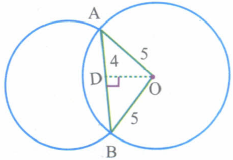
OD = DP =\(\cfrac { 4cm }{ 2 } \) = 2 cm
AD = BD =\(\sqrt { { 5 }^{ 2 }-{ 4 }^{ 2 } } \)
= \(\sqrt { 25-19 } \)
= \(\sqrt { 9 } \)
= 3 cm
\(\therefore\) The length of the common chord AB = AD + BD = (3 + 3) cm = 6 cm
43.
\((a+b)^{2}=a^{2}+b^{2} +2 a b \)
\(\left(x+\frac{1}{x}\right)^{2} =x^{2}+\frac{1}{x^{2}}+2 x \frac{1}{x} \)
= 23 + 2 = 25
\( \therefore x+\frac{1}{x} =\pm 5\)
\( \left(x+\frac{1}{x}\right)^{3} =x^{3}+\frac{1}{x^{3}}+3(x)\left(\frac{1}{x}\right)(x+\frac{1}{x}) \)
\(5^{3} =x^{3}+\frac{1}{x^{3}}+3\left(x+\frac{1}{x}\right) \)
\(125 =x^{3}+\frac{1}{x^{3}}+3(5) \)
\(125-15 =x^{3}+\frac{1}{x^{3}} \)
\(x^{3}+\frac{1}{x^{3}} =\pm 110\)
44.
\((a)\frac { 2 }{ 3 }
\)
\((b)\frac { 43 }{ 90 }
\)
\((c)\frac { 1 }{ 999 } \)
45.
Equivalent sets
46.
In \(\triangle \)LMN
LM = 7.5 cm,
MN = 5 cm,
LN = 8 cm
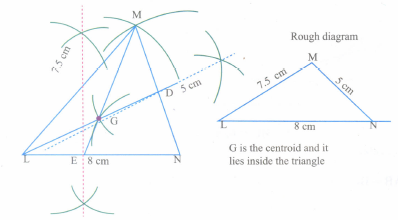
Construction :
Step 1: Draw \(\triangle \)LMN with LNM = 8 cm, MN = 5 cm, LM = 7.5 cm
Step 2: Construct perpendicular bisectors for any two sides (LN and MN) to find the midpoints of LM and MN.
Step 3: Draw the medians LD, ME. Let them meet at G.
Step 4: G is the centroid of the triangle LMN.

9th Standard Syllabus & Materials
9th Standard
TN 9th Tamil உள்ளத்தின் சீர் - திருக்குறள் Important Questions And Answers Study Material - QB365 Set A
NEW9th Standard
TN 9th Tamil உள்ளத்தின் சீர் - மணிமேகலை Important Questions And Answers Study Material - QB365 Set A
NEW9th Standard
TN 9th Tamil உள்ளத்தின் சீர் - ஏறு தழுவுதல் Important Questions And Answers Study Material - QB365 Set A
NEW9th Standard
TN 9th Tamil உயிருக்கு வேர் - தண்ணீர் Important Questions And Answers Study Material - QB365 Set A



Tamilnadu Stateboard 9th Standard Subjects
Tamilnadu Stateboard Standards





