100% FREE ACCESS
9th Standard CBSE Syllabus & Materials
9th Standard CBSE
CBSE 9th Science Is matter around us pure? - New Model Questions Papers Study Material - QB365 Set A
NEW9th Standard CBSE
CBSE 9th Science Matter in our surroundings - New Model Questions Papers Study Material - QB365 Set A
NEW9th Standard CBSE
CBSE 9th Mathematics Heron's Formula Sample Question Papers Study Material - QB365 Set A
NEW9th Standard CBSE
CBSE 9th Mathematics Circles Sample Question Papers Study Material - QB365 Set A
NEW9th Standard CBSE
CBSE 9th Mathematics Quadrilaterals Sample Question Papers Study Material - QB365 Set A
NEW9th Standard CBSE
CBSE 9th Mathematics Triangles Sample Question Papers Study Material - QB365 Set A

Published on: 29/02/2020
9th Standard Mathematics Board Exam Model Question 2019-2020
Download CBSE Class 9th Standard CBSE Mathematics question papers, sample papers, important questions, and previous year solved papers in PDF format. Get free study materials, NCERT solutions, and exam preparation resources for Class 9th Standard CBSE Mathematics
Questions + Answers key
Take MCQ Mathematics Test
1.
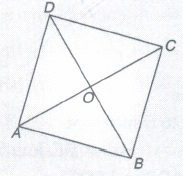
Show that sum of all sides of a quadrilateral is greater than the sum of its diagonals.
2.
If x+\(\frac { 1 }{ x } \) =5, evaluate x2+\(\frac { 1 }{ { x }^{ 2 } } \).
3.
1500 families with 2 children were released randomly and the following data was recorded:
| No.of girls | No.of.families |
| 0 | 211 |
| 1 | 814 |
| 2 | 475 |
If a family is chosen at random, find the probability that it has
(i) at most one girl
(ii) at least one girl
4.
Find the mean of the following marks of 20 students on a screening test. (out of 100) 76,44,45,87,71,72,82,83,41,32,75,32,46,78,17,70,84,12,77,74
5.
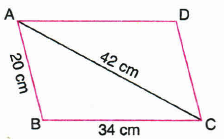
The adjacent sides of a parallelogram ABCD measure 34 cm and 20 cm and the diagonal AC measures 42 cm. Find the area of the parallelogram.
6.
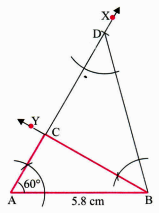
(i) Construct a ΔABC in which AB = 5.8cm, BC + CA = 8.4cm and B = 600
(ii) Measure AC
(iii) Measure BC
(iv) Is ACV + BC = 8.4cm?
(v) Meenu says that ㄥACB = 840 .Verify by measurement.Can you say that Meenu is right?Which value is depicted by Meenu's statement?
7.
Prove that the circle drawn on any equal side of an isosceles triangle as diameter, bisects the third side.
8.
BD is one of the diagonals of a quadrilateral AB CD. AM and CN are the perpendiculars from A and C respectively on BD. Show that
\(ar(ABCD)=\frac { 1 }{ 2 } BD.(AM+CN)\).
9.
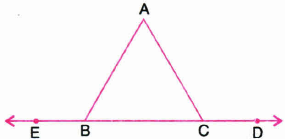
In the given figure side BC of \(\triangle ABC\) is produced in both the directions Prove that the sum of the two exterior angles so formed is greater than \(180^{ 0 }\)
10.
Solve the equation x -15 = 25 and state Euclid's Axiom used here.
11.
Find the value of 'm' if (-m, 3) is a solution of equation 4x+9y-3=0
12.
The following table gives the number of pairs of shoes and their corresponding price.Plot these as ordered pairs and join them.What type graph do you get?
| Number of pairs of shoes | (Corresponding prices in hundred of rupees) |
|---|---|
| 1 | 5 |
| 2 | 10 |
| 3 | 15 |
| 4 | 20 |
| 5 | 25 |
| 6 | 30 |
13.
Find four rational numbers between \(\frac { 3 }{ 7 } \)and \(\frac { 5 }{ 7 } \)
14.
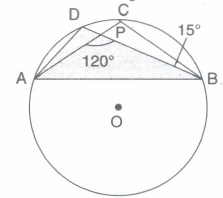
In the given figure, O is the centre of the circle and chord AC and BD intersect at P such that \(\angle\)APB = 120° and \(\angle\)PBC = 15°, find the value of \(\angle\)ADB.
15.
The probability of winning a game is \(\frac{1}{3}\) less than the twice of losing the game. Find probability of winning the game.
16.
Prove that if one angle of a triangle is equal to the sum of the other two angles, then the triangle is right angled triangle.
17.
ABCD is a rectangle and BD is one of its diagonals. If ar(\(\Delta\)ABD) = 8cm2, find ar(\(\Delta\) BCD).
18.
If angles of a quadrilateral are in ratio 1 : 2 : 3 : 4. Find the measure of all the angles of a quadrilateral.
19.
Prove that every line segment has one and only one mid-point.
20.
In a specific year, the distribution of the ages (in years) of primary teachers of a district is given:
| Age (in years) | Number of teachers |
| 15-20 | 10 |
| 20-25 | 30 |
| 25-30 | 50 |
| 30-35 | 50 |
| 35-40 | 30 |
| 40-45 | 6 |
| 45-50 | 4 |
(i) What is the lower limit of the first class interval?
(ii) What are the limits of the fourth class interval?
(iii) What is the class mark of the class 45-50?
21.
Monica has a piece of canvas whose area is 551 m2. She uses it to have a conical tent made, with a base radius of 7 m. Assuming that all the stitching margins and the wastage incurred while cutting, amounts to approximately 1 m2, find the volume of the tent that can be made with it.
22.
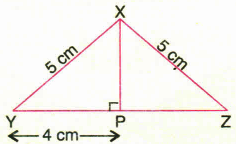
Find the area of an isosceles triangle with two equal sides as 5 cm each and unequal side as 8 cm.
23.
Write the following as an equation in two variables:
5y=2
24.
(i) Plot the points A(-5,-2), B(1,-2), C(6,4) and D(o,4).
(ii) Join the points to get AB, BC, CD and DA.Name the figures so obtained.
25.
Find the remainders when \(3x^3-4x^2+7x-5\) is divided by (x-3) and (x+3).
26.
Find the rational numbers a and b such that \(\frac { 2+5\sqrt { 7 } }{ 2-5\sqrt { 7 } } =a+\sqrt { 7 } b\)
27.
Three coins one tossed simultaneously 600 times with the following frequencies of different outcomes:
| Outcome | Frequency |
| 3 heads | 150 |
| 2 heads | 200 |
| 1 head | 100 |
| no head | 150 |
The probability of getting 3 heads is
\(\frac { 1 }{ 2 } \)
\(\frac { 1 }{ 3 } \)
\(\frac { 1 }{ 4 } \)
\(\frac { 1 }{ 5 } \)
28.
Mean of first five prime numbers is:
5.6
7.8
5.2
1.4
29.
The side of a cube is 1 cm. The total surface area of the figure formed by joining two such cubes is
2(2 + 1 + 2) cm2
2(2 + 2 + 2) cm2
2(1 + 1 + 1) cm2
2(1 + 1 + 2) cm2
30.
Heron's formula is
\(\Delta =\sqrt { s(s+a)(s+b)(s+c) } \)
\(\Delta =\sqrt { s(s-a)(s-b)(s-c) } \)
\(\Delta =\sqrt { s(s-a)(s-b)(s-c) } \), s=a+b+c
\(\Delta =\sqrt { s(s-a)(s-b)(s-c) } \), 2s=a+b+c
31.
The opposite angles of a cyclic quadrilateral
are complementary
are supplementary
are equal
form a linear pair.
32.
In the figure, if AB || DC and HF || AB, then which of the following is true?
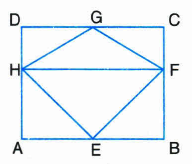
ar(GHF) = ar(DHFC)
3 ar(GHF) = 2 ar(DHFC)
ar(GHF) = ar(HEF)
None of these
33.
A rhombus is
a rectangle
a square
a kite
not a square.
34.
In ΔABC, if ㄥA = 35° and ㄥB = 65°, then the longest side of the triangle is:
AC
AB
BC
None of these
35.
Two complementary angles are in the ratio 4:5 then angles are:
\(90^{ 0 },90^{ 0 }\)
\(40^{ 0 },50^{ 0 }\)
\(30^{ 0 },150^{ 0 }\)
\(45^{ 0 },45^{ 0 }\)
36.
Euclid stated that things which are equal to the same thing are equal to one another in the form of:
an axiom
a definition
a postulate
a proof
37.
Which of the following ordered pairs is a solution of the equation x-2y=6?
(2, 4)
(0,3)
(-4, 1)
(4, -1)
38.
The line of intersection of IV and I quadrants is
x - axis
y - axis
vertical axis
None of these
39.
The value of p for which x+p is a factor of \(x^2+px+3-p \) is:
1
-1
3
-3
40.
The simplified value of \({ \left( 81 \right) }^{ -1/4 }\times \sqrt [ 4 ]{ 81 } \) is:
9
3
1
0
41.
Simplify: \((\sqrt{x})^{-\frac{2}{3}}\sqrt{y^{4}}\div\sqrt{(xy)^{-\frac{1}{2}}}\)
42.
Three coins are tossed simultaneously 200 times with the following frequencies of different outcomes:
| Outcome | 3 heads | 2 heads | 1 head | No head |
| Frequency | 23 | 72 | 77 | 28 |
If the three coins are simultaneously tossed again, compute the probability of 2 heads coming up.
43.
For what value of 'x' in the mode of the following data 7?
6,5,6,7,5,4,7,6,(x+1),8,7
44.
\(\frac { 3 }{ 4 } \) th of a cylindrical can contains milk. The height of the can is 1.4 m and radius is 0.4 m. This milk is poured into small cylindrical glasses of height 10 cm and radius 5 cm. How many small glasses are needed to empty the can?
45.
The sides of a triangle are in the ratio of 25: 17: 12 and its perimeter is 1080 cm. Find its area.
46.
If the non-parallel sides of a trapezium are equal, prove that it is cyclic.
47.
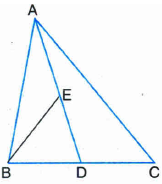
In a triangle ABC, E is the midpoint of median AD. Show that ar(\(\Delta \) BED) = \(\frac { 1 }{ 4 } \) ar(\(\Delta \) ABC).
48.
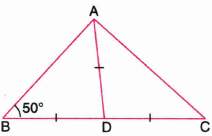
In the given figure, D is the mid-point of the side BC of a ΔABC and ㄥABD = 50°. If AD = BD = CD, then find the measure of ㄥACD.
49.
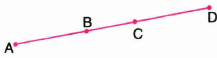
In figure, if AC = BD, then prove that AB = CD.
50.
In which quadrant or on which axes the following points lie?
P(9-2,4), Q(3,-1), R(-1,0) and S(0,-4)
51.
Expand each of the following using suitable identities: \((-2x+3y+2z)^2\)
52.
A cone of height 24 cm has a curved surface area 550 cm2. Find us volume.
53.
Raja, Renu and Reena are three friends. They decided to sweep a circular park near their homes. They divided the park into three parts by two equal chords AB and AC for convenience.
(i) Prove that the centre of the park lies on the angle bisector of \(\angle\)BAC
(ii) Which mathematical concept is used in the above problem?
(iii) By deciding sweeping, which value is depicted by the three friends?
54.
Represent the following data by means of a frequency polygon.
| Marks | Frequency |
|---|---|
| 41-45 | 4 |
| 45-49 | 10 |
| 49-53 | 15 |
| 53-57 | 18 |
| 57-61 | 20 |
| 61-65 | 12 |
| 65-69 | 13 |
55.
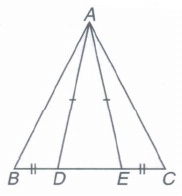
In the figure, AD = AE, BD = EC. Prove that \(\triangle\)ABC is an isosceles triangle.
56.
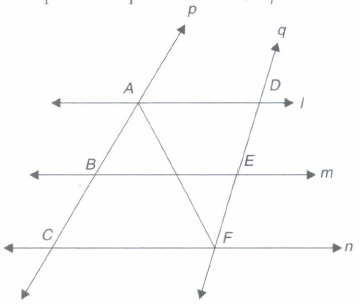
l, m and n are three parallel lines intersected by transversals p and q such that l, m and n cut off equal intercepts AB and BC on p (see Fig.). Show that l, m and n cut off equal intercepts DE and EF on q also.
57.
Prove that: \({ \left( \frac { { x }^{ { a }^{ 2 } } }{ { x }^{ { b }^{ 2 } } } \right) }^{ \frac { 1 }{ a+b } }.{ \left( \frac { { x }^{ { b }^{ 2 } } }{ { x }^{ { c }^{ 2 } } } \right) }^{ \frac { 1 }{ b+c } }.{ \left( \frac { { x }^{ { c }^{ 2 } } }{ { x }^{ { a }^{ 2 } } } \right) }^{ \frac { 1 }{ c+a } }=1\)
1.
By triangle inequality property,
In \(\triangle\) ABC, AB + BC>AC ...(1)
In \(\triangle\)BCD, BC + CD > BD ...(2)
In \(\triangle\)CDA, CD + DA >AC ...(3)
In \(\triangle\)DAB, DA +AB > BD ...(4)
using the fact that sum of two sides of a triangle is greater than the third side
Adding (1), (2), (3) and (4), we get
AB + BC + BC + CD + CD + DA + DA + AB > AC + BD + AC + BD
\(\Rightarrow\) 2(AB + BC + CD + DA) > 2(AC + BD)
Hence, Perimeter > Sum of its diagonals.
2.
\(x+\frac { 1 }{ x } =5\)
On Squaring both sides, we get
\({ \left( x+\frac { 1 }{ x } \right) }^{ 2 }={ 5 }^{ 2 }\)
\(\Rightarrow { x }^{ 2 }+{ \left( \frac { 1 }{ x } \right) }^{ 2 }+2\times x+\frac { 1 }{ x } =25\)
[\(\because\) (a+b)2=a2+b2+2ab)]
\(\Rightarrow { x }^{ 2 }+\frac { 1 }{ { x }^{ 2 } } +2=25\)
\(\Rightarrow { x }^{ 2 }+\frac { 1 }{ { x }^{ 2 } } =25-2\)
\(\Rightarrow { x }^{ 2 }+\frac { 1 }{ { x }^{ 2 } } =23\)
3.
Total number of families = 1500
(i) at most one girl means 0 girl or 1 girl.
Number of families which have at most one girl
= Number of families which have 0 girl + Number of families which have 1 girl.
= 211 + 814 = 1015
Probability that it has at most one girl=\(\frac { 1015 }{ 1500 } =\frac { 203 }{ 300 } \)
(ii) at least one girl means 1 girls or 2 girls.
Number of families which have at least one girl
= Number of families which have I girl + Number of families which have 2 girls.
= 814 + 475 = 1289
Probability that it has at least one girl=\(\frac { 1289 }{ 1500 } \)
4.
Mean
\(=\frac {76+44+45+87+71+72+82+83+41+32+75+32+46+78+17+70+84+12+77+74} {20}\)
\(=\frac {1198}{20}=59.9\)
5.
For \(\Delta \) ABC
a = 34 cm, b = 42 cm, c = 20 cm
\(\therefore s=\frac { a+b+c }{ 2 } =\frac { 34+42+20 }{ 2 } =48\) cm
\(\therefore \) Area of \(\Delta \) ABC = \(\sqrt { s(s-a)(s-b)(s-c) } \)
\(=\sqrt { 48(48-34)(48-42)(48-20) } \)
\(=\sqrt { 48(14)(6)(28) } =\quad 336\) cm2
\(\therefore \) Area of parallelogram ABCD = 2 area of triangle ABC
= 2\(\times \) 336 cm2 = 672 cm2
6.
(i) Steps of Construction
1. Draw the base AB = 5.8 ern.
2. At the point A, make an angle, say XAB=60°.
3. Cut a line segment AD equal to BC + CA = 8.4 cm from the ray BX.
4.Join DB
5.Make an angle DBY equal to ADB.
6.Let BY intersect AD at C. Then, ABC is the required triangle.
(ii) By measurement, AC = 3.4 cm
(iii) By measurement, BC = 5cm
(iv) Yes! AC + B C =3.4 + 5 = 8.4cm
(v) By measurement, ㄥACB = 84°
Meenu is right.
The value 'exactness' is depicted by Meenu's statement.
7.
Given: ABC is an isosceles triangles in which AB = AC. A circle has been drawn with AB as diameter to intersect the third side BC at D.
To Prove: This circle bisects the third side, i.e., BD=DC
Construction: Join AD.
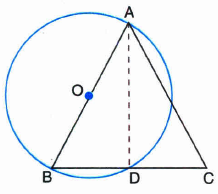
Proof: In \(\Delta ADB\) and \(\Delta ADC\)
AB=AC | Given ............(1)
\(\angle ADB=90°\) I Angle in a semicircle is 90°
\(\angle ADB+\angle ADC=180°\)
| Linear pair axiom
∴ \(\angle ADB=\angle ADC=90°\) .........(2)
AD=AD ..........(3) | Common
In view of (1), (2), and (3),
\(\Delta ADB\cong \Delta ADC\) | R.H.S congruence rule
∴BD=CD | CPCT
⇒ D is the mid-point of BC.
8.
Given: BD is one of the diagonals of a quadrilateral ABCD. AM and CN are perpendiculars from A and C respectively on BD.
To Prove: ar(quad. ABCD)
\(\frac { 1 }{ 2 } BD.(AM+CN)\)
Proof: ar(quad. ABCD)
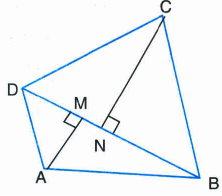
\(ar(\Delta ABD)+ar(\Delta BCD)\)
\(\\ =\frac { BD.AM }{ 2 } +\frac { BD.CN }{ 2 } \)
Area of a triangle = \(\frac { 1 }{ 2 } \times Base\times Corresponding\ altitude\)
\(\frac { 1 }{ 2 } BD(AM+CN)\)
9.
\(\because \) ED is the line
\(\therefore \angle 4+\angle 2=180^{ 0 }\)
|Linear Pair Axiom
and \(\angle 5+\angle 3=180^{ 0 }\)
| Linear Pair Axiom
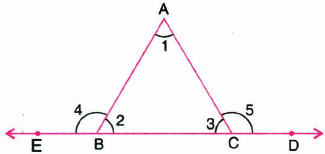
\(\therefore \angle 4+\angle 5+\angle 2\angle 3=360^{ 0 }\)
Now, \(\therefore \angle 1+\angle 2+\angle 3=180^{ 0 }\)
|Sum of the angles of a triangle is \(180^{ 0 }\)
\(\Rightarrow \angle 2+\angle 3=180^{ 0 }-\angle 1\) .....(5)
From (3) and (5)
\(\Rightarrow \angle 4+\angle 5=(180^{ 0 }-\angle 1)=360^{ 0 }\)
\(\Rightarrow \angle 4+\angle 5=180^{ 0 }-\angle 1\)
\(\Rightarrow \angle 4+\angle 5>180^{ 0 }\)
10.
We have,
x - 15 = 25
\(\Rightarrow \) x - I5 + 15 = 25 + 15 | If equals are added to equals, the wholesare equal (Euclid's Axiom (ii))
\(\Rightarrow \) x = 40
11.
if(-m, 3) is a solution of the equation
4x+9y-3=0, then
4(-m)+9(3)-3=0
⇒ -4m+27-3=0
⇒ -4m+24=0
⇒ 4m=24
⇒ \(m={24\over 4}=6\)
12.
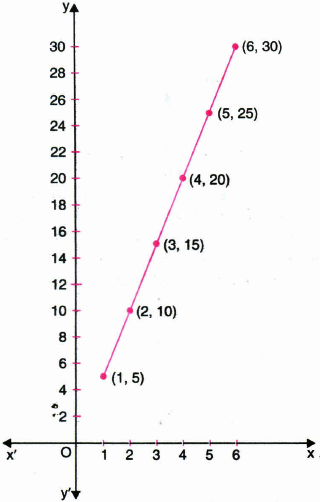
The graph we get is a straight line.
13.
\(\frac { 3 }{ 7 } =\frac { 30 }{ 70 } \)
\(\\ \frac { 5 }{ 7 } =\frac { 50 }{ 70 } \)
30<31<32<33<34<35
\(\frac { 30 }{ 70 } <\frac { 31 }{ 70 } <\frac { 32 }{ 70 } <\frac { 33 }{ 70 } <\frac { 34 }{ 70 } <\frac { 50 }{ 70 } \)
So four rational numbers between \(\frac { 3 }{ 7 } \) and \(\frac { 5 }{ 7 } \)
\(\frac { 31 }{ 70 } ,\frac { 32 }{ 70 } ,\frac { 33 }{ 70 } \) and \(\frac { 34 }{ 70 } \)
\(\frac { 31 }{ 70 } ,\frac { 16 }{ 35 } ,\frac { 33 }{ 70 } \)and \(\frac { 17 }{ 35 } \)
14.
In \(\Delta\)PCB,
\(\angle\)PCB + \(\angle\)PBC = \(\angle\)APB (exterior angle of a \(\Delta\) is equal to the sum of two opposite angles)
\(\angle\)PCB + 15° = 120°
\(\therefore\) \(\angle\)PCB = 105°
or, \(\angle\)ACB = 105°
\(\Rightarrow\)\(\angle\)ADB = \(\angle\)ACB = 105° [Angle in same sagment]
15.
Let the probability of winning a game = p
and probability of losing a game = q
we know that p + q = 1...(i)
According to questions,
\(p=2q-\frac{1}{3}\)
\(\Rightarrow \) 6q - 3p = 1...(ii)
On solving (i) and (ii), we get
\(q=\frac{4}{9}\ and\ p=\frac{5}{9}\)
\(\therefore \) Probability of winning game \(=\frac{5}{9}\)
16.
\(\because \angle A=\angle B+\angle C\)
\(\therefore \angle A+\angle B+\angle C=180^o\Rightarrow 2\angle A=180^o\)
\(\Rightarrow \angle A=90^o\)
17.
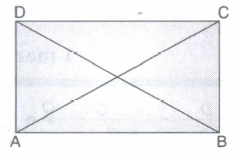
A diagonal of a parallelogram divides it into two triangles of equal area
\(\therefore\) ar(\(\Delta\)ABD)= ar(\(\Delta\)BCD)
Since, given, ar(\(\Delta\)ABD) = 8 cm2
\(\therefore\) ar(\(\Delta\)BCD) = 8 cm2.
18.
Let the measure of the angles be x, 2.x, 3x and 4x then,
x + 2x + 3x + 4x = 360°
⇒ x = 36°
ஃ Angles of quadrilateral are 36°, 72°, 108°,144°
19.

Let line segment \(\overline{AB}\) has 2 mid-points, say X and Y
then, \(\frac{AB}{2}=AX\ and\ \frac{AB}{2}=AY\)
\(\therefore\) AX = AY
X and Y coincides
20.
(i) 15
(ii) 30-35
(iii) 47.5
21.
Since the area of the canvas = 551 m2 and area of the canvas lost in wastage is 1 m2, therefore the area of canvas available for making the tent is (551 – 1) m2 = 550 m2.
Now, the surface area of the tent = 550 m2 and the required base radius of the conical tent = 7 m
Note that a tent has only a curved surface (the floor of a tent is not covered by canvas!!).
Therefore, curved surface area of tent = 550 m2.
That is, \(\pi\)rl = 550
or, \(\frac{22}{7} \times 7 \times l=550\)
or, \(l=3 \frac{550}{22} \mathrm{~m}=25 \mathrm{~m}\)
Now, l2 = r2 + h2
Therefore, \(h=\sqrt{l^{2}-r^{2}}=\sqrt{25^{2}-7^{2}} \mathrm{~m}=\sqrt{625-49} \mathrm{~m}=\sqrt{576} \mathrm{~m}\)
= 24 m
So, the volume of the conical tent \(=\frac{1}{3} \pi r^{2} h=\frac{1}{3} \times \frac{22}{7} \times 7 \times 7 \times 24 \mathrm{~m}^{3}=1232 \mathrm{~m}^{3}\)
22.
12 cm2
23.
0x+5y-2=0
24.
(i)
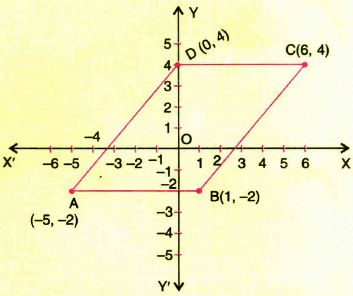
(ii) Parallelogram
25.
61, -143
26.
\(\quad a=-\frac { 179 }{ 171 } ,b=\frac { -20 }{ 171 } \)
27.
Required probability=\(\frac { 150 }{ 600 } =\frac { 1 }{ 4 } \)
28.
Mean \(\frac {2+3+5+7+11}{5}=5.6\)
29.
v = 5 \(\times\) (6 \(\times\) 2 \(\times\) 1.5)
30.
See Hero's formula.
31.
Theorem
32.
Evident.
33.
no of angle of a rhombus is 900
34.
ㄥA+ㄥB+ㄥC=1800
⇒ 350+650+ㄥC=1800
⇒ ㄥC=1800
∵ ㄥC > ㄥA
∵ AB > BC
∵ ㄥC > ㄥB
∴ AB > AC
In view of (1) and (2), AB is the longest side.
35.
\(\frac { x }{ y } =\frac { 4 }{ 3 } =k\)
36.
(a)
an axiom
37.
(4, -1) satisfies x-2y=6
38.
(a)
x - axis
39.
\(x+p=0\ \Rightarrow \ x=-p\)
By factor theorem,
\((-p)^2+p(-p)+3-p=0 \ \Rightarrow \ p=3\)
40.
(c)
1
41.
\(\frac { { \left( { x }^{ \frac { 1 }{ 2 } } \right) }^{ \frac { -2 }{ 3 } }{ \left( { y }^{ 4 } \right) }^{ \frac { 1 }{ 2 } } }{ { x }^{ \frac { -1 }{ 4 } }{ y }^{ \frac { -1 }{ 4 } } } ={ x }^{ \frac { -1 }{ 3 } }.{ y }^{ 2 }.{ x }^{ \frac { 1 }{ 4 } }.{ y }^{ \frac { 1 }{ 4 } }\)
\({ x }^{ \frac { -1 }{ 12 } }.{ y }^{ \frac { 9 }{ 4 } }=\frac { { y }^{ \frac { 9 }{ 4 } } }{ { x }^{ \frac { 1 }{ 12 } } } \)
42.
Total number of times the three coins are tossed = 200
Number of times when 2 heads come up = 72
Probability of 2 heads coming up
=\(\frac { 72 }{ 200 } =\frac { 9 }{ 25 } \)
43.
6
44.
672
45.
36000 cm2
46.
Given: ABCD is a trapezium whose nonparallel sides AD and BC are equal.
To Prove: Trapezium ABCD is cyclic.
Construction: Draw BE 11 AD.
Proof: ∵ AB || DE I Given
and AD || BE I By construction
∴ Quadrilateral ABCD is a parallelogram.
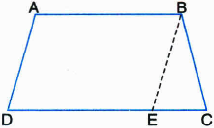
∴ \(\angle BAD=\angle BED\) ....(1)
| Opp.\(\angle \) s of a || gm are equal
and AD = BE ...(2)
Opp. sides of a || gm are equal
But AD = BC ...(3) I Given
From (2) and (3),
BE = BC
∴ \(\angle BEC=\angle BCE\) ....(4)
| Angles opposite to equal sides of a triangle are equal
\(\angle BEC+\angle BED=180°\) | Linear Pair Axiom
⇒ \(\angle BCE+\angle BAD=180°\) I From (4) and (1)
⇒ Trapezium ABCD is cyclic.
I ∵ If the sum of a pair of opposite angles of a quadrilateral is 180°, then the quadrilateral is cyclic
47.
AD is the median of ΔABC. Therefore, it will divide ΔABC into two triangles of equal areas.
∴ Area (ΔABD) = Area (ΔACD)
⇒ Area (ΔABD) = 1/2Area (ΔABC)... (1)
In ΔABD, E is the mid-point of AD. Therefore, BE is the median.
∴ Area (ΔBED) = Area (ΔABE)
⇒ Area (ΔBED) = 1/2Area (ΔABD)
⇒ Area (ΔBED) = 1/2 x 1/2Area (ΔABC) [From equation (1)]
⇒ Area (ΔBED) = 1/4Area (ΔABC)
48.
400
49.
We have
AC = BD
\(\Rightarrow \) AC - BC= BD - BC
If equals are subtracted from equals, the remainders are equal (Euclid's Axiom (iii))
\(\Rightarrow \) AB = CD
AC - BC coincides with AB; BD - BC coincides with CD [Things which coincide with one another are equal to one another (Euclid's Axiom (iv))]
50.
\(P\rightarrow \left( II \right) \)
\(\\ Q\rightarrow \left( IV \right)\)
\(\\ R\rightarrow \left( x-axis \right)\)
\( \\ S\rightarrow \left( y-axis \right) \)
51.
\((-2x+3y+2z)^2\)
\((-2x+3y+2z)^{ 2 }={ \{ (-2x)+3y+2z\} }^{ 2 }\)
\(={ (-2x) }^{ 2 }+{ (3y) }^{ 2 }+{ (2z) }^{ 2 }+2(-2x)(3y)+(3y)(2z)+2(2z)(-2x)\) |Using Identity V
\(=4{ x }^{ 2 }+9{ y }^{ 2 }+4{ z }^{ 2 }-12xy+12yz-8zx\)
52.
Height of the cone(h) = 24 cm
Let r cm be the radius of the base and l cm an can be the slant height of the cone, then
\(l=\sqrt { { r }^{ 2 }+{ h }^{ 2 } } \)
\(=\sqrt { { r }^{ 2 }+{ 24 }^{ 2 } } \)
\(=\sqrt { { r }^{ 2 }+576 } \)
Now, curved surface area=\(\pi\)rl
\(\Rightarrow \ \frac { 22 }{ 7 } \times r\times \sqrt { { r }^{ 2 }+576 } =550\)
\(\Rightarrow \ r\sqrt { { r }^{ 2 }+576 } =550\times \frac { 7 }{ 22 } \)
\(\Rightarrow \ r\sqrt { { r }^{ 2 }+576 } =175\)
Squaring both the sides we get
r2 (r2 + 576) = 30625
(r2)2 + 576r2-30625 = 0
Let r2 = x
x2 + 576x - 30625 = 0
\(\Rightarrow\) x2 + 625x - 49x - 30625 = 0
\(\Rightarrow\) x(x + 625)- 49(x + 625) = 0
\(\Rightarrow\) (x + 625)(x - 49) = 0
\(\Rightarrow\) x + 625=0 or x - 49 = 0
\(\Rightarrow\) x = 625 or x = 49
not possible x = 49
\(\therefore\) r2= 49
\(\Rightarrow\) r = 7 cm
Volume & the cone = \(\frac { 1 }{ 3 } \pi { r }^{ 2 }h\)
\(=\frac { 1 }{ 3 } \times \frac { 22 }{ 7 } \times { 7 }^{ 2 }+24\)
= 1232 cm3.
53.
(i) Given: A circle C(O, r) and chord AB = chord AC. AD is bisector of \(\angle\)CAB.
To Prove: Centre O lies on the bisector of \(\angle\)BAC
Construction Join Be, meeting bisector AD of \(\angle\)BAC, at M.
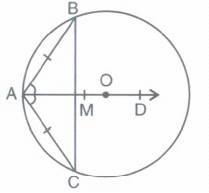
Proof: In triangles BAM and CAM,
AB=AC (given)
\(\angle\)BAM= \(\angle\)CAM (given)
AM=AM (Common)
\(\triangle BAM\cong \triangle CAM\) (SAS)
\(\Rightarrow\) BM=CM
and \(\angle\)BMA = \(\angle\)CMA
As \(\angle\)BMA + \(\angle\)CMA = 1800 (linear pair)
\(\Rightarrow\) \(\angle\)BMA = \(\angle\)CMA = 900
\(\Rightarrow\) AM is the perpendicular bisector of the chord BC
\(\Rightarrow\) AM passes through the centre O.
[\(\because\) Perpendicular bisector of chord of a circle passes through the centre of the circle]
Hence, the centre of the park lies on the angle bisector of \(\angle\)BAC
(ii) Congruency of triangles by SAS axiom (Geometry)
(iii) Cleanliness and respect for labour.
54.
| Marks | Frequency | Class Marks |
|---|---|---|
| 37-41 | 0 | 39 |
| 41-45 | 4 | 43 |
| 45-49 | 10 | 47 |
| 49-53 | 15 | 51 |
| 53-57 | 18 | 55 |
| 57-61 | 20 | 59 |
| 61-65 | 12 | 53 |
| 65-69 | 13 | 67 |
| 69-73 | 0 | 71 |
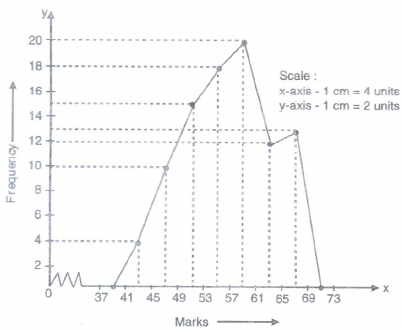
55.
Proof: In \(\triangle\)ADE, we have
AD = AE
\(\angle\)ADE = \(\angle\)AED
180°- \(\angle\)ADE = 180°- \(\angle\)AED
\(\Rightarrow\) \(\angle\)ADB = \(\angle\)AEC
Consider \(\triangle\)ABD and \(\triangle\)ACE
AD =AE
\(\angle\)ADB = \(\angle\)AEC
BD = EC
By SAS congruence,
\(\triangle ADB\cong \triangle AEC\)
By c.p.c.t., AB = AC
\(\therefore\) \(\triangle\)ABC is an isosceles triangle.
56.
We are given that AB = BC and have to prove that
DE = EF.
Let us join A to E intersecting m at G.
Let trapezium ACFD is divided into two triangles, namely ΔACF and ΔAFD.
In ΔACF, it is given that B is the mid-point of AC(AB = BC) and BG II CF (Since m || n)
So, G is the mid-point of AF (By the converse of midpoint theorem)
Now in ΔAFD, we can apply the sam argument as G is the mid-point of AF, GE IIAD so E is the mid-point of DF
i.e., DE = EF
In otherwords l, m and n cut off equal intercepts on q also.
57.
\(={ \left( { x }^{ { a }^{ 2 }-{ b }^{ 2 } } \right) }^{ \frac { 1 }{ a+b } }.{ \left( { x }^{ { b }^{ 2 }-{ c }^{ 2 } } \right) }^{ \frac { 1 }{ b+c } }.{ \left( { x }^{ { c }^{ 2 }-{ a }^{ 2 } } \right) }^{ \frac { 1 }{ c+a } }\)
\(={ x }^{ \frac { { a }^{ 2 }-{ b }^{ 2 } }{ a+b } }.{ x }^{ \frac { { b }^{ 2 }-{ c }^{ 2 } }{ a+b } }.{ x }^{ \frac { { c }^{ 2 }-{ a }^{ 2 } }{ c+a } }\)
\(={ x }^{ a-b }.{ x }^{ b-c }.{ x }^{ c-a }\)
\(={ x }^{ 0 }\)

9th Standard CBSE Syllabus & Materials
9th Standard CBSE
CBSE 9th Mathematics Lines and Angles Sample Question Papers Study Material - QB365 Set A
NEW9th Standard CBSE
CBSE 9th Mathematics Introduction to Euclid's Geometry Sample Question Papers Study Material - QB365 Set A
NEW9th Standard CBSE
CBSE 9th Mathematics Linear Equations in Two Variables Sample Question Papers Study Material - QB365 Set A
NEW9th Standard CBSE
CBSE 9th Mathematics Coordinate Geometry Sample Question Papers Study Material - QB365 Set A



CBSE 9th Standard CBSE Subjects
CBSE Standards