100% FREE ACCESS
9th Standard CBSE Syllabus & Materials
9th Standard CBSE
CBSE 9th Science Is matter around us pure? - New Model Questions Papers Study Material - QB365 Set A
NEW9th Standard CBSE
CBSE 9th Science Matter in our surroundings - New Model Questions Papers Study Material - QB365 Set A
NEW9th Standard CBSE
CBSE 9th Mathematics Heron's Formula Sample Question Papers Study Material - QB365 Set A
NEW9th Standard CBSE
CBSE 9th Mathematics Circles Sample Question Papers Study Material - QB365 Set A
NEW9th Standard CBSE
CBSE 9th Mathematics Quadrilaterals Sample Question Papers Study Material - QB365 Set A
NEW9th Standard CBSE
CBSE 9th Mathematics Triangles Sample Question Papers Study Material - QB365 Set A

Published on: 29/02/2020
9th Standard Mathematics Board Exam Sample Question 2020
Download CBSE Class 9th Standard CBSE Mathematics question papers, sample papers, important questions, and previous year solved papers in PDF format. Get free study materials, NCERT solutions, and exam preparation resources for Class 9th Standard CBSE Mathematics
Questions + Answers key
Take MCQ Mathematics Test
1.
A rectangular piece of paper is 22 cm long and 10 cm wide. A cylinder is formed by rolling the paper along its length. find the volume of the cylinder.
2.
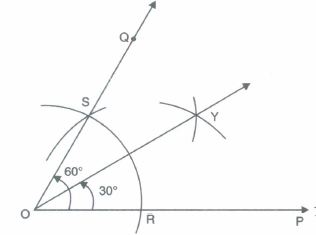
Draw an angle of an equilateral triangle,using protrator. Bisect it using compass
3.
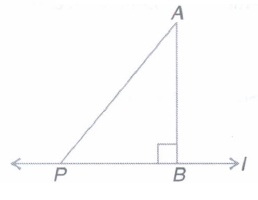
Show that of all the line segments drawn from a given point to a line, not on it, the perpendicular line segment is the shortest.
4.
Three coins are tossed simultaneously 200 times with the following frequencies of different outcomes
| Outcome | Frequency |
| 3 heads | 24 |
| 2 heads | 70 |
| 1 head | 75 |
| 3 tails | 31 |
Compute the probability of getting
(i) less than 2 heads
(ii) 3 heads.
5.
Find the median of the following observations:
46,64,87,41,58,77,35,90,55,92,33
6.
A triangle and a parallelogram have the same base and same area. If the sides of the triangle are 15 cm.14 cm and 13 cm and the parallelogram stands on the base 14 cm. find the height of the parallelogram.
7.
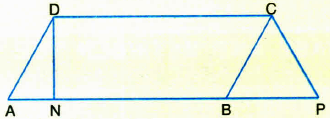
In the figure, ABCD is a parallelogram. P is a point on AB produced and \(DN\bot AB\) . If AB = 8 cm and DN = 3 cm. Find the area of \(\Delta \) CPD.
8.
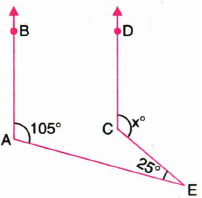
In the given figure AB || C Find the value of x.
9.
Write the following as an equation in two variables:
2x=3
10.
Plot the points A(-3,-3), B(3,-3), C(3,3), D(-3,3) in the Cartesian plane.Also, find the length of the line segment AB.
11.
If 2 is a zero of polynomial \(4y^2-6y-k,\)find the value of k. Also, find the other zero.
12.
Are the following statements true or false? Give reasons for your answers.
(i) Every whole number is a natural number.
(ii) Every integer is a rational number.
(iii) Every rational number is an integer.
13.
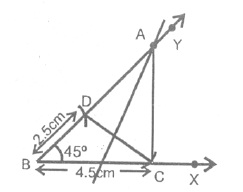
Construct a ΔABC in which BC = 4.7 cm,ㄥB = 45o and AB - AC = 2cm
14.
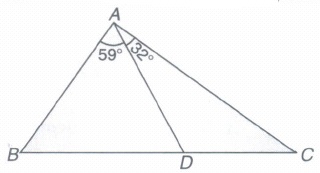
In the given figure, AD = BD. Prove that BD < AC.
15.
In \(\Delta\)ABC, E is the mid-point of median AD. show that ar(\(\Delta\)BED) = \(\frac { 1 }{ 4 } ar(\Delta ABC)\)
16.
Find what must be subtracted from the polynomial 4y4+12y3+6y2+50y+26 so that the obtained polynomial is exactly divisible by y2+4y+2.
17.
Draw a frequency polygon to represent the following information:
| Class | Frequency |
|---|---|
| 25-29 | 5 |
| 30-34 | 15 |
| 35-39 | 23 |
| 40-44 | 20 |
| 45-49 | 10 |
| 50-54 | 7 |
18.
Find the curved surface area of a closed cylindrical petrol storage tank that is 3.8 m in diameter and 4.9 m in height.
19.
Find the area of a right-angled \(\Delta \)ABC, right angled at B in which AB = 24 metre and BC = 10 metre.
20.
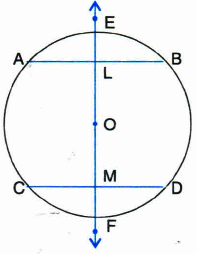
In figure, EF is a line passing through the centre 0 of a circle. If EF bisects chords AB and CD of the circle, prove that AB || CD.
21.
Prove that the sum of of all the angles of a quadrllateral is \(360^{ 0 }\)
22.
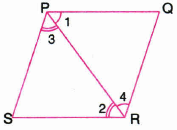
In the given figure, it is given that \(\angle \)1 = \(\angle \)4 and \(\angle \)3 = \(\angle \)2. By which Euclid's axiom, it can be shown that if \(\angle \)2 = \(\angle \)4, then \(\angle \)1 = \(\angle \)3.
23.
Draw the graph of the linear equation \(y={2\over3}x+{1\over3}\).Check from the graph that (7, 5) is a solution of the linear equation
24.
The perpendicular distance of a point from the x-axis is 2 units and the perpendicular distance from the y-axis is 3 units.Write the coordinates of the point if it lies in the:
(i) I quadrant
(ii) II quadrant
(iii) III quadrant
(iv) IV quadrant
25.
Express \(0.15\overline { 9 } \) in \(\frac { p }{ q } \) , where p and q are integers and \(q\neq 0\)
26.
The following table depicts the scores of 200 students in a test:
| Scores | Number of students |
| 400-450 | 15 |
| 450-500 | 30 |
| 500-550 | 35 |
| 550-600 | 30 |
| 600-650 | 25 |
| 650-700 | 25 |
| 700-750 | 20 |
| 750-800 | 20 |
Find the probability that a student selected at random has his score in the interval 650-700.
\(\frac { 1 }{ 4 } \)
\(\frac { 1 }{ 2 } \)
\(\frac { 1 }{ 8 } \)
\(\frac { 1 }{ 5 } \)
27.
The median of the distribution 2,3,4,7,5,1 is:
4
7
11
3.5
28.
The side of a cube is 1 cm. The total surface area of the figure formed by joining two such cubes is
2(2 + 1 + 2) cm2
2(2 + 2 + 2) cm2
2(1 + 1 + 1) cm2
2(1 + 1 + 2) cm2
29.
The area of a rhombus is 96 cm2.If one of its diagonals is 16 cm, then the length of its sides is
12 cm
10 cm
8 cm
6 cm
30.
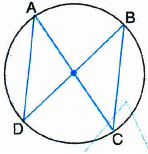
In the given figure, AD || BC and \(\angle BCA=40°\). The measure of \(\angle DBC\) is equal to:
50°
80°
40°
20°
31.
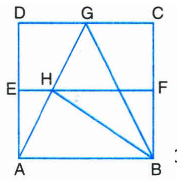
In the figure, ABCD is a square. E and F are midpoints of AD and BC respectively. The ratio of areas of \(\Delta\)GAB and \(\Delta\)HAB is:
4:1
1:4
1:2
2:1
32.
The quadrilateral formed by joining the mid-point of the sides of a rectangle taken in order is a
rectangle
square
rhombus
kite
33.
ΔABC ≅ ΔPQR.If AB = 5cm, ㄥB = 400and ㄥA = 800, then which of the following is true?
QP = 5cm, ㄥP = 600
QP = 5cm, ㄥR = 600
QR = 5cm, ㄥR = 600
QR = 5cm, ㄥQ = 400
34.
The angle which exceeds its complimentary angle by \(30^{ 0 }\)
\(50^{ 0 }\)
\(120^{ 0 }\)
\(60^{ 0 }\)
\(80^{ 0 }\)
35.
Two interesting lines cannot be parallel to the same line, is started in the form of:
an axiom
a definition
a postulate
a proof
36.
The maximum number of points that lie on the graph of a linear equation in two variables is:
two
infinite
three
None of these
37.
The points (-5,2) and (2,-5) lie in the:
Same quadrant
II and III quadrants respectively
II and IV quadrants respectively
IV and III quadrants respectively
38.
(x+2) is a factor of \(2x^3+5x^2-x-k.\) The value of k is:
6
-24
-6
24
39.
The value of \({ \left( 243 \right) }^{ \frac { 1 }{ 3 } }\) is equal to:
5
3
6
1
40.
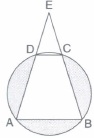
In \(\Delta\)ABE, AE = BE. Circle through A and B intersects AE and BE at D and C. Prove that DC II AB.
41.
The radius and height of a cylinder are in the ratio 5:7. If its volume is 4400 cm3, find radius of the cylinder.
42.
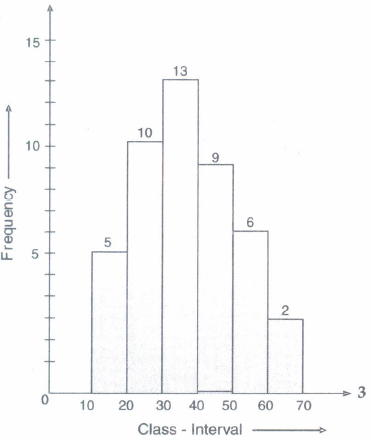
Draw a histogram of the following data:
| Class | 10-20 | 20-30 | 30-40 | 40-50 | 50-60 | 60-70 |
| Frequency | 5 | 10 | 13 | 9 | 6 | 2 |
43.
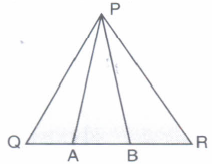
In \(\Delta \)PQR, A and B are points on sides QR such that they trisect QR, Prove that: ar(\(\Delta \)PQB) = 2ar (\(\Delta \)PBR)
44.
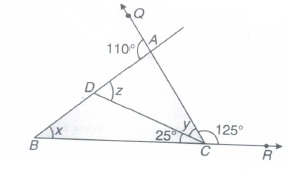
In the given figure, if \(\angle BCD=25^0,\angle BAQ=110^o\ and\ \angle ACR=125^o\), then find the values of x, y, z.
45.
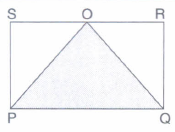
In a parallelogram PQRS of the given figure, the bisectors of ㄥP and ㄥQ meet SR at O. Show that ㄥPOQ=90°
46.
Factorize: 250x3-432y3.
47.
If 2xx4x = (8)1/3x(32)1/5 then, find the value of x.
48.
Write three solutions of the equation 3x=y+3. Draw its graph and find the points where the graph intersects the axes.
49.
Three coins are tossed simultaneously 250 times. The distribution of various outcomes is listed below:
(i) Three tails: 30
(ii) Two tails: 70
(iii) One tail : 90
(iv) No tail: 60
Find the respective probability of each event and check that the sum of all the probabilities is 1.
50.
The sides of a triangular park are in the ratio 3: 5:7 and its perimeter is 300 m. Find its area.
51.
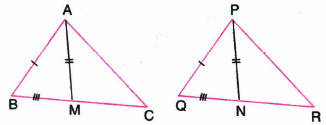
Two sides AB and BC and median AM of one triangle ABC are respectively equal to sides PQ and QR and median PN of \(\angle PQR\) (see figure). Show that:
(i) \(\triangle ABM\cong \triangle PQN\) (ii) \(\triangle ABC\cong \triangle PQR\)
52.
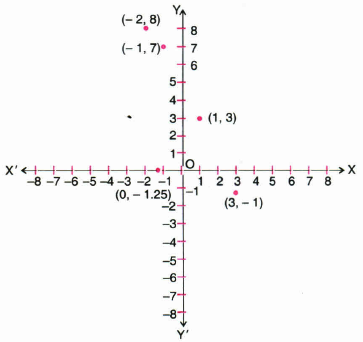
Plot the points (x,y) given in the following table on the plane, choosing suitable units of distance on the axes.
| x | -2 | -1 | 0 | 1 | 3 |
| y | 8 | 7 | -1.25 | 3 | -1 |
53.
A cone of height 24 cm has a curved surface area 550 cm2. Find us volume.
54.
Three students Priyanka, Sania and David are protesting against killing innocent animals for commercial purposes in a circular park of radius 20 m. They are standing at equal distance on its boundary by holding banners in their hands.
(i) Find the distance between each of them?
(ii) Which mathematical concept is used in it?
(iii) How does an act like this reflects their attitude towards society?
55.
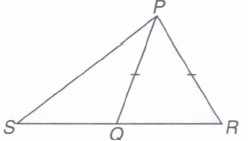
In figure, PQ = PR. Show that PS > PQ.
56.
The % of marks obtained by students in the annual examination of a class in mathematics are given below:
| Percentage of marks | No. of students |
|---|---|
| 0-10 | 8 |
| 10-30 | 32 |
| 30-45 | 18 |
| 45-50 | 10 |
(i) How many students get less than 30% of marks?
(ii) Represent the data by histogram.
(iii) Which value is depicted by a student Ram obtaining the highest marks in the interval 45-50?
57.
Ankush prepare a poster in the form of parallelogram, as in figure.
(i) If ㄥA=(5x + 7)° and LB = (3x- 3)°, find all the angles of a parallelogram ABCD.
(ii) Which mathemetical concept is used in this question?
(iii) By writing a slogan on poster which value is depicted by Ankush?
58.
Find the value of \(\frac { { 3 }^{ 30 }+{ 3 }^{ 29 }+{ 3 }^{ 28 } }{ { 3 }^{ 31 }+{ 3 }^{ 30 }-{ 3 }^{ 29 } } \)
1.
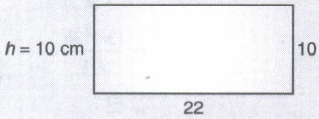
2\(\pi\)r = 22
\(2\times \frac { 22 }{ 7 } \times r=22\)
\(r=\frac { 7 }{ 2 } \)
V = \(\pi\)r2h
\(=\frac { 22 }{ 7 } \times \frac { 7 }{ 2 } \times \frac { 7 }{ 2 } \times 10\)
= 385 cm2
2.
We know that each angle of equilateral triangle is 60o,So have to draw an angle 60oand bisect it.
Construction:
i) Draw any line OP.
ii) With 0 as centre and any suitable radius, draw an arc to meet OP at R.
iii) With R as centre and same radius draw an arc to meet the previous arc at S.
iv) Join OS and Produce it to Q, then ㄥPOQ=60o
v) With R as centre and any suitable radius (not necessarily)equal to radius of step 1 (but >\(\frac { 1 }{ 2 } \)RS),draw an arc. Also, with 5 as centre and radius draw another arc to meet the previous arc at Y
vi) Join OY and produced it, the OY is the required bisector of ㄥPOQ(i.e,ㄥPOY=30o)
3.
Let AB be perpendicular to a line l and AP is any other line segment.
In right \(\triangle ABP,\angle B>\angle P,(\therefore \angle B=90^o)\)
\(\ \Rightarrow AP>AB\ or\ AB\)
4.
\((i)\frac { 53 }{ 100 }\)
\((ii)\frac { 3 }{ 25 } \)
5.
58
6.
6 cm
7.
12 cm2
8.
\(130^{ 0 }\)
9.
2x+0y-3=0
10.
6 Units.
11.
\(-\frac{1}{2}\)
12.
(i) False, because zero is a whole number but not a natural number.
(ii) True, because every integer m can be expressed in the form m/1, and so it is a rational number.
(iii) False because 3/5 is a rational number but not an integer.
13.
Steps of construction:
i) Draw a line segment BC = 4.7 cm. and at point B construct an angle of 45o i.e ㄥXBC=45o
ii) Cut the line segment BD = 2 cm (equal to AB-AC)on ray BX
iii) Join DC and draw the perpendicular bisector PQ of DC
iv) The perpendicular bisector intersects BXat point A. Jon AC ΔABC is the required triangle.
14.
AD = BD
\(\Rightarrow\) \(\angle\)ABD = \(\angle\)DAB = 590
(Angles opp. to equal sides are equal)
In \(\triangle\)ABD,
590 + 590 + \(\angle\)ADB = 1800
\(\Rightarrow\) \(\angle\)ADB = 1800- 1180 = 620
and \(\angle\)ACD = 620- 320 = 300
(Exterior angle is equal to the sum of interior opposite angles)
In \(\triangle\)ABD,
(Side opp. to greatest angle is the longest) 1
Also in \(\triangle\)ABC, AB < AC
BD < AC
15.
In figure, AD is the median of \(\Delta\)ABC.
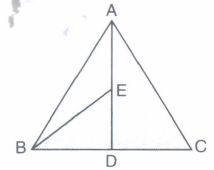
\(\therefore \ ar(\triangle ABD)=\frac { 1 }{ 2 } ar(\triangle ABC)\) ...........(i)
Now, BE is the median of \(\Delta\)ABD
\(\therefore \ ar(\triangle BED)=\frac { 1 }{ 2 } ar(\Delta ABD)\) ..............(ii)
From (i) and (ii), we get
ar(\(\Delta\)BED) = \(\frac { 1 }{ 2 } ar(\triangle ABC)\)
16.
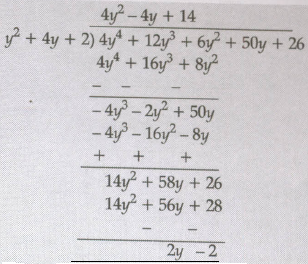
So, 2y-2 must be subtracted.
17.
We shall first make the class intervals continuous. Then, the modified table is as follows:
| Class | Class-marks | Frequency |
|---|---|---|
| 24.5-29.5 | 27 | 5 |
| 29.5-34.5 | 32 | 15 |
| 34.5-39.5 | 37 | 23 |
| 39.5-44.5 | 42 | 20 |
| 44.5-49.5 | 47 | 10 |
| 49.5-54.5 | 52 | 7 |
| Total | 80 |
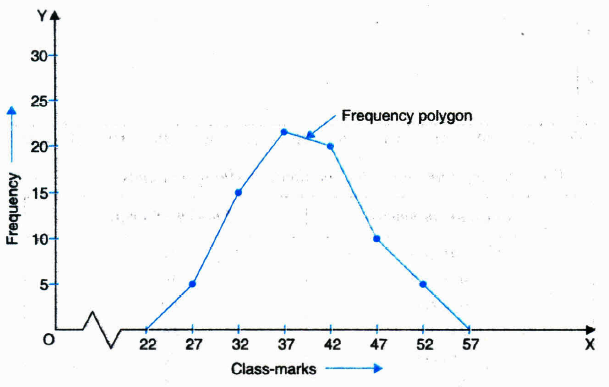
18.
For tank
\(r=\frac { 3.8 }{ 2 } m=1.9m\)
\(\\ h=4.9m\)
Curved surface area
\(=2\pi r\left( h+r \right) \)
\(\\ =2.\frac { 22 }{ 7 } .\frac { 19 }{ 10 } \left( 4.9+1.9 \right) { m }^{ 2 }\)
\(\\ =2.\frac { 22 }{ 7 } .\frac { 19 }{ 10 } .\frac { 68 }{ 10 } { m }^{ 2 }\)
\(\\ =81.21{ m }^{ 2 }\)
19.
Area of \(\Delta \)ABC = \(=\frac { AB\times BC }{ 2 } =\frac { 24\times 10 }{ 2 } \) = 120 m2.
20.
Given: In figure, EF is a line passing through the centre 0 of a circle. EF bisects chords AB and CD of the circle.
To Prove: AB || CD.
Proof: ∵ EF bisects chord AB
∴ OL bisects chord AB
∴ \(\angle OLB=\angle OLA=90°\) ...(1)
| ∵ The line drawn through the centre of a circle to bisect a chord is perpendicular to the chord
∵ From (1) and (2),
\(\angle OLB=\angle OMC=90°\)
But these angles form a pair of equal alternate interior angles
∴ AB || CD.
21.
Given ABCD is a quadrilateral
To prove \(\angle A+\angle B+\angle C+\angle D=360^{ 0 }\)
Construction Join AC
Proof In \(\triangle \) ABC
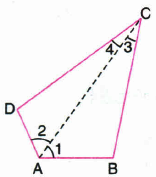
\(\angle 1+\angle B+\angle 3=180^{ 0 }\)
|Angle sum property of a traingleIn
In \(\triangle \) ADC
\(\angle 2+\angle D+\angle 4=180^{ 0 }\)
|Angle sum property of a traingleAdding (1) and (2) we get
\((\angle 1+\angle 2)+\angle B+(\angle 3+\angle 4)+\angle D=360^{ 0 }\)
\(\Rightarrow \angle A+\angle B+\angle C+\angle D=360^{ 0 }\)
22.
\(\angle \)2 = \(\angle \)4 ,,,,,,,(1) | Given
\(\angle \)1= \(\angle \)4 ........(2) | Given
\(\angle \)3 =\(\angle \)2 .......(3) | Given
From (1), \(\angle \)4 = \(\angle \)2 ......(4)
From (3) and (4),
\(\angle \)3 = \(\angle \)4 .....(5)
I Things which are equal to the same thing are equal to one another
From (2) and (4),
\(\angle \)1 = \(\angle \)3
I Things which are equal to the same thing are equal to one another
23.
The given linear equation
\(\Rightarrow\ \ y={2\over3}x+{1\over3}\ \ \ \ . . . .(1)\)
Table of solution
| x | 1 | 4 |
|---|---|---|
| y | 1 | 3 |
We plot the points (1, 1) and (4, 3) on a graph paper and join the same by a ruler to get the line which is the graph of the equation \(y={2\over3}x+{1\over3}\)
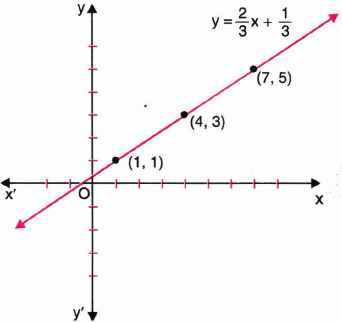
From graph, we see that the point (7, 5) lies on the graph, so it is a solution of the linear equation.
24.
(i) (3,2)
(ii) (-3,2)
(iii) (-3,-2)
(iv)(3,-2)
25.
Let x = \(0.15\overline { 9 } \)
x = 0.159999...
100x = 15.9999... ...(1)
1000x = 159.9999... ...(2)
Subtracting (1) from (2), we get
900x = 144
\(x=\frac { 144 }{ 900 } \)
\(\\ x=\frac { 4 }{ 25 } \)
Here, p = 4, q = 25(\(\neq 0\))
26.
Required probability=\(\frac { 25 }{ 200 } =\frac { 1 }{ 8 } \)
27.
(d)
3.5
28.
v = 5 \(\times\) (6 \(\times\) 2 \(\times\) 1.5)
29.
(b)
10 cm
30.
\(\angle BDA=\angle BCA=40°\) [Angles in the same segment]
Now, Since AD || BC
\(\angle\)DBC=\(\angle\)BDA [Alternate interior angles]
\(\therefore\) \(\angle\)DBC=40o
31.
(d)
2:1
32.
(c)
rhombus
33.
(b)
QP = 5cm, ㄥR = 600
34.
\(x=90^{ 0 }-x)+30^{ 0 }\Rightarrow x=60^{ 0 }\)
35.
(c)
a postulate
36.
For each value of x, we get the corresponding value of y.
37.
(c)
II and IV quadrants respectively
38.
Use factor theorem
39.
(b)
3
40.
AE = BE
\(\angle\)A = \(\angle\)B (angle opposite to equal sides of a \(\Delta\)are equal)
\(\angle\)EDC = \(\angle\)B;
\(\angle\)ECD = \(\angle\)A (exterior angle of cyclic quad.)
\(\therefore\) \(\angle\)EDC = \(\angle\)A (Corresponding Angles)
\(\therefore\) AB II DC Proved.
41.
Let r and h be the radius and height of the cylinder given r : h = 5 : 7
\(\therefore\) The radius of the cylinder(r) = 5x
and The height of the cylinder (h) = 7x
Volume of the cylinder = \(\pi\)r2h
\(\therefore\) 4400=\(\frac { 22 }{ 7 } \times { (5x) }^{ 2 }\times 7x\)
\(\left( \because \pi =\frac { 22 }{ 7 } \right) \)
\(\Rightarrow \ 4400=\frac { 22 }{ 7 } \times 5x\times 5x\times 7x\)
\(\Rightarrow \ { x }^{ 3 }=\frac { 4400\times 7 }{ 22\times 5\times 5\times 7 } \)
\(\Rightarrow\) x3 = 8 = 23
\(\therefore\) x = 2
Hence, the radius of the cylinder = 5x
= 5(2)
= 10 cm.
42.
43.
Given: PQR is a triangle and A and B are points on QR such that QA = AB = BR
To prove that: ar(\(\Delta \)PQB) = 2ar(\(\Delta \)PBR)
Let h be the height of triangle PQR.
Now, \(ar\left( \Delta PQA \right) =\frac { 1 }{ 2 } \times QA\times h\)
\(=\frac { 1 }{ 2 } \times \frac { 1 }{ 2 } QR\times h\) ..............(i)
\(ar(\Delta PAB)=\frac { 1 }{ 2 } \times AB\times h\)
\(=\frac { 1 }{ 2 } \times \frac { 1 }{ 2 } QR\times h\) ..............(ii)
\(ar(\Delta PBR)=\frac { 1 }{ 2 } \times BR\times h\)
\(=\frac { 1 }{ 2 } \times \frac { 1 }{ 2 } QR\times h\) ..................(iii)
\(ar(\Delta PQB)=\frac { 1 }{ 2 } \times QB\times h\)
\(=\frac { 1 }{ 2 } \times \frac { 2 }{ 3 } QR\times h\) ..................(iv)
From (i), (ii) and (iii), we conclude
ar(\(\Delta \)PQA) = ar(\(\Delta \)PAB) = ar(\(\Delta \)PBR) ......(v)
Now, ar(\(\Delta \)PQB) = ar(\(\Delta \)PQA) + ar(\(\Delta \)PAB)
\(\therefore\) ar(\(\Delta \)PQB) = ar(\(\Delta \)PBR) + ar(\(\Delta \)PBR)
[from (iv)]
\(\therefore\) ar(\(\Delta \)PQB) = ar(\(\Delta \)PBR) Hence Proved.
From (iii) and (iv), we get
\(ar\left( \Delta PQB \right) =\frac { 1 }{ 2 } \times \frac { 2 }{ 3 } QR\times h\)
\(=2\left( \frac { 1 }{ 2 } \times \frac { 1 }{ 3 } QR\times h \right) \)
= 2 ar(\(\Delta \)PBR) Hence Proved.
44.
y=180o-(25o+125o)(Linear pair)
\(\Rightarrow\) y=30o
y+z=110o (Exterior angle)
z=110o-30o=80o
x+25o=z (Exterior angle)
x=80o-25o=55o
45.
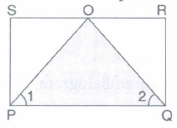
A parallelogram PQRS in which the bisectors of LP and LQ meet SR at O.
To Prove: ㄥPOQ=90°
Now, since PQRS is a parallelogram. Therefore,
PSIIQR
Now, PS II QR and transversal PQ intersects them.
ㄥP+ㄥQ=180°
(∵ Sum of consecutive interior angles is 180°)
\(\frac{1}{2}\)ㄥP+\(\frac{1}{2}\)ㄥQ=90°
⇒ ㄥ1+ㄥ2=90° ( OP is bisector of ㄥP...(i) and OQ is bisector of ㄥQ.
ㄥ1=\(\frac{1}{2}\) ㄥP and ㄥ2=\(\frac{1}{2}\) ㄥQ)
Now, in ΔPOQ
ㄥ1+ㄥPOQ+ㄥ2=180°
⇒ 90°+ㄥPOQ=180°
⇒ ㄥPOQ=90°
46.
250x3-432y3=2[125x3-216y3]
=2[(5x)3-(6y)3]
=2(5x-6y)[(5x)2+(6y)2+5x\(\times\)6y]
\(\because\) a3-b3=(a-b)(a2+b2+ab)
=2(5x-6y)(25x2+36y2+30xy).
47.
2xx(22)x = (23)1/3x(25)1/5
23x = 22
x =\(\frac{2}{3}\)
48.
3x=y+3; three solutions are x=1, y=0; x=2, y=3 and x=0, y=-3
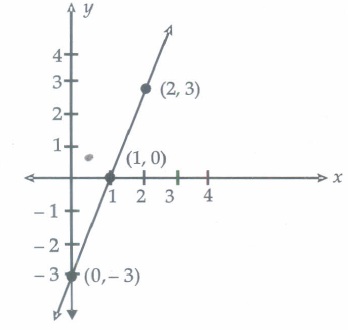
From graph it is clear that line meets x-axis at(1,0) and y-axis at (0,-3)
49.
\((i)\frac { 3 }{ 25 }\)
\((ii)\frac { 7 }{ 25 }\)
\((iii)\frac { 9 }{ 25 }\)
\((iv)\frac { 6 }{ 25 } \)
50.
\(1500\sqrt { 3 } \) cm2
51.
Given: Two sides AB and BC and median AM of one triangle ABC are respectively equal to sides PQ and QR and median PN of \(\angle PQR\)
To prove: (i) \(\triangle ABM\cong \triangle PQN\) (ii) \(\triangle ABC\cong \triangle PQR\)
Proof: In \(\triangle ABM\) and \(\triangle PQN\)
AB = PQ
AM = PN
BC = QR
2BM = 2QN | M and Nare the mid-points of BC and QR respectively
BM = QN
In view of (1), (2) and (3)
\(\triangle ABM\cong \triangle PQN\) | SSS rule
(ii) \(\triangle ABM\cong \triangle PQN\)
\(\angle ABM=\angle PQN\) | C.P.C.T
\(\angle ABC=\angle PQR\)
In \(\triangle ABC\) and \(\triangle PQR\)
AB = PQ
BC = QR
\(\angle ABC=\angle PQR\)
\(\triangle ABC=\triangle PQR\) | SAS rule
52.
53.
Height of the cone(h) = 24 cm
Let r cm be the radius of the base and l cm an can be the slant height of the cone, then
\(l=\sqrt { { r }^{ 2 }+{ h }^{ 2 } } \)
\(=\sqrt { { r }^{ 2 }+{ 24 }^{ 2 } } \)
\(=\sqrt { { r }^{ 2 }+576 } \)
Now, curved surface area=\(\pi\)rl
\(\Rightarrow \ \frac { 22 }{ 7 } \times r\times \sqrt { { r }^{ 2 }+576 } =550\)
\(\Rightarrow \ r\sqrt { { r }^{ 2 }+576 } =550\times \frac { 7 }{ 22 } \)
\(\Rightarrow \ r\sqrt { { r }^{ 2 }+576 } =175\)
Squaring both the sides we get
r2 (r2 + 576) = 30625
(r2)2 + 576r2-30625 = 0
Let r2 = x
x2 + 576x - 30625 = 0
\(\Rightarrow\) x2 + 625x - 49x - 30625 = 0
\(\Rightarrow\) x(x + 625)- 49(x + 625) = 0
\(\Rightarrow\) (x + 625)(x - 49) = 0
\(\Rightarrow\) x + 625=0 or x - 49 = 0
\(\Rightarrow\) x = 625 or x = 49
not possible x = 49
\(\therefore\) r2= 49
\(\Rightarrow\) r = 7 cm
Volume & the cone = \(\frac { 1 }{ 3 } \pi { r }^{ 2 }h\)
\(=\frac { 1 }{ 3 } \times \frac { 22 }{ 7 } \times { 7 }^{ 2 }+24\)
= 1232 cm3.
54.
(i) Let us assume that A, Band C are the position of Priyanka, Sania and David respectively on the boundary of circular park with centre O.
Draw AD\(\bot\) BC
Since the centre of the circle coincides with the centroid of the equilateral \(\triangle\) ABC
\(\therefore\) Radius of circumscribed circle = \(\frac{2}{3}\) AD
\(\Rightarrow 20=\frac { 2 }{ 3 } AD\)
\(\Rightarrow AD=20\times \frac { 2 }{ 3 } \)
\(\Rightarrow AD=30m\)
Now, AD\(\bot\)BC, and let AB=BC=CA=x
\(\Rightarrow BD=CD=\frac { 1 }{ 2 } BC=\frac { x }{ 2 } \)
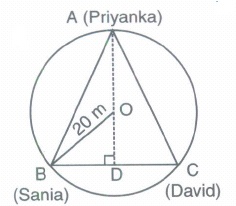
In rt. \(\triangle\)BDA, D=900
By Pythagoras Theorem, we have
AB2=BD2+AD2
\(\Rightarrow { x }^{ 2 }={ \left( \frac { x }{ 2 } \right) }^{ 2 }+{ (30) }^{ 2 }\)
\(\Rightarrow{ x }^{ 2 }-{ \frac { { x }^{ 2 } }{ 4 } }=90\)
\(\Rightarrow \frac { 3 }{ 4 } { x }^{ 2 }=90\)
\(\Rightarrow { x }^{ 2 }=900\times \frac { 4 }{ 3 } \)
\(\Rightarrow { x }^{ 2 }=1200\)
\(\therefore x=\sqrt { 1200 } =20\sqrt { 3 } \)
Hence, the distance between each of them is \(20\sqrt { 3 } .\)
(ii) Properties of the circle, equilateral triangle and Pythagoras theorem.
(iii) Live and let live.
55.
Proof: In \(\triangle\) PQR,
PQ =PR
\(\angle\) PQR = \(\angle\)PRQ
(Angles opp. to equal sides are equal) ...(i)
In \(\triangle\)PQS, \(\angle\)PQR > \(\angle\)PSQ
(Ext. angle of a 6 is greater than each of interior opp. angle)
\(\angle\)PRQ > \(\angle\)PSQ, using (i)
\(\Rightarrow\) \(\angle\)PRS >\(\angle\)PSR \(\Rightarrow\) PS > PR
PS>PQ (\(\because\) PR = PQ)
(Side opp. to greater angle is larger)
56.
(i) Required number of students = 8 + 32 = 40
(ii) Here, We notice that classes are continuous but class-size is not the same for all the classes. We notice minimum class-size is of class 45-50, i.e., 5. We will first find proportionate length of rectangle (adjusted frequency) for each class.
Length of rectangle (adjusted frequency) =\(\frac { Frequency\ of\ Class }{ Width\ of\ class } \times Minimum\ class-size\)
| Marks (C.I.) |
Number of students(f) | Width of class (Clss-size) |
Length of rectangle |
|---|---|---|---|
| 0-10 | 8 | 10 | \(\frac{8}{10}\)x 5 = 4 |
| 10-30 | 32 | 20 | \(\frac{32}{20}\) x 5 = 8 |
| 30-45 | 18 | 15 | \(\frac{18}{15}\) x 5 = 6 |
| 45-50 | 10 | 5 | \(\frac{10}{5}\) x 5 = 10 |
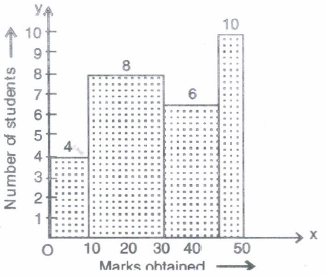
Now, we construct rectangles with respective class-intervals as widths and adjusted frequencies as heights.
Histogram representing marks obtained by students in unit test of Mathematics.
(iii) Hardwork and Dilligence.
57.
(i) Since sum of adjacent angles of a parallelogram is 180°
ஃ We have ㄥA+ㄥB=180
⇒ 5x + 7 + 3x - 3 = 180
⇒ 8x + 4 = 180
⇒ 8x = 176
⇒ x=\(\frac{176}{8}\)=22
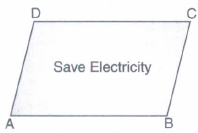
ㄥA=(5x+7)°=(5x22+7)=117°
ㄥB=(3x-3)°=(3x22-3)=63°
ㄥC=ㄥA=117°
and ㄥD=ㄥA=63°
(ii) Properties of parallelogram.
(iii) Energy conservation is necessary for a happy and prosperous future.
58.
\(\frac { { 3 }^{ 30 }+{ 3 }^{ 29 }+{ 3 }^{ 28 } }{ { 3 }^{ 31 }+{ 3 }^{ 30 }-{ 3 }^{ 29 } } =\frac { { 3 }^{ 38 }\left( { 3 }^{ 2 }+{ 3 }^{ 1 }+1 \right) }{ { 3 }^{ 29 }\left( { 3 }^{ 2 }+{ 3 }^{ 1 }-1 \right) } \)
\(=\frac { \left( 9+3+1 \right) }{ 3\left( 9+3-1 \right) } \)
\(=\frac { 13 }{ 3\times 11 } =\frac { 13 }{ 33 } \)

9th Standard CBSE Syllabus & Materials
9th Standard CBSE
CBSE 9th Mathematics Lines and Angles Sample Question Papers Study Material - QB365 Set A
NEW9th Standard CBSE
CBSE 9th Mathematics Introduction to Euclid's Geometry Sample Question Papers Study Material - QB365 Set A
NEW9th Standard CBSE
CBSE 9th Mathematics Linear Equations in Two Variables Sample Question Papers Study Material - QB365 Set A
NEW9th Standard CBSE
CBSE 9th Mathematics Coordinate Geometry Sample Question Papers Study Material - QB365 Set A



CBSE 9th Standard CBSE Subjects
CBSE Standards