
 100% FREE ACCESS
9th Standard Syllabus & Materials
9th Standard
TN 9th Tamil உள்ளத்தின் சீர் -கற்கண்டு (இலக்கணம்) - தொடர் இலக்கணம், ஆகுபெயர் Important Questions And Answers Study Material - QB365 Set A
NEW9th Standard
TN 9th Tamil உள்ளத்தின் சீர் -விரிவானம் (துணைப்பாடம்) - தாய்மைக்கு வறட்சி இல்லை! Important Questions And Answers Study Material - QB365 Set A
NEW9th Standard
TN 9th Tamil உள்ளத்தின் சீர் -கவிதை பேழை (செய்யுள்) - மார்கழி பெருவிழா Important Questions And Answers Study Material - QB365 Set A
NEW9th Standard
TN 9th Tamil உயிருக்கு வேர்-இலக்கணம் - பகுபத உறுப்பிலக்கணம் Important Questions And Answers Study Material - QB365 Set A
NEW9th Standard
TN 9th Tamil அமுதென்று பேர் - இலக்கணம்-எழுத்து -அளபெடை Important Questions And Answers Study Material - QB365 Set A
NEW9th Standard
TN 9th Tamil அமுதென்று பேர்-துணைப்பாடம் - ஆறாம்திணை Important Questions And Answers Study Material - QB365 Set A

Published on: 12/02/2020
9th Standard Mathematics Annual model
Download Tamil Nadu 9th Standard Maths question papers, model tests, one-mark questions, important questions, and public exam papers in PDF format. Free study materials and answer keys for TN State Board students.
Questions + Answers key
Take MCQ Maths Test1.
Find the value of \(\frac{\tan 25^{\circ}}{\cot 65^{\circ}}+\frac{\sin 40^{\circ}}{\cos 50^{\circ}}\)
2.
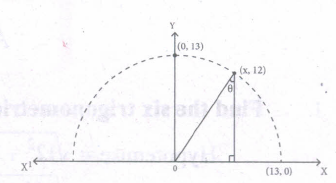
From the given figure, find all the trigonometric ratios of angle \(\theta\).
3.
Find the surface area of a cube whose edge is
(i) 27 cm
(ii) 3 cm
(iii) 6 cm
(iv) 2.1 cm
4.
Find the coordinates of the point which divides, the line segment joining the point A (3,7) and B (-11, -2) in the ratio 5 : 1.
5.
If A (10, 11) and B (2, 3) are the coordinates of end points of diameter of circle. Then find the centre of the circle.
6.
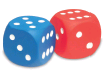
Two dice are rolled, find the probability that the sum is
(i) equal to 1
(ii) equal to 4
(iii) less than 13
7.
Find any 3 irrational numbers between 0.12 and 0.13.
8.
The points A(−5, 4) , B(−1, −2) and C(5,2) are the vertices of an isosceles right-angled triangle where the right angle is at B. Find the coordinates of D so that ABCD is a square.
9.
Find whether x and y are rational or irrational in the following
(i) a = 2 + \(\sqrt { 3 } \) , b = 2 - \(\sqrt { 3 } \) ; x = a + b, y = a+ b
(ii) a = \(\sqrt { 2 } \) + 7, b = \(\sqrt { 2 } \) - 7 ; x = a + b, y = a - b
(iii) a = \(\sqrt { 75 } \), b = \(\sqrt { 3 } \), x = ab, y = \(\frac { a }{ b } \)
(iv) a = \(\sqrt { 18 } \), b = \(\sqrt { 3 } \), x = ab, y = \(\frac { a }{ b } \)
10.
Express the following in the form 3n: \(\sqrt { 27 } \)
11.
A set of numbers consists of five 4’s, four 5’s, nine 6’s, and six 9’s. What is the mode.
12.
Expand the following: (2a-3b+4c)2
13.
Which of the following sets are equivalent or unequal or equal sets?
G = {x : x is a prime number and 3 < x < 23}
H = {x : x is a divisor of 18}
14.
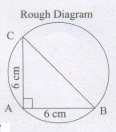
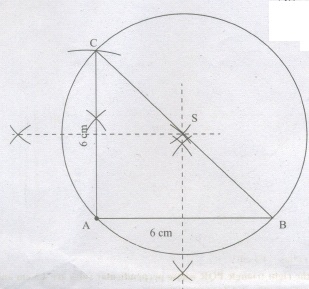
Draw the circumcircle for, An isosceles right triangle having 6 cm as the length of the equal sides.
15.
When a dice is rolled, find the probability to get the number greater than 4?
16.
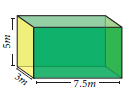
Find the TSA and LSA of a cuboid whose length, breadth and height are 7.5 m, 3 m and 5 m respectively.
17.
Find the value of sin 64034'.
18.
Check the value of k for which the given system of equations kx + 2y = 3; 2x − 3y = 1 has a unique solution.
19.
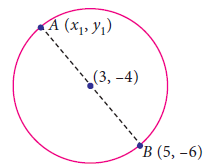
The point (3, −4) is the centre of a circle. If AB is a diameter of the circle and B is (5, −6), find the coordinates of A.
20.
Verify \(\left( A\cup B \right) '\)=\(A'\cap B'\) using Venn diagrams
21.
Add \(\sqrt [ 5 ]{ 11 } \) and \(\sqrt [ 7 ]{ 11 } \). Check whether the sum is rational or irrational
22.
Find the median of the given values: 47, 53, 62, 71, 83, 21, 43, 47, 41
23.
What must added to \({ x }^{ 4 }-3x^{ 2 }+2x+6\quad to\quad get\quad { x }^{ 4 }-2x^{ 3 }-x+8?\)
24.
Given that A = {1,3,5,7} B = {1,2,4,6,8}. Find
(i) AΔB and
(ii) BΔA
25.
Locate an irrational number between two rational numbers\(\frac { 23 }{ 10 } \) and\(\frac { 12 }{ 5 } \)
26.
Express the following decimal expression into rational numbers \(0.\overline { 0001 } \)
27.
Find the perimeter of the triangle whose vertices are (3, 2), (7, 2) and (7, 5).
28.
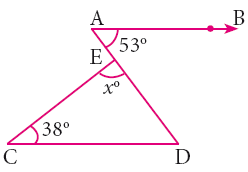
In the figure, AB is parallel to CD, find x
29.
Factorise 2x3- x2 - 12x - 9 into linear factors
30.
Find the quotient and remainder for the following using synthetic division:
(i) (x3+x2-7x-3) ÷ (x - 3)
(ii) (x3+2x2-x-4) ÷ (x + 2)
(ii) (3x3-2x2+7x-5) ÷ (x + 3)
(iv) (8x4-2x2+6x+5) ÷ (4x + 1)
31.
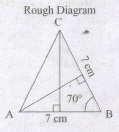
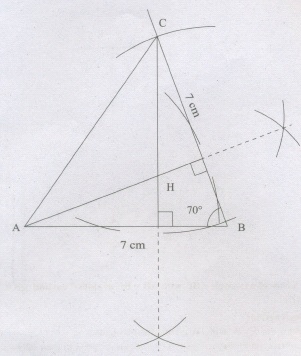
Construct an isosceles triangle ABC with AB = BC of sides 7 cm and ㄥB = 700 and locate its Orthocentre.
32.
The number of bricks each measuring 50 cm × 30 cm × 20 cm that will be required to build a wall whose dimensions are 5 m × 3 m × 2 m is _______.
1000
2000
3000
5000
33.
A letter is chosen at random from the word “STATISTICS”. The probability of getting a vowel is
\(\frac { 1 }{ 10 } \)
\(\frac { 2 }{ 10 } \)
\(\frac { 3 }{ 10 } \)
\(\frac { 4 }{ 10 } \)
34.
The value of 3 sin 700sec 200 + 2 sin 490sec 510 is ________.
2
3
5
6
35.
If x - 2 is a factor of q(x), then the remainder is___________
q(-2)
x - 2
0
-2
36.
The length of a square is 1.2\(\times\)103 m. Its area is_______
14.4 \(\times\) 106
1.44 \(\times\) 106
0.144 \(\times\) 10
1440
37.
The angle in a semicircle is_________
180°
90°
60°
45°
38.
The mean of the first 10 whole numbers is
4
4.5
5
5.5
39.
The mean of a, b, c, d and e is 28. If the mean of a, c and e is 24, then mean of b and d is _______.
24
36
26
34
40.
What is 5.92 \(\times\)10-3 written in decimal form?
0.000592
0.00592
0.0592
0.592
41.
If A is a proper subset of B, then A ∩ B = __________
A
B
Ø
A U B
42.
The point whose abscissa is 5 and lies on the x-axis is__________
(-5, 0)
(5,5)
(0,5)
(5,0)
43.
If Q1, Q2, Q3, Q4 are the quadrants in a Cartesian plane then \({ Q }_{ 2 }\cap { Q }_{ 3 }\) is ______.
\({ Q }_{ 1 }\cup { Q }_{ 2 }\)
\({ Q }_{ 2 }\cup { Q }_{ 3 }\)
Null set
Negative x-axis
44.
The zero of the polynomial 2x+5 is _______.
\(\frac {5}{2}\)
\(-\frac {5}{2}\)
\(\frac {2}{5}\)
\(-\frac {2}{5}\)
45.
If B ⊆ A then n(A∩B) is –––––––––.
n(A – B)
n(B)
n(B – A)
n(A)
46.
Draw an equilateral triangle of side 8 cm and locate its incentre. Also draw the incircle.
1.
\( \frac{\tan 25^{\circ}}{\cot 65^{\circ}}+\frac{\sin 40^{\circ}}{\cos 50^{\circ}} \)
\(= \frac{\tan \left(90^{\circ}-65^{\circ}\right)}{\cot 65^{\circ}}+\frac{\sin \left(90^{\circ}-50^{\circ}\right)}{\cos 50^{\circ}} \)
\(= \frac{\cot 65^{\circ}}{\cot 65^{\circ}}+\frac{\cos 50^{\circ}}{\cos 50^{\circ}}=1+1=2 \)
2.
\(x=\sqrt { { 13 }^{ 2 }-{ 12 }^{ 2 } } \)
\(\sqrt { 169-144 } =\sqrt { 25 } =5\)
\(sin\theta =\cfrac { 5 }{ 13 } ;cos\theta =\cfrac { 12 }{ 13 } ;tan\cfrac { 5 }{ 12 } ;cosec\theta =\cfrac { 13 }{ 5 } ;\)
\(sec\theta =\cfrac { 13 }{ 12 } ;cot\theta =\cfrac { 12 }{ 5 } \)
3.
(i) TSA = 6a2 = 6 \(\times\) 272 = 6 \(\times\) 729 = 4374 cm2
(ii) TSA = 6a2 = 6 \(\times\)32 = 54 cm2
(iii) TSA = 6a2 = 6 \(\times\) 62 = 6 \(\times\) 36 = 216 cm2
(iv) TSA = 6a2 = 6 \(\times\) 2.12 = 6 \(\times\) 4.41 = 26.46 cm2
4.
\((x,y)=\left( \frac { 3(1)+5(-11) }{ 5+1 } ,\frac { 1(7)+5(-2) }{ 6 } \right) \)
\(=\left( \frac { 3-55 }{ 6 } ,\frac { 7-10 }{ 6 } \right) =\left( \frac { -52 }{ 6 } ,\frac { -3 }{ 6 } \right) =\left( \frac { -26 }{ 3 } ,\frac { -1 }{ 2 } \right) \)
5.
Centre of the circle \(=\left( \frac { 10+2 }{ 2 } ,\frac { 11+3 }{ 2 } \right) =(6,7)\)
6.
When two dice are rolled
Sample space
S = {(1,1), (1,2), (1,3), (1,4), (1,5), (1,6), (2,1), (2,2), (2,3), (2,4), (2,5), (2,6), (3,1), (3,2), (3,3), (3,4), (3,5), (3,6), (4,1), (4,2), (4,3), (4,4),(4,5),(4,6), (5,1), (5,2), (5,3), (5,4), (5,5), (5,6), (6,1), (6,2), (6,3), (6,4), (6,5), (6,6)}
n(S) = 36
(i) Event of the sum is equal to 1 = 0
∴ Probability = \(\frac { 0 }{ n(S) } \) = 0
(ii) Event of the sum is equal to 4
B = {(1, 3), (2, 2), (3, 1)}
n(B) = 3
P(B)= \(\frac { n(B) }{ n(S) } =\frac { 3 }{ 6 } =\frac { 1 }{ 12 } \)
(iii) Event of the sum is equal to less than 13
C= {(1,1), (1,2), (1,3), (1,4), (1,5), (1,6), (2,1), (2,2), (2,3), (2,4), (2,5), (2,6), (3,1), (3,2), (3,3), (3,4), (3,5), (3,6), (4,1), (4,2), (4,3), (4,4), (4,5), (4,6), (5,1), (5,2), (5,3), (5,4), (5,5), (5,6), (6,1), (6,2), (6,3), (6,4), (6,5), (6,6)}
n(C) = 36
P(C) = \(\frac { n(C) }{ n(S) } =\frac { 36 }{ 6 } \).
7.
Three irrational numbers between 0.12 and 0.13 are 0.12010010001…, 0.12040040004…, 0.12070070007…
8.
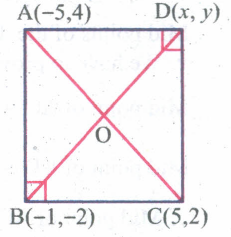
In a square the diagonals are equal and bisect each other
∴ Mid point of BD = Mid point of AC
\(\left( \frac { -1+x }{ 2 } ,\frac { -2+y }{ 2 } \right) =\left( \frac { -5+5 }{ 2 } ,\frac { 4+2 }{ 2 } \right) \)
\(\frac { -1+x }{ 2 } =\frac { 0 }{ 2 } \quad \frac { -2+y }{ 2 } =\frac { 6 }{ 2 } \)
-1 + x = -2 + y = 6
x =1 y = 8
∴ The vertex D(x, y) = (1, 8)
9.
(i) Given that a = 2 + \(\sqrt { 3 } \) , b = 2 - \(\sqrt { 2 } \)
x = a + b = ( 2 + \(\sqrt { 3 } \)) + (2 - \(\sqrt { 3 } \)) = 4 a rational number
y = a - b = (2 + \(\sqrt { 3 } \) ) - (2 - \(\sqrt { 3 } \)) = 2\(\sqrt { 3 } \) an irrational number
(ii) Given that a = \(\sqrt { 2 } \) + 7 , b = \(\sqrt { 2 } \) - 7
x = a + b = (\(\sqrt { 2 } \) + 7) + (\(\sqrt { 2 } \) - 7) = 2\(\sqrt { 2 } \) an irrational number.
y = a -b = (\(\sqrt { 2 } \) + 7 ) - (\(\sqrt { 2 } \) - 7) = 14 a rational number
(iii) Given that a = \(\sqrt { 75 } \) , b = \(\sqrt { 3 } \)
x = ab = \(\sqrt { 75 } \times \sqrt { 3 } =\sqrt { 75\times 3 } =\sqrt { 5\times 5\times 3\times 3 } =5\times 3=15\) a rational number
\(y=\frac { a }{ b } =\frac { \sqrt { 75 } }{ \sqrt { 3 } } =\sqrt { \frac { 75 }{ 3 } } =\sqrt { 25 } =5\), rational number
(iv) Given that a = \(\sqrt { 18 } \), b = \(\sqrt { 3 } \)
\(x=ab=\sqrt { 18 } \times \sqrt { 3 } =\sqrt { 18\times 3 } =\sqrt { 6\times 3\times 3 } =3\sqrt { 6 } ,\) an irrational number,
\(y=\frac { a }{ b } =\frac { \sqrt { 18 } }{ \sqrt { 3 } } =\sqrt { \frac { 18 }{ 3 } } =\sqrt { 6 } \) an irrational number
10.
\(\sqrt { 27 } \) =\(\sqrt { 3 } \times \sqrt { 3 } \times \sqrt { 3 } =\left( { 3 }^{ \cfrac { 1 }{ 2 } } \right) ^{ 3 }=\left( 3 \right) ^{ \left( \cfrac { 3 }{ 2 } \right) }\)
11.
| Size of item | 4 | 5 | 6 | 9 |
|---|---|---|---|---|
| Frequency | 5 | 4 | 9 | 6 |
6 has the maximum frequency 9. Therefore 6 is the mode.
12.
(2a-3b+4c)2= (2a+(-3b)+4c)2 = (2a)2+(-3b)2+(4c)2+2(2a)(-3b)+2(-3b)(4c)+2(4c)(2a)
= 4a2+9b2+16c2+(-12ab)+(-24bc)+16ca
= 4a2+9b2+16c2-12ab-24bc+16ca
13.
Equivalent sets
14.
Steps of construction:
Step 1: Draw the ΔABC with the given measure.
Step 2: Construct the perpendicular bisector of any two sides (AB and AC) and let them meet at S which is the circumcentre.
Step 3: With S as centre and SA = SB = SC as radius draw the circumcircle to passes through A, B and C.
15.
Sample space S = {1, 2, 3, 4, 5, 6}
Let E be the event of getting a number greater than 4
E = {5, 6}
\(P(E)=\frac { Number\ of\ favourable\ outcomes }{ Total\ number\ of\ outcomes } \)
\(P(E)=\frac { n(E) }{ n(S) } =\frac { 2 }{ 6 } =0.333...\)
16.
Given the dimensions of the cuboid;
that is length (l) = 7.5 m, breadth (b) = 3 m and height (h) = 5 m.
TSA = 2(lb + bh + lh)
= 2[(7.5 × 3) + (3 × 5) + (7.5 × 5)]
= 2(22.5 +15 + 37.5)
= 2 × 75
= 150 m2
LSA = 2(l + b) × h
= 2(7.5 + 3) × 5
= 2 ×10.5 × 5
= 105 m2
17.
| 0' | 6' | 12' | 18' | 24' | 30' | 36' | 42' | 48' | 54' | Mean Difference | |||||
| 0.00 | 0.10 | 0.20 | 0.30 | 0.40 | 0.50 | 0.60 | 0.70 | 0.80 | 0.90 | 1 | 2 | 3 | 4 | 5 | |
| 640 | 0.9026 | 5 | |||||||||||||
write 64034' = 64030' + 4'
From the table we have, sin64030' = 0.9026

18.
Given linear equations are
kx + 2y = 3 ......(1)
2x - 3y = 1 .......(2)
\(\left[ \begin{matrix} { a }_{ 1 }x+{ b }_{ 1 }y+{ c }_{ 1 }=0 \\ { a }_{ 2 }x+{ b }_{ 2 }y+{ c }_{ 2 }=0 \end{matrix} \right] \)
Here a1 = k, b1 = 2, a2 = 2, b2 = −3 ;
For unique solution we take \(\frac { { a }_{ 1 } }{ { a }_{ 2 } } \neq \frac { { b }_{ 1 } }{ { b }_{ 2 } } \); therefore \(\frac { k }{ 2 } \neq \frac { 2 }{ -3 } \);\(k\neq \frac { 4 }{ -3 } \), that is \(k\neq -\frac { 4 }{ 3 } \)
19.
Let the coordinates of A be (x1, y1) and the given point is B(5,−6). Since the centre is the mid-point of the diameter AB, we have
\(\frac { { x }_{ 1 }+{ x }_{ 2 } }{ 2 } \) = 3
x1 + 5 = 6
x1 = 6 − 5
x1 = 1
\(\frac { { y}_{ 1 }+{ y }_{ 2 } }{ 2 } \) = -4
y1 − 6 = −8
y1 = −8 + 6
y1 = −2
Therefore, the coordinates of A is (1, −2) .
20.
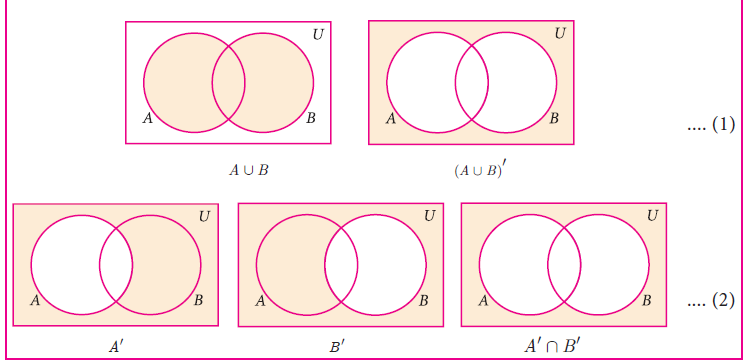
From (1) and (2), it is verified that \(\left( A\cup B \right) '\)=\(A'\cap B'\)
21.
\(\sqrt [ 5 ]{ 11 } +\sqrt [ 7 ]{ 11 } =\left( 5+7 \right) \sqrt { 11 } =12\sqrt { 11 } \)
22.
47, 53, 62, 71, 83, 21, 43, 47, 41
Ascending order = 21, 41, 43, 47, 53, 62, 71, 83
The number of value 9, which is odd
\(\therefore\) Median =\(\left( \cfrac { 9+1 }{ 2 } \right) ^{ th }\quad \)
\(=\left( \cfrac { 10 }{ 2 } \right) ^{ th }\) Value = 5th Value = 47
23.
Let A be the required number to be added.
(x4 - 3x2 + 2x + 6 ) + A = x4 - 2x3 - x + 8
\(\therefore\) A = x4- 2x3 - x + 8 - (x4 - 3x2 + 2x + 6)
= x4 - 2x3 - x + 8 - x4 + 3x2 - 2x - 6
= -2x3 + 3x2 - 3x + 2
Hence -2x3 + 3x2 - 3x + 2 must be added.
24.
(i) A = {1,3,5,7} ; B = {1,2,4,6,8}
A-B = {1,3,5,7} - {1,2,4,6,8}
= {3,5,7}
B -A = {1,2,4,6, 8} - {1,3,5,7}
= {2,4,6,8}
AΔB = (A - B)U(B-A)
= {3,5,7} U {2,4,6,8}
= {2,3,4,5,6,7,8}.
(ii) BΔA = (B-A) U (A-B)
= {2,4,6,8} u {3,5,7}
= {2,3,4,5,6,7,8}
25.
\(\frac { 23 }{ 10 } \)is 2.3 and\(\frac { 12 }{ 5 } \) is 2.4
You need an irrational number greater than 2.3 but less than 2.4
One such irrational number is
2.301001000100001000001000000100000001……..
observe that it is non-terminating and non-recurring.
26.
Let x = 0.00010001 ............. \(\rightarrow\) (1)
10000x = 1.00010001 .......... \(\rightarrow\) (2)
(2) - (1) \(\Rightarrow\) 10000x - x = 1.00010001 ......... (-)
0.00010001 .........
____________
9999x = 1
\(x=\frac{1}{9999}\)
27.
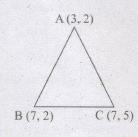
Distance = \(\sqrt { ({ x }_{ 2 }-{ x }_{ 1 })^{ 2 }+(y_{ 2 }-{ y }_{ 1 })^{ 2 } } \)
AB= \(\sqrt { (7-3)^{ 2 }+(2-2)^{ 2 } } \)
= \(\sqrt { { 4 }^{ 2 }+0^{ 2 } } \)
= \(\sqrt { 16 } =4\)
BC = \(\sqrt { (7-7)^{ 2 }+(5-2)^{ 2 } } \)
= \(\sqrt { 0+(3)^{ 2 } } \)
= \(\sqrt { 9 } =3\)
AC = \(\sqrt { (7-3)^{ 2 }+(5-2)^{ 2 } } \)
= \(\sqrt { { 4 }^{ 2 }+{ 3 }^{ 2 } } \)
= \(\sqrt { 16+9 } =\sqrt { 25 } =5\)
Perimeter of ΔABC = AB + BC + AC
= 4 + 3 + 5 =12 units
28.
In the given figure AB || CD, AD is the transversal
\(\angle CDA=\angle BAD\)
= 53° (alternate angles are equal)
In \(\triangle ECD,\angle D=\angle A=53^0\) (Alternate angles are equal)
\(\angle E+\angle C+\angle D=180^0\) (sum of the angles of a triangle)
x° + 38° + 53° = 180°
x° = 180°- 91° = 89°
x = 89°
29.
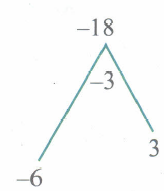
Let p (x) 2x3 - x2 - 12x - 9
Sum of the co-efficients = 2 - 1- 12- 9 = -20 \(\neq \) 0
Hence x-1 is not a factor
Sum of co-efficients of even powers with constant = -1 - 9 = -10
Sum of co-efficients of odd powers = 2 - 12= -10
Hence x + 1 is a factor of x.
Now we use synthetic division to find the other factors.
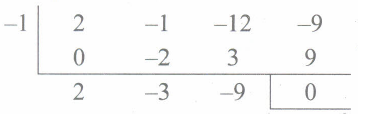
Then p (x) = (x + 1)(2x2 - 3x - 9)
Now 2x2 - 3x - 9 = 2x2 - 6x + 3x - 9 = 2x (x - 3) + 3 (x - 3)
= (x - 3)(2x + 3)
Hence 2x3 - x2 - 12x - 9 (x + 1) (x - 3) (2x + 3)
30.
(i) (x3+x2-7x-3) ÷ (x-3)
Let p (x) = x3+x2-7x-3
q (x) = x - 3
To find the zero of x - 3 :
p(x) in standard form ((i.e.) descending order)
Co-efficients are 1 1 -7 -3
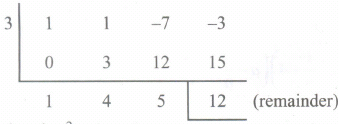
Quotient is: x2 +4x+5
Remainder is :12
(ii) (x3+2x2-x-4) ÷ (x+2)
p(x) = x3+2x2-x-4
Co-efficients are 1 2 -1 -4
To find zero of x+2, put x+2 = 0; x = -2
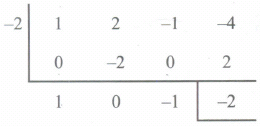
Quotient is: (x2-1)
Remainder is: -2
(iii) (3x3-2x2+7x-5) ÷ (x+3)
To find zero of the divisor (x + 3), put x + 3 = 0; x = - 3
Dividend in Standard form 3x3-2x2+7x-5
Co-efficients are 3 -2 7 -5
Synthetic Division
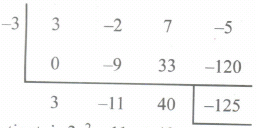
Quotient is: 3x2-11x+40
Remainder: is -125
(iv) (8x4-2x2+6x+5) ÷ (4x+1)
To find zero of the divisor 4x + 1, put 4x + 1 = 0; 4x = -1; x = \(-\frac{1}{4}\)
Dividend in Standard form 8x4-2x2+6x+5
Co-efficients are 8 0 -2 6 5
Synthetic Division
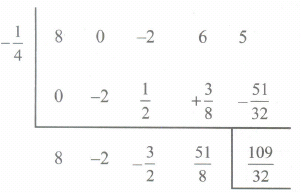
8x4-2x2+6x+5 = \((x+\frac{1}{4})(8x^3-2x^2-\frac{3x}{2}+\frac{51}{8})+\frac{109}{32}\)
=\(\frac{4x+1}{ ̶4̶}\times ̶4̶(2x^3-\frac{x^2}{2}-\frac{3x}{8}+\frac{51}{32})+\frac{109}{32}\)
= (4x+1)\((2x^3-\frac{x^2}{2}-\frac{3x}{8}+\frac{51}{32})+\frac{109}{32}\)
Quotient is: \(2x^2-{x^2\over2}-{3x\over8}+{51\over32}\)
Remainder is: \({109\over32}\)
31.
Steps for construction:
Step 1: Draw the ΔABC with the given measurements.
Step 2: Construct altitudes from any two vertices A and C to their opposite sides BC and AB respectively.
Step 3: The point of intersection of the altitude H is the orthocentre of the given triangle ABC.
32.
(a)
1000
33.
(c)
\(\frac { 3 }{ 10 } \)
34.
(c)
5
35.
(c)
0
36.
(b)
1.44 \(\times\) 106
37.
(b)
90°
38.
(b)
4.5
39.
(d)
34
40.
(b)
0.00592
41.
(a)
A
42.
(d)
(5,0)
43.
(c)
Null set
44.
(b)
\(-\frac {5}{2}\)
45.
(b)
n(B)
46.
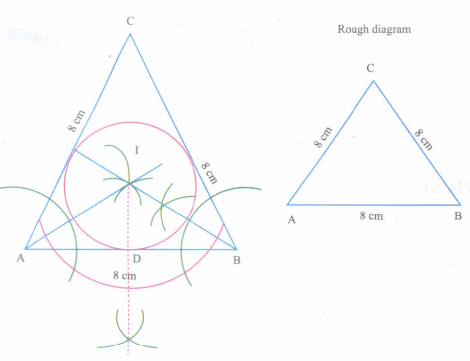
Construction :
Step 1: Draw \(\triangle\)ABC with AB = BC = CA = 8 cm
Step 2: Construct angle bisectors of any two angles (A and B) and let them meet at I. I is the incentre of \(\triangle\)ABC.
Step 3: Draw perpendicular from I to any one of the sides (AB) to meet AB at D.
Step 4: With I as centre, ID as radius draw the circle. This circle touches all the sides of triangle internally.

9th Standard Syllabus & Materials
9th Standard
TN 9th Tamil உள்ளத்தின் சீர் - திருக்குறள் Important Questions And Answers Study Material - QB365 Set A
NEW9th Standard
TN 9th Tamil உள்ளத்தின் சீர் - மணிமேகலை Important Questions And Answers Study Material - QB365 Set A
NEW9th Standard
TN 9th Tamil உள்ளத்தின் சீர் - ஏறு தழுவுதல் Important Questions And Answers Study Material - QB365 Set A
NEW9th Standard
TN 9th Tamil உயிருக்கு வேர் - தண்ணீர் Important Questions And Answers Study Material - QB365 Set A



Tamilnadu Stateboard 9th Standard Subjects
Tamilnadu Stateboard Standards





