
 100% FREE ACCESS
9th Standard Syllabus & Materials
9th Standard
TN 9th Tamil உள்ளத்தின் சீர் -கற்கண்டு (இலக்கணம்) - தொடர் இலக்கணம், ஆகுபெயர் Important Questions And Answers Study Material - QB365 Set A
NEW9th Standard
TN 9th Tamil உள்ளத்தின் சீர் -விரிவானம் (துணைப்பாடம்) - தாய்மைக்கு வறட்சி இல்லை! Important Questions And Answers Study Material - QB365 Set A
NEW9th Standard
TN 9th Tamil உள்ளத்தின் சீர் -கவிதை பேழை (செய்யுள்) - மார்கழி பெருவிழா Important Questions And Answers Study Material - QB365 Set A
NEW9th Standard
TN 9th Tamil உயிருக்கு வேர்-இலக்கணம் - பகுபத உறுப்பிலக்கணம் Important Questions And Answers Study Material - QB365 Set A
NEW9th Standard
TN 9th Tamil அமுதென்று பேர் - இலக்கணம்-எழுத்து -அளபெடை Important Questions And Answers Study Material - QB365 Set A
NEW9th Standard
TN 9th Tamil அமுதென்று பேர்-துணைப்பாடம் - ஆறாம்திணை Important Questions And Answers Study Material - QB365 Set A

Published on: 06/02/2020
9th Standard Maths Annual Exam Model Question Paper II - 2019 - 2020
Download Tamil Nadu 9th Standard Maths question papers, model tests, one-mark questions, important questions, and public exam papers in PDF format. Free study materials and answer keys for TN State Board students.
Questions + Answers key
Take MCQ Maths Test1.
Find the value of \(\cfrac { cos{ 63 }^{ 0 }20' }{ sin{ 26 }^{ 0 }40' } \)
2.
If 3 (tan \(\theta\)) + 4 (sec \(\theta\) \(\times\) sin 6) = 24. Then find all the trigonometric ratios of the angle \(\theta\)
3.
Using Heron's formula, find the area of a triangle whose sides are 41 m, 15 m, 25 m.
4.
A car travels, at an uniform speed. At 2 pm it is at a distance of 5 km at 6 pm it is at a distance of 120 km. Using section formula, find at what distance it will reach 2 midnight.
5.
If A (10, 11) and B (2 ,3) are the coordinates of end points of diameter of circle. Then find the centre of the circle.
6.
1500 families were surveyed and following data was recorded about their maids at homes
| Type of maids | Only part time | Only full time | Both |
| Number of families | 860 | 370 | 250 |
A family is selected at random. Find the probability that the family selected has
(i) Both types of maids
(ii) Part time maids
(iii) No maids
7.
Show that the line segment joining the mid-points of two sides of a triangle is half of the third side
(Hint: Place triangle ABC in a clever way such that A is (0, 0), B is (2a, 0) and C to be (2b, 2c). Now consider the line segment joining the mid-points of AC and BC. This will make calculations simpler).
8.
We used to write \(\pi\) as \(\frac{22}{7}.\) Can we say \(\pi\) is a rational number?
9.
A set of numbers consists of five 4’s, four 5’s, nine 6’s, and six 9’s. What is the mode.
10.
Factorise the following: m3+\(\frac{1}{m^2}\)-23
11.
Find the value of \(\left( \frac { 1 }{ 27 } \right) ^{ \frac { -2 }{ 3 } }\)
12.
Express the following in the form \({p\over q},\) where p and q are integers and q \(\ne\) 0.
\(0.5\overline {7}\)
13.
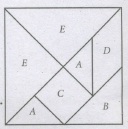
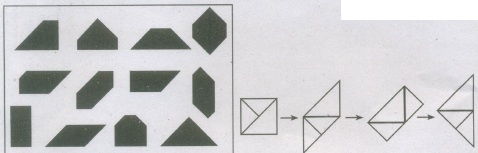
This is a copy of the tangram puzzle. The tangram puzzle consists of 7 geometric pieces which are normally boxed in the shape;of a square. The pieces, called 'tans', are used to create different patterns including animals, people, numbers, geometric shapes and many more.
You can make several polygons using the pieces in different ways.
14.
Write the set of letters of the following words in Roster form
ASSESSMENT
15.
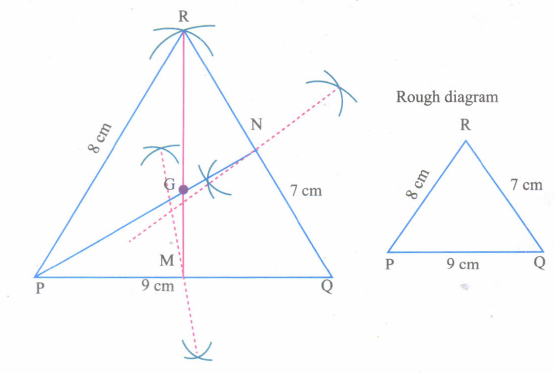
Construct the centroid of \(\triangle\)PQR such that PQ = 9 cm, QR = 7 cm, RP = 8 cm.
16.
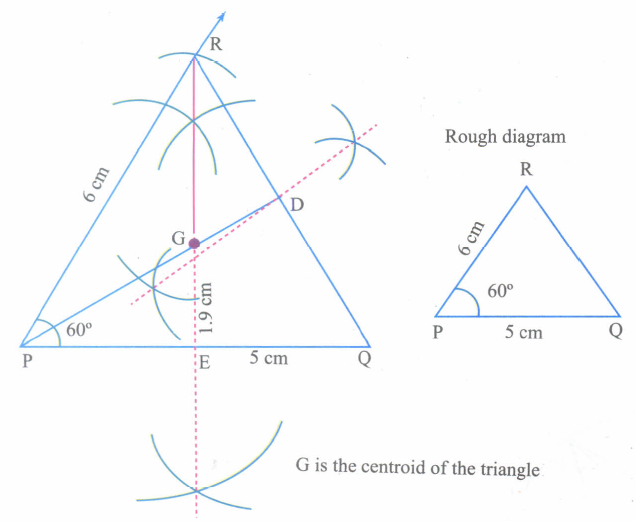
Construct the ΔPQR such that PQ = 5cm, PR= 6cm and ㄥQPR = 60° and locate its centroid.
17.
Construct an isosceles triangle PQR where PQ = PR and ㄥQ = 500, QR = 7cm. Also draw its circumcircle.
18.
When a dice is rolled, find the probability to get the number greater than 4?
19.
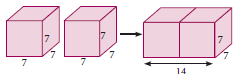
Two identical cubes of side 7 cm are joined end to end. Find the Total and Lateral surface area of the new resulting cuboid.
20.
Evaluate:
(i) \(\frac { sin\ 49° }{ cos\ 41° } \)
(ii) \(\frac { sec\ 63° }{ cosec\ 27° } \)
21.
Solve by cross-multiplication method
(i) 8x − 3y = 12 ; 5x = 2y + 7
(ii) 6x + 7y −11 = 0 ; 5x + 2y = 13
(iii) \(\frac { 2 }{ x } +\frac { 3 }{ y } =5;\frac { 3 }{ x } -\frac { 1 }{ y } +9=0\)
22.
The point (3, −4) is the centre of a circle. If AB is a diameter of the circle and B is (5, −6), find the coordinates of A.
23.
Find the GCD of (x - 7)2, (x + 7)2, (x - 4)3
24.
Arrange in ascending order:\(\sqrt [ 3 ]{ 5 } ,\sqrt [ 4 ]{ 7 } ,\sqrt [ 2 ]{ 6 } \)
25.
The median of observation 11,12,14,18, x+12, x+4, 30, 32, 35, 41 arranged in ascending order is 24. Find the values of x.
26.
Find the value of a and b if \(\frac { \sqrt { 7 } -2 }{ \sqrt { 7 } +2 } \) = a\(\sqrt{7}\) + b
27.
In a class there are 40 students. 26 have opted for Mathematics and 24 have opted for Science. How many student have opted for Mathematics and Science.
28.
Out of 500 car owners investigated, 400 owned car A and 200 owned car B, 50 owned both A and B cars. Is this data correct?
29.
Express the following decimal expression into rational numbers \(0.\overline { 0001 } \)
30.
The abscissa of a point A is equal to its ordinate, and its distance from the point B(1, 3) is 10 units, What are the coordinates of A?
31.
The number of bricks each measuring 50 cm × 30 cm × 20 cm that will be required to build a wall whose dimensions are 5 m × 3 m × 2 m is _______.
1000
2000
3000
5000
32.
A random experiment contains
At least one outcome
At least two outcomes
At most one outcome
At most two outcomes
33.
The value of \(\frac { sin{ 29 }^{ 0 }31' }{ cos{ 60 }^{ 0 }29' } \) is
0
2
1
-1
34.
\(\left[ n\left( A\cup B\cup C \right) ^{ ' } \right] \)=_______
\(n\left( A\cap B\cap C \right) \)
\(n\left( U \right) -n\left( A\cup B\cup C \right) \)
n(U)
\(\Phi \)
35.
If x - 2 is a factor of q(x), then the remainder is___________
q(-2)
x - 2
0
-2
36.
\(\sqrt [ 4 ]{ 405 } =h\sqrt [ 4 ]{ 5 } \), then h = ____________
5
4
2
3
37.
The mean of 5, 9, x, 17, and 21 is 13 then find the value of x ___________
9
13
17
21
38.
The mean of the first 10 prime numbers is ___________
12.6
12.7
12.8
12.9
39.
If n(A \(\cup \) B \(\cup \) C) = 40, n(A) = 30, n(B) = 25, n(C) = 20, n(A\(\cap \)B) = 12, n(B\(\cap \)C) = 18 and n(A\(\cap \)C) = 15 , then n(A\(\cap \)B\(\cap \)C) is ___________
5
10
15
20
40.
The angle sum of a convex polygon with number of sides 7 is ________
900°
1080°
1444°
720°
41.
The point which is on y-axis with ordinate - 5 is _____________
(0, -5)
(-5,0)
(5,0)
(0,5)
42.
if \(\frac { 1 }{ 7 } \) = \(0.\overline { 142857 } \) then the value of \(\frac { 5 }{ 7 } \) ________.
\(0.\overline { 142857 } \)
\(0.\overline { 714285 } \)
\(0.\overline { 571428 } \)
0.714285
43.
If x51 + 51 is divided by x + 1, then the remainder is _______.
0
1
49
50
44.
Signs of the abscissa and ordinate of a point in the fourth quadrant are respectively
(+,+)
( –, –)
(–, +)
( +, –)
45.
Solve 3x − 4y = 10 and 4x + 3y = 5 by the method of cross multiplication.
46.
Find the quotient and remainder when 5x3 + 7x2 + 3x + 2 is divided by 3x + 2
1.
\(\cfrac { cos{ 63 }^{ 0 }20' }{ sin{ 26 }^{ 0 }40' } =\cfrac { cos63^{ 0 }20' }{ cos{ 63 }^{ 0 }20' } =1\)
2.
3 tan \(\theta\) + 4 (sec \(\theta\) \(\times\) sin\(\theta\)) = 24
\(3tan\theta +4\left( \cfrac { 1 }{ cos\theta } \times sin\theta \right) =24\)
7 tan \(\theta\) = 24
\(tan\theta =\cfrac { 24 }{ 7 } \)
hypetenuse = \(\sqrt { { 24 }^{ 2 }+49 } =\sqrt { 576+49 } =\sqrt { 625 } =25\)
\(sin\theta =\cfrac { 24 }{ 25 } ;cos\theta =\cfrac { 7 }{ 25 } ;cosec\theta =\cfrac { 25 }{ 24 } ;sec\theta =\cfrac { 25 }{ 27 } ;cot\theta =\cfrac { 7 }{ 24 } \)
3.
s = \(\frac { 41+15+25 }{ 2 } \) = 40.5
Area = \(\sqrt { s(s-a)(s-b)(s-c) } =\sqrt { 40.5\times 0.5\times 25.5\times 15.5 } \)
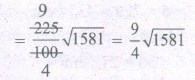
=\(\sqrt { \frac { 405 }{ 10 } \times \frac { 5 }{ 10 } \times \frac { 255 }{ 10 } \times \frac { 155 }{ 10 } } =\sqrt { \frac { 5\times 9\times 9\times 5\times 5\times 3\times 17\times 5\times 31 }{ 10\times 10\times 10\times 10 } } \)
=\(\frac { 1 }{ 100 } \times 5\times 9\times 5\times \sqrt { 3\times 17\times 31 } \)
4.
\(120=\frac { 8(50)+4(y) }{ 12 } \)
1440 = 400 + 4y
4y = 1040
\(y=\frac { 1040 }{ 4 } =260\ km\)
5.
Centre of the circle \(=\left( \frac { 10+2 }{ 2 } ,\frac { 11+3 }{ 2 } \right) =(6,7)\)
6.
Total number of families S = 1500
n(S) = 1569
Let P be the event of selecting a family having part time maids and F be the event of selecting a family having full time maids.
(i) Both types of maids Let P \(\cap\) F be the event of selecting a family having both types of maids.
Let (P \(\cap\) F) = 259
\(\mathrm{P}(\mathrm{P} \cap \mathrm{F})=\frac{\mathrm{n}(\mathrm{P} \cap \mathrm{F})}{\mathrm{n}(\mathrm{S})}=\frac{250}{1500}=\frac{1}{6}\)
(ii) Part time maids Part time maids = only part time maid + both
= 860 + 250 = 1110 '
n(P) = 1110
\(\mathrm{p}(\mathrm{P})=\frac{\mathrm{n}(\mathrm{P})}{\mathrm{n}(\mathrm{S})}=\frac{1110}{1500}=\frac{111}{150}\)
(iii) No maids Let (P \(\cup\) P)'be the event of choosing a family not having maids and (P u F) be the event of choosing a family having part time or full time or both maids.
n(P \(\cup\) F ) = only n(P) + only n(F) + n(p \(\cap\) p) = 850 + 370 + 250
n(P\(\cup\)F) = 1480
n(P\(\cup\)F)' = n(S)-n(P\(\cup\)F)
= 1500 - 1480
n(P \(\cup\) F)' = 20
\(\mathrm{P}(\mathrm{P} \cup \mathrm{F})^{\prime}=\frac{\mathrm{n}(\mathrm{P} \cup \mathrm{F})^{\prime}}{\mathrm{n}(\mathrm{S})}=\frac{20}{1500}=\frac{1}{75}\)
7.
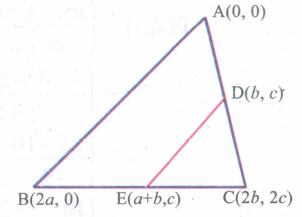
Mid point of AC

Mid point of BC
\(=\left( \frac { 2a+2b }{ 2 } ,\frac { 0+2c }{ 2 } \right) \)
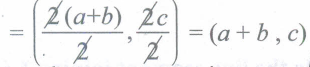
Distance between two points \(=\sqrt { { ({ x }_{ 2 }-{ x }_{ 1 }) }^{ 2 }+{ ({ y }_{ 2 }-{ y }_{ 1 }) }^{ 2 } } \)
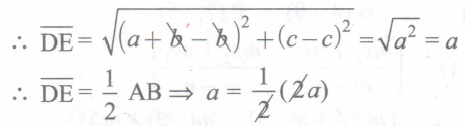
\(\therefore \bar { AB } =\sqrt { { (2a-0) }^{ 2 }+({ 0-0) }^{ 2 } } =\sqrt { { 4a }^{ 2 } } =2a\)
8.
\(\frac{22}{7}\) = 3.142857142 ...... and \(\pi\) = 3.141592653289 ........
It is an irrational number.
We usually take \(\pi\) as \(\frac{22}{7}\) (a rational number only But up to 2 decimal places).
But it is not exactly equal to \(\frac{22}{7},\) it is approximate value.
9.
| Size of item | 4 | 5 | 6 | 9 |
|---|---|---|---|---|
| Frequency | 5 | 4 | 9 | 6 |
6 has the maximum frequency 9. Therefore 6 is the mode.
10.
\(m^2+\frac{1}{m^2}-23=(m+\frac{1}{m})^2-2-23=(m+\frac{1}{m})^2-25\)
=\((m+\frac{1}{m})^2-5^2\)
\(\left( m+\frac { 1 }{ m } +5 \right) \left( m+\frac { 1 }{ m } -5 \right) \)
11.
\(\left( \frac { 1 }{ 27 } \right) ^{ \frac { -2 }{ 3 } }=(27)^{\frac{2}{3}}=(3^3)^{\frac{2}{3}}=3^ { ̶2̶\times\frac{2}{ ̶3̶}}=3^2=9\)
12.
Let x = 0.57777 ......... \(\rightarrow\) (1)
10x = 5.77777 ............ \(\rightarrow\) (2)
100x = 57.7777 ........... \(\rightarrow\) (3)
| (3) - (2) \(\Rightarrow\) 100x - 10x | = 57.7777 .......... |
| = 57.7777 ........ | |
| 99x | = 52.0000 ....... |
\(x={52\over 90}={26\over 45}\)
\(\therefore 0.5\overline{7}={26\over 45}\)
13.
By using the given shapes, students has to make different shapes like birds, house, numbers, animals, rocket etc.
These pictures are called tangram pictures.
14.
ASSESSMENT
A= {A, S, E, M, N, T}
15.
In \(\triangle\)PQR, PQ = 5 cm, PR = 6 cm, \(\angle\)QPR = 60°
Construction:
Step 1: Draw \(\triangle\) PQR using the given measurements PQ = 9 cm, QR = 7 cm and RP = 8 cm and construct the perpendicular bisector of any two sides (PQ and QR) to find the mid-points M and N of PQ and QR respectively.
Step 2: Draw the medians PN and RM and let them meet at G. The point G is the centroid of the given \(\triangle\)PQR.
16.
In PQR,
PQ = 5 cm,
PR = 6 cm
\(\angle \)QPR = 60°
Construction :
Step 1: Draw △ PQR with the given measurement
Step 2: Draw perpendicular bisectors of any two sides (PQ and QR) to find the midpoints of PQ and QR.
Step 3: Draw medians PD and RE. Let them meet at G.
Step 4: G is the centroid of the given △PQR.
17.
Given PQ = PR
∴ ㄥR = 50° (opposite angles are equal)
Steps for construction:
Step 1: Draw the ΔABC with the given measures.
Step 2: Construct the perpendicular bisector of any two sides (QR and PR) and let them meet at S. S is the circumcenter of Δ PQR.
Step 3: With S as centre SP = SQ = SR as radius. Draw the circumcircle.
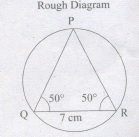
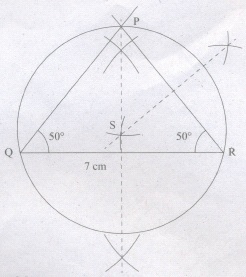
Circum radius = 3.5 cm.
Construction of Orthocentre of a Triangle:
Orthocentre: The orthocentre is the point of concurrency of the altitudes of a triangle. Usually it is denoted by H.
18.
Sample space S = {1, 2, 3, 4, 5, 6}
Let E be the event of getting a number greater than 4
E = {5, 6}
\(P(E)=\frac { Number\ of\ favourable\ outcomes }{ Total\ number\ of\ outcomes } \)
\(P(E)=\frac { n(E) }{ n(S) } =\frac { 2 }{ 6 } =0.333...\)
19.
Side of a cube = 7 cm
Now length of the resulting cuboid (l) = 7+7 =14 cm
Breadth (b) = 7 cm, Height (h) = 7 cm
So, Total Surface Area = 2(lb + bh + lh)
= 2[(14 \(\times\) 7)+(7 \(\times\) 7)+(14 \(\times\) 7)]
= 2(98 + 49 + 98)
= 2 × 245
= 490 cm2
Lateral Surface Area = 2(l + b) × h
= 2(14 + 7) × 7 = 2 × 21× 7
= 294 cm2
20.
(i) \(\frac { sin\ 49° }{ cos\ 41° } \)
sin 490 = sin(900 - 410) = cos 410, since 490 + 410 = 900 (complementary),
Hence on substituting sin 49o = cos41o we get, \( \frac { cos\ 41° }{ cos\ 41° } \)= 1
(ii) \(\frac { sec\ 63° }{ cosec\ 27° } \)
sec63o = sec (90o- 27o) = cosec27o, here, 63o and 27o are complementary angles
we have \(\frac { sec\ 63° }{ cosec\ 27° } =\frac { cosec\ 27° }{ cosec\ 27° } =1\)
21.
(i) 8x- 3y = 12 ...(1)
5x-2y = 7 ..(2)
8x- 3y-12 = 0
5x-2y- 7 = 0
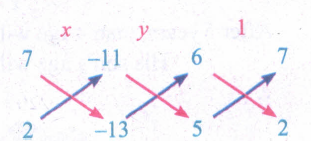
For cross multiplication method, we write the co-efficients as

\(\cfrac { x }{ (-3)(-7)(-2)(-12) } =\cfrac { y }{ (-12)(5)-(-7)(8) } =\cfrac { 1 }{ (8)(-2)-(5)(-3) } \)
\(\cfrac { x }{ 21-24 } =\cfrac { y }{ -60+56 } =\cfrac { 1 }{ -16+15 } \)
\(\cfrac { x }{ -3 } =\cfrac { y }{ -60+56 } =\cfrac { 1 }{ -16+15 } \)
\(\therefore \ \cfrac { x }{ 3 } =\cfrac { 1 }{ -1 } \ \cfrac { y }{ -4 } =\cfrac { 1 }{ -1 } \)
x = 3 , y = 4
\(\therefore\) Solutions: x = 3; y = 4
(ii) 6x+ 7y-11 = 0
5x+ 2y-13 = 0
For cross multiplication method, we write the co-efficients as
\(\cfrac { x }{ -91-(-22) } =\cfrac { y }{ -55-(-68) } =\cfrac { 1 }{ 12-35 } \)
\(\cfrac { x }{ -91+22 } =\cfrac { y }{ -55+78 } =\cfrac { 1 }{ -23 } \)
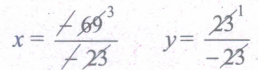
\(\cfrac { x }{ -69 } =\cfrac { y }{ 23 } =\cfrac { 1 }{ -23 } \)
\(\cfrac { x }{ -69 } =\cfrac { 1 }{ -23 } \quad \cfrac { y }{ 23 } =\cfrac { 1 }{ -23 } \)
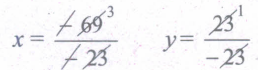
x = 3, y= -1
\(\therefore\) x = 3; y= -1
(iii)
\(\cfrac { 2 }{ x } +\cfrac { 3 }{ y } -5=0\)
\(\cfrac { 3 }{ x } -\cfrac { 1 }{ y } +9=0\)
In (1), (2) Put \(\cfrac { 1 }{ x } =a,\cfrac { 1 }{ y } =b\)
(1) \(\Rightarrow\) 2a + 3b - 5 = 0
(2) \(\Rightarrow\) 3a - b + 9 = 0
For cross multiplication method, we write the co-efficients as
\(\cfrac { a }{ (3)(9)-(-1)(-5) } =\cfrac { b }{ (-5)(3)-(9)(2) } =\cfrac { 1 }{ (2)(-1)-(3)(3) } \)
\(\cfrac { a }{ 27-5 } =\cfrac { b }{ -15-18 } =\cfrac { 1 }{ -2-9 } \)
\(\cfrac { a }{ 22 } =\cfrac { b }{ -33 } =\cfrac { 1 }{ -11 } \)
\(\therefore \ \cfrac { a }{ 22 } =\cfrac { 1 }{ -11 } \cfrac { b }{ -33 } =\cfrac { 1 }{ -11 } \)
a = -2 b = 3
\(a=\cfrac { 1 }{ x } =-2\quad b=\cfrac { 1 }{ y } =3\)
\(\therefore \ x=\cfrac { -1 }{ 2 } \ \ y=\cfrac { 1 }{ 3 } \)
solution \(\ x=\cfrac { -1 }{ 2 } \ \ y=\cfrac { 1 }{ 3 } \)
22.
Let the coordinates of A be (x1, y1) and the given point is B(5,−6). Since the centre is the mid-point of the diameter AB, we have
\(\frac { { x }_{ 1 }+{ x }_{ 2 } }{ 2 } \) = 3
x1 + 5 = 6
x1 = 6 − 5
x1 = 1
\(\frac { { y}_{ 1 }+{ y }_{ 2 } }{ 2 } \) = -4
y1 − 6 = −8
y1 = −8 + 6
y1 = −2
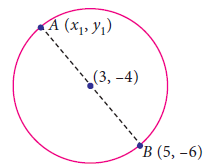
Therefore, the coordinates of A is (1, −2) .
23.
(x - 7)2 = ( x - 7) (x - 7)
(x - 7)2 = ( x + 7) (x + 7)
(x - 4)3 = (x - 4) (x - 4) = x(x - 3) - 4(x - 3) = (x - 3)(x - 4)
There is no common factor other than one.
Therefore, GCD = 1
24.
The order of the surds \(\sqrt [ 3 ]{ 5 } ,\sqrt [ 4 ]{ 7 } \) and \(\sqrt [ 2 ]{ 6 } \) 3, 4, 2 L.C.M of 3, 4, 2 = 12
\(\sqrt [ 3 ]{ 5 } ={ 5 }^{ \frac { 1 }{ 3 } }={ 5 }^{ \frac { 4 }{ 12 } }=\left( 625 \right) ^{ \frac { 1 }{ 12 } }\)
\(\sqrt [ 4 ]{ 7 } ={ 7 }^{ \frac { 1 }{ 4 } }=7^{ \frac { 3 }{ 12 } }=\left( 343 \right) ^{ \frac { 1 }{ 12 } }\)
\(\sqrt [ 2 ]{ 6 } ={ 6 }^{ \frac { 1 }{ 2 } }=7^{ \frac { 6 }{ 12 } }=\left( 46656 \right) ^{ \frac { 1 }{ 12 } }\)
The order of the surds \(\sqrt [ 3 ]{ 5 } ,\sqrt [ 4 ]{ 7 } ,\sqrt [ 2 ]{ 6 } \) is \(\left( 343 \right) ^{ \frac { 1 }{ 12 } }<\left( 625 \right) ^{ \frac { 1 }{ 12 } }<\left( 46656 \right) ^{ \frac { 1 }{ 12 } }\) that is \(\sqrt [ 4 ]{ 7 } <\sqrt [ 3 ]{ 5 } <\sqrt [ 2 ]{ 6 } \)
25.
11, 12,14,18, x+12, x+4, 30, 32, 35, 41
The number of values = 10,which is an even number
Median = Average of,\(\left( \cfrac { 10 }{ 2 } \right) ^{ th }\) and \(\left( \cfrac { 10 }{ 2 } +1 \right) ^{ th }\)
\(24=\cfrac{x+2+x+4}{2}\)
\(24=\cfrac { 2x+6 }{ 2 } =\cfrac { 2\left( x+3 \right) }{ 2 } \)
\(\therefore\) x+3 = 24
x = 24-3 = 21
26.
\(\frac { \sqrt { 7 } -2 }{ \sqrt { 7 } +2 } =a\sqrt{7}+b\)
L.H.S = \(\frac{\sqrt{7}-2\times\sqrt{7}-2}{\sqrt{7}+2\times\sqrt{7}-2}=\frac{(\sqrt{7}-2)^2}{\sqrt{7}^2-2^2}=\frac{\sqrt{7}^2-2\sqrt{7}\times2+2^2}{7-4}\)
=\(\frac{7-4\sqrt{7}+4}{3}=\frac{11-4\sqrt{7}}{3}=\frac{11}{3}-\frac{4\sqrt{7}}{3}\)
\(\frac{-4\sqrt{7}}{3}+\frac{11}{3}=a\sqrt{7}+b\)
a √7=\(\frac{-4\sqrt{7}}{3}\)
a = \(\frac{-4}{3}\)
b = \(\frac{11}{3}\)
27.
Let M be the set of students opting for Mathematics.
Let S be the set of students opting for Science.
n (M U S) = 40, n (M) = 26, n (S) = 24
n (M U S) = n (M) + n (S) - n (M ∩ S)
40 = 26 + 24 - n (M ∩ S)
n (M ∩ S) = 26 + 24 - 40
= 50 - 40 = 10
∴ Number of students opted for Mathematics and Science = 10
28.
Let A be the set of people owned car A
Let B be the set of people owned car B
n( A) = 400, n(B) = 200, n(A \(\cap\) B) = 50
n(A \(\cup\) B) = 500 .........(1)
n(A) + n(B) - n(A \(\cap\) B) = 400 + 200 - 50
= 600 - 50
= 550 ...........(2)
From (1) and (2) we get
\(n(A\cup B)\ne n(A) +n(B)-n(A\cap B)\)
\(\therefore\) The given data is incorrect.
29.
Let x = 0.00010001 ............. \(\rightarrow\) (1)
10000x = 1.00010001 .......... \(\rightarrow\) (2)
(2) - (1) \(\Rightarrow\) 10000x - x = 1.00010001 ......... (-)
0.00010001 .........
____________
9999x = 1
\(x=\frac{1}{9999}\)
30.
Let the point A be (a, a), B is (1, 3)
Distance AB = 10 (Given)
By distance formula \(\sqrt { (a-1)^{ 2 }+(a-3)^{ 2 } } =10\)
Simplifying
2a2- 8a + 10 = 100
a2- 4a - 45 = 0
(a - 9)(a + 5) = 0
⇒ a = -5 ; A = (-5,-5)
a = 9 ; A = (9,9)
31.
(a)
1000
32.
(b)
At least two outcomes
33.
(c)
1
34.
(b)
\(n\left( U \right) -n\left( A\cup B\cup C \right) \)
35.
(c)
0
36.
(d)
3
37.
(b)
13
38.
(d)
12.9
39.
(b)
10
40.
(a)
900°
41.
(a)
(0, -5)
42.
(b)
\(0.\overline { 714285 } \)
43.
(d)
50
44.
(d)
( +, –)
45.
The given system of equations are
3x − 4y = 10 \(\Rightarrow\) 3x − 4y −10 = 0 .....(1)
4x + 3y = 5 \(\Rightarrow\) 4x + 3y − 5 = 0 .....(2)
For the cross multiplication method, we write the coefficients as
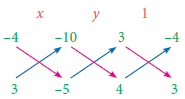
\(\frac { x }{ (-4)(-5)-(3)(-10) } =\frac { y }{ (-10)(4)-(-5)(3) } =\frac { 1 }{ (3)(3)-(4)(-4) } \)
\(\frac { x }{ (20)-(-30) } =\frac { y }{ (-40)-(-15) } =\frac { 1 }{ (9)-(-16) } \)
\(\frac { x }{ 20+30 } =\frac { y }{ -40+15 } =\frac { 1 }{ 9+16 } \)
\(\frac { x }{ 50 } =\frac { y }{ -25 } =\frac { 1 }{ 25 } \)
Therefore, we get \(x=\frac { 50 }{ 25 } ;y=\frac { -25 }{ 25 } \)
x = 2; y = -1
Thus the solution is x = 2, y = –1.
Verification:
3x–4y = 10 ...(1)
3(2)–4(–1) = 10
6 + 4 = 10
10 = 10 True
4x + 3y = 5 ...(2)
4(2) + 3(–1) = 5
8–3 = 5
5 = 5 True
46.
P (x) = 5x3 + 7x2 + 3x + 2
d(x) = 3x + 2
Standard form of p (x) = 5x3 + 7x2 + 3x + 2
and d (x) = 3x + 2
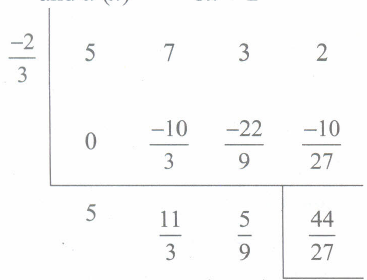
5x3 + 7x2 + 3x + 2 = \(\left( x+\cfrac { 2 }{ 3 } \right) \left( 5{ x }^{ 2 }-{ \cfrac { 11 }{ 3 } x+\cfrac { 5 }{ 9 } } \right) +\cfrac { 44 }{ 27 } =\left( \cfrac { 3x+2 }{ 3 } \right) \left( 5x2-\cfrac { 11 }{ 3 } x+\cfrac { 5 }{ 9 } \right) +\cfrac { 44 }{ 27 } \)
= \(\left( \cfrac { 3x+2 }{ 3 } \right) 3\left( \cfrac { 5 }{ 3 } { x }^{ 2 }-\cfrac { 11 }{ 9 } x+\cfrac { 5 }{ 27 } \right) +\cfrac { 44 }{ 27 } \)
= \(\left( 3x+2 \right) \left( \cfrac { 5 }{ 3 } { x }^{ 2 }-\cfrac { 11 }{ 9 } x+\cfrac { 5 }{ 27 } \right) +\cfrac { 44 }{ 27 } \)
Hence the quotient \(\cfrac { 5 }{ 3 } { x }^{ 2 }-\cfrac { 11 }{ 9 } x+\cfrac { 5 }{ 21 } \) and remainder IS \(\cfrac { 44 }{ 27 } \)

9th Standard Syllabus & Materials
9th Standard
TN 9th Tamil உள்ளத்தின் சீர் - திருக்குறள் Important Questions And Answers Study Material - QB365 Set A
NEW9th Standard
TN 9th Tamil உள்ளத்தின் சீர் - மணிமேகலை Important Questions And Answers Study Material - QB365 Set A
NEW9th Standard
TN 9th Tamil உள்ளத்தின் சீர் - ஏறு தழுவுதல் Important Questions And Answers Study Material - QB365 Set A
NEW9th Standard
TN 9th Tamil உயிருக்கு வேர் - தண்ணீர் Important Questions And Answers Study Material - QB365 Set A



Tamilnadu Stateboard 9th Standard Subjects
Tamilnadu Stateboard Standards





