
 100% FREE ACCESS
9th Standard Syllabus & Materials
9th Standard
TN 9th Tamil உள்ளத்தின் சீர் -கற்கண்டு (இலக்கணம்) - தொடர் இலக்கணம், ஆகுபெயர் Important Questions And Answers Study Material - QB365 Set A
NEW9th Standard
TN 9th Tamil உள்ளத்தின் சீர் -விரிவானம் (துணைப்பாடம்) - தாய்மைக்கு வறட்சி இல்லை! Important Questions And Answers Study Material - QB365 Set A
NEW9th Standard
TN 9th Tamil உள்ளத்தின் சீர் -கவிதை பேழை (செய்யுள்) - மார்கழி பெருவிழா Important Questions And Answers Study Material - QB365 Set A
NEW9th Standard
TN 9th Tamil உயிருக்கு வேர்-இலக்கணம் - பகுபத உறுப்பிலக்கணம் Important Questions And Answers Study Material - QB365 Set A
NEW9th Standard
TN 9th Tamil அமுதென்று பேர் - இலக்கணம்-எழுத்து -அளபெடை Important Questions And Answers Study Material - QB365 Set A
NEW9th Standard
TN 9th Tamil அமுதென்று பேர்-துணைப்பாடம் - ஆறாம்திணை Important Questions And Answers Study Material - QB365 Set A

Published on: 06/02/2020
9th Standard Maths Annual Exam Model Question Paper III - 2019 - 2020
Download Tamil Nadu 9th Standard Maths question papers, model tests, one-mark questions, important questions, and public exam papers in PDF format. Free study materials and answer keys for TN State Board students.
Questions + Answers key
Take MCQ Maths Test1.
Draw and locate the centroid of the triangle ABC where right angle at A, AB = 4cm and AC = 3cm
2.
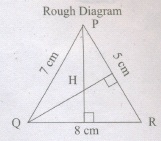
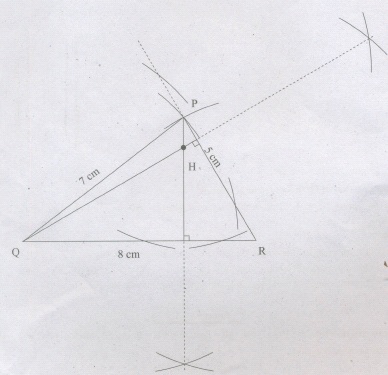
Draw ΔPQR with sides PQ = 7 cm, QR = 8 cm and PR = 5 cm and construct its Orthocentre.
3.
Find the value of sin 3x. sin 6x. sin 9x when x = 10°
4.
Find the volume of a cube whose surface are is a 96 cm2.
5.
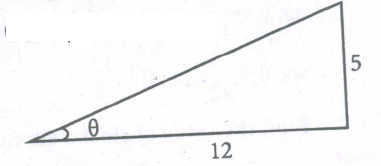
Find the six trigo'nometric ratios of the angle 0 using the diagram
6.
Find the coordinates of the point which divides, the line segment joining the point A (3,7) and B (-11, -2) in the ratio 5 : 1.
7.
If A (10, 11) and B (2 ,3) are the coordinates of end points of diameter of circle. Then find the centre of the circle.
8.
A manufacturer tested 7000 LED lights at random and found that 25 of them were defective. If a LED light is selected at random, what is the probability that the selected LED light is a defective one.
9.
A set of numbers consists of five 4’s, four 5’s, nine 6’s, and six 9’s. What is the mode.
10.
Factorise the following expressions: pr+qr+pq+p2
11.
The mass of the Earth is 5.97 \(\times\) 1024 kg and that of the Moon is 0.073 \(\times\) 1024 kg. What is their total mass?
12.
Write the following in the form of 5n
\(\sqrt{5}\)
13.
Without actual division classify the decimal expansion of the following numbers as terminating or non-terminating and recurring.
\(7\over 16\)
14.
If U = {a, b, c, d, e, f, g, h}, A = {b, d, f, h} and B = {a, d, e, h}, find the following sets. A′\(\cup \) B′
15.
Find the distance between the following pairs of points. (3,4) and (– 7, 2)
16.
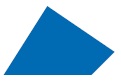
Which ones are not quadrilaterals?
17.
The perimeter of an equilateral triangle is 30 cm. The area is _______.
\(10\sqrt { 3 } \) cm2
\(12\sqrt { 3 } \) cm2
\(15\sqrt { 3 } \) cm2
\(25\sqrt { 3 } \) cm 2
18.
A number between 0 and 1 that is used to measure uncertainty is called _______.
Random variable
Trial
Simple event
Probability
19.
The value of 2tan30° tan60° is
1
2
\(2\sqrt { 3 } \)
6
20.
The linear equation in one variable is __________
2x + 2 = y
5x − 7 = 6 − 2x
2t(5 − t) = 0
7p − q = 0
21.
In what ratio does the y-axis divide the line joining the points (−5, 1) and (2, 3) internally ______.
1 : 3
2 : 5
3 : 1
5 : 2
22.
Rationalising the denominator \(\cfrac { 1 }{ \sqrt [ 3 ]{ 3 } } \) ___________
3
\(\cfrac { { 3 }^{ \frac { 2 }{ 3 } } }{ 3 } \)
\(\sqrt { 3 } \)
\(\sqrt [ 3 ]{ 3 } \)
23.
The perpendicular line from the centre of the circle to the chord divides the chord in the ratio________
1: 1
1: 2
2: 1
1: 3
24.
The mean of 5, 9, x, 17, and 21 is 13 then find the value of x ___________
9
13
17
21
25.
A particular observation which occurs maximum number of times in a given data is called its _______.
Frequency
range
mode
Median
26.
The length and breadth of a rectangular plot are 5 \(\times\) 105 and 4 \(\times\) 104 metres respectively. Its area is ______.
9 \(\times\) 101 m2
9 \(\times\) 109 m2
2 \(\times\) 1010 m2
20 \(\times\) 1020 m2
27.
The value of the polynomial f(x) = 6x - 3x2+9 when x = -1 is _____________________
0
1
2
3
28.
The set (A - B) U(B - A) is ___________
AΔB
AUB
A∩B
A'UB'
29.
The distance between the points (4, -1) and the origin is___________
\(\sqrt{24}\)
\(\sqrt{37}\)
\(\sqrt{26}\)
\(\sqrt{17}\)
30.
If U = {x | x ∈ N, x < 10} and A = {x | x ∈ N, 2 ≤ x < 6} then (A′)′ is –––––––––.
{1, 6, 7, 8, 9}
{1, 2, 3, 4}
{2, 3, 4, 5}
{ }
31.
The total surface area of a cube is 864 cm2. Find its volume
32.
Team I and Team II play 10 cricket matches each of 20 overs. Their total scores in each match are tabulated in the table as follows:
| Match numbers | 1 | 2 | 3 | 4 | 5 | 6 | 7 | 8 | 9 | 10 |
| Team I | 200 | 122 | 111 | 88 | 156 | 184 | 99 | 199 | 121 | 156 |
| Team II | 143 | 123 | 156 | 92 | 164 | 72 | 100 | 201 | 98 | 157 |
What is the relative frequency of Team I winning?
33.
If (x, 3), (6, y), (8, 2) and (9, 4) are the vertices of a parallelogram taken in order, then find the value of x and y.
34.
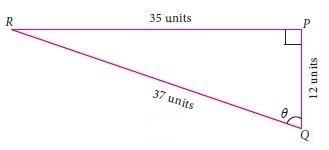
For the measures in the figure, compute sine, cosine and tangent ratios of the angle \(\theta \)
35.
Show that x+4 is a factor of x3 + 6x2 - 7x - 60
36.
Write in scientific notation ;(60000000)3
37.
The median of observation 11,12,14,18, x+12, x+4, 30, 32, 35, 41 arranged in ascending order is 24. Find the values of x.
38.
(i) Add 3\(\sqrt{7}\) and 5\(\sqrt{7}\) . Check whether the sum is rational or irrational.
(ii) Subtract 4\(\sqrt{5}\) from 7\(\sqrt{5}\) . Is the answer rational or irrational?
39.
If K = {a,b,d e f } L = {b,c,d,g} and M = {a,b,c,d,h}, then find the following:
(i) K \(\cup \)(L \(\cap \) M)
(ii) K \(\cap \)(L \(\cup \) M)
(iii) (K\(\cup \)L)\(\cap \)(K\(\cup \)M)
(iv) (K\(\cap \)L)\(\cup \)(K\(\cap \)M)
40.
Given that A = {1,3,5,7} B = {1,2,4,6,8}. Find
(i) AΔB and
(ii) BΔA
41.
Find quotient and the remainder when f(x) is divided by g(x) x4 – 3x3 + 5x2 – 7 is divided by x2 + x + 1
42.
Express the following decimal expression into rational numbers. \(2.\overline { 327 } \)
43.
Determine whether the given set of points in each case are collinear or not (a, –2), (a, 3), (a, 0)
44.
Find the quotient and remainder when 5x3 + 7x2 + 3x + 2 is divided by 3x + 2
45.
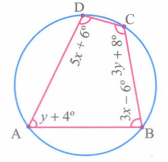
Find the angle of the given cyclic quadrilateral ABCD in the figure.
46.
Factorise the following:
(i) (p - q2) - 6(p - q) -16
(ii) m2 + 2mn - 24n2
(iii) \(\sqrt{5}a^2+2a-3\sqrt5\)
(iv) a4- 3a2+ 2
(iv) 8m3- 2m2n -15mn2
(v) \({1\over x^2}+{1\over y^2}+{2\over xy}\)
1.
In \(\triangle \)ABC,
AB = 4 cm, AC = 3 cm, \(\angle\)A = 90°
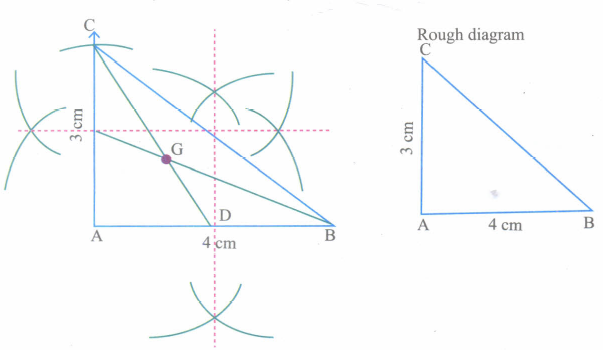
Construction :
Step 1: Draw \(\triangle \)ABC with AB = 4 cm, AC = 3 cm, \(\angle\)A = 90°
Step 2: Draw perpendicular bisectors of any two sides (AB and AC) to find the midpoints of AB and AC.
Step 3: Draw the medians CD and BE. Let them meet at G.
Step 4: G is the centroid of the given triangle.
2.
Steps for construction:
Step 1: Draw the ΔPQR with the given measurements.
Step 2: Construct altitudes from any two vertices P and Q to their opposite sides QR and PR respectively.
Step 3: The point of intersection of the altitude H is the orthocentre of the given ΔPQR.
3.
sin 3 (10°) sin 6 (10°) sin 9 (10°)
= \(\cfrac { 1 }{ 2 } \times \cfrac { \sqrt { 3 } }{ 2 } \times 1=\cfrac { \sqrt { 3 } }{4 } \)
4.
6a2 = 96 cm2
a2 =\(\frac { 96 }{ 6 } \)
a = 6
Volume = a3 = 63 = 36 \(\times\) 6 = 216 cm3.
5.
Hypotenuse = \(\sqrt { { 12 }^{ 2 }+{ 5 }^{ 2 } } \)
= \(\sqrt { 144+25\quad } =\sqrt { 69 } \)
= 13
\(sin\theta =\cfrac { 5 }{ 13 } ;cos\theta =\cfrac { 12 }{ 13 } ;tan\theta =\cfrac { 5 }{ 12 } ;
\)
\(cosec\theta =\cfrac { 13 }{ 5 } ;sec\theta =\cfrac { 13 }{ 12 } ;cot\theta =\cfrac { 12 }{ 3 } \)
6.
\((x,y)=\left( \frac { 3(1)+5(-11) }{ 5+1 } ,\frac { 1(7)+5(-2) }{ 6 } \right) \)
\(=\left( \frac { 3-55 }{ 6 } ,\frac { 7-10 }{ 6 } \right) =\left( \frac { -52 }{ 6 } ,\frac { -3 }{ 6 } \right) =\left( \frac { -26 }{ 3 } ,\frac { -1 }{ 2 } \right) \)
7.
Centre of the circle \(=\left( \frac { 10+2 }{ 2 } ,\frac { 11+3 }{ 2 } \right) =(6,7)\)
8.
n(S) = 7000
S - Total no. of lights.
n(A) = 25
A - Defective ones.
P(A) = \(\frac { n(A) }{ n(S) } =\frac { 25 }{ 7000 } =\frac { 1 }{ 280 } \).
9.
| Size of item | 4 | 5 | 6 | 9 |
|---|---|---|---|---|
| Frequency | 5 | 4 | 9 | 6 |
6 has the maximum frequency 9. Therefore 6 is the mode.
10.
pr+qr+pq+p2 = p(p+r)+q(p+r)
= (p+r)(p+q)
11.
Total mass = 5.97\(\times\) 1024 kg + 0.073 \(\times\) 1024 kg
= (5.97 + 0.073) \(\times\) 1024 kg
= 6.043 \(\times\) 1024 kg
12.
\({ 5 }^{ \frac { 1 }{ 2 } }\)
13.
\({7\over 16}={7\over 2^4}={7\over 2^4\times 5^6}\)
\(\therefore {7\over 16}\) has a terminating decimal expansion.
14.
A′\(\cup \) B′ = {a, c, e, g} \(\cup \) {b, c, f, g}
{a, b, c, e, f, g}
15.
Distance between the points (3,4) and (- 7, 2)

= \(\sqrt { ({ x }_{ 2 }-{ x }_{ 1 })^{ 2 }+({ y }_{ 2 }-{ y }_{ 1 })^{ 2 } } \)
= \(\sqrt { (-7-3)^{ 2 }+(2-4)^{ 2 } } =\sqrt { (-10)^{ 2 }+(-2)^{ 2 } } \)
= \(\sqrt { 100+4 } =\sqrt { 104 } =\sqrt { { 2 }^{ 2 }\times 2\times 13 } \)
= \(2\sqrt { 26 } \) units
16.
It is a quadrilateral
17.
(d)
\(25\sqrt { 3 } \) cm 2
18.
(d)
Probability
19.
(b)
2
20.
(b)
5x − 7 = 6 − 2x
21.
(d)
5 : 2
22.
(b)
\(\cfrac { { 3 }^{ \frac { 2 }{ 3 } } }{ 3 } \)
23.
(a)
1: 1
24.
(b)
13
25.
(c)
mode
26.
(c)
2 \(\times\) 1010 m2
27.
(a)
0
28.
(a)
AΔB
29.
(d)
\(\sqrt{17}\)
30.
(c)
{2, 3, 4, 5}
31.
Let ‘a’ be the side of the cube.
Given that, total surface area = 864 cm2
6a2= 864
a2 = \(\frac{864}{6}\)
a2 = 144
Therefore, side (a) = 12 cm
Now, volume of the cube = a3
= 123 = 12 ×12 ×12 = 1728 cm3
32.
In this experiment, each trial is a match where Team I faces Team II.
We are concerned about the winning status of Team I.
There are 10 trials in total; out of which Team I wins in the 1st, 6th and 9th matches.
The relative frequency of Team I winning the matches = \(\frac { 3 }{ 10 } \)or 0.3
33.
Let A(x, 3), B(6, y), C(8, 2) and D(9, 4) be the vertices of the parallelogram ABCD. By definition, diagonals AC and BD bisect each other.
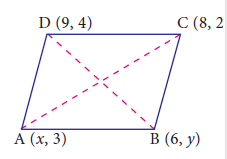
Mid-point of AC = Mid-point of BD
\(\left( \frac { x+8 }{ 2 } ,\frac { 3+2 }{ 2 } \right) =\left( \frac { 6+9 }{ 2 } ,\frac { y+4 }{ 2 } \right) \)
equating the coordinates on both sides, we get
\(\frac { x+8 }{ 2 } =\frac { 15 }{ 2 } \)
x + 8 = 15
x = 7
\(\frac { 5 }{ 2 } =\frac { y+4 }{ 2 } \)
5 = y + 4
y = 1
Hence, x = 7 and y = 1.
34.
In the given right angled triangle, note that for the given angle \(\theta \), PR is the ‘opposite’ side and PQ is the ‘adjacent’ side.
\(sin\theta =\frac { opposite\ side }{ hypotenuse } =\frac { PR }{ QR } =\frac { 35 }{ 37 } \)
\(cos\theta =\frac { adjacent\ side }{ hypotenuse } =\frac { PQ }{ QR } =\frac { 12 }{ 37 } \)
\(tan\theta =\frac { opposite\ side }{ adjacent\ side } =\frac { PR }{ PQ } =\frac { 35 }{ 12 } \)
It is enough to leave the ratios as fractions. In case, if you want to simplify each ratio neatly in a terminating decimal form, you may opt for it, but that is not obligatory.
35.
Let p (x) = x3 + 6x2 - 7x - 60
By factor theorem (x+4) is a factor of p(-4) = 0
p(-4) = (-4)3 + 6(-4)2 -7(-4) -60 = -64 + 96 + 28 - 60 = 0
Therefore,(x+4) is a factor of x3 + 6x2 + (-7x) -60
36.
(60000000)3 = \(\left(6.0 \times 10^{7}\right)^{4}=(6.04)^{4} \times\left(10^{7}\right)^{4}\)
\(
=1296 \times 10^{28}=1.296 \times 10^{3} \times 10^{28} \\
=1.296 \times 10^{31}
\)
37.
11, 12,14,18, x+12, x+4, 30, 32, 35, 41
The number of values = 10,which is an even number
Median = Average of,\(\left( \cfrac { 10 }{ 2 } \right) ^{ th }\) and \(\left( \cfrac { 10 }{ 2 } +1 \right) ^{ th }\)
\(24=\cfrac{x+2+x+4}{2}\)
\(24=\cfrac { 2x+6 }{ 2 } =\cfrac { 2\left( x+3 \right) }{ 2 } \)
\(\therefore\) x+3 = 24
x = 24-3 = 21
38.
(i) 3\(\sqrt{7}\) + 5\(\sqrt{7}\) = (3 + 5)\(\sqrt{7}\) = 8\(\sqrt{7}\). The answer is irrational.
(ii) 7\(\sqrt{5}\) - 4\(\sqrt{5}\) = (7 - 4)\(\sqrt{5}\) = 3\(\sqrt{5}\). The answer is irrational.
39.
K = {a,b,d,e,f}, L = {b,c,d,g} and M = {a,b,c,d,h}
(i) K\(\cup\)(L\(\cap \)M)
L\(\cap \) M = {b,c,d,g} \(\cap \) {a,b,c,d,h} = {b,c,d}
K\(\cup\)(L\(\cap \)M) = {a,b,d,e,f} \(\cup\) {b,c,d} = {a,b,c,d,e,f}
(ii) K∩(L\(\cup\)M)
L\(\cup\)M = {a,b,c,d,g,h}
K⋂(L \(\cup\) M) = {a,b,d,e,f) \(\cap \) {a,b,c,d,g,h} = {a,b,d}
(iii) (K \(\cup\) L) \(\cap \) (K\(\cup\)M)
K \(\cup\) L = {a,b,c,d,e,f,g}
K \(\cup\) M = {a,b,c,d,e,f,h}
(K \(\cup\) L) \(\cap \) (K \(\cup\) M) = {a,b,c,d,e,f}
(iv) (K \(\cap \) L) \(\cup\) (K \(\cap \) M)
(K \(\cap \) L) = {b,d}
(K \(\cap \) M) = {a,b,d}
(K \(\cap \) L) \(\cup\) (K \(\cap \) M) = {b,d} \(\cup\) {a,b,d} = {a,b,d}
40.
(i) A = {1,3,5,7} ; B = {1,2,4,6,8}
A-B = {1,3,5,7} - {1,2,4,6,8}
= {3,5,7}
B -A = {1,2,4,6, 8} - {1,3,5,7}
= {2,4,6,8}
AΔB = (A - B)U(B-A)
= {3,5,7} U {2,4,6,8}
= {2,3,4,5,6,7,8}.
(ii) BΔA = (B-A) U (A-B)
= {2,4,6,8} u {3,5,7}
= {2,3,4,5,6,7,8}
41.
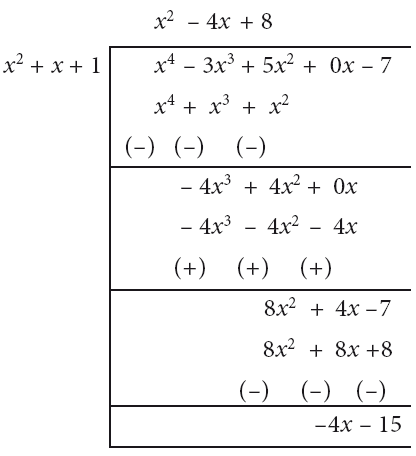
∴ Quotient = x2 – 4x + 8 and Remainder = –4x – 15
42.
Let \(2.\overline { 327 } \) = 2.327327327 ..... \(\rightarrow\) (1)
Here period of decimal is 3, multiply equation (1) by 1000
1000 x = 2327.327327 ..... \(\rightarrow\) (2)
(2) - (1) \(\Rightarrow\) 1000x - x = 999x = 2325
\(x=\frac{2325}{999}\) (or) \(775\over 333\)
43.

Distance AB = \(\sqrt { (a-a)^{ 2 }+(3+2)^{ 2 } } \)
= \(\sqrt { 0+{ 5 }^{ 2 } } =\sqrt { 25 } =5\)
BC = \(\sqrt { (a-a)^{ 2 }+(0-3)^{ 2 } } \)
= \(\sqrt { 0+9 } =\sqrt { 9 } =3\)
AC = \(\sqrt { (a-a)^{ 2 }+(0+2)^{ 2 } } \)
= \(\sqrt { 0+2^{ 2 } } =\sqrt { 4 } =2\)
AC + BC = AB ⇒ 2 + 3 = 5
∴ The given three points are collinear
44.
P (x) = 5x3 + 7x2 + 3x + 2
d(x) = 3x + 2
Standard form of p (x) = 5x3 + 7x2 + 3x + 2
and d (x) = 3x + 2
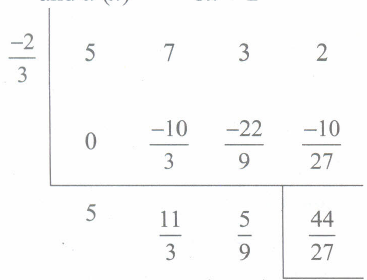
5x3 + 7x2 + 3x + 2 = \(\left( x+\cfrac { 2 }{ 3 } \right) \left( 5{ x }^{ 2 }-{ \cfrac { 11 }{ 3 } x+\cfrac { 5 }{ 9 } } \right) +\cfrac { 44 }{ 27 } =\left( \cfrac { 3x+2 }{ 3 } \right) \left( 5x2-\cfrac { 11 }{ 3 } x+\cfrac { 5 }{ 9 } \right) +\cfrac { 44 }{ 27 } \)
= \(\left( \cfrac { 3x+2 }{ 3 } \right) 3\left( \cfrac { 5 }{ 3 } { x }^{ 2 }-\cfrac { 11 }{ 9 } x+\cfrac { 5 }{ 27 } \right) +\cfrac { 44 }{ 27 } \)
= \(\left( 3x+2 \right) \left( \cfrac { 5 }{ 3 } { x }^{ 2 }-\cfrac { 11 }{ 9 } x+\cfrac { 5 }{ 27 } \right) +\cfrac { 44 }{ 27 } \)
Hence the quotient \(\cfrac { 5 }{ 3 } { x }^{ 2 }-\cfrac { 11 }{ 9 } x+\cfrac { 5 }{ 21 } \) and remainder IS \(\cfrac { 44 }{ 27 } \)
45.
\(\angle\)In the cyclic quadrilateral \(\angle\) A+\(\angle\)C = 180o
y + 4o + 3yo + 8o = 180o
4yo + 12o = 80o
4yo = 180o -12o = 168
y =\(\cfrac { 168 }{ 4 } \) = 42
\(\angle\)B + \(\angle\)D = 180o
8x + 12 = 180o
8x = 180o - 12o = 168
x = \(\cfrac { 168 }{ 8 } \) = 21o
\(\therefore\) \(\angle\)A = y + 4o = 42o + 4o = 46o
\(\angle\)C = 3y + 8 = 3 \(\times\) 42 + 8 = 126 + 8 = 134o
\(\angle\)B = 3x + 6 = 3 \(\times\) 21 + 6 = 63 + 6 = 69o
\(\angle\)D = 5x + 6 = 5 \(\times\) 21 + 6
= 105 + 6 = 111o
46.
(i) (p-q)2- 6(p - q) -16
= (p - q)2- 8(p - q) +2(p - q) -16
= (p - q)((p - q) -8)+2((p - q)-8)
= (p - q - 8)(p - q + 2)

(ii) m2+ 2mn - 24n2
= m2+ 6mn - 4mn - 24n2
= m(m + 6n) - 4n(m + 6n)
= (m + 6n)(m - 4n)

(iii) √5a2+2a-3√5
=√5a2+2a-3√5
=√5a(a+√5)-3(a+√5)
=(a+√5)(√5a-3)

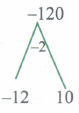
(iv) a4- 3a2+2
= a4-2a2-1a2+2
= a2(a2-2)-1(a2-2)
= (a2-2)(a2-1)=(a2-2)(a+1)(a-1)

(v) 8m3-2m2n-15mn2
= m(8m2-2mn-15n2)
= m(8m2-12mn+10mn-15n2)
= m(4m(2m-3n)+5n(2m-3n))
= m(4m+5n)(2m-3n)
(vi) \(\frac{1}{x^2}+\frac{1}{y^2}+\frac{2}{xy}\)
=\((\frac{1}{x})^2+2(\frac{1}{x})(\frac{1}{y})+(\frac{1}{y})^2\)
=\(\left({1\over x}+{1\over y}\right)^2\)

9th Standard Syllabus & Materials
9th Standard
TN 9th Tamil உள்ளத்தின் சீர் - திருக்குறள் Important Questions And Answers Study Material - QB365 Set A
NEW9th Standard
TN 9th Tamil உள்ளத்தின் சீர் - மணிமேகலை Important Questions And Answers Study Material - QB365 Set A
NEW9th Standard
TN 9th Tamil உள்ளத்தின் சீர் - ஏறு தழுவுதல் Important Questions And Answers Study Material - QB365 Set A
NEW9th Standard
TN 9th Tamil உயிருக்கு வேர் - தண்ணீர் Important Questions And Answers Study Material - QB365 Set A



Tamilnadu Stateboard 9th Standard Subjects
Tamilnadu Stateboard Standards





