
 100% FREE ACCESS
9th Standard Syllabus & Materials
9th Standard
TN 9th Tamil உள்ளத்தின் சீர் -கற்கண்டு (இலக்கணம்) - தொடர் இலக்கணம், ஆகுபெயர் Important Questions And Answers Study Material - QB365 Set A
NEW9th Standard
TN 9th Tamil உள்ளத்தின் சீர் -விரிவானம் (துணைப்பாடம்) - தாய்மைக்கு வறட்சி இல்லை! Important Questions And Answers Study Material - QB365 Set A
NEW9th Standard
TN 9th Tamil உள்ளத்தின் சீர் -கவிதை பேழை (செய்யுள்) - மார்கழி பெருவிழா Important Questions And Answers Study Material - QB365 Set A
NEW9th Standard
TN 9th Tamil உயிருக்கு வேர்-இலக்கணம் - பகுபத உறுப்பிலக்கணம் Important Questions And Answers Study Material - QB365 Set A
NEW9th Standard
TN 9th Tamil அமுதென்று பேர் - இலக்கணம்-எழுத்து -அளபெடை Important Questions And Answers Study Material - QB365 Set A
NEW9th Standard
TN 9th Tamil அமுதென்று பேர்-துணைப்பாடம் - ஆறாம்திணை Important Questions And Answers Study Material - QB365 Set A

Published on: 06/02/2020
9th Standard Maths Annual Exam Model Question Paper IV - 2019 - 2020
Download Tamil Nadu 9th Standard Maths question papers, model tests, one-mark questions, important questions, and public exam papers in PDF format. Free study materials and answer keys for TN State Board students.
Questions + Answers key
Take MCQ Maths Test1.
Team I and Team II play 10 cricket matches each of 20 overs. Their total scores in each match are tabulated in the table as follows:
| Match numbers | 1 | 2 | 3 | 4 | 5 | 6 | 7 | 8 | 9 | 10 |
| Team I | 200 | 122 | 111 | 88 | 156 | 184 | 99 | 199 | 121 | 156 |
| Team II | 143 | 123 | 156 | 92 | 164 | 72 | 100 | 201 | 98 | 157 |
What is the relative frequency of Team I winning?
2.
Find the value of cos19059'
3.
The sides of a triangular park are in the ratio 9:10:11 and its perimeter is 300 m. Find the area of the triangular park.
4.
Expand the following using identities (4a + 3b) (4a - 3b)
5.
Write in scientific notation ;(60000000)3
6.
The median of observation 11,12,14,18, x+12, x+4, 30, 32, 35, 41 arranged in ascending order is 24. Find the values of x.
7.
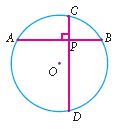
In the given figure, ㄥCAB = 25°, find ㄥBDC, ㄥDBA and ㄥCOB
8.
Can you reduce the following numbers to surds of same order :
(i) \(\sqrt{3}\)
(ii) \(\sqrt [ 4 ]{ 3 } \)
(iii) \(\sqrt [ 3 ]{ 3 } \)
9.
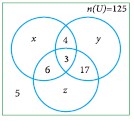
In the adjacent diagram, if n(U) = 125, y is two times of x and z is 10 more than x, then find the value of x,y and z.
10.
Write the following polynomials in standard form.
| S.No | Polynomial | Standard form |
|---|---|---|
| 1 | 5m4 -3m + 7m2 + 8 | |
| 2 | \(\frac { 2 }{ 3 } y+{ 8y }^{ 3 }-12+\sqrt { 5 } { y }^{ 2 }\) | |
| 3 | 12p2 -8p5 -10p4 -7 |
11.
Given that A = {1,3,5,7} B = {1,2,4,6,8}. Find
(i) AΔB and
(ii) BΔA
12.
Show that the following points taken in order form an equilateral triangle in each case \(A\left( 2,2 \right) ,B\left( -2,-2 \right) ,C\left( -2\sqrt { 3 } ,2\sqrt { 3 } \right) \)
13.
Express the following decimal expression into rational numbers \(3.1\overline { 7 } \)
14.
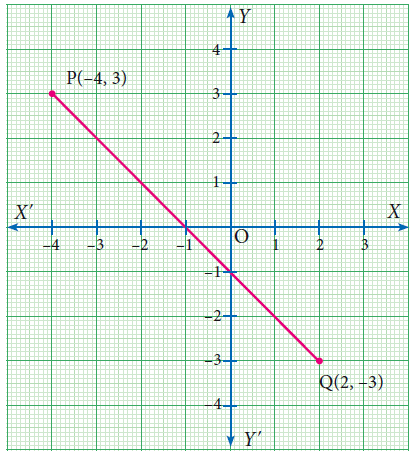
Find the distance between the points (–4, 3), (2, –3).
15.
Find the value of \(\frac{\tan 25^{\circ}}{\cot 65^{\circ}}+\frac{\sin 40^{\circ}}{\cos 50^{\circ}}\)
16.
If 3 (tan \(\theta\)) + 4 (sec \(\theta\) \(\times\) sin 6) = 24. Then find all the trigonometric ratios of the angle \(\theta\)
17.
Find the TSA and LSA of a cuboid whose length, breadth and height are 10 cm, 12 cm and 14 cm respectively.
18.
If the centroid of a triangle is at (10, -1) and two vertices are (3, 2) and (5, -11). Find the third vertex of a triangle.
19.
Find the centroid of the triangle whose vertices are (2, -5), (5, 11) and (9, 9)
20.
In a survey of 400 youngsters aged 16-20 years, it was found that 191 have their voter ID card. If a youngster is selected at random, find the probability that the youngster does not have their voter ID card.
21.
Find any 3 irrational numbers between 0.12 and 0.13.
22.
Use a fractional index to write \(\sqrt [ 3 ]{ 7 } \)
23.
In a rice mill, seven labours are receiving the daily wages of Rs. 500, Rs. 600, Rs. 600, Rs. 800, Rs. 800, Rs. 800 and Rs. 1000, find the modal wage
24.
Expand the following using identities: (2x - 3b)2
25.
Express the following in the form 2n:
\(\frac{1}{4}\)
26.
Identify the following sets as null set or singleton set.
B = The set of all even natural numbers which are not divisible by 2
27.
Plot the following points in the coordinate plane and join them. What is your conclusion about the resulting figure?
(0, –4) (0, –2) (0, 4) (0, 5)
28.
The lateral surface area of a cube of side 12 cm is _______.
144 cm2
196 cm2
576 cm2
664 cm2
29.
The probability of an event cannot be _______.
Equal to zero
Greater than zero
Equal to one
Less than zero
30.
If sin 300 = x and cos 600 = y, then x2 + y2 is________.
\(\frac { 1 }{ 2 } \)
0
sin90°
cos90°
31.
If U = {x : x\(\in \)W and x < 20}, A = {2,4,6,8}, B = {6,8,12,14} then\(\left[ n\left( A\cup B^{ ' } \right) \right] \)
15%
20%
10%
5%
32.
Which of the following is not an irrational number?
\(\sqrt { 2 } \)
\(\sqrt { 5 } \)
\(\sqrt { 3 } \)
\(\sqrt { 25 } \)
33.
If the mean of five observations x, x+2, x+4, x+6, x+8, is 11, then the mean of first three observations is __________
9
11
13
15
34.
The mean of the first 10 prime numbers is ___________
12.6
12.7
12.8
12.9
35.
The value of the polynomial f(x) = 6x - 3x2+9 when x = -1 is _____________________
0
1
2
3
36.
What is the name of a regular polygon of six sides?
Square
Equilateral triangle
Regular hexagon
Regular octagon
37.
A point on the y-axis is ________________
(1, 1)
(6,0)
(0,6)
(-1, -1)
38.
Which one of the following is an irrational number.
\(\sqrt { 25 } \)
\(\sqrt { \frac { 9 }{ 4 } } \)
\(\frac { 7 }{ 11 } \)
\(\pi\)
39.
The type of the polynomial 4–3x3 is ________.
constant polynomial
linear polynomial
quadratic polynomial
cubic polynomial.
40.
Point (0, –7) lies ________
on the x-axis
in the II quadrant
on the y-axis
in the IV quadrant
41.
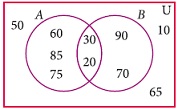
From the adjacent diagram n[P(AΔB)] is ________.
8
16
32
64
42.
Prove that x -1 is a factor of x5 - 45x4 + 36x3 + 45x2 - 36x-1
43.
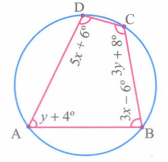
Find the angle of the given cyclic quadrilateral ABCD in the figure.
44.
Verify x3+y3+z3-3xyz = \(\frac{1}{2}\)[x+y+z][(x-y)2+(y-z)2+(z-x)2]
45.
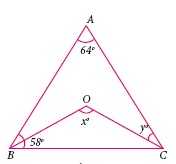
In the given Fig, ∠A = 64° , ∠ABC = 58°. If BO and CO are the bisectors of ∠ABC and ∠ACB respectively of ΔABC, find x° and y°.
46.
Draw a right triangle whose hypotenuse is 10 cm and one of the legs is 8 cm. Locate its incentre and also draw the incircle.
1.
In this experiment, each trial is a match where Team I faces Team II.
We are concerned about the winning status of Team I.
There are 10 trials in total; out of which Team I wins in the 1st, 6th and 9th matches.
The relative frequency of Team I winning the matches = \(\frac { 3 }{ 10 } \)or 0.3
2.
| 0' | 6' | 12' | 18' | 24' | 30' | 36' | 42' | 48' | 54' | Mean Difference | |||||
| 0.00 | 0.10 | 0.20 | 0.30 | 0.40 | 0.50 | 0.60 | 0.70 | 0.80 | 0.90 | 1 | 2 | 3 | 4 | 5 | |
| 190 | 0.9403 | 5 | |||||||||||||
write 19059' = 19054' + 5'
From the table we have, cos19054' = 0.9403

3.
Given the sides are in the ratio 9:10:11, let the sides be 9k, 10k, 11k
The perimeter of the triangular park = 300 m
9k +10k +11k = 300 m
30k = 300
k = 10 m
Therefore, the sides are a = 90 m, b = 100 m, c = 110 m
s=\(\frac{1+b+c}{2}=\frac{90+100+110}{2}=\frac{300}{2}\)= 150 m
Hence, Area of triangular park = \(\sqrt { s(s-a)(s-b)(s-c) } \)
= \(\sqrt { 150\times (150-90)(150-100)(150-110) } \)
= \(\sqrt { 150\times 60\times 50\times 40 } \)
= \(\sqrt { 3\times 50\times 20\times 3\times 50\times 2\times 20 } \)
= 50 \(\times\) 20 \(\times\) 3\(\sqrt{2}\)
= 3000 \(\times\)1.414 = 4242 m2
4.
(4a+3b) (4a-3b) = (4a)2 - (3b)2 = 16a2 - 9b2 [We have (a+b)(a-b) = a2 - b2] Put [a = 4a, b = 3b]
5.
(60000000)3 = \(\left(6.0 \times 10^{7}\right)^{4}=(6.04)^{4} \times\left(10^{7}\right)^{4}\)
\(
=1296 \times 10^{28}=1.296 \times 10^{3} \times 10^{28} \\
=1.296 \times 10^{31}
\)
6.
11, 12,14,18, x+12, x+4, 30, 32, 35, 41
The number of values = 10,which is an even number
Median = Average of,\(\left( \cfrac { 10 }{ 2 } \right) ^{ th }\) and \(\left( \cfrac { 10 }{ 2 } +1 \right) ^{ th }\)
\(24=\cfrac{x+2+x+4}{2}\)
\(24=\cfrac { 2x+6 }{ 2 } =\cfrac { 2\left( x+3 \right) }{ 2 } \)
\(\therefore\) x+3 = 24
x = 24-3 = 21
7.
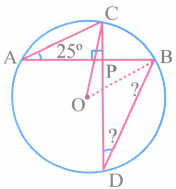
(i)\(\angle\)CAB = 250
\(\therefore\) \(\angle\)BDC = 250
(ii) \(\angle\)DBA = \(\angle\)DCA =180-(90+250)
= 1800 - 1150
= 65
(iii)\(\angle\)COB = 2\(\angle\)CAB = 2\(\times\)250 = 500
8.
(i) \( \sqrt{3} =3^{\frac{1}{2}} =3^{\frac{6}{12}} =\sqrt[12]{3^{6}} =\sqrt[12]{729} \)
(ii) \( \sqrt[4]{3} =3^{\frac{1}{4}} =3^{\frac{3}{12}} =\sqrt[12]{3^{3}} =\sqrt[12]{27} \)
(iii) \( \sqrt[3]{3} =3^{\frac{1}{3}} =3^{\frac{4}{12}} =\sqrt[12]{3^{4}} =\sqrt[12]{81} \)
The last row has surds of same order.
9.
n(U) = 125
y = 2x
z = x + 10
ஃ x + y + z + 4 + 17 + 6 + 3 + 5 = 125
x + 2x + x + 10 + 35 = 125
4x + 45 = 125
4x = 125 - 45
4x = 80
x = 20
ஃ y = 2x = 2 \(\times\) 20 = 40
z = x +10 = 20 + 10 = 30
Hence x = 20; y = 40; z = 30
10.
| S.No | Polynomial | Standard form |
|---|---|---|
| 1 | 5m4 -3m + 7m2 + 8 | 5m4+7m2-3m +8 |
| 2 | \(\frac { 2 }{ 3 } y+{ 8y }^{ 3 }-12+\sqrt { 5 } { y }^{ 2 }\) | \({ 8y }^{ 3 }+\sqrt { 5 } { y }^{ 2 }+\frac { 2 }{ 3 } y-12\) |
| 3 | 12p2 -8p5 -10p4 -7 | -8p5-10p4 + 12p2- 7 |
11.
(i) A = {1,3,5,7} ; B = {1,2,4,6,8}
A-B = {1,3,5,7} - {1,2,4,6,8}
= {3,5,7}
B -A = {1,2,4,6, 8} - {1,3,5,7}
= {2,4,6,8}
AΔB = (A - B)U(B-A)
= {3,5,7} U {2,4,6,8}
= {2,3,4,5,6,7,8}.
(ii) BΔA = (B-A) U (A-B)
= {2,4,6,8} u {3,5,7}
= {2,3,4,5,6,7,8}
12.
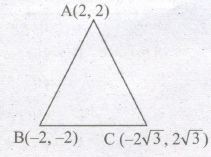
Distance = \(\sqrt { ({ x }_{ 2 }-{ x }_{ 1 })^{ 2 }+(y_{ 2 }-y_{ 1 })^{ 2 } } \)
AB= \(\sqrt { (-2-2)^{ 2 }+(-2-2)^{ 2 } } \)
= \(\sqrt { (-4)^{ 2 }+(-4)^{ 2 } } =\sqrt { 16+16 } =\sqrt { 32 } \)
BC = \(\sqrt { (-2\sqrt { 3 } +2)^{ 2 }+(2\sqrt { 3 } +2)^{ 2 } } \)
= \(\sqrt { 12+4-8\sqrt { 3 } +12+4+8\sqrt { 3 } } \)
= \(\sqrt { 16+16 } =\sqrt { 32 } \)
AC = \(\sqrt { (-2\sqrt { 3 } -2)^{ 2 }+(2\sqrt { 3 } -2)^{ 2 } } \)
= \(\sqrt { 2(\sqrt { 3 } +2)^{ 2 }+2(\sqrt { 3 } -2)^{ 2 } } \)
= \(\sqrt { 12+4+8\sqrt { 3 } +12+4-8\sqrt { 3 } } \)
= \(\sqrt { 16+16 } =\sqrt { 32 } \)
AB = BC = AC (Three sides are equal)
∴ ABC is an equilateral triangle.
13.
Let x = \(3.1\overline { 7 } \) = 3.1777 ....... (1)
Here period of decimal is 2, multiply equation (1) by 100
100x = 31.777 ......... (2)
(2)-(1)
.JPG)
\( =\frac{143}{45} \)
14.
The distance between the points (-4, 3), (2, -3) is
\(d=\sqrt { \left( { x }_{ 2 }-{ x }_{ 1 } \right) ^{ 2 }+\left( y_{ 2 }-y_{ 1 } \right) ^{ 2 } } \)
\(=\sqrt { \left( 2+4 \right) ^{ 2 }+\left( -3-3 \right) ^{ 2 } } \)
\(=\sqrt { \left( { 6 }^{ 2 }+\left( -6 \right) ^{ 2 } \right) } =\sqrt { \left( 36+36 \right) } \)
\(=\sqrt { 36\times 2 } \)
\(=6\sqrt { 2 } \)
15.
\( \frac{\tan 25^{\circ}}{\cot 65^{\circ}}+\frac{\sin 40^{\circ}}{\cos 50^{\circ}} \)
\(= \frac{\tan \left(90^{\circ}-65^{\circ}\right)}{\cot 65^{\circ}}+\frac{\sin \left(90^{\circ}-50^{\circ}\right)}{\cos 50^{\circ}} \)
\(= \frac{\cot 65^{\circ}}{\cot 65^{\circ}}+\frac{\cos 50^{\circ}}{\cos 50^{\circ}}=1+1=2 \)
16.
3 tan \(\theta\) + 4 (sec \(\theta\) \(\times\) sin\(\theta\)) = 24
\(3tan\theta +4\left( \cfrac { 1 }{ cos\theta } \times sin\theta \right) =24\)
7 tan \(\theta\) = 24
\(tan\theta =\cfrac { 24 }{ 7 } \)
hypetenuse = \(\sqrt { { 24 }^{ 2 }+49 } =\sqrt { 576+49 } =\sqrt { 625 } =25\)
\(sin\theta =\cfrac { 24 }{ 25 } ;cos\theta =\cfrac { 7 }{ 25 } ;cosec\theta =\cfrac { 25 }{ 24 } ;sec\theta =\cfrac { 25 }{ 27 } ;cot\theta =\cfrac { 7 }{ 24 } \)
17.
TSA = 2 (lb + bh + lh)
= 2 (10 \(\times\)12 + 12 \(\times\) 14 +10 \(\times\) 14)
= 2 (120 + 168 + 140)
= 856 cm2
LSA = 2 (bh + lh)
= 2 (12 \(\times\) 14 + 10 \(\times\) 14)
= 2 (168 + 140)
= 2 (308) = 616 cm2.
18.
\((10,-1)=\left( \frac { 3+5+x }{ 3 } ,\frac { 2-11+y }{ 3 } \right) \)
\(10=\frac { 3+5+x }{ 3 } ,\)
30 = 3 + 5 + x
22 = x
\(-1=\frac { 2-11+y }{ 3 } \)
-3 = 2 - 11 + y
-3 + 9 = y
y = 6
(22, 6)
19.
\(G\left( \frac { { x }_{ 1 }+{ x }_{ 2 }+{ x }_{ 3 } }{ 3 } ,\frac { { y }_{ 1 }+{ y }_{ 2 }+{ y }_{ 3 } }{ 3 } \right) =\left( \frac { 2+5+9 }{ 3 } ,\frac { -5+11+9 }{ 9 } \right) =\left( \frac { 16 }{ 3 } ,5 \right) \)
20.
No. of youngsters = 400
n(S)
No. of youngsters having voter id = 191
n(A)
No. of youngsters do not have their voter id
n(B) = 400 - 191 = 209
P(B) = \(\frac { n(B) }{ n(S) } =\frac { 209 }{ 400 } \).
21.
Three irrational numbers between 0.12 and 0.13 are 0.12010010001…, 0.12040040004…, 0.12070070007…
22.
\(\sqrt [ 3 ]{ 7 } \) = \({ 7 }^{ \cfrac { 1 }{ 3 } }\)
23.
In the given data Rs. 800 occurs thrice. Hence the mode is Rs. 800
24.
(2x - 3b)2 [we have (a - b)2 = a2- 2ab + b2]
(2a - 3b)2= (2a)2-2(2a)(3b)+(3b)2 put [a = 2a, b = 3b]
= 4a2-12ab + 9b2
25.
\(\frac { 1 }{ 4 } =\frac { 1 }{ 2\times 2 } =\frac { 1 }{ { 2 }^{ 2 } } \) = 2-2
26.
The set B is a Null set
27.
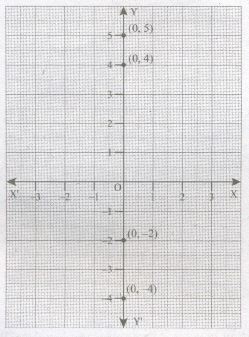
The line is on the y - axis
28.
(c)
576 cm2
29.
(d)
Less than zero
30.
(a)
\(\frac { 1 }{ 2 } \)
31.
(b)
20%
32.
(d)
\(\sqrt { 25 } \)
33.
(a)
9
34.
(d)
12.9
35.
(a)
0
36.
(c)
Regular hexagon
37.
(c)
(0,6)
38.
(d)
\(\pi\)
39.
(d)
cubic polynomial.
40.
(c)
on the y-axis
41.
(c)
32
42.
Let p (x) x5 - 45x4 + 36x3 + 45x2 - 36x- 1
Sum of co-efficients = 1 - 45 + 36 + 45 - 36 - 1 = 0
Thus x -1 is a factor of p (x)
43.
\(\angle\)In the cyclic quadrilateral \(\angle\) A+\(\angle\)C = 180o
y + 4o + 3yo + 8o = 180o
4yo + 12o = 80o
4yo = 180o -12o = 168
y =\(\cfrac { 168 }{ 4 } \) = 42
\(\angle\)B + \(\angle\)D = 180o
8x + 12 = 180o
8x = 180o - 12o = 168
x = \(\cfrac { 168 }{ 8 } \) = 21o
\(\therefore\) \(\angle\)A = y + 4o = 42o + 4o = 46o
\(\angle\)C = 3y + 8 = 3 \(\times\) 42 + 8 = 126 + 8 = 134o
\(\angle\)B = 3x + 6 = 3 \(\times\) 21 + 6 = 63 + 6 = 69o
\(\angle\)D = 5x + 6 = 5 \(\times\) 21 + 6
= 105 + 6 = 111o
44.
R.H.S = \(\frac{1}{2}(x+y+z)[(x-y)^2+(y-z)^2+(z-x)^2]\)
= \(\frac{1}{2}(x+y+z)[x^2-2xy+y^2+y^2-2yz+z^2-2zx+x^2]\)
= \(\frac{1}{2}[(x+y+z)[2x^2+2y^2+2z^2-2xy-2yz-2zx^2]]\)
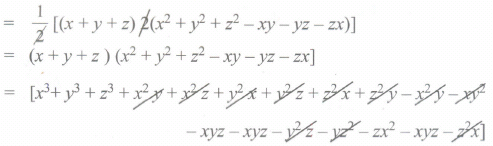
= x3+y3+z3-3xyz = L.H.S
Hence it is verified.
45.
In the given \(\triangle ABC\)
\(\angle A=64^0\ and\ \angle B=58^0\)
\(\angle C=180^0-(64^0+58^0)\)
= 180° - 122°
= 58°
Since OC is the bisector of \(\angle C\)
\(y=\frac{58^0}{2}=29^0\)
Given \(\triangle OBC\)
\(\angle OBC=\frac{58^0}{2}=29^0\)
\(\angle OCB=29^0\)
\(\therefore\angle BOC=180^0-(29^0+29^0)\)
x = 180° - 58°
x = 122°
\(\angle x=122^0\ and\ \angle y=29^0\).
46.
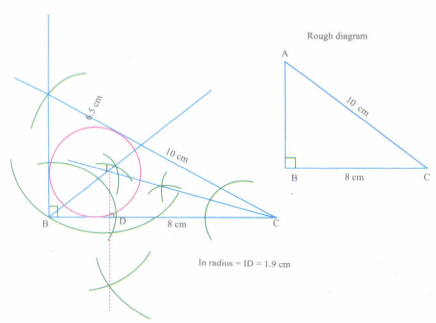
Construction :
Step 1: Draw \(\triangle \)ABC with BC = 8 cm. AC = 10 cm with right angle at B.
Step 2: Construct angle bisectors of any two angles (B and C) and let them meet at I. I is the incentre.
Step 3: Draw perpendicular from I to any side of the triangle to meet BC at D.
Step 4: With I as centre, ID as radius draw the incircle, which touches all the three sides of the triangle internally. Inradius = 1.9 cm.

9th Standard Syllabus & Materials
9th Standard
TN 9th Tamil உள்ளத்தின் சீர் - திருக்குறள் Important Questions And Answers Study Material - QB365 Set A
NEW9th Standard
TN 9th Tamil உள்ளத்தின் சீர் - மணிமேகலை Important Questions And Answers Study Material - QB365 Set A
NEW9th Standard
TN 9th Tamil உள்ளத்தின் சீர் - ஏறு தழுவுதல் Important Questions And Answers Study Material - QB365 Set A
NEW9th Standard
TN 9th Tamil உயிருக்கு வேர் - தண்ணீர் Important Questions And Answers Study Material - QB365 Set A



Tamilnadu Stateboard 9th Standard Subjects
Tamilnadu Stateboard Standards





