 100% FREE ACCESS
9th Standard Syllabus & Materials
9th Standard
TN 9th Tamil உள்ளத்தின் சீர் -கற்கண்டு (இலக்கணம்) - தொடர் இலக்கணம், ஆகுபெயர் Important Questions And Answers Study Material - QB365 Set A
NEW9th Standard
TN 9th Tamil உள்ளத்தின் சீர் -விரிவானம் (துணைப்பாடம்) - தாய்மைக்கு வறட்சி இல்லை! Important Questions And Answers Study Material - QB365 Set A
NEW9th Standard
TN 9th Tamil உள்ளத்தின் சீர் -கவிதை பேழை (செய்யுள்) - மார்கழி பெருவிழா Important Questions And Answers Study Material - QB365 Set A
NEW9th Standard
TN 9th Tamil உயிருக்கு வேர்-இலக்கணம் - பகுபத உறுப்பிலக்கணம் Important Questions And Answers Study Material - QB365 Set A
NEW9th Standard
TN 9th Tamil அமுதென்று பேர் - இலக்கணம்-எழுத்து -அளபெடை Important Questions And Answers Study Material - QB365 Set A
NEW9th Standard
TN 9th Tamil அமுதென்று பேர்-துணைப்பாடம் - ஆறாம்திணை Important Questions And Answers Study Material - QB365 Set A

Published on: 25/07/2019
Real Numbers
Download Tamil Nadu 9th Standard Maths question papers, model tests, one-mark questions, important questions, and public exam papers in PDF format. Free study materials and answer keys for TN State Board students.
Questions + Answers key
Take MCQ Maths Test1.
Show that \(\sqrt [ 3 ]{ 2 } >\sqrt [ 5 ]{ 3 } \)
2.
Find the decimal expansion of \(\sqrt { 3 } \)
3.
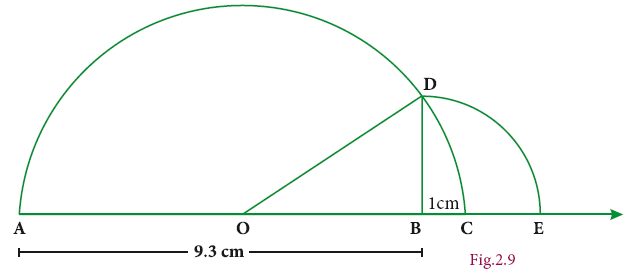
Represent \(\sqrt { 9.3 } \) on a number line
4.
Find any three rational numbers between \(\frac { 1 }{ 2 } \) and \(\frac { 1 }{ 5 } \)
5.
Find any two irrational numbers between\(\frac { 6 }{ 7 } \) and \(\frac { 12 }{ 13 } \)
6.
The decimal form of -\(\frac { 3 }{ 4 } \) is_______________
- 0.75
- 0.50
-0.25
- 0.125
7.
\(0.\overline { 34 } +0.3\bar { 4 } \) = ________.
\(0.6\overline { 87 } \)
\(0.\overline { 68 } \)
\(0.6\bar { 8 } \)
\(0.68\bar { 7 } \)
8.
The value of \(0.\bar { 23 } +0.\bar { 22 } \) is ____________
\(0.\bar { 43 } \)
0.45
\(0.4\bar { 5 } \)
\(0.\bar { 45 } \)
9.
An irrational number between 2 and 2.5 is ________.
\(\sqrt { 11 } \)
\(\sqrt { 5 } \)
\(\sqrt { 2.5 } \)
\(\sqrt { 8 } \)
10.
Which one of the following, regarding sum of two irrational numbers, is true?
always an irrational number
may be a rational or irrational number
always a rational number
always an integer.
11.
If n is a natural number then \(\sqrt { n } \) is ________.
always a natural number
always an irrational number
always a rational number
may be rational or irrational
12.
Divide \(15\sqrt { 12 } \) by \(3\sqrt { 3 } \) the result is ___________.
13.
The rational number equivalent to \(\frac { 5 }{ 9 } \) such that its numerator is 25 is____________ .
14.
If \(\sqrt { 10 } \)= 3.1622, then the value of is \(\frac { 1 }{ \sqrt { 10 } } \) is_________.
15.
The value of \(\left[ \sqrt { { x }^{ 3 } } \right] ^{2/3}\) is
16.
The value of \(3\sqrt { 3 } +\sqrt { 3 } \) is ______________.
17.
Find any 4 irrational numbers between \(\frac { 1 }{ 4 } \) and \(\frac { 1 }{ 3 } \)
18.
We used to write \(\pi\) as \(\frac{22}{7}.\) Can we say \(\pi\) is a rational number?
19.
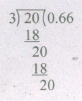
Convert the following rational numbers into decimal
(i) \(2\over 3\)
(ii) \(47\over 99\)
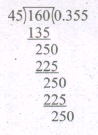
(iii) \(-{16\over 45}\)
20.
Convert the following decimal numbers in the form of \(\frac { p }{ q } (p,q\in Z\ and\ q\neq 0)\)
(i) \(0.\overline { 3 } \)
(ii) \(2.\overline { 124 } \)
(iii) \(0.4\overline { 5 } \)
(iv) \(0.5\overline { 68 } \)
21.
Represent the following as decimal form
(i) \(\frac { -4 }{ 11 } \)
(ii) \(\frac { 11 }{ 75 } \)
22.
Find any three rational numbers between \(\frac { -7 }{ 11 } \)and \(\frac { 2 }{ 11 } \)
23.
Find the value of \({ 625 }^{ \frac { 3 }{ 4 } }\)
24.
Evaluate : 10 -4
25.
Find three different irrational numbers between the rational numbers \(\frac { 5 }{ 7 } \) and \(\frac { 9 }{ 11 } \)
26.
Express the following in the form \({p\over q},\) where p and q are integers and q \(\ne\) 0.
\(0.\overline {47}\)
1.
\(\sqrt [ 3 ]{ 2 } =\sqrt [ 15 ]{ { 2 }^{ 5 } } =\sqrt [ 15 ]{ 32 } \)
\(\sqrt [ 5 ]{ 3 } =\sqrt [ 15 ]{ 3^{ 3 } } =\sqrt [ 15 ]{ 27 } \)
\(\sqrt [ 15 ]{ 32 } >\sqrt [ 5 ]{ 3 } \)
Therefore, \(\sqrt [ 3 ]{ 2 } >\sqrt [ 5 ]{ 3 } \)
2.
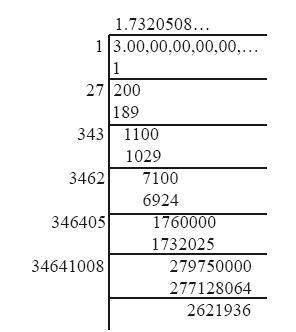
Thus, by division method \(\sqrt { 3 } \) = 1.7320508…
It is found that the square root of every positive non perfect square number is an irrational number \(\sqrt { 2 } ,\sqrt { 3 } ,\sqrt { 5 } ,\sqrt { 6 } ,\sqrt { 7 } \)..... are all irrational numbers.
3.
i) Draw a line and mark a point A on it.
ii) Mark a point B such that AB = 9.3 cm.
iii) Mark a point C on this line such that BC = 1 unit
iv) Find the midpoint of AC by drawing perpendicular bisector of AC and let it be O
v) With O as center and OC = OA as radius, draw a semicircle
vi) Draw a line BD, which is perpendicular to AB at B.
vii) Now BD = \(\sqrt { 9.3 } \) which can be marked in the number line as the value of BE = BD =\(\sqrt { 9.3 } \)
4.
Rational between \(\frac { 1 }{ 2 } \) and \(\frac { 1 }{ 5 } \) = \(\frac { 1 }{ 2 } \left( \frac { 1 }{ 2 } +\frac { 1 }{ 5 } \right) \)
=\(\frac { 1 }{ 2 } \left( \frac { 1 }{ 2 } +\frac { 1 }{ 5 } \right) \)
= \(\frac { 1 }{ 2 } \left( \frac { 1 }{ 2 } +\frac { 1 }{ 5 } \right) \)
Rational numbers between\(\frac { 1 }{ 2 } \) and \(\frac { 7 }{ 20 } \)
=\(\frac { 1 }{ 2 } \left( \frac { 10+7 }{ 20 } \right) \)
=\(\frac { 17 }{ 40 } \)
Rational number between \(\frac { 1 }{ 2 } \) and \(\frac { 7 }{ 20 } \) =\(\frac { 1 }{ 2 } \left( \frac { 1 }{ 2 } \times \frac { 17 }{ 40 } \right) \)
=\(\frac { 1 }{ 2 } \left( \frac { 20+17 }{ 40 } \right) \)
=\(\frac { 37 }{ 80 } \)
Thus the rational numbers are \(\frac { 7 }{ 20 } ,\frac { 17 }{ 40 } and\frac { 37 }{ 80 } \)
5.
\({6\over 7}=0.\overline {857142}\)
\({12\over 13}=0.\overline{923076}\)
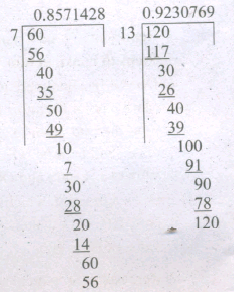
The two irrational numbers are 0.866142 ...and 0.903076.......
6.
(a)
- 0.75
7.
(a)
\(0.6\overline { 87 } \)
8.
(d)
\(0.\bar { 45 } \)
9.
(b)
\(\sqrt { 5 } \)
10.
(b)
may be a rational or irrational number
11.
(d)
may be rational or irrational
12.
()
10
13.
()
\(\frac { 25 }{ 45 } \)
14.
()
0.31623
15.
()
x
16.
()
\(4\sqrt { 3 } \)
17.
\(\frac { 1 }{ 4 } \) = 0.25 and \(\frac { 1 }{ 3 } \) = 0.3333….. = \(0.\bar3\)
In between 0.25 and \(0.\bar3\), there are infinitely many irrational numbers.
Four irrational numbers between 0.25 and \(0.\bar3\) are
0.2601001000100001…..
0.2701001000100001…..
0.2801001000100001…..
0.3101001000100001…..
18.
\(\frac{22}{7}\) = 3.142857142 ...... and \(\pi\) = 3.141592653289 ........
It is an irrational number.
We usually take \(\pi\) as \(\frac{22}{7}\) (a rational number only But up to 2 decimal places).
But it is not exactly equal to \(\frac{22}{7},\) it is approximate value.
19.
(i) \(2\over 3\) = 0.666... = \(0.\overline 6\)
(ii) \(47\over 99\) = 0.4747... = \(0.\overline {47}\)
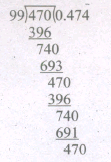
(iii) \(-{16\over 45}\) = 0.355.... = \(0.3\overline{5}\)
20.
(i) Let \(x=0.\overline { 3 } \)= 0.3333 (1)
(Here period of decimal is 1, multiply equation (1) by 10)
10x = 3.3333.... (2)
(2) - (1) : 9x = 3 or \(x=\frac { 1 }{ 3 } \)
(ii) Let \(x=2.\overline { 124 } \) = 2.124124124… (1)
(Here period of decimal is 3, multiply equation (1) by 1000)
1000 x = 2124.124124124… (2)
(2)–(1): 999 x = 2122 \(x=\frac { 2122 }{ 999 } \)
(iii) Let x = \(0.4\overline { 5 } \) = 0.45555… (1)
(Here the repeating decimal digit is 5, which is the second digit after the decimal point, multiply equation (1) by 10)
10 x = 4.5555… (2)
(Now period of decimal is 1, multiply equation (2) by 10)
100 x = 45.5555… (3)
(3) – (2): 90 x = 41 or \(x=\frac { 41 }{ 90 } \)
(iv) Let x = \(0.5\overline { 68 } \)= 0.5686868… (1)
(Here the repeating decimal digit is 68, which is the second digit after the decimal point, so multiply equation (1) by 10)
10 x = 5.686868… (2)
(Now period of decimal is 2, multiply equation (2) by 100)
1000 x = 568.686868… (3)
3) – (2): 990 x = 563 or \(x=\frac { 563 }{ 990 } \)
21.
(i) \(\frac { -4 }{ 11 } \)
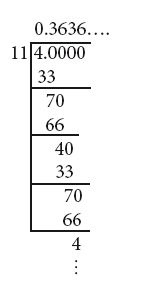
Thus we see that \(\frac { -4 }{ 11 } =-0.\overline { 36 } \)
(ii) \(\frac { 11 }{ 75 } \)
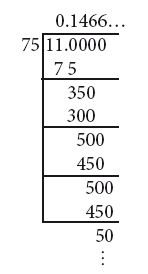
Thus we see that \(\frac { 11 }{ 75 } =0.14\overline { 6 } \)
A rational number can be expressed by
(i) either a terminating
(ii) or a non-terminating and recurring (repeating) decimal expansion.
The converse of this statement is also true. That is, if the decimal expansion of a number is terminating or non-terminating and recurring, then the number is a rational number.
22.
The rational numbers between \(-7\over 11\) and \(2\over 11\) is
\(\frac {- 6 }{ 11 } , \frac { -5 }{ 11 } , \frac { -4 }{ 11 },\frac {- 3 }{ 11 },\frac {- 2 }{ 11 },\frac {- 1 }{ 11 } , 0, \frac { 1 }{ 11 } \)
23.
\({ 625 }^{ \frac { 3 }{ 4 } }\) =\(\left( \sqrt [ 4 ]{ 625 } \right) ^{ 3 }=\left( \sqrt [ 4 ]{ { 5 }^{ 4 } } \right) ^{ 3 }={ 5 }^{ 3 }=5\times 5\times 5=125\)
24.
10-4 = \(\cfrac { 1 }{ { 10 }^{ 4 } } =\cfrac { 1 }{ 1000 } =0.0001\)
25.
(a) 0.750750075000750....
(b) 0.767076700767000767 ...
(c) 0.78080078008000780 ...
26.
Let x = 0.474747 ....... \(\rightarrow\) (1)
100x = 47.4747 ......... \(\rightarrow\) (2)
| (2) - (1) \(\Rightarrow \) 100x - x | = 47.4747 ..... |
| = 0. 4747 | |
| 99 x | = 47.0000 |
\(x={47\over 99}\)
\(\therefore 0.\overline {47}={47\over 99}\)

9th Standard Syllabus & Materials
9th Standard
TN 9th Tamil உள்ளத்தின் சீர் - திருக்குறள் Important Questions And Answers Study Material - QB365 Set A
NEW9th Standard
TN 9th Tamil உள்ளத்தின் சீர் - மணிமேகலை Important Questions And Answers Study Material - QB365 Set A
NEW9th Standard
TN 9th Tamil உள்ளத்தின் சீர் - ஏறு தழுவுதல் Important Questions And Answers Study Material - QB365 Set A
NEW9th Standard
TN 9th Tamil உயிருக்கு வேர் - தண்ணீர் Important Questions And Answers Study Material - QB365 Set A



Tamilnadu Stateboard 9th Standard Subjects
Tamilnadu Stateboard Standards