
 100% FREE ACCESS
9th Standard Syllabus & Materials
9th Standard
TN 9th Tamil உள்ளத்தின் சீர் -கற்கண்டு (இலக்கணம்) - தொடர் இலக்கணம், ஆகுபெயர் Important Questions And Answers Study Material - QB365 Set A
NEW9th Standard
TN 9th Tamil உள்ளத்தின் சீர் -விரிவானம் (துணைப்பாடம்) - தாய்மைக்கு வறட்சி இல்லை! Important Questions And Answers Study Material - QB365 Set A
NEW9th Standard
TN 9th Tamil உள்ளத்தின் சீர் -கவிதை பேழை (செய்யுள்) - மார்கழி பெருவிழா Important Questions And Answers Study Material - QB365 Set A
NEW9th Standard
TN 9th Tamil உயிருக்கு வேர்-இலக்கணம் - பகுபத உறுப்பிலக்கணம் Important Questions And Answers Study Material - QB365 Set A
NEW9th Standard
TN 9th Tamil அமுதென்று பேர் - இலக்கணம்-எழுத்து -அளபெடை Important Questions And Answers Study Material - QB365 Set A
NEW9th Standard
TN 9th Tamil அமுதென்று பேர்-துணைப்பாடம் - ஆறாம்திணை Important Questions And Answers Study Material - QB365 Set A

Published on: 11/10/2019
Coordinate Geometry
Download Tamil Nadu 9th Standard Maths question papers, model tests, one-mark questions, important questions, and public exam papers in PDF format. Free study materials and answer keys for TN State Board students.
Questions + Answers key
Take MCQ Maths Test1.
If the centroid of a triangle is at (−2, 1) and two of its vertices are (1, −6) and (−5, 2), then find the third vertex of the triangle.
2.
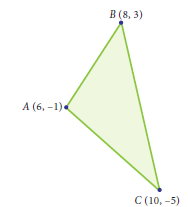
Find the centroid of the triangle whose veritices are A(6, −1), B(8, 3) and C(10, −5).
3.
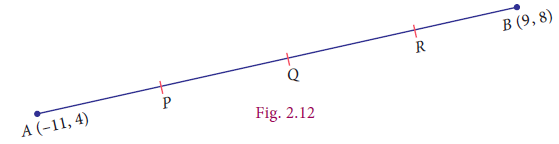
Find the points which divide the line segment joining A(−11, 4) and B(9, 8) into four equal parts.
4.
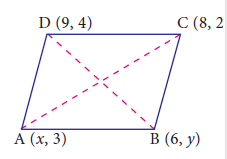
If (x, 3), (6, y), (8, 2) and (9, 4) are the vertices of a parallelogram taken in order, then find the value of x and y.
5.
The point (3, −4) is the centre of a circle. If AB is a diameter of the circle and B is (5, −6), find the coordinates of A.
6.
What are the coordinates of B if point P(−2, 3) divides the line segment joining A(−3, 5) and B internally in the ratio 1 : 6?
7.
The mid-points of the sides of a triangle are (5, 1), (3, −5) and (−5, −1). Find the coordinates of the vertices of the triangle.
8.
If \(\left( \frac { 3 }{ 2 } ,5 \right) ,\left( 7,\frac { -9 }{ 2 } \right) \)and\((\frac{13}{2},\frac{-13}{2})\) are mid-points of the sides of a triangle, then find the centroid of the triangle.
9.
If the centroid of a triangle is at (4, −2) and two of its vertices are (3, −2) and (5, 2) then find the third vertex of the triangle.
10.
A line segment AB is increased along its length by 25% by producing it to C on the side of B. If A and B have the coordinates (−2,−3) and (2,1) respectively, then find the coordinates of C.
11.
The line segment joining A(6, 3) and B(−1, −4) is doubled in length by adding half of AB to each end. Find the coordinates of the new end points.
12.
In what ratio does the point P(2, −5) divide the line segment joining A(−3, 5) and B(4, −9) .
13.
Prove that the diagonals of the parallellogram bisect each other. [Hint: Take scale on both axes as 1 cm = a units]
14.
The points A(−3, 6), B(0, 7) and C(1, 9) are the mid-points of the sides DE, EF and FD of a triangle DEF. Show that the quadrilateral ABCD is a parallellogram.
15.
The mid-point of the sides of a triangle are (2, 4), (−2, 3) and (5, 2). Find the coordinates of the vertices of the triangle.
16.
The centre of a circle is (−4, 2). If one end of the diameter of the circle is (−3, 7) then find the other end.
17.
The centroid of the triangle with vertices (−1, −6), (−2, 12) and (9, 3) is
(3, 2)
(2, 3)
(4, 3)
(3, 4)
18.
If (1,−2), (3, 6), (x, 10) and (3, 2) are the vertices of the parallelogram taken in order, then the value of x is ______.
6
5
4
3
19.
In what ratio does the y-axis divides the line joining the points (−5, 1) and (2, 3) internally ______.
1 :3
2 :5
3 :1
5 :2
20.
If the coordinates of the mid-points of the sides AB, BC and CA of a triangle are (3, 4), (1, 1) and (2, −3) respectively, then the vertices A and B of the triangle are ______.
(3, 2), (2, 4)
(4, 0), (2, 8)
(3, 4), (2, 0)
(4, 3), (2, 4)
21.
The ratio in which the x-axis divides the line segment joining the points A(a1, b1) and B(a2, b2 ) is ______.
b1 : b2
−b1 : b2
a1 : a2
−a1 : a2
22.
In what ratio does the point Q(1, 6) divide the line segment joining the points P(2, 7) and R(−2, 3) ______.
1 :2
2 :1
1 :3
3 :1
23.
The coordinates of the point C dividing the line segment joining the points P(2, 4) and Q(5, 7) internally in the ratio 2:1 is______.
\((\frac{7}{2},\frac{11}{2})\)
(3, 5)
(4, 4)
(4, 6)
1.
Let the vertices of a triangle be A(1, −6), B(−5, 2) and C(x3, y3)
Given the centroid of a triangle as (−2, 1) we get,
\(\frac { { x }_{ 1 }+{ x }_{ 2 }+{ x }_{ 3 } }{ 3 } \) = -2
\(\frac { 1-5+{ x }_{ 3 } }{ 3 } \) = -2
−4 + x3 = −6
x3 = −2
\(\frac { { y }_{ 1 }+{ y }_{ 2 }+{ y }_{ 3 } }{ 3 } \) = 1
\(\frac { 6+2+{ y }_{ 3 } }{ 3 } \) = 1
−4 + y3 = 3
y3 = 7
Therefore, third vertex is (−2, 7).
2.
The centroid G(x, y) of a triangle whose vertices are (x1, y1), (x2 , y2 ) and (x3 , y3) is given by
G(x,y)=G\(\left( \frac { { x }_{ 1 }+{ x }_{ 2 }+{ x }_{ 3 } }{ 3 } ,\frac { { y }_{ 1 }+{ y }_{ 2 }+{ y }_{ 3 }3 }{ } \right) \)
We have (x1, y1) = (6, −1); (x2 , y2 ) = (8, 3); (x3 , y3) = (10, −5)
The centroid of the triangle
G(x, y) =G\(\left( \frac { 6+8+10 }{ 3 } ,\frac { -1+3-5 }{ 3 } \right) \)
= G \((\frac{24}{3},\frac{-3}{3})\)= G(8, -1)
3.
Let P, Q, R be the points on the line segment joining A(−11, 4) and B(9, 8) such that AP = PQ = QR = RB .
Here Q is the mid-point of AB, P is the mid-point of AQ and R is the mid-point of QB.
Q is the mid-point of AB =\(\left( \frac { -11+9 }{ 2 } ,\frac { 4+8 }{ 2 } \right) =\left( \frac { -2 }{ 2 } ,\frac { 12 }{ 2 } \right) \)= (-1, 6)
P is the mid-point of AQ =\(\left( \frac { -11-1 }{ 2 } ,\frac { 4+6 }{ 2 } \right) =\left( \frac { -12 }{ 2 } ,\frac { 10 }{ 2 } \right) \) = (-6, 5)
R is the mid-point of QB =\(\left( \frac { -1+9 }{ 2 } ,\frac { 6+8 }{ 2 } \right) =\left( \frac { 8 }{ 2 } ,\frac { 14 }{ 2 } \right) \) = (4, 7)
Hence the points which divides AB into four equal parts are P(–6, 5), Q(–1, 6) and R(4, 7).
4.
Let A(x, 3), B(6, y), C(8, 2) and D(9, 4) be the vertices of the parallelogram ABCD. By definition, diagonals AC and BD bisect each other.
Mid-point of AC = Mid-point of BD
\(\left( \frac { x+8 }{ 2 } ,\frac { 3+2 }{ 2 } \right) =\left( \frac { 6+9 }{ 2 } ,\frac { y+4 }{ 2 } \right) \)
equating the coordinates on both sides, we get
\(\frac { x+8 }{ 2 } =\frac { 15 }{ 2 } \)
x + 8 = 15
x = 7
\(\frac { 5 }{ 2 } =\frac { y+4 }{ 2 } \)
5 = y + 4
y = 1
Hence, x = 7 and y = 1.
5.
Let the coordinates of A be (x1, y1) and the given point is B(5,−6). Since the centre is the mid-point of the diameter AB, we have
\(\frac { { x }_{ 1 }+{ x }_{ 2 } }{ 2 } \) = 3
x1 + 5 = 6
x1 = 6 − 5
x1 = 1
\(\frac { { y}_{ 1 }+{ y }_{ 2 } }{ 2 } \) = -4
y1 − 6 = −8
y1 = −8 + 6
y1 = −2
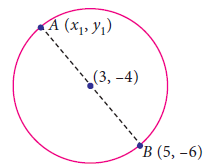
Therefore, the coordinates of A is (1, −2) .
6.
Let A(−3, 5) and B(x2, y2 ) be the given two points.
Given P(−2, 3) divides AB internally in the ratio 1:6.
By section formula, P\(\left( \frac { m{ x }_{ 2 }+n{ x }_{ 1 } }{ m+n } ,\frac { m{ y }_{ 2 }+n{ y }_{ 1 } }{ m+n } \right) \) = P(-2, 3)
P\(\left( \frac { 1({ x }_{ 2 })+6(-33) }{ 1+6 } ,\frac { 1({ y }_{ 2 })+6(5) }{ 1+6 } \right) \) = P(-2, 3)
Equating the coordinates
\(\frac { { x }_{ 2 }-18 }{ 7 } \) = -2
x2 −18 = −14
x2 = 4
\(\frac { { y }_{ 2 }-30 }{ 7 } \) = 3
y2 + 30 = 21
y2 = −9
Therefore, the coordinate of B is (4, −9)
7.
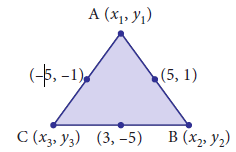
Let the vertices of the ABC be A(x1, y1), B(x2, y2 ) and C(x3, y3) and the given mid-points of the sides AB, BC and CA are (5, 1), (3, −5) and (−5, −1) respectively. Therefore
\(\frac { { x }_{ 1 }+{ x }_{ 2 } }{ 2 } =5 \Rightarrow\)x1 + x2 = 10 ...(1)
\(\frac { { x }_{ 2 }+{ x }_{ 3 } }{ 2 } =3 \Rightarrow\)x2 + x3 = 6 ...(2)
\(\frac { { x }_{ 3 }+{ x }_{ 1 } }{ 2 } =-5 \Rightarrow\)x3 + x1 = –10 ...(3)
Adding (1), (2) and (3)
2x1 + 2x2 + 2x3 = 6
x1 + x2 + x3 = 3 ...(4)
(4) − (2) \(\Rightarrow\) x1 = 3 − 6 = −3
(4) − (3) \(\Rightarrow\) x2 = 3 +10 = 13
(4) − (1) \(\Rightarrow\) x3 = 3 −10 = −7
\(\frac { { y }_{ 1 }+{ y }_{ 2 } }{ 2 } =1\)\(\Rightarrow\)y1 + y2 = 2 …(5)
\(\frac { { y }_{ 2 }+{ y }_{ 3 } }{ 2 } =-5\)\(\Rightarrow\)y2 + y3 = –10 …(6)
\(\frac { { y }_{ 3 }+{ y }_{ 1 } }{ 2 } =1\)\(\Rightarrow\)y3 + y1 = –2 …(7)
Adding (5), (6) and (7),
2y1 + 2y2 + 2y3 = −10
y1 + y2 + y3 = −5 ...(8)
(8) − (6) \(\Rightarrow\) y1 = −5 +10 = 5
(8) − (7) \(\Rightarrow\) y2 = −5 + 2 = −3
(8) − (5) \(\Rightarrow\) y3 = −5 − 2 = −7
Therefore the vertices of the triangles are A(−3, 5), B(13, −3) and C(−7, −7).
8.
"The centroid of the triangle obtained by joining the mid points of the sides of a triangle is the same as the centroid of the original triangle."
\(\therefore\) The mid points of the sides of the triangle are given as
x1y1 , x2y, x3y3
\(\left( \frac { 3 }{ 2 } ,5 \right) \left( 7,\frac { -9 }{ 2 } \right) \left( \frac { 13 }{ 2 } ,\frac { -13 }{ 2 } \right) \)
\(\therefore\)Centroid \(=\left( \frac { { x }_{ 1 }+{ x }_{ 2 }+{ x }_{ 3 } }{ 3 } ,\frac { { y }_{ 1 }+{ y }_{ 2 }+{ y }_{ 3 } }{ 3 } \right) \)
\(=\left( \frac { \frac { 3 }{ 2 } +\frac { 7 }{ 1 } +\frac { 13 }{ 2 } }{ 3 } ,\frac { 5+\left( \frac { -9 }{ 2 } \right) +\frac { (-13) }{ 2 } }{ 3 } \right) =\left( \frac { \frac { 3+14+13 }{ 2 } }{ 3 } ,\frac { \frac { 10-9-13 }{ 2 } }{ 3 } \right) \)
\(=\left( \frac { \frac { 30 }{ 2 } }{ 3 } ,\frac { \frac { -12 }{ 2 } }{ 3 } \right) =\left( \frac { 15 }{ 3 } ,\frac { -6 }{ 3 } \right) =(5,-2)\)
9.
Centroid G (x,y) = (4, -2)
two vertices (x1, y1) = (3, -2)
(x2, y2) = (5, 2), (x3, y3) =?
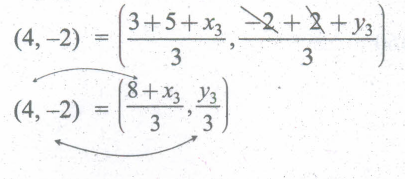
\(\frac { 8+{ x }_{ 3 } }{ 3 } =4\ \ \frac { { y }_{ 3 } }{ 3 } =-2\)
8 + x3 = 12 y3 = -6
x3 = 4
∴ The third vertex (x3, y3) = (4, -6)
10.
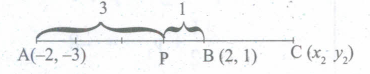
x1 y1 x2 y2
A(-2, -3) B(2, 1)
m : n = 3 : 1
The point P divides AB in the ratio 3 : 1
\(P(x,y)=\left( \frac { { mx }_{ 2 }+{ nx }_{ 1 } }{ m+n } ,\frac { { my }_{ 2 }+{ ny }_{ 1 } }{ m+n } \right) \)
\(=\left( \frac { 3\times 2+1\times -2 }{ 3+1 } ,\frac { 3\times 1+1\times -3) }{ 3+1 } \right) \)
\(=\left( \frac { 6-2 }{ 4 } ,\frac { 3-3 }{ 4 } \right) =\left( \frac { 4 }{ 4 } ,\frac { 0 }{ 4 } \right) =(1,0)\)
P is at 25% distance from B on its left and C is at 25% distance from B on its right
\(\therefore\) B is the mid point of PC
Mid point of \(\bar { PC } =\left( \frac { { x }_{ 1 }+{ x }_{ 2 } }{ 2 } ,\frac { { y }_{ 1 }+{ y }_{ 2 } }{ 2 } \right) \)
\((2,1)=\left( \frac { 1+{ x }_{ 2 } }{ 2 } ,\frac { 0+{ y }_{ 2 } }{ 2 } \right) \)
\(\frac { 1+{ x }_{ 2 } }{ 2 } =2\quad \frac { { y }_{ 2 } }{ 2 } =1\)
1 + x2 = 4 y2 = 2
⇒ x2 = 3, y2 = 2
∴ C(x2, y2) = (3, 2) is the solutions.
11.

\(\bar { AB } =\sqrt { { ({ x }_{ 2 }-{ x }_{ 1 }) }^{ 2 }+{ ({ y }_{ 2 }-{ y }_{ 1 }) }^{ 2 } } =\sqrt { { (-1-6) }^{ 2 }+{ (-4-3) }^{ 2 } } \)
\(=\sqrt { { (-7) }^{ 2 }+{ (-7) }^{ 2 } } =\sqrt { 49+49 } =\sqrt { (49)2 } \)
\(\frac { 1 }{ 2 } AB=\frac { 7\sqrt { 2 } }{ 2 } =\frac { 7\sqrt { 2 } }{ \sqrt { 2 } \times \sqrt { 2 } } =\frac { 7 }{ \sqrt { 2 } } \)
\(AB=\left( \frac { 6+(-1) }{ 2 } ,\frac { 3+(-4) }{ 2 } \right) =\left( \frac { 5 }{ 2 } ,\frac { -1 }{ 2 } \right) \)
Mid point of \(AB=\left( \frac { 6+(-1) }{ 2 } ,\frac { 3+(-4) }{ 2 } \right) =\left( \frac { 5 }{ 2 } ,\frac { -1 }{ 2 } \right) \)
SinceC is at the distance \(\frac{1}{2}\) AB from B
Midpoint of MC = B
\(\left( \frac { \frac { 5 }{ 2 } +{ x }_{ 3 } }{ 2 } ,\frac { \frac { -1 }{ 2 } +{ y }_{ 3 } }{ 2 } \right) =(-1,-4)\)
\(\left( \frac { \frac { 5 }{ 2 } +{ x }_{ 3 } }{ 2 } \right) =-1\)
\(\frac { 5 }{ 2 } +{ x }_{ 3 }=-2\)
\({ x }_{ 3 }=-2-\frac { 5 }{ 2 } \)
\(=\frac { -4-5 }{ 2 } \)
\(=\frac { -9 }{ 2 } \)
\(\therefore C({ x }_{ 3 },{ y }_{ 3 })=\left( \frac { -9 }{ 2 } ,\frac { -15 }{ 2 } \right) \)
\(\left( \frac { -\frac { 1 }{ 2 } +{ y }_{ 3 } }{ 2 } \right) =-4\)
|\(-\frac { 1 }{ 2 } +{ y }_{ 3 }=-8\)
\({ y }_{ 3 }=-8+\frac { 1 }{ 2 } \)
\(=\frac { -16+1 }{ 2 } \)
\(=\frac { -15 }{ 2 } \)
Similarly by Mid point of DM = A(6, 3)
\(\left( \frac { { x }_{ 4 }+\frac { 5 }{ 2 } }{ 2 } ,\frac { { y }_{ 4 }+\left( \frac { -1 }{ 2 } \right) }{ 2 } \right) =(6,3)\)
\(\frac { { x }_{ 4 }+\frac { 5 }{ 2 } }{ 2 } =6\)
\({ x }_{ 4 }+\frac { 5 }{ 2 } =12\)
\({ x }_{ 4 }=12-\frac { 5 }{ 2 } =\frac { 24-5 }{ 2 } =\frac { 19 }{ 2 } \)
\(\frac { { y }_{ 4 }+\left( \frac { -1 }{ 2 } \right) }{ 2 } =3\)
\({ y }_{ 4 }+\left( \frac { -1 }{ 2 } \right) =6\)
\({ y }_{ 4 }=6+\frac { 1 }{ 2 } =\frac { 12+102 }{ 2 } =\frac { 13 }{ 2 } \)
\(\therefore\) The other end D (x4, y4)\(=\left( \frac { 19 }{ 2 } ,\frac { 13 }{ 2 } \right) \)
12.
x1 y1 x2 y2
A(-3, 5) B(4, -9) P(2, -5)
\(=P(x,y)\left( \frac { { mx }_{ 2 }+{ nx }_{ 1 } }{ m+n } ,\frac { { my }_{ 2 }+{ ny }_{ 1 } }{ m+n } \right) \)
\(P(2,-5)=\left( \frac { m\times 4+n(-5) }{ m+n } ,\frac { m\times (-9)+n(5) }{ m+n } \right) \)
\(\left( \frac { 4m-3n }{ m+n } \right) =2\)
4m -3n = 2m+ 2n
4m -2m = 2n + 3n
2m = 5n
\(\frac { m }{ n } =\frac { 5 }{ 2 } \)
∴ The ratio m : n = 5 : 2
13.
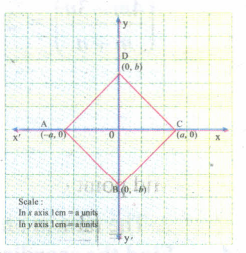
Mid point of Diagonal AC:
\(=\left( \frac { -a+a }{ 2 } ,\frac { 0+0 }{ 2 } \right) =\left( \frac { 0 }{ 2 } ,\frac { 0 }{ 2 } \right) =(0,0)\)
Mid point Diagonal of BD:
\(=\left( \frac { 0+0 }{ 2 } ,\frac { b+(-b) }{ 2 } \right) =\left( \frac { 0 }{ 2 } ,\frac { 0 }{ 2 } \right) =(0,0)\)
Mid point of AC = Mid point of BD
∴ Diagonals bisect each other
14.
In a parallelogram diagonals bisect each other and diagonals are not equal.
Mid point of DE \(=\left( \frac { { x }_{ 1 }+{ x }_{ 2 } }{ 2 } ,\frac { { y }_{ 1 }+{ y }_{ 2 } }{ 2 } \right) \)
(-3, 6)\(=\left( \frac { { x }_{ 1 }+{ x }_{ 2 } }{ 2 } ,\frac { { y }_{ 1 }+{ y }_{ 2 } }{ 2 } \right) \)
\(\frac { x_{ 1 }+{ x }_{ 2 } }{ 2 } =-3\ \ \ \ \ \frac { y_{ 1 }+y_{ 2 } }{ 2 } =6\)
x1 + x2 = -6........(1)
y1 + y2 = 12.......(2)
Mid point of EF\(\left( \frac { { x }_{ 2 }+{ x }_{ 3 } }{ 2 } ,\frac { { y }_{ 2 }+{ y }_{ 3 } }{ 2 } \right) \)
(0, 7)=\(\left( \frac { { x }_{ 2 }+{ x }_{ 3 } }{ 2 } ,\frac { { y }_{ 2 }+{ y }_{ 3 } }{ 2 } \right) \)
\(\frac { x_{ 2 }+{ x }_{ 3 } }{ 2 } =0\ \ \ \frac { y_{ 2 }+{ y }_{ 3 } }{ 2 } =7\)
x2+x3= 0..............(3)
Mid point of FD=\(\left( \frac { { x }_{ 3 }+{ x }_{ 1 } }{ 2 } ,\frac { { y }_{ 3 }+{ y }_{ 1 } }{ 2 } \right) =(-3,-2)\)
x3 + x1 = -6.......(5)
y3 + y1 = -4..........(6)
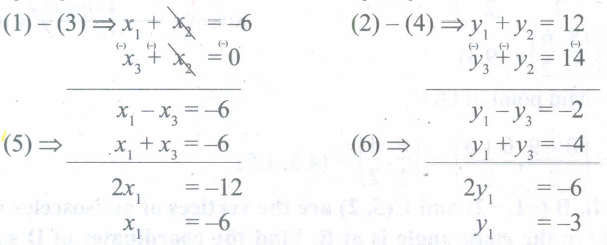
∴ D (x1, y1) = (-6, -3)
Mid points of the diagonals are equal in parallelogram
∴ We have to prove this
Mid point of AC \(=\left( \frac { (-3)+(-3) }{ 2 } ,\frac { 6+(-2) }{ 2 } \right) =\left( \frac { -6 }{ 2 } ,\frac { 4 }{ 2 } \right) =(-3,2)\)
Mid Point of BD \(=\left( \frac { -6+0 }{ 2 } ,\frac { -3+7 }{ 2 } \right) =\left( \frac { -6 }{ 2 } ,\frac { 4 }{ 2 } \right) =(-3,2)\)
∴ Mid point of AC = Mid point of BD
∴ ABCD is a parallelogram
15.
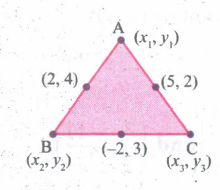
Mid point
\(M(x,y)=\left( \frac { { x }_{ 1 }+{ x }_{ 2 } }{ 2 } ,\frac { { y }_{ 1 }+{ y }_{ 2 } }{ 2 } \right) \)
Mid point AB(2, 4)=\(\left( \frac { { x }_{ 1 }+{ x }_{ 2 } }{ 2 } ,\frac { { y }_{ 1 }+{ y }_{ 2 } }{ 2 } \right) \)
\(\frac { { x }_{ 1 }+{ x }_{ 2 } }{ 2 } =2\Rightarrow { x }_{ 1 }+{ x }_{ 2 }=4\ \ \ ...(1)\)
\(\frac { { y }_{ 1 }+{ y }_{ 2 } }{ 2 } =4\Rightarrow { y }_{ 1 }+{ y }_{ 2 }\ \ \ ...(2)\)
Mid point of BC (-2, 3) =\(\left( \frac { { x }_{ 2 }+{ x }_{ 3 } }{ 2 } ,\frac { { y }_{ 2 }+{ y }_{ 3 } }{ 2 } \right) \)
\(\left( \frac { { x }_{ 2 }+{ x }_{ 3 } }{ 2 } \right) =-2\Rightarrow { x }_{ 2 }+{ x }_{ 3 }=-4 \quad ...(3)\)
\(\left( \frac { { y }_{ 2 }+{ y }_{ 3 } }{ 2 } \right) =3\Rightarrow { y }_{ 2 }+y_{ 3 }=6\ \quad ...(4)\)
Mid point of AC (5, 2) =\(\left( \frac { { x }_{ 1 }+{ x }_{ 3 } }{ 2 } ,\frac { { y }_{ 1 }+{ y }_{ 3 } }{ 2 } \right) \)
\(\left( \frac { x_{ 1 }+{ x }_{ 3 } }{ 2 } \right) =3\Rightarrow x_{ 1 }+x_{ 3 }=10 \quad ...(5)\)
\(\frac { { y }_{ 1 }+{ y }_{ 3 } }{ 2 } =3\Rightarrow { y }_{ 1 }+y_{ 3 }=4 \quad ...(6)\)
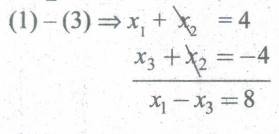
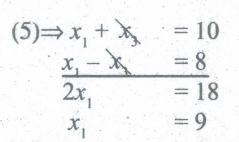
Substitue x1 = 9 in (5)
9 +X3 = 10
X3 = 1
Substitue X1 = 1 in(3)
x2 + 1 = -4 ⇒ x2 = -5
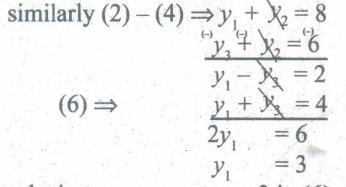
substitute y1 = 3 in (6)
3 + y3 = 4
y3 = 1
substitute y3 = 1 in (4)
1 + y2 = 6
y3 = 5
ஃ The vertices of the triangle A(x1 y1) = (9, 3)
B (x2 y2) = (-5, 5)
C(x3y3) = (1, 1)
16.
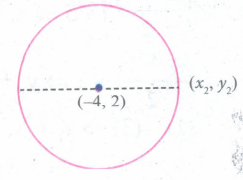
\(M(x,y)=\left( \frac { { x }_{ 1 }+{ x }_{ 2 } }{ 2 } ,\frac { { y }_{ 1 }+{ y }_{ 2 } }{ 2 } \right) \)
\((-4,2)=\left( \frac { -3+{ x }_{ 2 } }{ 2 } ,\frac { 7+{ y }_{ 2 } }{ 2 } \right) \left( { x }_{ 1 }{ y }_{ 1 } \right) \)
\(\frac { -3+{ x }_{ 2 } }{ 2 } =-4\quad \frac { 7+{ y }_{ 2 } }{ 2 } =2\)
-3 + x2 = -8
7 +y2 = 4
x2 = -8 +3
y2 = 4 -7 = -3
x2 = -5
The other end is (-5, -3)
17.
(b)
(2, 3)
18.
(b)
5
19.
(d)
5 :2
20.
(b)
(4, 0), (2, 8)
21.
(b)
−b1 : b2
22.
(c)
1 :3
23.
(d)
(4, 6)

9th Standard Syllabus & Materials
9th Standard
TN 9th Tamil உள்ளத்தின் சீர் - திருக்குறள் Important Questions And Answers Study Material - QB365 Set A
NEW9th Standard
TN 9th Tamil உள்ளத்தின் சீர் - மணிமேகலை Important Questions And Answers Study Material - QB365 Set A
NEW9th Standard
TN 9th Tamil உள்ளத்தின் சீர் - ஏறு தழுவுதல் Important Questions And Answers Study Material - QB365 Set A
NEW9th Standard
TN 9th Tamil உயிருக்கு வேர் - தண்ணீர் Important Questions And Answers Study Material - QB365 Set A



Tamilnadu Stateboard 9th Standard Subjects
Tamilnadu Stateboard Standards





