
 100% FREE ACCESS
9th Standard Syllabus & Materials
9th Standard
TN 9th Tamil உள்ளத்தின் சீர் -கற்கண்டு (இலக்கணம்) - தொடர் இலக்கணம், ஆகுபெயர் Important Questions And Answers Study Material - QB365 Set A
NEW9th Standard
TN 9th Tamil உள்ளத்தின் சீர் -விரிவானம் (துணைப்பாடம்) - தாய்மைக்கு வறட்சி இல்லை! Important Questions And Answers Study Material - QB365 Set A
NEW9th Standard
TN 9th Tamil உள்ளத்தின் சீர் -கவிதை பேழை (செய்யுள்) - மார்கழி பெருவிழா Important Questions And Answers Study Material - QB365 Set A
NEW9th Standard
TN 9th Tamil உயிருக்கு வேர்-இலக்கணம் - பகுபத உறுப்பிலக்கணம் Important Questions And Answers Study Material - QB365 Set A
NEW9th Standard
TN 9th Tamil அமுதென்று பேர் - இலக்கணம்-எழுத்து -அளபெடை Important Questions And Answers Study Material - QB365 Set A
NEW9th Standard
TN 9th Tamil அமுதென்று பேர்-துணைப்பாடம் - ஆறாம்திணை Important Questions And Answers Study Material - QB365 Set A

Published on: 18/01/2019
Coordinate Geometry Full chapter Material
Download Tamil Nadu 9th Standard Maths question papers, model tests, one-mark questions, important questions, and public exam papers in PDF format. Free study materials and answer keys for TN State Board students.
Questions + Answers key
Take MCQ Maths Test1.
If the centroid of a triangle is at (−2, 1) and two of its vertices are (1, −6) and (−5, 2), then find the third vertex of the triangle.
2.
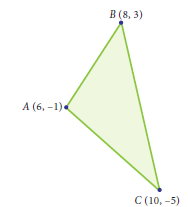
Find the centroid of the triangle whose vertices are A(6, −1), B(8, 3) and C(10, −5).
3.
If (x, 3), (6, y), (8, 2) and (9, 4) are the vertices of a parallelogram taken in order, then find the value of x and y.
4.
the mid-point formula to show that the mid-point of the hypotenuse of a right angled triangle is equidistant from the vertices (with suitable points).
5.
The point (3, −4) is the centre of a circle. If AB is a diameter of the circle and B is (5, −6), find the coordinates of A.
6.
What are the coordinates of B if point P(−2, 3) divides the line segment joining A(−3, 5) and B internally in the ratio 1 : 6?
7.
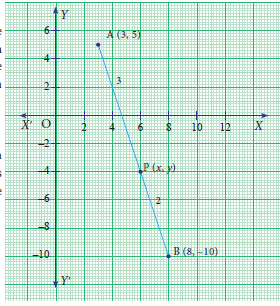
Find the coordinates of the point which divides the line segment joining the points (3, 5) and (8, −10) internally in the ratio 3:2.
8.
The mid-points of the sides of a triangle are (5, 1), (3, −5) and (−5, −1). Find the coordinates of the vertices of the triangle.
9.
If \(\left( \frac { 3 }{ 2 } ,5 \right) ,\left( 7,\frac { -9 }{ 2 } \right) \)and\((\frac{13}{2},\frac{-13}{2})\) are mid-points of the sides of a triangle, then find the centroid of the triangle.
10.
ABC is a triangle whose vertices are A(3, 4), B(−2, −1) and C(5, 3) . If G is the centroid and BDCG is a parallelogram then find the coordinates of the vertex D.
11.
The vertices of a triangle are (1, 2), (h, −3) and (−4, k). If the centroid of the triangle is at the point (5, −1) then find the value of \(\sqrt { { (h+k) }^{ 2 }+{ (h+3k) }^{ 2 } } \)
12.
Find the length of median through A of a triangle whose vertices are A(−1, 3), B(1, −1) and C(5, 1).
13.
If the centroid of a triangle is at (4, −2) and two of its vertices are (3, −2) and (5, 2) then find the third vertex of the triangle.
14.
A car travels at an uniform speed. At 2 pm it is at a distance of 180 km and at 6pm it is at 360 km. Using section formula, find at what distance it will reach 12 midnight.
15.
A line segment AB is increased along its length by 25% by producing it to C on the side of B. If A and B have the coordinates (−2,−3) and (2,1) respectively, then find the coordinates of C.
16.
The line segment joining A(6, 3) and B(−1, −4) is doubled in length by adding half of AB to each end. Find the coordinates of the new end points.
17.
Find the coordinates of the point which divides the line segment joining A(−5,11) and B(4,−7) in the ratio 7:2.
18.
Prove that the diagonals of the parallelogram bisect each other. [Hint: Take scale on both axes as 1 cm = a units]
19.
Show that the line segment joining the mid-points of two sides of a triangle is half of the third side
(Hint: Place triangle ABC in a clever way such that A is (0, 0), B is (2a, 0) and C to be (2b, 2c). Now consider the line segment joining the mid-points of AC and BC. This will make calculations simpler).
20.
The points A(−5, 4) , B(−1, −2) and C(5,2) are the vertices of an isosceles right-angled triangle where the right angle is at B. Find the coordinates of D so that ABCD is a square.
21.
O(0,0) is the centre of a circle whose one chord is AB, where the points A and B are (8,6) and (10,0) respectively. OD is the perpendicular from the centre to the chord AB. Find the coordinates of the mid-point of OD.
22.
The mid-point of the sides of a triangle are (2, 4), (−2, 3) and (5, 2). Find the coordinates of the vertices of the triangle.
23.
The centre of a circle is (−4, 2). If one end of the diameter of the circle is (−3, 7) then find the other end.
24.
The centroid of the triangle with vertices (−1, −6), (−2, 12) and (9, 3) is
(3, 2)
(2, 3)
(4, 3)
(3, 4)
25.
If (1,−2), (3, 6), (x, 10) and (3, 2) are the vertices of the parallelogram taken in order, then the value of x is ______.
6
5
4
3
26.
In what ratio does the y-axis divide the line joining the points (−5, 1) and (2, 3) internally ______.
1 : 3
2 : 5
3 : 1
5 : 2
27.
The mid-point of the line joining (−a, 2b) and (−3a,−4b) is ______.
(2a, 3b)
(−2a, −b)
(2a, b)
(−2a, −3b)
28.
If the coordinates of the mid-points of the sides AB, BC and CA of a triangle are (3, 4), (1, 1) and (2, −3) respectively, then the vertices A and B of the triangle are ______.
(3, 2), (2, 4)
(4, 0), (2, 8)
(3, 4), (2, 0)
(4, 3), (2, 4)
29.
The ratio in which the x-axis divides the line segment joining the points (6, 4) and (1, −7) is ______.
2:3
3:4
4:7
4:3
30.
The ratio in which the x-axis divides the line segment joining the points A(a1, b1) and B(a2, b2) is ______.
b1 : b2
−b1 : b2
a1 : a2
−a1 : a2
31.
In what ratio does the point Q(1, 6) divide the line segment joining the points P(2, 7) and R(−2, 3) ______.
1 : 2
2 : 1
1 : 3
3 : 1
32.
If \(P(\frac{a}{3},\frac{b}{2})\)is the mid-point of the line segment joining A(−4, 3) and B(−2, 4) then (a, b) is ______.
(-9, 7)
\((-3, \frac{7}{2})\)
(9, -7)
\((3, -\frac{7}{2})\)
33.
The coordinates of the point C dividing the line segment joining the points P(2, 4) and Q(5, 7) internally in the ratio 2:1 is______.
\((\frac{7}{2},\frac{11}{2})\)
(3, 5)
(4, 4)
(4, 6)
1.
Let the vertices of a triangle be A(1, −6), B(−5, 2) and C(x3, y3)
Given the centroid of a triangle as (−2, 1) we get,
\(\frac { { x }_{ 1 }+{ x }_{ 2 }+{ x }_{ 3 } }{ 3 } \) = -2
\(\frac { 1-5+{ x }_{ 3 } }{ 3 } \) = -2
−4 + x3 = −6
x3 = −2
\(\frac { { y }_{ 1 }+{ y }_{ 2 }+{ y }_{ 3 } }{ 3 } \) = 1
\(\frac { 6+2+{ y }_{ 3 } }{ 3 } \) = 1
−4 + y3 = 3
y3 = 7
Therefore, third vertex is (−2, 7).
2.
The centroid G(x, y) of a triangle whose vertices are (x1, y1), (x2 , y2 ) and (x3 , y3) is given by
G(x,y)\(\left( \frac { { x }_{ 1 }+{ x }_{ 2 }+{ x }_{ 3 } }{ 3 } ,\frac { { y }_{ 1 }+{ y }_{ 2 }+{ y }_{ 3 }3 }{ } \right) \)
We have (x1, y1) = (6, −1); (x2 , y2 ) = (8, 3); (x3 , y3) = (10, −5)
The centroid of the triangle
G(x, y) =G\(\left( \frac { 6+8+10 }{ 3 } ,\frac { -1+3-5 }{ 3 } \right) \)
= G \((\frac{24}{3},\frac{-3}{3})\)= G(8, -1)
3.
Let A(x, 3), B(6, y), C(8, 2) and D(9, 4) be the vertices of the parallelogram ABCD. By definition, diagonals AC and BD bisect each other.
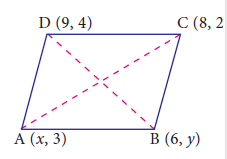
Mid-point of AC = Mid-point of BD
\(\left( \frac { x+8 }{ 2 } ,\frac { 3+2 }{ 2 } \right) =\left( \frac { 6+9 }{ 2 } ,\frac { y+4 }{ 2 } \right) \)
equating the coordinates on both sides, we get
\(\frac { x+8 }{ 2 } =\frac { 15 }{ 2 } \)
x + 8 = 15
x = 7
\(\frac { 5 }{ 2 } =\frac { y+4 }{ 2 } \)
5 = y + 4
y = 1
Hence, x = 7 and y = 1.
4.
Let POQ be the right angled triangle and O be placed at the origin. Let OQ = a units and OP be b units. Let us name the coordinates of P as (0,b) and Q as (a,0).
By mid-point formula, if M is the mid-point of the hypotenuse PQ [PM=MQ], then M is
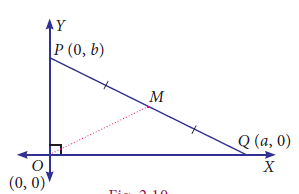
\(\left( \frac { a+0 }{ 2 } ,\frac { b+0 }{ 2 } \right) =\left( \frac { a }{ 2 } ,\frac { b }{ 2 } \right) \)
We now use the distance formula and find that
OM=\(\sqrt { { \left( \frac { a }{ 2 } -0 \right) }^{ 2 }{ +\left( \frac { b }{ 2 } -0 \right) }^{ 2 } } =\sqrt { \frac { { a }^{ 2 } }{ 4 } +\frac { { b }^{ 2 } }{ 4 } } \) which is the same value as
QM=\(\sqrt { { \left( a-\frac { a }{ 2 } \right) }^{ 2 }{ +\left( 0-\frac { b }{ 2 } \right) }^{ 2 } } =\sqrt { \frac { { a }^{ 2 } }{ 4 } +\frac { { b }^{ 2 } }{ 4 } } \) and similarly PM=\(\sqrt { \frac { { a }^{ 2 } }{ 4 } +\frac { { b }^{ 2 } }{ 4 } } \)
This shows OM = QM = PM, which we desired to prove.
5.
Let the coordinates of A be (x1, y1) and the given point is B(5,−6). Since the centre is the mid-point of the diameter AB, we have
\(\frac { { x }_{ 1 }+{ x }_{ 2 } }{ 2 } \) = 3
x1 + 5 = 6
x1 = 6 − 5
x1 = 1
\(\frac { { y}_{ 1 }+{ y }_{ 2 } }{ 2 } \) = -4
y1 − 6 = −8
y1 = −8 + 6
y1 = −2
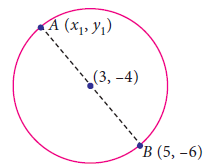
Therefore, the coordinates of A is (1, −2) .
6.
Let A(−3, 5) and B(x2, y2 ) be the given two points.
Given P(−2, 3) divides AB internally in the ratio 1:6.
By section formula, P\(\left( \frac { m{ x }_{ 2 }+n{ x }_{ 1 } }{ m+n } ,\frac { m{ y }_{ 2 }+n{ y }_{ 1 } }{ m+n } \right) \) = P(-2, 3)
P\(\left( \frac { 1({ x }_{ 2 })+6(-33) }{ 1+6 } ,\frac { 1({ y }_{ 2 })+6(5) }{ 1+6 } \right) \) = P(-2, 3)
Equating the coordinates
\(\frac { { x }_{ 2 }-18 }{ 7 } \) = -2
x2 −18 = −14
x2 = 4
\(\frac { { y }_{ 2 }-30 }{ 7 } \) = 3
y2 + 30 = 21
y2 = −9
Therefore, the coordinate of B is (4, −9)
7.
Let A(3,5), B(8,−10) be the given points and let the point P(x, y) divides the line segment AB internally in the ratio 3:2.
By section formula,
P(x, y) =P\(\left( \frac { m{ x }_{ 2 }+n{ x }_{ 1 } }{ m+n } ,\frac { m{ y }_{ 2 }+n{ y }_{ 1 } }{ m+n } \right) \)
Here x1 = 3, y1 = 5, x2 = 8, y2 = −10 and m = 3, n = 2
Therefore P(x, y) = P\(\left( \frac { 3(8)+2(3) }{ 3+2 } ,\frac { 3(-10)+2(5) }{ 3+2 } \right) \) = P(6, -4)
8.
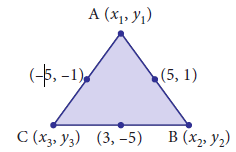
Let the vertices of the ABC be A(x1, y1), B(x2, y2 ) and C(x3, y3) and the given mid-points of the sides AB, BC and CA are (5, 1), (3, −5) and (−5, −1) respectively. Therefore
\(\frac { { x }_{ 1 }+{ x }_{ 2 } }{ 2 } =5 \Rightarrow\)x1 + x2 = 10 ...(1)
\(\frac { { x }_{ 2 }+{ x }_{ 3 } }{ 2 } =3 \Rightarrow\)x2 + x3 = 6 ...(2)
\(\frac { { x }_{ 3 }+{ x }_{ 1 } }{ 2 } =-5 \Rightarrow\)x3 + x1 = –10 ...(3)
Adding (1), (2) and (3)
2x1 + 2x2 + 2x3 = 6
x1 + x2 + x3 = 3 ...(4)
(4) − (2) \(\Rightarrow\) x1 = 3 − 6 = −3
(4) − (3) \(\Rightarrow\) x2 = 3 +10 = 13
(4) − (1) \(\Rightarrow\) x3 = 3 −10 = −7
\(\frac { { y }_{ 1 }+{ y }_{ 2 } }{ 2 } =1\)\(\Rightarrow\)y1 + y2 = 2 …(5)
\(\frac { { y }_{ 2 }+{ y }_{ 3 } }{ 2 } =-5\)\(\Rightarrow\)y2 + y3 = –10 …(6)
\(\frac { { y }_{ 3 }+{ y }_{ 1 } }{ 2 } =1\)\(\Rightarrow\)y3 + y1 = –2 …(7)
Adding (5), (6) and (7),
2y1 + 2y2 + 2y3 = −10
y1 + y2 + y3 = −5 ...(8)
(8) − (6) \(\Rightarrow\) y1 = −5 +10 = 5
(8) − (7) \(\Rightarrow\) y2 = −5 + 2 = −3
(8) − (5) \(\Rightarrow\) y3 = −5 − 2 = −7
Therefore the vertices of the triangle are A(−3, 5), B(13, −3) and C(−7, −7).
9.
"The centroid of the triangle obtained by joining the mid points of the sides of a triangle is the same as the centroid of the original triangle."
\(\therefore\) The mid points of the sides of the triangle are given as
x1y1 , x2y, x3y3
\(\left( \frac { 3 }{ 2 } ,5 \right) \left( 7,\frac { -9 }{ 2 } \right) \left( \frac { 13 }{ 2 } ,\frac { -13 }{ 2 } \right) \)
\(\therefore\)Centroid \(=\left( \frac { { x }_{ 1 }+{ x }_{ 2 }+{ x }_{ 3 } }{ 3 } ,\frac { { y }_{ 1 }+{ y }_{ 2 }+{ y }_{ 3 } }{ 3 } \right) \)
\(=\left( \frac { \frac { 3 }{ 2 } +\frac { 7 }{ 1 } +\frac { 13 }{ 2 } }{ 3 } ,\frac { 5+\left( \frac { -9 }{ 2 } \right) +\frac { (-13) }{ 2 } }{ 3 } \right) =\left( \frac { \frac { 3+14+13 }{ 2 } }{ 3 } ,\frac { \frac { 10-9-13 }{ 2 } }{ 3 } \right) \)
\(=\left( \frac { \frac { 30 }{ 2 } }{ 3 } ,\frac { \frac { -12 }{ 2 } }{ 3 } \right) =\left( \frac { 15 }{ 3 } ,\frac { -6 }{ 3 } \right) =(5,-2)\)
10.
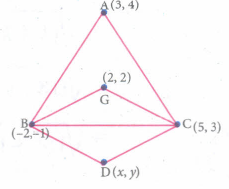
Centroid G =\(\left( \frac { { x }_{ 1 }+{ x }_{ 2 }+{ x }_{ 3 } }{ 3 } ,\frac { { y }_{ 1 }+{ y }_{ 2 }+{ y }_{ 3 } }{ 3 } \right) \)
\(\therefore G(x,y)=\left( \frac { 3+(-2)+5 }{ 3 } ,\frac { 4+(-1)+3 }{ 3 } \right) \)
\(=\left( \frac { 8-2 }{ 3 } ,\frac { 7-1 }{ 3 } \right) =\left( \frac { 6 }{ 3 } ,\frac { 6 }{ 3 } \right) =(2,2)\)
In a parallelogram diagonals bisect each other
∴ Mid point of DG = Mid point of BC
\(\left( \frac { x+2 }{ 2 } ,\frac { y+2 }{ 2 } \right) =\left( \frac { -2+5 }{ 2 } ,\frac { -1+3 }{ 2 } \right) \)
\(\frac { x+2 }{ 2 } =\frac { 3 }{ 2 } \)
x+2 = 3
x = 3 - 2 = 1
\(\frac { y+2 }{ 2 } =\frac { 2 }{ 2 } \)
y = 2 - 2 = 0
y + 2 = 2
\(\therefore\) The co-ordinates of the vertex D (x, y) = (1, 0)
11.
Vertices of a triangle
(x1 ,y1) = (1,2)
(x2,y2) = (h,-3)
(x3, y3) = (-4, k)
Centroid G (x,y) = (5, -1)
\(G=\left( \frac { { x }_{ 1 }+{ x }_{ 2 }+{ x }_{ 3 } }{ 3 } ,\frac { { y }_{ 1 }+{ y }_{ 2 }+{ y }_{ 3 } }{ 3 } \right) =(5,-1)\)
\(\left( \frac { 1+h+(-4) }{ 3 } ,\frac { 2+(-3)+k }{ 3 } \right) =(5,-1)\)
\(\Rightarrow \frac { -3+h }{ 3 } =5\)
-3 + h = 15
h = 18
\(\frac { 2-3+k }{ 3 } =-1\)
\(\therefore \sqrt { { (h+k) }^{ 2 }+{ (h+3k) }^{ 2 } } \)
\(=\sqrt { (18+(-2))^{ 2 }+{ (18+3(-2)) }^{ 2 } } \)
\(=\sqrt { { 16 }^{ 2 }+{ 12 }^{ 2 } } =\sqrt { 256+144 } =\sqrt { 400 } =20\)
12.
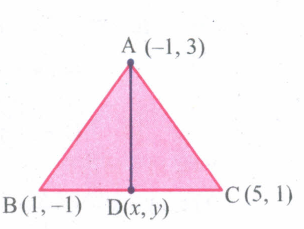
D (x, y) is the Mid point BC
\(\therefore \ D(x,y)=\left( \frac { 1+5 }{ 2 } ,\frac { -1+1 }{ 2 } \right) \)
\(=\left( \frac { 6 }{ 2 } ,\frac { 0 }{ 2 } \right) \)
= (3, 0)
AD is the median through A
Here A x2 y2 D x3 y3
(-1,3) (3,0)
\( \therefore\) Length of AD \(=\sqrt { { ({ x }_{ 2 }-{ x }_{ 1 }) }^{ 2 }+{ ({ y }_{ 2 }-{ y }_{ 1 }) }^{ 2 } } =\sqrt { { (3-(-1)) }^{ 2 }+{ (0-3) }^{ 2 } } \)
\(=\sqrt { { (3+1) }^{ 2 }+{ (-3) }^{ 2 } } =\sqrt { 16+9 } =\sqrt { 25 } =5\) units
13.
Centroid G (x,y) = (4, -2)
two vertices (x1, y1) = (3, -2)
(x2, y2) = (5, 2), (x3, y3) =?
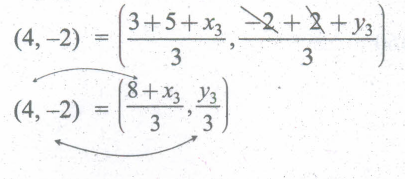
\(\frac { 8+{ x }_{ 3 } }{ 3 } =4\ \ \frac { { y }_{ 3 } }{ 3 } =-2\)
8 + x3 = 12 y3 = -6
x3 = 4
∴ The third vertex (x3, y3) = (4, -6)
14.
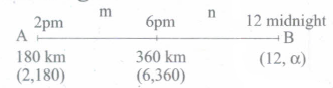
Dividing point \((x,y)=\left( \frac { { mx }_{ 2 }+{ nx }_{ 1 } }{ m+n } ,\frac { { my }_{ 2 }+{ ny }_{ 1 } }{ m+n } \right) \)
\((6,360)=\left( \frac { m\times 12+n\times 2 }{ m+n } ,\frac { m\alpha +n\times 180 }{ m+n } \right) \)
⇒\(\frac { 12m+2n }{ m+n } =6\)
12m + 2n = 6m + 6n
12m - 6m = 6n -2n
6m=4n
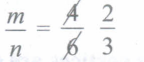
m=\(\frac{2}{3}\)n ...(1)
\(\Rightarrow \frac { m\alpha +180n }{ m+n } =360\) ...(2)
\(\Rightarrow \frac { \frac { 2 }{ 3 } n\alpha +180n }{ \frac { 2 }{ 3 } n+n } =360\)
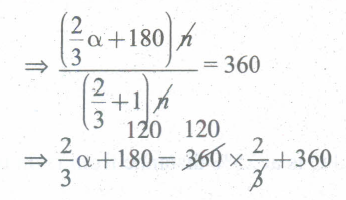
\(\Rightarrow \frac { 2 }{ 3 } \alpha =240+360-180\)
\(\frac { 2 }{ 3 } \alpha =600-180\)
\(\frac { 2 }{ 3 } \alpha =420\)
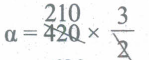
\(\alpha\)=630
\(\therefore\)The car will reach 630km at 12midnight
15.
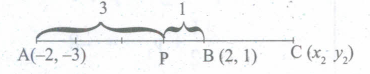
x1 y1 x2 y2
A(-2, -3) B(2, 1)
m : n = 3 : 1
The point P divides AB in the ratio 3 : 1
\(P(x,y)=\left( \frac { { mx }_{ 2 }+{ nx }_{ 1 } }{ m+n } ,\frac { { my }_{ 2 }+{ ny }_{ 1 } }{ m+n } \right) \)
\(=\left( \frac { 3\times 2+1\times -2 }{ 3+1 } ,\frac { 3\times 1+1\times -3) }{ 3+1 } \right) \)
\(=\left( \frac { 6-2 }{ 4 } ,\frac { 3-3 }{ 4 } \right) =\left( \frac { 4 }{ 4 } ,\frac { 0 }{ 4 } \right) =(1,0)\)
P is at 25% distance from B on its left and C is at 25% distance from B on its right
\(\therefore\) B is the mid point of PC
Mid point of \(\bar { PC } =\left( \frac { { x }_{ 1 }+{ x }_{ 2 } }{ 2 } ,\frac { { y }_{ 1 }+{ y }_{ 2 } }{ 2 } \right) \)
\((2,1)=\left( \frac { 1+{ x }_{ 2 } }{ 2 } ,\frac { 0+{ y }_{ 2 } }{ 2 } \right) \)
\(\frac { 1+{ x }_{ 2 } }{ 2 } =2\quad \frac { { y }_{ 2 } }{ 2 } =1\)
1 + x2 = 4 y2 = 2
⇒ x2 = 3, y2 = 2
∴ C(x2, y2) = (3, 2) is the solutions.
16.

\(\bar { AB } =\sqrt { { ({ x }_{ 2 }-{ x }_{ 1 }) }^{ 2 }+{ ({ y }_{ 2 }-{ y }_{ 1 }) }^{ 2 } } =\sqrt { { (-1-6) }^{ 2 }+{ (-4-3) }^{ 2 } } \)
\(=\sqrt { { (-7) }^{ 2 }+{ (-7) }^{ 2 } } =\sqrt { 49+49 } =\sqrt { (49)2 } \)
\(\frac { 1 }{ 2 } AB=\frac { 7\sqrt { 2 } }{ 2 } =\frac { 7\sqrt { 2 } }{ \sqrt { 2 } \times \sqrt { 2 } } =\frac { 7 }{ \sqrt { 2 } } \)
\(AB=\left( \frac { 6+(-1) }{ 2 } ,\frac { 3+(-4) }{ 2 } \right) =\left( \frac { 5 }{ 2 } ,\frac { -1 }{ 2 } \right) \)
Mid point of \(AB=\left( \frac { 6+(-1) }{ 2 } ,\frac { 3+(-4) }{ 2 } \right) =\left( \frac { 5 }{ 2 } ,\frac { -1 }{ 2 } \right) \)
SinceC is at the distance \(\frac{1}{2}\) AB from B
Midpoint of MC = B
\(\left( \frac { \frac { 5 }{ 2 } +{ x }_{ 3 } }{ 2 } ,\frac { \frac { -1 }{ 2 } +{ y }_{ 3 } }{ 2 } \right) =(-1,-4)\)
\(\left( \frac { \frac { 5 }{ 2 } +{ x }_{ 3 } }{ 2 } \right) =-1\)
\(\frac { 5 }{ 2 } +{ x }_{ 3 }=-2\)
\({ x }_{ 3 }=-2-\frac { 5 }{ 2 } \)
\(=\frac { -4-5 }{ 2 } \)
\(=\frac { -9 }{ 2 } \)
\(\therefore C({ x }_{ 3 },{ y }_{ 3 })=\left( \frac { -9 }{ 2 } ,\frac { -15 }{ 2 } \right) \)
\(\left( \frac { -\frac { 1 }{ 2 } +{ y }_{ 3 } }{ 2 } \right) =-4\)
|\(-\frac { 1 }{ 2 } +{ y }_{ 3 }=-8\)
\({ y }_{ 3 }=-8+\frac { 1 }{ 2 } \)
\(=\frac { -16+1 }{ 2 } \)
\(=\frac { -15 }{ 2 } \)
Similarly by Mid point of DM = A(6, 3)
\(\left( \frac { { x }_{ 4 }+\frac { 5 }{ 2 } }{ 2 } ,\frac { { y }_{ 4 }+\left( \frac { -1 }{ 2 } \right) }{ 2 } \right) =(6,3)\)
\(\frac { { x }_{ 4 }+\frac { 5 }{ 2 } }{ 2 } =6\)
\({ x }_{ 4 }+\frac { 5 }{ 2 } =12\)
\({ x }_{ 4 }=12-\frac { 5 }{ 2 } =\frac { 24-5 }{ 2 } =\frac { 19 }{ 2 } \)
\(\frac { { y }_{ 4 }+\left( \frac { -1 }{ 2 } \right) }{ 2 } =3\)
\({ y }_{ 4 }+\left( \frac { -1 }{ 2 } \right) =6\)
\({ y }_{ 4 }=6+\frac { 1 }{ 2 } =\frac { 12+102 }{ 2 } =\frac { 13 }{ 2 } \)
\(\therefore\) The other end D (x4, y4)\(=\left( \frac { 19 }{ 2 } ,\frac { 13 }{ 2 } \right) \)
17.

x1 y1
Here (-5,11)
x2 y2
(4,-7)
m n
7 : 2
\(=P(x,y)\left( \frac { { mx }_{ 2 }+{ nx }_{ 1 } }{ m+n } ,\frac { { my }_{ 2 }+{ ny }_{ 1 } }{ m+n } \right) \)
\(=\left( \frac { 7\times 4+2\times -5 }{ 7+2 } ,\frac { 7\times -7+2\times 11) }{ 7+2 } \right) \)
\(=\left( \frac { 28-10 }{ 9 } ,\frac { -49+22 }{ 9 } \right) \)
\(=\left( \frac { 18 }{ 9 } ,\frac { -27 }{ 9 } \right) =(2,-3)\)
18.
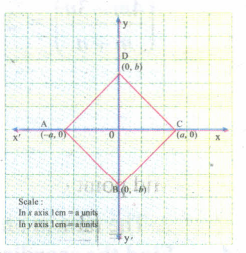
Mid point of Diagonal AC:
\(=\left( \frac { -a+a }{ 2 } ,\frac { 0+0 }{ 2 } \right) =\left( \frac { 0 }{ 2 } ,\frac { 0 }{ 2 } \right) =(0,0)\)
Mid point Diagonal of BD:
\(=\left( \frac { 0+0 }{ 2 } ,\frac { b+(-b) }{ 2 } \right) =\left( \frac { 0 }{ 2 } ,\frac { 0 }{ 2 } \right) =(0,0)\)
Mid point of AC = Mid point of BD
∴ Diagonals bisect each other
19.
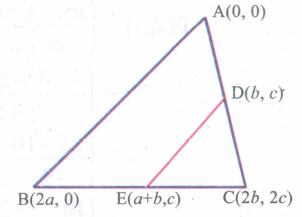
Mid point of AC

Mid point of BC
\(=\left( \frac { 2a+2b }{ 2 } ,\frac { 0+2c }{ 2 } \right) \)
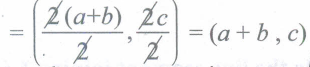
Distance between two points \(=\sqrt { { ({ x }_{ 2 }-{ x }_{ 1 }) }^{ 2 }+{ ({ y }_{ 2 }-{ y }_{ 1 }) }^{ 2 } } \)
\(\therefore \bar { AB } =\sqrt { { (2a-0) }^{ 2 }+({ 0-0) }^{ 2 } } =\sqrt { { 4a }^{ 2 } } =2a\)
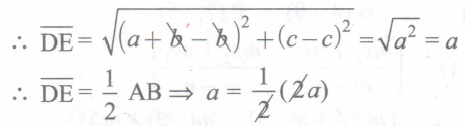
20.
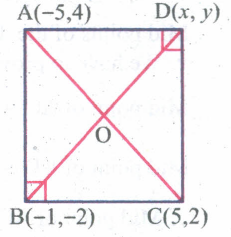
In a square the diagonals are equal and bisect each other
∴ Mid point of BD = Mid point of AC
\(\left( \frac { -1+x }{ 2 } ,\frac { -2+y }{ 2 } \right) =\left( \frac { -5+5 }{ 2 } ,\frac { 4+2 }{ 2 } \right) \)
\(\frac { -1+x }{ 2 } =\frac { 0 }{ 2 } \quad \frac { -2+y }{ 2 } =\frac { 6 }{ 2 } \)
-1 + x = -2 + y = 6
x =1 y = 8
∴ The vertex D(x, y) = (1, 8)
21.
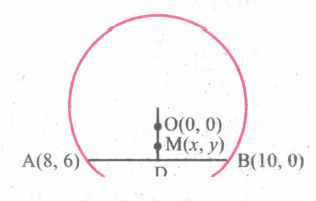
Mid point = \(\left( \frac { { x }_{ 1 }+{ x }_{ 2 } }{ 2 } ,\frac { { y }_{ 1 }+{ y }_{ 2 } }{ 2 } \right) \)
Mid point of AB=\(\left( \frac { 8+10 }{ 2 } ,\frac { 6+10 }{ 2 } \right) \)
\(=\left( \frac { 18 }{ 2 } ,\frac { 6 }{ 2 } \right) =(9,3)\)
Mid point M(x,y) = Mid point of OD
\(=\left( \frac { 0+9 }{ 2 } ,\frac { 0+3 }{ 2 } \right) =\left( \frac { 9 }{ 2 } ,\frac { 3 }{ 2 } \right) =(4.5,1.5) \)
22.
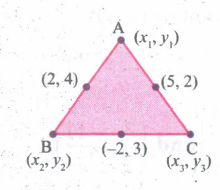
Mid point
\(M(x,y)=\left( \frac { { x }_{ 1 }+{ x }_{ 2 } }{ 2 } ,\frac { { y }_{ 1 }+{ y }_{ 2 } }{ 2 } \right) \)
Mid point AB(2, 4)=\(\left( \frac { { x }_{ 1 }+{ x }_{ 2 } }{ 2 } ,\frac { { y }_{ 1 }+{ y }_{ 2 } }{ 2 } \right) \)
\(\frac { { x }_{ 1 }+{ x }_{ 2 } }{ 2 } =2\Rightarrow { x }_{ 1 }+{ x }_{ 2 }=4\ \ \ ...(1)\)
\(\frac { { y }_{ 1 }+{ y }_{ 2 } }{ 2 } =4\Rightarrow { y }_{ 1 }+{ y }_{ 2 }\ \ \ ...(2)\)
Mid point of BC (-2, 3) =\(\left( \frac { { x }_{ 2 }+{ x }_{ 3 } }{ 2 } ,\frac { { y }_{ 2 }+{ y }_{ 3 } }{ 2 } \right) \)
\(\left( \frac { { x }_{ 2 }+{ x }_{ 3 } }{ 2 } \right) =-2\Rightarrow { x }_{ 2 }+{ x }_{ 3 }=-4 \quad ...(3)\)
\(\left( \frac { { y }_{ 2 }+{ y }_{ 3 } }{ 2 } \right) =3\Rightarrow { y }_{ 2 }+y_{ 3 }=6\ \quad ...(4)\)
Mid point of AC (5, 2) =\(\left( \frac { { x }_{ 1 }+{ x }_{ 3 } }{ 2 } ,\frac { { y }_{ 1 }+{ y }_{ 3 } }{ 2 } \right) \)
\(\left( \frac { x_{ 1 }+{ x }_{ 3 } }{ 2 } \right) =3\Rightarrow x_{ 1 }+x_{ 3 }=10 \quad ...(5)\)
\(\frac { { y }_{ 1 }+{ y }_{ 3 } }{ 2 } =3\Rightarrow { y }_{ 1 }+y_{ 3 }=4 \quad ...(6)\)
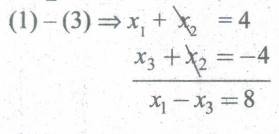
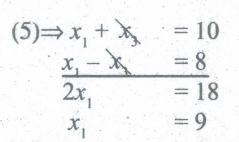
Substitute x1 = 9 in (5)
9 +X3 = 10
X3 = 1
Substitute X1 = 1 in (3)
x2 + 1 = -4 ⇒ x2 = -5
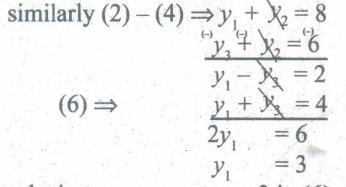
substitute y1 = 3 in (6)
3 + y3 = 4
y3 = 1
substitute y3 = 1 in (4)
1 + y2 = 6
y3 = 5
ஃ The vertices of the triangle A(x1 y1) = (9, 3)
B (x2 y2) = (-5, 5)
C(x3y3) = (1, 1)
23.
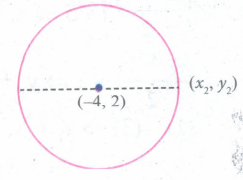
\(M(x,y)=\left( \frac { { x }_{ 1 }+{ x }_{ 2 } }{ 2 } ,\frac { { y }_{ 1 }+{ y }_{ 2 } }{ 2 } \right) \)
\((-4,2)=\left( \frac { -3+{ x }_{ 2 } }{ 2 } ,\frac { 7+{ y }_{ 2 } }{ 2 } \right) \left( { x }_{ 1 }{ y }_{ 1 } \right) \)
\(\frac { -3+{ x }_{ 2 } }{ 2 } =-4\quad \frac { 7+{ y }_{ 2 } }{ 2 } =2\)
-3 + x2 = -8
7 +y2 = 4
x2 = -8 +3
y2 = 4 -7 = -3
x2 = -5
The other end is (-5, -3)
24.
(b)
(2, 3)
25.
(b)
5
26.
(d)
5 : 2
27.
(b)
(−2a, −b)
28.
(b)
(4, 0), (2, 8)
29.
(c)
4:7
30.
(b)
−b1 : b2
31.
(c)
1 : 3
32.
(a)
(-9, 7)
33.
(d)
(4, 6)

9th Standard Syllabus & Materials
9th Standard
TN 9th Tamil உள்ளத்தின் சீர் - திருக்குறள் Important Questions And Answers Study Material - QB365 Set A
NEW9th Standard
TN 9th Tamil உள்ளத்தின் சீர் - மணிமேகலை Important Questions And Answers Study Material - QB365 Set A
NEW9th Standard
TN 9th Tamil உள்ளத்தின் சீர் - ஏறு தழுவுதல் Important Questions And Answers Study Material - QB365 Set A
NEW9th Standard
TN 9th Tamil உயிருக்கு வேர் - தண்ணீர் Important Questions And Answers Study Material - QB365 Set A



Tamilnadu Stateboard 9th Standard Subjects
Tamilnadu Stateboard Standards





