
 100% FREE ACCESS
9th Standard Syllabus & Materials
9th Standard
TN 9th Tamil உள்ளத்தின் சீர் -கற்கண்டு (இலக்கணம்) - தொடர் இலக்கணம், ஆகுபெயர் Important Questions And Answers Study Material - QB365 Set A
NEW9th Standard
TN 9th Tamil உள்ளத்தின் சீர் -விரிவானம் (துணைப்பாடம்) - தாய்மைக்கு வறட்சி இல்லை! Important Questions And Answers Study Material - QB365 Set A
NEW9th Standard
TN 9th Tamil உள்ளத்தின் சீர் -கவிதை பேழை (செய்யுள்) - மார்கழி பெருவிழா Important Questions And Answers Study Material - QB365 Set A
NEW9th Standard
TN 9th Tamil உயிருக்கு வேர்-இலக்கணம் - பகுபத உறுப்பிலக்கணம் Important Questions And Answers Study Material - QB365 Set A
NEW9th Standard
TN 9th Tamil அமுதென்று பேர் - இலக்கணம்-எழுத்து -அளபெடை Important Questions And Answers Study Material - QB365 Set A
NEW9th Standard
TN 9th Tamil அமுதென்று பேர்-துணைப்பாடம் - ஆறாம்திணை Important Questions And Answers Study Material - QB365 Set A

Published on: 18/01/2019
Term 3 - Probability Complete Study Material
Download Tamil Nadu 9th Standard Maths question papers, model tests, one-mark questions, important questions, and public exam papers in PDF format. Free study materials and answer keys for TN State Board students.
Questions + Answers key
Take MCQ Maths Test1.
In a recent year, of the 1184 centum scorers in various subjects in tenth standard public exams, 233 were in mathematics. 125 in social science and 106 in science. If one of the student is selected at random, find the probability of that selected student,
(i) is a centum scorer in Mathematics
(ii) is not a centum scorer in Science
2.
The probability that it will rain tomorrow is \(\\ \frac { 91 }{ 100 } \). What is the probability that it will not rain tomorrow?
3.
Team I and Team II play 10 cricket matches each of 20 overs. Their total scores in each match are tabulated in the table as follows:
| Match numbers | 1 | 2 | 3 | 4 | 5 | 6 | 7 | 8 | 9 | 10 |
| Team I | 200 | 122 | 111 | 88 | 156 | 184 | 99 | 199 | 121 | 156 |
| Team II | 143 | 123 | 156 | 92 | 164 | 72 | 100 | 201 | 98 | 157 |
What is the relative frequency of Team I winning?
4.
In an office, where 42 staff members work, 7 staff members use cars, 20 staff members use two-wheelers and the remaining 15 staff members use cycles. Find the relative frequencies.
5.
When a dice is rolled, find the probability to get the number greater than 4?
6.
1500 families were surveyed and following data was recorded about their maids at homes
| Type of maids | Only part time | Only full time | Both |
| Number of families | 860 | 370 | 250 |
A family is selected at random. Find the probability that the family selected has
(i) Both types of maids
(ii) Part time maids
(iii) No maids
7.
If a probability of a player winning a particular tennis match is 0.72. What is the probability of the player losing the match?
8.
The probability of guessing the correct answer to a certain question is \(\frac { x }{ 3 } \). If the probability of not guessing the correct answer is \(\frac { x }{ 5 } \), then find the value of x.
9.
In a survey of 400 youngsters aged 16-20 years, it was found that 191 have their voter ID card. If a youngster is selected at random, find the probability that the youngster does not have their voter ID card.
10.
A company manufactures 10,000 Laptops in 6 months. In that 25 of them are found to be defective. When you choose one Laptop from the manufactured, what is the probability that selected Laptop is a good one.
11.
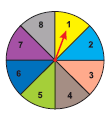
Frame two problems in calculating probability, based on the spinner shown here.
12.
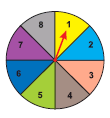
What is the probability that the spinner will not land on a multiple of 3?
13.
In a football match, a goalkeeper of a team can stop the goal, 32 times out of 40 attempts tried by a team. Find the probability that the opponent team can convert the attempt into a goal.
14.
A manufacturer tested 7000 LED lights at random and found that 25 of them were defective. If a LED light is selected at random, what is the probability that the selected LED light is a defective one.
15.
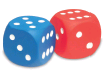
Two dice are rolled, find the probability that the sum is
(i) equal to 1
(ii) equal to 4
(iii) less than 13
16.
When two coins are tossed, what is the probability that two heads are obtained?
17.
There are 24 balls in a pot. If 3 of them are Red, 5 of them are Blue and the remaining are Green then, what is the probability of picking out
(i) a Blue ball
(ii) a Red ball and
(iii) a Green ball?
18.
What is the probability of throwing an even number with a single standard dice of six faces?
19.
What is the probability of drawing a King or a Queen or a Jack from a deck of cards?
20.
You are walking along a street. If you just choose a stranger crossing you, what is the probability that his next birthday will fall on a Sunday?
21.
A letter is chosen at random from the word “STATISTICS”. The probability of getting a vowel is
\(\frac { 1 }{ 10 } \)
\(\frac { 2 }{ 10 } \)
\(\frac { 3 }{ 10 } \)
\(\frac { 4 }{ 10 } \)
22.
The six faces of the dice are called equally likely if the dice is _______.
Small
Fair
Six-faced
Round
23.
A particular result of an experiment is called _______.
Trial
Simple event
Compound event
Outcome
24.
Which of the following cannot be taken as probability of an event?
0
0.5
1
-1
25.
The probability of all possible outcomes of a random experiment is always equal to _______.
One
Zero
Infinity
Less than one
26.
A random experiment contains
At least one outcome
At least two outcomes
At most one outcome
At most two outcomes
27.
The probability of an event cannot be _______.
Equal to zero
Greater than zero
Equal to one
Less than zero
28.
The probability based on the concept of relative frequency theory is called _______.
Empirical probability
Classical probability
Both (1) and (2)
Neither (1) nor (2)
29.
Probability lies between _______.
−1 and +1
0 and 1
0 and n
0 and \(\infty \)
30.
A number between 0 and 1 that is used to measure uncertainty is called _______.
Random variable
Trial
Simple event
Probability
1.
Total number of centum scorers = 1184
Therefore n = 1184
(i) Let E1 be the event of getting a centum scorer in Mathematics.
Therefore n(E1) = 233, That is, r1 = 233
\(P({ E })_{ 1 }=\frac { { r }_{ 2 } }{ n } =\frac { 233 }{ 1184 } \)
(ii) Let E2 be the event of getting a centum scorer in Science.
Therefore n(E2 ) = 106, That is, r2 = 106
\(P({ E })_{ 2 }=\frac { { r }_{ 2 } }{ n } =\frac {106 }{ 1184 } \)
P(E'2) = 1− P(E2)
\(=1-\frac { 106 }{ 1184 } \)
\(=\frac { 1078 }{ 1184 } \)
2.
Let E be the event that it will rain tomorrow. Then E′ is the event that it will not rain tomorrow.
Since P(E) = 0.91, we have P(E′) = 1−0.91 (how?)
= 0.09
Therefore, the probability that it will not rain tomorrow
= 0.09
3.
In this experiment, each trial is a match where Team I faces Team II.
We are concerned about the winning status of Team I.
There are 10 trials in total; out of which Team I wins in the 1st, 6th and 9th matches.
The relative frequency of Team I winning the matches = \(\frac { 3 }{ 10 } \)or 0.3
4.
Total number of staff members = 42
The relative frequencies:
Car users \(=\frac { 7 }{ 42 } =\frac { 1 }{ 6 } \)
Two-wheeler users \(=\frac { 20 }{ 42 } =\frac { 10 }{ 21 } \)
Cycle users \(=\frac { 15 }{ 42 } =\frac { 5 }{ 14 } \)
5.
Sample space S = {1, 2, 3, 4, 5, 6}
Let E be the event of getting a number greater than 4
E = {5, 6}
\(P(E)=\frac { Number\ of\ favourable\ outcomes }{ Total\ number\ of\ outcomes } \)
\(P(E)=\frac { n(E) }{ n(S) } =\frac { 2 }{ 6 } =0.333...\)
6.
Total number of families S = 1500
n(S) = 1569
Let P be the event of selecting a family having part time maids and F be the event of selecting a family having full time maids.
(i) Both types of maids Let P \(\cap\) F be the event of selecting a family having both types of maids.
Let (P \(\cap\) F) = 259
\(\mathrm{P}(\mathrm{P} \cap \mathrm{F})=\frac{\mathrm{n}(\mathrm{P} \cap \mathrm{F})}{\mathrm{n}(\mathrm{S})}=\frac{250}{1500}=\frac{1}{6}\)
(ii) Part time maids Part time maids = only part time maid + both
= 860 + 250 = 1110 '
n(P) = 1110
\(\mathrm{p}(\mathrm{P})=\frac{\mathrm{n}(\mathrm{P})}{\mathrm{n}(\mathrm{S})}=\frac{1110}{1500}=\frac{111}{150}\)
(iii) No maids Let (P \(\cup\) P)'be the event of choosing a family not having maids and (P u F) be the event of choosing a family having part time or full time or both maids.
n(P \(\cup\) F ) = only n(P) + only n(F) + n(p \(\cap\) p) = 850 + 370 + 250
n(P\(\cup\)F) = 1480
n(P\(\cup\)F)' = n(S)-n(P\(\cup\)F)
= 1500 - 1480
n(P \(\cup\) F)' = 20
\(\mathrm{P}(\mathrm{P} \cup \mathrm{F})^{\prime}=\frac{\mathrm{n}(\mathrm{P} \cup \mathrm{F})^{\prime}}{\mathrm{n}(\mathrm{S})}=\frac{20}{1500}=\frac{1}{75}\)
7.
p(A) = 0.72
P(A') = 1 - 0.72 = 0.28
8.
\(\frac { x }{ 3 } +\frac { x }{ 5 } \) = 1
\(\frac { 5x+3x }{ 15 } \) = 1
\(\frac { 8x }{ 15 } \) = 1
8x = 15
x = \(\frac { 15 }{ 8 } \)
9.
No. of youngsters = 400
n(S)
No. of youngsters having voter id = 191
n(A)
No. of youngsters do not have their voter id
n(B) = 400 - 191 = 209
P(B) = \(\frac { n(B) }{ n(S) } =\frac { 209 }{ 400 } \).
10.
Total n(S) = 10,000
Defective n(A) = 25
Number of defective laptop is 25
Number of good laptop is = 10000 - 25 = 9975
Let A be the event of choosing a good laptop. n(A) = 9975
\(\mathrm{P}(\mathrm{A})=\frac{\mathrm{n}(\mathrm{A})}{\mathrm{n}(\mathrm{S})}=\frac{9975}{10000}\)
P(A) = 0.9975
Probability of getting a good laptop is 0.9975
11.
(i) What is the probability that the spinner will not land on a multiple of 2?
(ii) What is the probability that the spinner will land on an odd number?
12.
Total no. of choices = 8
n(S)
Total no. of multiples of 3 (A) = {3, 6}
n(A) = 2
Event of non-multiples of 3(B) = {1, 2, 4, 5, 7, 8}
n(B) = 6
\(\frac { n(B) }{ n(S) } =\frac { 6 }{ 8 } =\frac { 3 }{ 4 } \).
13.
Total no. of attempts n(S) = 40
Total no. of attempts by A team n(A) = 32
Total no. of attempts by the opponent team B = n(B) = 40 - 32 = 8
P(B) = \(\frac { n(B) }{ n(S) } =\frac { 8 }{ 40 } =\frac { 1 }{ 5 } \).
14.
n(S) = 7000
S - Total no. of lights.
n(A) = 25
A - Defective ones.
P(A) = \(\frac { n(A) }{ n(S) } =\frac { 25 }{ 7000 } =\frac { 1 }{ 280 } \).
15.
When two dice are rolled
Sample space
S = {(1,1), (1,2), (1,3), (1,4), (1,5), (1,6), (2,1), (2,2), (2,3), (2,4), (2,5), (2,6), (3,1), (3,2), (3,3), (3,4), (3,5), (3,6), (4,1), (4,2), (4,3), (4,4),(4,5),(4,6), (5,1), (5,2), (5,3), (5,4), (5,5), (5,6), (6,1), (6,2), (6,3), (6,4), (6,5), (6,6)}
n(S) = 36
(i) Event of the sum is equal to 1 = 0
∴ Probability = \(\frac { 0 }{ n(S) } \) = 0
(ii) Event of the sum is equal to 4
B = {(1, 3), (2, 2), (3, 1)}
n(B) = 3
P(B)= \(\frac { n(B) }{ n(S) } =\frac { 3 }{ 6 } =\frac { 1 }{ 12 } \)
(iii) Event of the sum is equal to less than 13
C= {(1,1), (1,2), (1,3), (1,4), (1,5), (1,6), (2,1), (2,2), (2,3), (2,4), (2,5), (2,6), (3,1), (3,2), (3,3), (3,4), (3,5), (3,6), (4,1), (4,2), (4,3), (4,4), (4,5), (4,6), (5,1), (5,2), (5,3), (5,4), (5,5), (5,6), (6,1), (6,2), (6,3), (6,4), (6,5), (6,6)}
n(C) = 36
P(C) = \(\frac { n(C) }{ n(S) } =\frac { 36 }{ 6 } \).
16.
sample space when two coins are tossed (S) = {HH, TT, HT, TH}
n(S) = 4
Event of getting two heads (A) = {HH}
n(A) = 1
Probability of getting two heads p(A) = \(\frac { n(A) }{ n(S) } =\frac { 1 }{ 4 } \).
17.
n(S) = 24
Red = n(R) = 3
Blue = n(B) = 5
Green= n(G) = 16
(i) Probability of picking a Blue ball =\(\frac { n(B) }{ n(S) } =\frac { 5 }{ 24 } \)
(ii) Probability of picking a Red ball =\(\frac { n(R) }{ n(S) } =\frac { 3 }{ 24 } =\frac { 1 }{ 8 } \)
(iii) Probability of picking a Green ball =\(\frac { n(G) }{ n(S) } =\frac { 16 }{ 24 } =\frac { 2 }{ 3 } \).
18.
Faces of a dice (S) = {1, 2, 3, 4,5, 6}
n(S) = 6
Event of throwing an even number
A = {2, 4, 6}, n(A) = 3
∴ Probability of throwing an even number
P(A) = \(\frac { n(A) }{ n(S) } =\frac { 3 }{ 6 } =\frac { 1 }{ 2 } \).
19.
Number of cards n(S) = 52
No. of King cards n(A) = 4
No. of Queen cards n(B) = 4
No. of Jack cards n(C) = 4
Probability of drawing a King card
\(\frac { n(A) }{ n(S) } =\frac { 4 }{ 52 } \)
Probability of drawing a Queen card
=\(\frac { n(B) }{ n(S) } =\frac { 4 }{ 52 } \)
Probability of drawing a Jack card
=\(\frac { n(C) }{ n(S) } =\frac { 4 }{ 52 } \)
∴ The Probability of drawing a King or a Queen or a Jack from a deck of cards
= p(A) + P(B)+ P(C) =\(\frac { 4 }{ 52 } +\frac { 4 }{ 52 } +\frac { 4 }{ 52 } =\frac { 4+4+4 }{ 52 } =\frac { 12 }{ 52 } =\frac { 3 }{ 13 } \).
20.
(S) Days in a week = {Sunday, Monday, Tuesday, Wednesday, Thursday, Friday, Saturday}
n(S) = 7
∴ No. of days in week = 7
(A) Event of selecting Sunday = {Sunday}
n(A) = 1
∴ Probability of selecting Sunday = \(\frac { n(A) }{ n(S) } =\frac { 1 }{ 7 } \).
21.
(c)
\(\frac { 3 }{ 10 } \)
22.
(b)
Fair
23.
(d)
Outcome
24.
(d)
-1
25.
(a)
One
26.
(b)
At least two outcomes
27.
(d)
Less than zero
28.
(a)
Empirical probability
29.
(b)
0 and 1
30.
(d)
Probability

9th Standard Syllabus & Materials
9th Standard
TN 9th Tamil உள்ளத்தின் சீர் - திருக்குறள் Important Questions And Answers Study Material - QB365 Set A
NEW9th Standard
TN 9th Tamil உள்ளத்தின் சீர் - மணிமேகலை Important Questions And Answers Study Material - QB365 Set A
NEW9th Standard
TN 9th Tamil உள்ளத்தின் சீர் - ஏறு தழுவுதல் Important Questions And Answers Study Material - QB365 Set A
NEW9th Standard
TN 9th Tamil உயிருக்கு வேர் - தண்ணீர் Important Questions And Answers Study Material - QB365 Set A



Tamilnadu Stateboard 9th Standard Subjects
Tamilnadu Stateboard Standards





