
 100% FREE ACCESS
9th Standard Syllabus & Materials
9th Standard
TN 9th Tamil உள்ளத்தின் சீர் -கற்கண்டு (இலக்கணம்) - தொடர் இலக்கணம், ஆகுபெயர் Important Questions And Answers Study Material - QB365 Set A
NEW9th Standard
TN 9th Tamil உள்ளத்தின் சீர் -விரிவானம் (துணைப்பாடம்) - தாய்மைக்கு வறட்சி இல்லை! Important Questions And Answers Study Material - QB365 Set A
NEW9th Standard
TN 9th Tamil உள்ளத்தின் சீர் -கவிதை பேழை (செய்யுள்) - மார்கழி பெருவிழா Important Questions And Answers Study Material - QB365 Set A
NEW9th Standard
TN 9th Tamil உயிருக்கு வேர்-இலக்கணம் - பகுபத உறுப்பிலக்கணம் Important Questions And Answers Study Material - QB365 Set A
NEW9th Standard
TN 9th Tamil அமுதென்று பேர் - இலக்கணம்-எழுத்து -அளபெடை Important Questions And Answers Study Material - QB365 Set A
NEW9th Standard
TN 9th Tamil அமுதென்று பேர்-துணைப்பாடம் - ஆறாம்திணை Important Questions And Answers Study Material - QB365 Set A

Published on: 25/09/2019
Real Numbers
Download Tamil Nadu 9th Standard Maths question papers, model tests, one-mark questions, important questions, and public exam papers in PDF format. Free study materials and answer keys for TN State Board students.
Questions + Answers key
Take MCQ Maths Test1.
Represent the following numbers on the number line.
(i) 5.348
(ii) \(6.\bar { 4 } \) up to 3 decimal places
(iii) \(4.\overline { 73 } \) up to 4 decimal places
2.
Find any two irrational numbers between\(\frac { 6 }{ 7 } \) and \(\frac { 12 }{ 13 } \)
3.
Write in scientific notation ;(60000000)3
4.
Simplify;\(\sqrt { 44 } +\sqrt { 99 } -\sqrt { 275 } \)
5.
Find the decimal expansion of \(\sqrt { 3 } \)
6.
Express the following decimal expression into rational numbers \(17.2\overline { 15 } \)
7.
Express the following decimal expression into rational numbers. \(0.\overline { 24 } \)
8.
The value of \(\bar { 0.03 } \) +\(\bar { 0.03 } \) is ___________.
\(\bar { 0.09 } \)
\(\bar { 0.09 } \)
\(\bar { 0.09 } \)
0
9.
Which one of the following has terminating decimal expansion?
\(\frac { 7 }{ 9 } \)
\(\frac { 8 }{ 15 } \)
\(\frac { 1 }{ 2 } \)
\(\frac { 5 }{ 32 } \)
10.
\(0.\overline { 34 } +0.3\bar { 4 } \) = ________.
\(0.6\overline { 87 } \)
\(0.\overline { 68 } \)
\(0.6\bar { 8 } \)
\(0.68\bar { 7 } \)
11.
The number \(0.\bar { 3 } \) in the form \(\frac { p }{ q } \) where p and q are integers and \(q\neq 0\)
\(\frac { 33 }{ 100 } \)
\(\frac { 3 }{ 10 } \)
\(\frac { 1 }{ 3 } \)
\(\frac { 3 }{ 100 } \)
12.
Which one of the following, regarding sum of two irrational numbers, is true?
always an irrational number
may be a rational or irrational number
always a rational number
always an integer.
13.
If n is a natural number then \(\sqrt { n } \) is ________.
always a natural number
always an irrational number
always a rational number
may be rational or irrational
14.
Divide \(15\sqrt { 12 } \) by \(3\sqrt { 3 } \) the result is ___________.
15.
The rational number equivalent to \(\frac { 5 }{ 9 } \) such that its numerator is 25 is____________ .
16.
If \(\sqrt { 10 } \)= 3.1622, then the value of is \(\frac { 1 }{ \sqrt { 10 } } \) is_________.
17.
The value of \(\left[ \sqrt { { x }^{ 3 } } \right] ^{2/3}\) is
18.
The value of \(3\sqrt { 3 } +\sqrt { 3 } \) is ______________.
19.
Find any two rational numbers between \(\frac { 1 }{ 2 } \) and \(\frac { 2 }{ 3 } \)
20.
Give any two rational numbers lying between 0.5151151115…. and 0.5353353335…
21.
We used to write \(\sqrt{2}=1.414=\frac{1414}{1000}.\) Can we say \(\sqrt{2}\) is a rational number?
22.
Verify that 1 = \(0.\overline { 9 } \)
23.
Convert the following decimal numbers in the form of \(\frac { p }{ q } (p,q\in Z\ and\ q\neq 0)\)
(i) \(0.\overline { 3 } \)
(ii) \(2.\overline { 124 } \)
(iii) \(0.4\overline { 5 } \)
(iv) \(0.5\overline { 68 } \)
24.
Express the rational number \(\frac { 1 }{ 27 } \) in recurring decimal form by using the recurring decimal expansion of \(1\over3\). Hence write\(\frac { 59 }{ 27 } \) in recurring decimal form.
25.
Find any three rational numbers between \(\frac { -7 }{ 11 } \)and \(\frac { 2 }{ 11 } \)
1.
(i) 5.348 lies between 5 and 6.
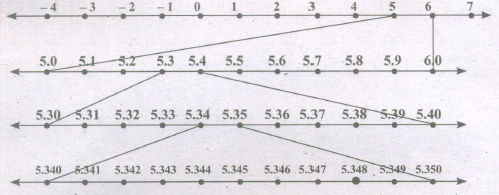
Steps of construction:
1. Divide the distance between 5 and 6 into 10 equal intervals.
2. Mark the point 5.3 which is the sixth from the left of 6 and 3 from the right of 5.
3. 5.34 lies between 5.30 and 5.40. Divide the distance into 10 equal intervals.
4. Mark the point 5.34 which is sixth from the left of 5.40
5. 5.348 lies between 5.34 and 5.35. Divide the distance into 10 equal intervals.
6. Mark a point 5.348 which is second from the left of 5.350 and seventh from the right of 5.340.
(ii) \(6.\overline{4}\) up to 3 decimal places.
\(6.\overline{4}\) = 6.4444 .......
\(6.\overline{4}\) = 6.444 (correct to 3 decimal places)
The number lies between 6 and 7.
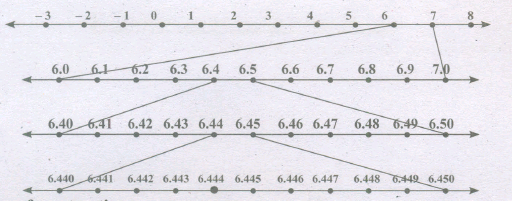
Steps of construction:
1. Divide the distance between 6 and 7 into 10 equal intervals.
2. Mark the point 6.4 which is the sixth from the left of 7 and fourth from the right of 6.
3. 6.44 lies between 6.4 and 6.5. Divide the distance into 10 equal intervals.
4. Mark the point 6.44 which is sixth from the left of 6.5 and fourth from the right of 6.40.
5. Mark the point 6.444 which is sixth from the left of 6.450 and fourth from the right of 6.440.
(iii) \(4.\overline{73}\) = 4.737373 ......
= 4.737374 (correct to 4 decimal places 4.7374 lies between 4 and 4)
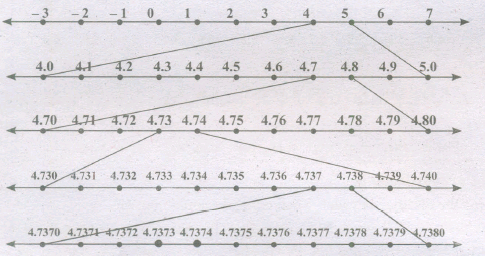
Steps of construction:
1. Divide the distance between 4 and 5 into 10 equal parts.
2. Mark the point 4.7 which is third from the left of 5 and seventh from the right of 4.
3. 4.73 lies between 4.7 and 4.8. Divide the distance into 10 equal intervals.
4. Mark the point 4.73 which is seventh from the left of 4.80 and third from the left of 4.70.
5. 4.737 lies between 4.73 and 4.74. Divide the distance into 10 equal intervals.
6. Mark the point 4.737 which is third from the left of 4.740 and seventh from the right of 4.730.
7. 4.7374 lies between 4.737 and 4.738. Divide the distance into 10 equal intervals.
8. Mark the point 4.7374 which is sixth from the left of 4.7380 and fourth from the right of 4.7370.
2.
\({6\over 7}=0.\overline {857142}\)
\({12\over 13}=0.\overline{923076}\)
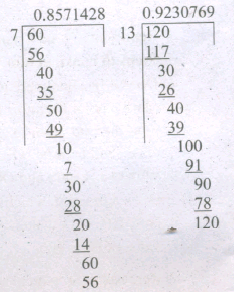
The two irrational numbers are 0.866142 ...and 0.903076.......
3.
(60000000)3 = \(\left(6.0 \times 10^{7}\right)^{4}=(6.04)^{4} \times\left(10^{7}\right)^{4}\)
\(
=1296 \times 10^{28}=1.296 \times 10^{3} \times 10^{28} \\
=1.296 \times 10^{31}
\)
4.
\(\sqrt { 44 } +\sqrt { 99 } -\sqrt { 275 } \) = \(\sqrt { 4\times 11 } +\sqrt { 9\times 11 } -\sqrt { 11\times 25 } \)
= \(\left( 2\sqrt { 11 } +3\sqrt { 11 } \right) -5\sqrt { 11 } =5\sqrt { 11 } -5\sqrt { 11 } =0\)
5.
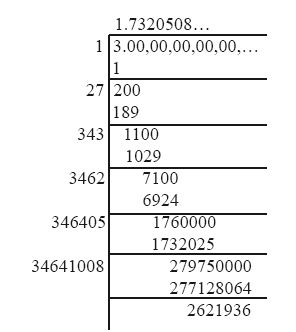
Thus, by division method \(\sqrt { 3 } \) = 1.7320508…
It is found that the square root of every positive non perfect square number is an irrational number \(\sqrt { 2 } ,\sqrt { 3 } ,\sqrt { 5 } ,\sqrt { 6 } ,\sqrt { 7 } \)..... are all irrational numbers.
6.
Let x = 17.2151515 ...... (1)
Here period of decimal is 3, multiply equation (1) by 1000
1000 x = 17215.151515
(2) - (1)
999x = 17197.936
\( x=\frac{17197.936}{999} \\ x=\frac{17197936}{999000} \\ x=\frac{5681}{330} \)
7.
Let x = 0.242424..... \(\rightarrow\) (1)
100 x = 24.2424 ...... \(\rightarrow\) (2)
(2) - (1) \(\Rightarrow\) 100x - x = 24.2424
99x = 24
x = \(24\over 99\) (or) \(8\over 33\)
x = \(8\over 33\)
8.
(c)
\(\bar { 0.09 } \)
9.
(d)
\(\frac { 5 }{ 32 } \)
10.
(a)
\(0.6\overline { 87 } \)
11.
(c)
\(\frac { 1 }{ 3 } \)
12.
(b)
may be a rational or irrational number
13.
(d)
may be rational or irrational
14.
()
10
15.
()
\(\frac { 25 }{ 45 } \)
16.
()
0.31623
17.
()
x
18.
()
\(4\sqrt { 3 } \)
19.
A rational number between \(\frac { 1 }{ 2 } \) and \(\frac { 2 }{ 3 } \) = \(\frac { 1 }{ 2 } \left( \frac { 1 }{ 2 } +\frac { 2 }{ 3 } \right) =\frac { 1 }{ 2 } \left( \frac { 3+4 }{ 6 } \right) =\frac { 1 }{ 2 } \left( \frac { 7 }{ 6 } \right) =\frac { 7 }{ 12 } \)
A rational number between \(\frac { 1 }{ 2 } \) and \(\frac { 7 }{ 12 } \) = \(\frac { 1 }{ 2 } \left( \frac { 1 }{ 2 } +\frac { 7 }{ 12 } \right) =\frac { 1 }{ 2 } \left( \frac { 6+7 }{ 12 } \right) =\frac { 1 }{ 2 } \left( \frac { 13 }{ 12 } \right) =\frac { 13 }{ 24 } \)
Hence two rational numbers between \(\frac { 1 }{ 2 } \) and \(\frac { 2 }{ 3 } \) are \(\frac { 7 }{ 12 } \) and \(\frac { 13 }{ 24 } \) (of course, there are many more!)
There is an interesting result that could help you to write instantly rational numbers between any two given rational numbers.
20.
Two rational numbers between the given two irrational numbers are 0.5152 and 0.5352
21.
No. \(\sqrt{2}\) = 1.4142135 .... it is an irrational number. It has non-terminating and non-repeating decimal representation.
22.
Let x = \(0.\overline { 9 } \) = 0.99999… (1)
(Multiply equation (1) by 10)
10 x = 9.99999… (2)
Subtract (1) from (2)
9x = 9 or x = 1
Thus, \(0.\overline { 9 } \) = 1
23.
(i) Let \(x=0.\overline { 3 } \)= 0.3333 (1)
(Here period of decimal is 1, multiply equation (1) by 10)
10x = 3.3333.... (2)
(2) - (1) : 9x = 3 or \(x=\frac { 1 }{ 3 } \)
(ii) Let \(x=2.\overline { 124 } \) = 2.124124124… (1)
(Here period of decimal is 3, multiply equation (1) by 1000)
1000 x = 2124.124124124… (2)
(2)–(1): 999 x = 2122 \(x=\frac { 2122 }{ 999 } \)
(iii) Let x = \(0.4\overline { 5 } \) = 0.45555… (1)
(Here the repeating decimal digit is 5, which is the second digit after the decimal point, multiply equation (1) by 10)
10 x = 4.5555… (2)
(Now period of decimal is 1, multiply equation (2) by 10)
100 x = 45.5555… (3)
(3) – (2): 90 x = 41 or \(x=\frac { 41 }{ 90 } \)
(iv) Let x = \(0.5\overline { 68 } \)= 0.5686868… (1)
(Here the repeating decimal digit is 68, which is the second digit after the decimal point, so multiply equation (1) by 10)
10 x = 5.686868… (2)
(Now period of decimal is 2, multiply equation (2) by 100)
1000 x = 568.686868… (3)
3) – (2): 990 x = 563 or \(x=\frac { 563 }{ 990 } \)
24.
We know that \(\frac { 1 }{ 3 } =0.\overline { 3 } \)
Therefore \(\frac { 1 }{ 27 } =\frac { 1 }{ 9 } \times \frac { 1 }{ 3 } \times \frac { 1 }{ 9 } \times 0 333... = 0.037037..\ =\ 0.\overline { 037 } \)
Also, \(\frac { 59 }{ 27 } =2\frac { 5 }{ 27 } =2+\frac { 5 }{ 27 } =2+\left( 5\times \frac { 1 }{ 27 } \right) \)
\(=2+(5\times 0.\overline { 037 } )=2+(5\times 0.037037037..)\)
\(=2+0.185185...=2.185185..\quad =2.\overline { 185 } \)
25.
The rational numbers between \(-7\over 11\) and \(2\over 11\) is
\(\frac {- 6 }{ 11 } , \frac { -5 }{ 11 } , \frac { -4 }{ 11 },\frac {- 3 }{ 11 },\frac {- 2 }{ 11 },\frac {- 1 }{ 11 } , 0, \frac { 1 }{ 11 } \)

9th Standard Syllabus & Materials
9th Standard
TN 9th Tamil உள்ளத்தின் சீர் - திருக்குறள் Important Questions And Answers Study Material - QB365 Set A
NEW9th Standard
TN 9th Tamil உள்ளத்தின் சீர் - மணிமேகலை Important Questions And Answers Study Material - QB365 Set A
NEW9th Standard
TN 9th Tamil உள்ளத்தின் சீர் - ஏறு தழுவுதல் Important Questions And Answers Study Material - QB365 Set A
NEW9th Standard
TN 9th Tamil உயிருக்கு வேர் - தண்ணீர் Important Questions And Answers Study Material - QB365 Set A



Tamilnadu Stateboard 9th Standard Subjects
Tamilnadu Stateboard Standards





