
 100% FREE ACCESS
9th Standard Syllabus & Materials
9th Standard
TN 9th Tamil உள்ளத்தின் சீர் -கற்கண்டு (இலக்கணம்) - தொடர் இலக்கணம், ஆகுபெயர் Important Questions And Answers Study Material - QB365 Set A
NEW9th Standard
TN 9th Tamil உள்ளத்தின் சீர் -விரிவானம் (துணைப்பாடம்) - தாய்மைக்கு வறட்சி இல்லை! Important Questions And Answers Study Material - QB365 Set A
NEW9th Standard
TN 9th Tamil உள்ளத்தின் சீர் -கவிதை பேழை (செய்யுள்) - மார்கழி பெருவிழா Important Questions And Answers Study Material - QB365 Set A
NEW9th Standard
TN 9th Tamil உயிருக்கு வேர்-இலக்கணம் - பகுபத உறுப்பிலக்கணம் Important Questions And Answers Study Material - QB365 Set A
NEW9th Standard
TN 9th Tamil அமுதென்று பேர் - இலக்கணம்-எழுத்து -அளபெடை Important Questions And Answers Study Material - QB365 Set A
NEW9th Standard
TN 9th Tamil அமுதென்று பேர்-துணைப்பாடம் - ஆறாம்திணை Important Questions And Answers Study Material - QB365 Set A

Published on: 25/09/2019
Set Language
Download Tamil Nadu 9th Standard Maths question papers, model tests, one-mark questions, important questions, and public exam papers in PDF format. Free study materials and answer keys for TN State Board students.
Questions + Answers key
Take MCQ Maths Test1.
State the formula to find \(n\left( A\cup B\cup C \right) \)
2.
State Associative property of sets.
3.
If A = {0, 2, 4, 6, 8}, B = {x : x is a prime number and x < 11} and C = {x : x ∈ N and 5 ≤ x < 9} then verify \(A\cup (B\cap C)=(A\cup B)\cap (A\cup C)\).
4.
If A = {p, q, r, s}, B = {m, n, q, s, t} and C = {m, n, p, q, s}, then verify the associative property of union of sets.
5.
If P = {1,2,5,7,9}, Q = {2, 3, 5, 9, 11}, R = {3, 4,5 7, 9} and S = {2, 3, 4, 5, 8}, then find
(i) \((P\cup Q)\cup R\)
(ii) \((P\cap Q)\cap S\)
(iii) \((Q\cap S)\cap R\)
6.
If A = {2, 3, 4, 5}, B = {2, 3, 5, 7} and C = {1, 3, 5}, then verify \(A\cup (B\cup C)=(A\cup B)\cup C\).
7.
If A = {2,5,6,7} and B = {3,5,7,8}, then verify the commutative property of union sets
8.
If A = {-2,0,1,3,5}, B = {-1,0,2,5,6} and C = {-1,2,5,6,7} then show that A-(B∪C) = (A-B)∩(A-C).
9.
If P = {x : x\(\in \)W and 0 < x < 10} Q = {x : x = 2n+1, n\(\in \)W and n < 5} and R = {2, 3, 5, 7, 11, 13} then verify P −(Q ⋂ R) = (P − Q) U (P − R).
10.
Verify \((A\cap B)'=A'\cup B'\) using Venn diagrams.
11.
Verify \(A-(B\cap C)=(A-B)\cup (A-C)\)using Venn diagrams.
12.
If A = {11,13,14,15,16,18}, B = {11,12,15,16,17,19}, and C = {13,15,16,17,18,20}, then verify \(A\cap (B\cup C)=(A\cap B)\cup (A\cap C)\).
13.
Verify A∩(B∪C)=(A∩B)∪(A∩C) using Venn diagrams.
14.
A survey of 1000 farmers found that 600 grew paddy, 350 grew ragi, 280 grew corn, 120 grew paddy and ragi, 100 grew ragi and corn, 80 grew paddy and corn. If each farmer grew at least any one of the above three, then find the number of farmers who grew all the three.
15.
If A = {x : x = 6n, n\(\in \)W and n < 6}, B = {x : x = 2n, n \(\in \)N and 2 < n ≤ 9} and C = {x : x = 3n, n\(\in \)N and 4n ≤ n < 10}, then show that \(A-(B\cap C)=(A-B)\cup (A-C)\).
16.
\(n(A\cup B\cup C)\)=________
n(A) + n(B) + n(C)
n(A) + n(b) + n(C) -\(n\left( A\cap B\cap C \right) \)
\(n\left( A\cap B\cap C \right) \)
n(A) + n(B) + n(C) -\(n\left( A\cap B \right) \)-\(n\left( B\cap A \right) -n\left( A\cap C \right) +n\left( A\cap B\cap C \right) \)
17.
If A,B,C are non-overlapping sets, then n \(\left( A\cap B\cap C \right) \) is ___________
n(A) + n(B) + n(C)
\(n\left( A\cup B\cup C \right) \)
0
\(n\left( A\cap B \right) \)
18.
For any three A, B and C, \(A-\left( B\cup C \right) \) ________
(A-B)\(\cup \)(A-C)
(A-B)\(\cap \)(A\(\cup \)C)
(A-B)\(\cup \)C
A\(\cup \)(B-C)
19.
If A and B are two non-empty sets, then (A-B)U(A⋂B) is _____________
A
B
ф
U
20.
If n(A U B U C) = 100, n(A) = 4x, n(B) = 6x, n(C) = 5x, n(A ∩ B) = 20, n(B ⋂C) = 15, n(A C) = 25 and n(A ⋂ B ⋂ C) = 10 , then the value of x is ________.
10
15
25
30
21.
Which of the following is true?
A-B = A\(\cap \)B
A−B = B −A
(A\(\cup \)B)' = A'\(\cup \)B'
(A\(\cap \)B)' = A'\(\cup \)B'
22.
If U = {x : x\(\in \)N and x<10}, A = {1, 2, 3, 5, 8} and B = {2, 5, 6, 7, 9}, then n[(A∪B)′] is ________.
1
2
4
8
1.
\(n\left( A\cup B\cup C \right) \)= n(A) + n(B) + n(C) - \(n\left( A\cap B \right) -\left( B\cap C \right) -n\left( A\cap C \right) +\left( A\cap B\cap B \right) \)
2.
For any three sets A, B and C
(i) \(A\cap \left( B\cap C \right) =\left( A\cap B \right) \cap C\)
(ii) \(A\cup \left( B\cup C \right) =\left( A\cup B \right) \cup C\)
3.
Given A = {0, 2, 4,6, 8} , B = {2, 3, 5, 7} and C = {5, 6, 7, 8}
First, we find \(B\cap C\) = {5, 7} ,\(A\cup (B\cap C)\) = {0, 2, 4, 5, 6, 7, 8} .......... (1)
Next, \(A\cup B\) = {0,2,3,4,5,6,7, 8}, \(A\cup C\) = {0, 2, 4, 5, 6, 7, 8}
Then, \((A\cup B)\cap (A\cup C)\) = {0, 2, 4, 5, 6, 7, 8} .............(2)
From (1) and (2), it is verified that \((A\cup \left( B\cap C \right) =(A\cup B)\cap (A\cup C)\).
4.
Associative Property of union of sets
AU(BUC) = (AUB)UC
BUC = {m, n, q, s, t} U {m, n, p, q, s} = {m, n, p, q, s, t}
AU(BUC) = {p, q, r, s} U {m, n, p, q, s, t} = {m, n, p, q, r, s, t} ...(1)
(AUB) = {p, q, r, s} U {m, n, q, s, t} = {p, q, r, s, m, n, t}
(AUB)UC = {p, q, r, s, m, n, t} U {m, n, p, q, s} = {p, q, r, s, m, n, t}...(2)
From (1) & (2)
It is verified that AU(BUC) =( AUB)UC
5.
(i) (P∪Q)∪R
(P∪Q) = {1, 2, 5, 7, 9} U {2, 3, 5, 9, 11} = {1,2,3,5,7,9,11}
(P∪Q)∪R = {1,2,3,5,7,9,11} U {3,4,5,7,9} = {1,2,3,4,5,7,9,11}
(ii) (P⋂Q)⋂S
(P⋂Q) = {1,2,5,7,9} ⋂ {2,3,5,9,11} = {2,5,9}
(P⋂Q)⋂S = {2,5,9} ⋂ {2,3,4,5,8} = {2,5}
(iii) (Q⋂S)⋂R
(Q⋂S) = {2,3,5,9,11} ⋂ {2,3,4,5,8} = {2,3,5}
(Q⋂S)⋂R = {2,3,5} ⋂ {3,4,5,7,9} = {3,5}
6.
Given, A = {2, 3, 4, 5},B = {2, 3, 5,7} and C = {1, 3, 5}
Now, \(B\cup C\) = {1,2, 3,5,7}
\(A\cup (B\cup C)\) ={1, 2, 3, 4, 5, 7} .....(1)
Then, \(A\cup B\) = {2, 3, 4,5,7}
\((A\cup B)\cup C\) = {1,2, 3, 4, 5, 7} ...(2)
From (1) and (2), it is verified that \(A\cup (B\cup C)\) = \((A\cup B)\cup C\).
7.
Given, A = {2,5,6,7} and B = {3,5,7,8}
\(A\cup B\) = {2,3,5,6,7,8} ...........(1)
\(B\cup A\) = {2,3,5,6,7,8} ..............(2)
8.
A = {-2,0,1,3,5}, B = {-1,0,2,5,6}
C = {-1,2,5,6,7}
B∪C = {-1,0,2,5,6,7}
A-(B∪C) = {-2,1,3}.............(1)
(A-B) = {-2,1,3}
(A-C) = {-2,0,1,3}
(A-B)∩(A-C) = {-2,1,3}............(2)
From (1) and (2), it is verified that
A-(B∪C) = (A-B)⋂(A-C)
9.
The roster form of sets P, Q and R are
P = {1,2, 3, 4,5,6,7,8,9}, Q = {1, 3,5,7,9} and R = {2, 3, 5,7,11,13}
First, we find (Q ⋂ R) = {3, 5, 7}
Then, P −(Q ⋂ R) = {1, 2, 4 ,6, 8, 9}........ (1)
Next, P–Q = {2, 4, 6, 8} and P–R = {1, 4, 6, 8, 9}
and so, (P −Q) U (P −R) = {1,2, 4, 6, 8, 9}............ (2)
Hence from (1) and (2), it is verified that P −(Q ∩ R) = (P −Q) U (P −R).
Finding the elements of set Q
Given, x = 2n + 1
n = 0 ⟶ x = 2(0) + 1 = 0 + 1 = 1
n = 1 ⟶ x = 2(1) + 1 = 2 + 1 = 3
n = 2 ⟶ x = 2(2) + 1 = 4 + 1 = 5
n = 3 ⟶ x = 2(3) + 1 = 6 + 1 = 7
n = 4 ⟶ x = 2(4) + 1 = 8 + 1 = 9
Therefore, x takes values such as 1, 3, 5, 7 and 9.
10.
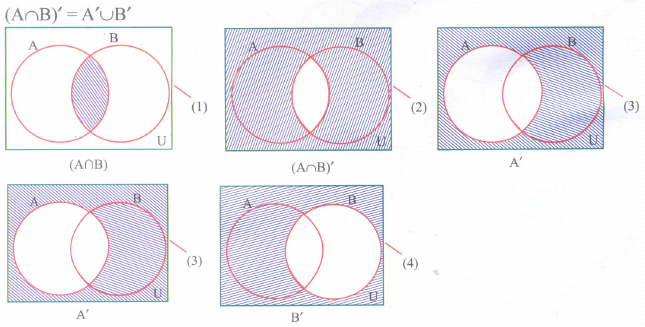
(2)=(5)
ஃ (A∩B)'=A'UB'
11.
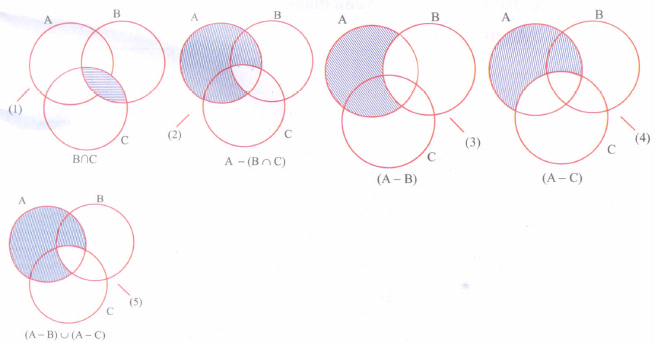
ஃ A-(B∩C)=(A-B)U(A-C)
Hence it is proved.
12.
A = {11,13,14,15,16,18}
B = {11,12,15,16,17,19}, C = {13,15,16,17,18,20}
(BUC) = {11,12,13,15,16,17,18,19,20}
A⋂(BUC) = {11,13,14,15,16,18}⋂{11,12,13,15,16,17,18,19,20}
= {11,13,15,16,18}...(1)
A⋂B = {11,15,16}; A⋂C = {13,15,16,18}
(A⋂B)U(A⋂C) = {11,13,15,16,18}...(2)
From (1) and (2) it is verified that A⋂(BUC) = (A⋂B)U(A⋂C).
13.
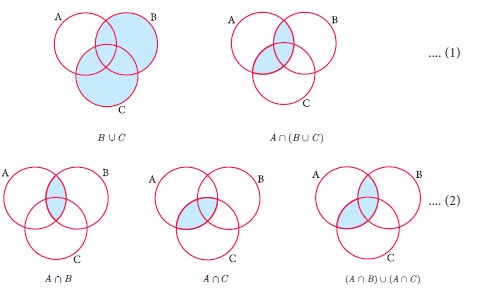
From (1) and (2), \(A\cap (B\cup C)=(A\cap B)\cup (A\cap C)\) is verified.
14.
a = 600 - (120 -x + x + 80 -x)
= 600 - (200 -x)
= 600 - 200 + x = 400 + x
b = 350 - (120 -x + x + 100 -x)
= 350 - (220 - x)
= 350 - 230 + x = 130 + x
c = 280 - (80 - x + x + 100 - x)
280 - (180 -x)
= 280 - 180 + x = 100 + x
Each farmer grew at least one of the above three, the number of farmers who grew all the three is x.
= a + b + c + 120 - x + 100 - x + 80 - x + x = 1000
400 + x + 130 + x + 100 + x + 120 - x + 100 - x + 80 - x + x = 1000
ஃ 930 + x = 1000
x = 1000 - 930 = 70
ஃ 70 farmers grew all the three crops.
15.
A = {x : x = 6n, n ∈ W, n < 6}
x = 6n
n = {0,1,2,3,4,5}
x = 6 \(\times\) 0 = 0
x = 6 \(\times\) 1 = 6
x = 6 \(\times\) 2 =12
x = 6 \(\times\) 3 =18
x = 6 \(\times\) 4 = 24
x = 6 \(\times\) 5 = 30
ஃ A = {0,6,12,18,24,30}
B = {x : x = 2n, n∈N, 2
x = 2n
x = 2 \(\times \) 3 = 6;
2\(\times\)4 = 8;
2 \(\times\)5 = 10
2 \(\times\)6 = 12
2\(\times\) 7 = 14
2 \(\times\)8 = 16
2 \(\times\)9 = 18
ஃ B = {6,8,10,12,14,16,18}
C = {x : x = 3n, n∈N, 4 ≤ n < 10
N = {4,5,6,7,8,9}
x = 3\(\times\)4 = 12
x = 3 \(\times\) 5 = 15
x = 3 \(\times\) 6 = 18
x = 3 \(\times\) 7 = 21
x = 3 \(\times\) 8 = 24
x = 3 \(\times\) 9 = 27
x = 2 \(\times\) 9 = 18
ஃ C = {12,15,18,21,24,27}
A-(B⋂C) = (A-B)U(A-C)
L.H.S = R.H.S
B⋂C = {12,18}
A-(B⋂C) = {0,6,12,18,24,30} - {12,18}
= {0,6,24,30} .........(1)
(A-B) = {0,24,30}
(A-C) = {0,6,30}
(A-B)U(A-C) = {0,6,24,30} .........(2)
From (1) and (2), it is verified that
A-(B⋂C) = (A-B)U(A-C).
16.
(d)
n(A) + n(B) + n(C) -\(n\left( A\cap B \right) \)-\(n\left( B\cap A \right) -n\left( A\cap C \right) +n\left( A\cap B\cap C \right) \)
17.
(c)
0
18.
(b)
(A-B)\(\cap \)(A\(\cup \)C)
19.
(a)
A
20.
(a)
10
21.
(d)
(A\(\cap \)B)' = A'\(\cup \)B'
22.
(a)
1

9th Standard Syllabus & Materials
9th Standard
TN 9th Tamil உள்ளத்தின் சீர் - திருக்குறள் Important Questions And Answers Study Material - QB365 Set A
NEW9th Standard
TN 9th Tamil உள்ளத்தின் சீர் - மணிமேகலை Important Questions And Answers Study Material - QB365 Set A
NEW9th Standard
TN 9th Tamil உள்ளத்தின் சீர் - ஏறு தழுவுதல் Important Questions And Answers Study Material - QB365 Set A
NEW9th Standard
TN 9th Tamil உயிருக்கு வேர் - தண்ணீர் Important Questions And Answers Study Material - QB365 Set A



Tamilnadu Stateboard 9th Standard Subjects
Tamilnadu Stateboard Standards





