 100% FREE ACCESS
9th Standard Syllabus & Materials
9th Standard
TN 9th Tamil உள்ளத்தின் சீர் -கற்கண்டு (இலக்கணம்) - தொடர் இலக்கணம், ஆகுபெயர் Important Questions And Answers Study Material - QB365 Set A
NEW9th Standard
TN 9th Tamil உள்ளத்தின் சீர் -விரிவானம் (துணைப்பாடம்) - தாய்மைக்கு வறட்சி இல்லை! Important Questions And Answers Study Material - QB365 Set A
NEW9th Standard
TN 9th Tamil உள்ளத்தின் சீர் -கவிதை பேழை (செய்யுள்) - மார்கழி பெருவிழா Important Questions And Answers Study Material - QB365 Set A
NEW9th Standard
TN 9th Tamil உயிருக்கு வேர்-இலக்கணம் - பகுபத உறுப்பிலக்கணம் Important Questions And Answers Study Material - QB365 Set A
NEW9th Standard
TN 9th Tamil அமுதென்று பேர் - இலக்கணம்-எழுத்து -அளபெடை Important Questions And Answers Study Material - QB365 Set A
NEW9th Standard
TN 9th Tamil அமுதென்று பேர்-துணைப்பாடம் - ஆறாம்திணை Important Questions And Answers Study Material - QB365 Set A

Published on: 08/08/2019
Download Tamil Nadu 9th Standard Maths question papers, model tests, one-mark questions, important questions, and public exam papers in PDF format. Free study materials and answer keys for TN State Board students.
Questions + Answers key
Take MCQ Maths Test1.
7x - 5y + 3 has __________ terms
2.
If A ⊆ B, then A - B is __________
3.
The axis intersect at a point called _____________
4.
Consider the following sets A = {0, 3, 5, 8}, B = {2, 4, 6, 10} and C = {12, 14,18, 20}.
4 _____ B.
5.
Consider the following sets A = {0, 3, 5, 8}, B = {2, 4, 6, 10} and C = {12, 14,18, 20}.
3\(\in \) ______
6.
Consider the set A = {Ashwin, Muralivijay, Vijay Shankar, Badrinath }.
Fill in the blanks with the appropriate symbol \(\in \) or \(\notin \).
Badrinath ______A.
7.
Represent the following as decimal form
(i) \(\frac { -4 }{ 11 } \)
(ii) \(\frac { 11 }{ 75 } \)
8.
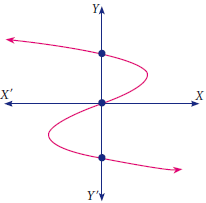
Find the number of zeros of the following polynomials represented by their graphs.
9.
Find the zeros of the polynomial in each of the following: p(x) = 2x + 5.
10.
From the given Venn diagram, write the elements of
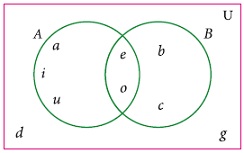
(i) A
(ii) B
(iii) A – B
(iv) B – A
(v) A′
(vi) B′
(vii) U
11.
Which of the following expressions are polynomials. If not give reason: \(\frac { 1 }{ { x }^{ 2 } } +3x-4\)
12.
If U = {c, d, e, f, g, h, i, j} and A = { c, d, g, j} , find A′.
13.
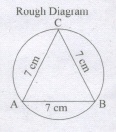
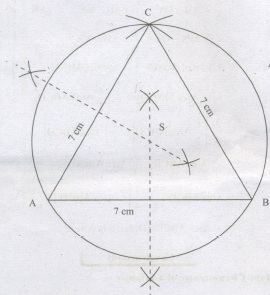
Draw the circumcircle for, An equilateral triangle of side 7 cm.
14.
Find the supplement of the following angles.
Right angle
15.
Write the set of letters of the following words in Roster form
ASSESSMENT
16.
Find the product (4x – 5), (2x2 + 3x – 6).
17.
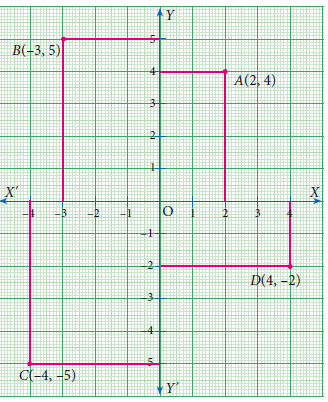
Plot the points A(2, 4), B(–3, 5), C(–4, –5), D(4, –2) in the Cartesian plane
18.
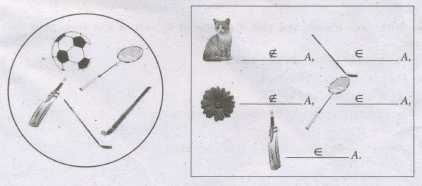
Insert the appropriate symbol ∈ (belongs to) or ∉ (does not belong to) in the blanks.
19.
Find the quotient and remainder of the following.
(8x3 – 1)÷(2x–1)
20.
Show that the following points taken in order form an isosceles triangle A (6, –4), B (–2, –4), C (2, 10)
21.
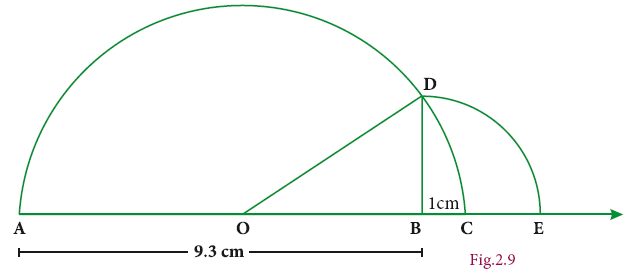
Represent \(\sqrt { 9.3 } \) on a number line
22.
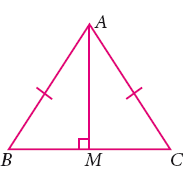
Consider the given pairs of triangles and say whether each pair is that of congruent triangles. If the triangles are congruent, say ‘how’; if they are not congruent say ‘why’ and also say if a small modification would make them congruent:
23.
An irrational number between 2 and 2.5 is ________.
\(\sqrt { 11 } \)
\(\sqrt { 5 } \)
\(\sqrt { 2.5 } \)
\(\sqrt { 8 } \)
24.
The points (–5, 2) and (2, –5) lie in the ________.
same quadrant
II and III quadrant respectively
II and IV quadrant respectively
IV and II quadrant respectively
25.
x3 – x2 is a …………..
monomial
binomial
trinomial
constant polynomial
26.
If B - A is B, then A∩B is ________.
A
B
U
∅
27.
Which of the following is correct?
{7} ∈ {1,2,3,4,5,6,7,8,9,10}
7 ∈ {1,2,3,4,5,6,7,8,9,10}
7 ∉ {1,2,3,4,5,6,7,8,9,10}
{7} \(\nsubseteq \) {1,2,3,4,5,6,7,8,9,10}
28.
The exterior angle of a triangle is equal to the sum of two ________.
Exterior angles
Interior opposite angles
Alternate angles
Interior angles
29.
Diameter is a chord
30.
Line segment joining any two points on the circle is called radius of the circle
31.
Consider the following sets A = {0, 3, 5, 8}, B = {2, 4, 6, 10} and C = {12, 14,18, 20}.
0\(\in \)B
32.
Consider the following sets A = {0, 3, 5, 8}, B = {2, 4, 6, 10} and C = {12, 14,18, 20}.
10 \(\in \) B
33.
Consider the following sets A = {0, 3, 5, 8}, B = {2, 4, 6, 10} and C = {12, 14,18, 20}.
18 \(\in \)C
1.
()
3
2.
()
Ø
3.
()
Origin
4.
()
\(\in \)
5.
()
A
6.
()
Badrinath \(\in \) A.
7.
(i) \(\frac { -4 }{ 11 } \)
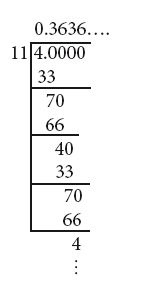
Thus we see that \(\frac { -4 }{ 11 } =-0.\overline { 36 } \)
(ii) \(\frac { 11 }{ 75 } \)
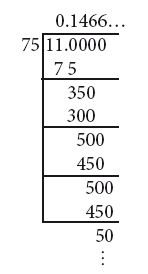
Thus we see that \(\frac { 11 }{ 75 } =0.14\overline { 6 } \)
A rational number can be expressed by
(i) either a terminating
(ii) or a non-terminating and recurring (repeating) decimal expansion.
The converse of this statement is also true. That is, if the decimal expansion of a number is terminating or non-terminating and recurring, then the number is a rational number.
8.
Number of zeros = 1 (The curve is intersecting at the origin)
9.
P(x) = 2x +5
= \(2\left( x+\frac { 5 }{ 2 } \right) \)
\(p\left( -\frac { 5 }{ 2 } \right) =2\left( -\frac { 5 }{ 2 } \right) +\frac { 5 }{ 2 } \)
= -5 + 5 = 2(0) = 0
Hence \(-\frac { 5 }{ 2 } \) is the zero of p(x)
10.
(i) A = {a, e, i, o, u}
(ii) B = {b, c, e, o}
(iii) A – B = {a, i, u}
(iv) B – A = {b, c}
(v) A′ = {b, c, d, g}
(vi) B′ = {a, d, g, i, u}
(vii) U = {a, b, c, d, e, g, i, o, u}.
11.
\(\frac { 1 }{ { x }^{ 2 } } +3x-4\) is not a polynomial.
Since the exponent of x2 is not a whole number but it is \(\left( \frac { 1 }{ 2 } ={ x }^{ -2 } \right) \) negative number
12.
U = {c, d, e, f, g, h, i, j}, A = {c, d, g, j}
A′ = {e, f, h, i}
13.
Steps for construction:
Step 1: Draw the ΔABC with the given measurement.
Step 2: Construct the perpendicular bisector of any two sides (AB and AC) and let them meet at S which is the circumcentre.
Step 3: With S as centre and SA = SB = SC as radius draw the circumcircle to passes through A, B and C.
14.
Supplement of Right angle (90°) = 180° - 90°
= 90°
15.
ASSESSMENT
A= {A, S, E, M, N, T}
16.
To multiply (4x – 5) and (2x2 + 3x – 6) distribute each term of the first polynomial to every term of the second polynomial. In this case, we need to distribute the terms 4x and –5. Then gather the like terms and combine them:

= 8x3+12x2-24x+10x2-15x+30
= 8x3 +2x2–39x +30
Aliter: You may also use the method of detached coefficients:
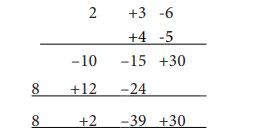
∴ (4x –5) (2x2+3x–6) = 8x3 + 2x2 – 39x + 30
17.
(i) To plot (2, 4), draw a vertical line at x = 2 and draw a horizontal line at y = 4. The intersection of these two lines is the position of (2, 4) in the Cartesian plane. Thus, the Point A (2, 4) is located in the I quadrant of Cartesian plane.
(ii) To plot (–3, 5), draw a vertical line at x = –3 and draw a horizontal line at y = 5. The intersection of these two lines is the position of (–3, 5) in the Cartesian plane. Thus, the Point B (–3, 5) is located in the II quadrant of Cartesian plane.
(iii) To plot (–4, –5), draw a vertical line at x = –4 and draw a horizontal line at y = -5. The intersection of these two lines is the position of (-4, -5) in the Cartesian plane. Thus, the Point C (–4, –5) is located in the III quadrant of Cartesian plane.
(iv) To plot (4, –2), draw a vertical line at x = 4 and draw a horizontal line at y = –2. The Intersection of these two lines is the position of (4,–2) in the Cartesian plane. Thus, the Point D (4,–2) is located in the IV quadrant of Cartesian plane
18.
19.
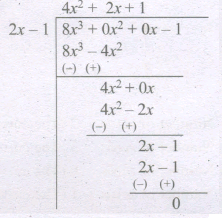
\(\therefore\) The Quotient : 4x2+2x+1
The Remainder : 0
20.
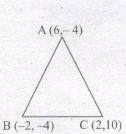
Distance = \(\sqrt { ({ x }_{ 2 }-{ x }_{ 1 })^{ 2 }+({ y }_{ 2 }-y_{ 1 })^{ 2 } } \)
AB= \(\sqrt { (-2-6)^{ 2 }+(-4+4)^{ 2 } } \)
= \(\sqrt { (-8)^{ 2 }+0 } =\sqrt { 64 } =8\)
BC = \(\sqrt { (2+2)^{ 2 }+(10+4)^{ 2 } } \)
= \(\sqrt { (4)^{ 2 }+(14)^{ 2 } } =\sqrt { 16+196 } =\sqrt { 212 } \)
AC = \(\sqrt { (2-6)^{ 2 }+(10+4)^{ 2 } } \)
= \(\sqrt { (-4)^{ 2 }+(14)^{ 2 } } =\sqrt { 1+-196 } =\sqrt { 212 } \)
BC = AC =\(\sqrt { 212 } \) (Two sides are equal)
∴ ABC is an isosceles triangle.
21.
i) Draw a line and mark a point A on it.
ii) Mark a point B such that AB = 9.3 cm.
iii) Mark a point C on this line such that BC = 1 unit
iv) Find the midpoint of AC by drawing perpendicular bisector of AC and let it be O
v) With O as center and OC = OA as radius, draw a semicircle
vi) Draw a line BD, which is perpendicular to AB at B.
vii) Now BD = \(\sqrt { 9.3 } \) which can be marked in the number line as the value of BE = BD =\(\sqrt { 9.3 } \)
22.
In the given figure
AB = AC (Given)
BM = MC (AM is the median of the \(\triangle\)ABC)
AM is common (By SSS congruency)
\(\therefore\triangle ABM\cong\triangle ACM\)
23.
(b)
\(\sqrt { 5 } \)
24.
(c)
II and IV quadrant respectively
25.
(b)
binomial
26.
(d)
∅
27.
(b)
7 ∈ {1,2,3,4,5,6,7,8,9,10}
28.
(b)
Interior opposite angles
29.
(a)
30.
(b)
31.
(b)
32.
(a)
33.
(a)

9th Standard Syllabus & Materials
9th Standard
TN 9th Tamil உள்ளத்தின் சீர் - திருக்குறள் Important Questions And Answers Study Material - QB365 Set A
NEW9th Standard
TN 9th Tamil உள்ளத்தின் சீர் - மணிமேகலை Important Questions And Answers Study Material - QB365 Set A
NEW9th Standard
TN 9th Tamil உள்ளத்தின் சீர் - ஏறு தழுவுதல் Important Questions And Answers Study Material - QB365 Set A
NEW9th Standard
TN 9th Tamil உயிருக்கு வேர் - தண்ணீர் Important Questions And Answers Study Material - QB365 Set A



Tamilnadu Stateboard 9th Standard Subjects
Tamilnadu Stateboard Standards