
 100% FREE ACCESS
9th Standard Syllabus & Materials
9th Standard
TN 9th Tamil உள்ளத்தின் சீர் -கற்கண்டு (இலக்கணம்) - தொடர் இலக்கணம், ஆகுபெயர் Important Questions And Answers Study Material - QB365 Set A
NEW9th Standard
TN 9th Tamil உள்ளத்தின் சீர் -விரிவானம் (துணைப்பாடம்) - தாய்மைக்கு வறட்சி இல்லை! Important Questions And Answers Study Material - QB365 Set A
NEW9th Standard
TN 9th Tamil உள்ளத்தின் சீர் -கவிதை பேழை (செய்யுள்) - மார்கழி பெருவிழா Important Questions And Answers Study Material - QB365 Set A
NEW9th Standard
TN 9th Tamil உயிருக்கு வேர்-இலக்கணம் - பகுபத உறுப்பிலக்கணம் Important Questions And Answers Study Material - QB365 Set A
NEW9th Standard
TN 9th Tamil அமுதென்று பேர் - இலக்கணம்-எழுத்து -அளபெடை Important Questions And Answers Study Material - QB365 Set A
NEW9th Standard
TN 9th Tamil அமுதென்று பேர்-துணைப்பாடம் - ஆறாம்திணை Important Questions And Answers Study Material - QB365 Set A

Published on: 04/09/2019
Term 2 Real Numbers
Download Tamil Nadu 9th Standard Maths question papers, model tests, one-mark questions, important questions, and public exam papers in PDF format. Free study materials and answer keys for TN State Board students.
Questions + Answers key
Take MCQ Maths Test1.
Arrange surds in descending order:
(i) \(\sqrt [ 3 ]{ 5 } ,\sqrt [ 9 ]{ 4 } ,\sqrt [ 6 ]{ 3 } \)
(ii) \(\sqrt [ 2 ]{ \sqrt [ 3 ]{ 5 } } ,\sqrt [ 2 ]{ \sqrt [ 3 ]{ 5 } } ,\sqrt [ 3 ]{ \sqrt [ 4 ]{ 7 } } ,\sqrt { \sqrt { 3 } } \)
2.
Simplify the following using multiplication and division properties of surds:
(i) \(\sqrt { 3 } \times \sqrt { 5 } \times \sqrt { 2 } \)
(ii) \(\sqrt { 35 } \div \sqrt { 7 } \)
(iii) \(\sqrt [ 3 ]{ 27 } \times \sqrt [ 3 ]{ 8 } \times \sqrt [ 3 ]{ 125 } \)
(iv) \((7\sqrt { a } -5\sqrt { b } )(7\sqrt { a } +5\sqrt { b } )\)
(v) \(\left[ \sqrt { \frac { 225 }{ 729 } } -\sqrt { \frac { 25 }{ 144 } } \right] \div \sqrt { \frac { 16 }{ 81 } } \)
3.
(i) Add 3\(\sqrt{7}\) and 5\(\sqrt{7}\) . Check whether the sum is rational or irrational.
(ii) Subtract 4\(\sqrt{5}\) from 7\(\sqrt{5}\) . Is the answer rational or irrational?
4.
Represent the following information in scientific notation:
(i) The world population is nearly 7,000,000,000.
(ii) One light year means the distance 9460528400000000 km.
(iii) Mass of an electron is 0.000 000 000 000 000 000 000 000 000 00091093822 kg.
5.
Find the value of a and b if \(\frac { \sqrt { 7 } -2 }{ \sqrt { 7 } +2 } \) = a\(\sqrt{7}\) + b
6.
Write the following in scientific notation: (4000000)3 ÷ (0.00002)4
7.
Write the following in scientific notation: (300000)3 \(\times\) (2000)4
8.
The mass of the Earth is 5.97 \(\times\) 1024 kg and that of the Moon is 0.073 \(\times\) 1024 kg. What is their total mass?
9.
The length and breadth of a rectangular plot are 5 \(\times\) 105 and 4 \(\times\) 104 metres respectively. Its area is ______.
9 \(\times\) 101 m2
9 \(\times\) 109 m2
2 \(\times\) 1010 m2
20 \(\times\) 1020 m2
10.
What is 5.92 \(\times\)10-3 written in decimal form?
0.000592
0.00592
0.0592
0.592
11.
Which is the best example of a number written in scientific notation?
0.5 \(\times\) 105
0.1254
5.367 \(\times\) 10-6
12.5 \(\times\) 102
12.
\(\left( 0.000729 \right) ^{ \frac { -3 }{ 4 } }\times \left( 0.09 \right) ^{ \frac { -3 }{ 4 } }\) = ______.
\(\frac { { 10 }^{ 3 } }{ { 3 }^{ 3 } } \)
\(\frac { { 10 }^{ 5 } }{ { 3 }^{ 5 } } \)
\(\frac { { 10 }^{ 2 } }{ { 3 }^{ 2 } } \)
\(\frac { { 10 }^{ 6 } }{ { 3 }^{ 6 } } \)
13.
Which of the following statement is false?
The square root of 25 is 5 or −5
\(\sqrt{25}\) = 5
-\(\sqrt{25}\) = -5
\(\sqrt{25}\) = ±5
1.
(i) \(\sqrt [ 3 ]{ 5 } ,\sqrt [ 9 ]{ 4 } ,\sqrt [ 6 ]{ 3 } \)
\(5^{\frac{1}{3}}\)
ஃ The order of the surds \(\sqrt [ 3 ]{ 5 } ,\sqrt [ 9 ]{ 4 } ,\sqrt [ 6 ]{ 3 } \) are 3,9,6
\(4^{\frac{1}{9}}\)
\(3^{\frac{1}{6}}\) l.c.m of 3,9,6 is 18
ஃ \(\frac{1}{3}=\frac{1\times6}{3\times6}=\frac{6}{18}\)
\(\frac{1}{9}=\frac{1\times2}{9\times2}=\frac{2}{18};\frac{1}{6}=\frac{1\times3}{6\times3}=\frac{3}{18}\)
\((5^{\frac{1}{3}})=5^{\frac{6}{18}}=(15625)^{\frac{1}{18}}\)
\((4^{\frac{1}{9}})=4^{\frac{2}{18}}=(4^2)^{\frac{1}{18}}=16^{\frac{1}{18}}\)
\((3^{\frac{1}{6}})=3^{\frac{3}{18}}=(3^3)^{\frac{1}{18}}=27^{\frac{1}{18}}\)
ஃ The descending order of \(\sqrt [ 3 ]{ 5 } ,\sqrt [ 9 ]{ 4 } ,\sqrt [ 6 ]{ 3 } \) is \((15625)^{\frac{1}{18}}>(27)^{\frac{1}{18}}>16^{\frac{1}{18}}\) i.e., \(\sqrt { \sqrt { 3 } } >\sqrt [ 2 ]{ \sqrt [ 3 ]{ 5 } } >\sqrt [ 3 ]{ \sqrt [ 4 ]{ 7 } } \)
(ii) \(\sqrt [ 2 ]{ \sqrt [ 3 ]{ 5 } } ,\sqrt [ 2 ]{ \sqrt [ 3 ]{ 5 } } ,\sqrt [ 3 ]{ \sqrt [ 4 ]{ 7 } } ,\sqrt { \sqrt { 3 } } \)
The order of the surds \(\sqrt [ 2 ]{ \sqrt [ 3 ]{ 5 } } ,\sqrt [ 2 ]{ \sqrt [ 3 ]{ 5 } } ,\sqrt [ 3 ]{ \sqrt [ 4 ]{ 7 } } ,\sqrt[2] { \sqrt [2]{ 3 } } \) are 6, 12, 4
l.c.m of 6,12,4 is 12
\(\sqrt[2]{\sqrt[3]{5}}=5^{\frac{1}{6}}=5^{\frac{1\times2}{6\times2}}=5^{\frac{2}{12}}=(5^2)^{\frac{1}{12}}=25^{\frac{1}{12}}\)
\(\sqrt[3]{\sqrt[4]{\sqrt{7}}}=7^{\frac{1}{12}};\sqrt{\sqrt{3}}=3^{\frac{1}{4}}=3^{\frac{1\times3}{4\times3}}=3^{\frac{3}{12}}=(3^3)^{\frac{1}{12}}=27^{\frac{1}{12}}\)
ஃ The ascending order of the surds
\(\sqrt [ 2 ]{ \sqrt [ 3 ]{ 5 } } ,\sqrt [ 2 ]{ \sqrt [ 3 ]{ 5 } } ,\sqrt [ 3 ]{ \sqrt [ 4 ]{ 7 } } ,\sqrt { \sqrt { 3 } } \) is \(7^{\frac{1}{12}}<25^{\frac{1}{2}}<27^{\frac{1}{2}}\), that is \(\sqrt[3]{\sqrt[4]{7}}<\sqrt[2]{\sqrt[3]{5}}<\sqrt{\sqrt{3}}\)
2.
(i) \(\sqrt{3}\times\sqrt{5}\times\sqrt{2}=\sqrt{3\times5\times2}=\sqrt{30}\)
(ii) \(\sqrt{35}\div\sqrt{7}=\sqrt{\frac{35}{7}}=\sqrt{5}\)
(iii) \(\sqrt[3]{27}\times\sqrt[3]{8}\times\sqrt[3]{125}=\sqrt[3]{27\times8\times125}=\sqrt[3]{3^3\times2^3\times5^3}=3\times2\times5=30\)
(iv) \((7\sqrt{a}-5\sqrt{b})(7\sqrt{a}+5\sqrt{b})=(7\sqrt{a})^2-(5\sqrt{b})^2=49a-25b\) = 21\(\sqrt 3\)
(v) \([\sqrt{\frac{225}{729}}-\sqrt{\frac{25}{144}}]\div\sqrt{\frac{16}{81}}\)
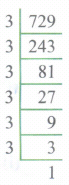
=\([\sqrt{\frac{15^2}{27^2}}-\sqrt{\frac{5^2}{12^2}}]\times\sqrt{\frac{9^2}{4^2}}\)
=\((\frac{15}{27}-\frac{5}{12})\times\frac{9}{4}=(\frac{5}{9}-\frac{5}{12})\times\frac{9}{4}\)
=\((\frac{20-15}{36})\times\frac{9}{4}=\frac{5}{ ̶3̶6̶}\times\frac{ ̶9̶}{4}=\frac{5}{16}\)
3.
(i) 3\(\sqrt{7}\) + 5\(\sqrt{7}\) = (3 + 5)\(\sqrt{7}\) = 8\(\sqrt{7}\). The answer is irrational.
(ii) 7\(\sqrt{5}\) - 4\(\sqrt{5}\) = (7 - 4)\(\sqrt{5}\) = 3\(\sqrt{5}\). The answer is irrational.
4.
(i) The world population is nearly
7,000,000,000 = 7.0 \(\times\) 109
(ii) One light year means the distance
9460528400000000 km = 9.4605284 \(\times\) 1015 km
(iii) Mass of an electron is
0.000 000 000 000 000 000 000 000 000 00091093822 kg = 9.1093822 \(\times\) 10-31 kg
5.
\(\frac { \sqrt { 7 } -2 }{ \sqrt { 7 } +2 } =a\sqrt{7}+b\)
L.H.S = \(\frac{\sqrt{7}-2\times\sqrt{7}-2}{\sqrt{7}+2\times\sqrt{7}-2}=\frac{(\sqrt{7}-2)^2}{\sqrt{7}^2-2^2}=\frac{\sqrt{7}^2-2\sqrt{7}\times2+2^2}{7-4}\)
=\(\frac{7-4\sqrt{7}+4}{3}=\frac{11-4\sqrt{7}}{3}=\frac{11}{3}-\frac{4\sqrt{7}}{3}\)
\(\frac{-4\sqrt{7}}{3}+\frac{11}{3}=a\sqrt{7}+b\)
a √7=\(\frac{-4\sqrt{7}}{3}\)
a = \(\frac{-4}{3}\)
b = \(\frac{11}{3}\)
6.
(4000000)3 ÷ (0.00002)4
\( =\left(4.0 \times 10^{6}\right)^{3} \div\left(2.0 \times 10^{-5}\right) 4 \)
\(=(4.0)^{3} \times\left(10^{6}\right)^{3} \div(2.0)^{4} \times\left(10^{-5}\right)^{4} \)
\(=\frac{64.0 \times 10^{18}}{16.0 \times 10^{-20}} \)
\(=4 \times 10^{18} \times 10^{+20} \)
\(=4.0 \times 10^{38} \)
7.
(300000)3 \(\times\) (2000)4
\( =\left(3.0 \times 10^{5}\right)^{3} \times\left(2.0 \times 10^{3}\right)^{4} \)
\( =(3.0)^{3} \times\left(10^{5}\right)^{3} \times(2.0)^{4} \times\left(10^{3}\right)^{4} \)
\( =(27.0) \times\left(10^{15}\right) \times(16.0) \times\left(10^{12}\right) \)
\(= \left(2.7 \times 10^{1}\right) \times\left(10^{15}\right) \times\left(1.6 \times 10^{1}\right) \times\left(10^{12}\right) \)
\( =2.7 \times 1.6 \times 10^{1} \times 10^{15} \times 10^{1} \times 10^{12} \)
\(=4.32 \times 10^{1+15+1+12}=4.32 \times 10^{29} \)
8.
Total mass = 5.97\(\times\) 1024 kg + 0.073 \(\times\) 1024 kg
= (5.97 + 0.073) \(\times\) 1024 kg
= 6.043 \(\times\) 1024 kg
9.
(c)
2 \(\times\) 1010 m2
10.
(b)
0.00592
11.
(c)
5.367 \(\times\) 10-6
12.
(d)
\(\frac { { 10 }^{ 6 } }{ { 3 }^{ 6 } } \)
13.
(d)
\(\sqrt{25}\) = ±5

9th Standard Syllabus & Materials
9th Standard
TN 9th Tamil உள்ளத்தின் சீர் - திருக்குறள் Important Questions And Answers Study Material - QB365 Set A
NEW9th Standard
TN 9th Tamil உள்ளத்தின் சீர் - மணிமேகலை Important Questions And Answers Study Material - QB365 Set A
NEW9th Standard
TN 9th Tamil உள்ளத்தின் சீர் - ஏறு தழுவுதல் Important Questions And Answers Study Material - QB365 Set A
NEW9th Standard
TN 9th Tamil உயிருக்கு வேர் - தண்ணீர் Important Questions And Answers Study Material - QB365 Set A



Tamilnadu Stateboard 9th Standard Subjects
Tamilnadu Stateboard Standards





