
 100% FREE ACCESS
9th Standard Syllabus & Materials
9th Standard
TN 9th Tamil உள்ளத்தின் சீர் -கற்கண்டு (இலக்கணம்) - தொடர் இலக்கணம், ஆகுபெயர் Important Questions And Answers Study Material - QB365 Set A
NEW9th Standard
TN 9th Tamil உள்ளத்தின் சீர் -விரிவானம் (துணைப்பாடம்) - தாய்மைக்கு வறட்சி இல்லை! Important Questions And Answers Study Material - QB365 Set A
NEW9th Standard
TN 9th Tamil உள்ளத்தின் சீர் -கவிதை பேழை (செய்யுள்) - மார்கழி பெருவிழா Important Questions And Answers Study Material - QB365 Set A
NEW9th Standard
TN 9th Tamil உயிருக்கு வேர்-இலக்கணம் - பகுபத உறுப்பிலக்கணம் Important Questions And Answers Study Material - QB365 Set A
NEW9th Standard
TN 9th Tamil அமுதென்று பேர் - இலக்கணம்-எழுத்து -அளபெடை Important Questions And Answers Study Material - QB365 Set A
NEW9th Standard
TN 9th Tamil அமுதென்று பேர்-துணைப்பாடம் - ஆறாம்திணை Important Questions And Answers Study Material - QB365 Set A

Published on: 10/10/2019
Term 2 Set Language
Download Tamil Nadu 9th Standard Maths question papers, model tests, one-mark questions, important questions, and public exam papers in PDF format. Free study materials and answer keys for TN State Board students.
Questions + Answers key
Take MCQ Maths Test1.
A survey was conducted among 200 magazine subscribers of three different magazines A, B and C. It was found that 75 members do not subscribe magazine A, 100 members do not subscribe magazine B, 50 members do not subscribe magazine C and 125 subscribe atleast two of the three magazines. Find
(i) Number of members who subscribe exactly two magazines.
(ii) Number of members who subscribe only one magazine
2.
Each student in a class of 35 plays atleast one game among chess, carrom and table tennis. 22 play chess, 21 play carrom, 15 play table tennis, 10 play chess and table tennis, 8 play carrom and table tennis and 6 play all the three games. Find the number of students who play (Hint: Use Venn diagram)
(i) chess and carrom but not table tennis
(ii) only chess
(iii) only carrom.
3.
A survey of 1000 farmers found that 600 grew paddy, 350 grew ragi, 280 grew corn, 120 grew paddy and ragi, 100 grew ragi and corn, 80 grew paddy and corn. If each farmer grew at least any one of the above three, then find the number of farmers who grew all the three.
4.
A soap company interviewed 800 people in a city. It was found out that \(\frac{3}{8}\) use brand A soap, \(\frac{1}{5}\)use brand B soap, 70 use brand A and B soap, 55 use brand B and C soap, 60 use brand A and C soap and \(\frac{1}{40}\) use all the three brands Find,
(i) Number of people who use exactly two branded soaps,
(ii) Number of people who use at least one branded soap,
(iii) Number of people who do not use any one of these brands.
5.
In a colony, 275 families buy Tamil newspaper, 150 families buy English newspaper, 45 families buy Hindi newspaper, 125 families buy Tamil and English newspapers, 17 families buy English and Hindi newspapers, 5 families buy Tamil and Hindi newspapers and 3 families buy all the three newspapers. If each family buy at least one of these newspapers then find.
(i) Number of families buy only one newspaper.
(ii) Number of families buy at least two newspapers.
(iii) Total number of families in the colony.
6.
Verify \(n\left( A\cup B\cup C \right) =n(A)+n(B)+n(C)-n(A\cap B)-n(B\cap C)-n(A\cap C)+n(A\cap B\cap C)\)for the following sets.
(i) A = {a, c, e, f , h} , B = {c, d, e, f } and C = {a, b, c, f }
(ii) A = {1, 3, 5} , B = {2, 3, 5, 6} and C = {1, 5, 6, 7}
7.
If A = {y : y =\(\frac { a+1 }{ 2 } \), a \(\in \) W and a ≤ 5}, B = {y : y =\(\frac { 2n-1 }{ 2 } \), n\(\in \)W and n < 5} and C =\(\left\{ -1,-\frac { 1 }{ 2 } ,1,\frac { 3 }{ 2 } ,2 \right\} \), then show that \(A-(B\cup C)=(A-B)\cap (A-C)\).
8.
If A = {x : x = 6n, n\(\in \)W and n < 6}, B = {x : x = 2n, n \(\in \)N and 2 < n ≤ 9} and C = {x : x = 3n, n\(\in \)N and 4n ≤ n < 10}, then show that \(A-(B\cap C)=(A-B)\cup (A-C)\).
9.
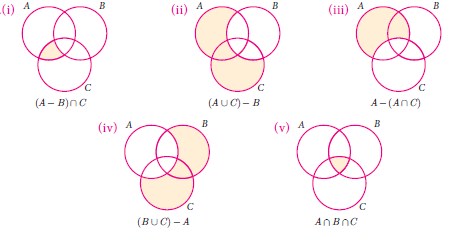
If A, B and C are overlapping sets, then draw Venn diagram for the following sets:
(i) (A-B)\(\cap \)C
(ii) (A\(\cup \)C)-B
(iii) A-(A\(\cap \)C)
(iv) (B\(\cup \)C)-A
(v) A\(\cap \)B\(\cap \)C
10.
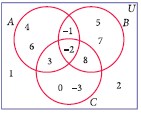
Using the adjacent Venn diagram, find the following sets:
(i) A-B
(ii) B-C
(iii) A'\(\cup \)B')
(iii) A'\(\cap \)B'
(iv) (B\(\cup \)C)'
(vi) A-(B\(\cup \)C)
(vii) A-(B\(\cap \)C)
1.
Total number of subscribers = 200
| Magazine | Do not subscribe | Subscribe |
| A | 75 | 125 |
| B | 100 | 100 |
| C | 50 | 150 |
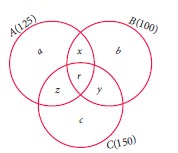
From the Venn diagram,
Number of members who subscribe only one magazine = a + b + c
Number of members who subscribe exactly two magazines = x + y + z
and 125 members subscribe atleast two magazines.
That is, x + y + z + r = 125 ..... (1)
Now, n(A U B U C) = 200, n(A) = 125, n(B) = 100, n(C) = 150, n(A∩B) = x + r
n(B∩C) = y + r, n(A∩C) = z + r, n(A∩B∩C) = r
We know that,
n(AUBUC) = n(A) + n(B) + n(C) – n(A∩B) – n(B∩C) – n(A∩C) + n(A∩B∩C)
200 = 125 + 100 + 150 – x – r – y – r – z – r + r
= 375 - (x + y + z + r) - r
= 375 -125 [∵ x + y + z + r = 125]
200 = 250 - r ⇒ r = 50
From (1) x + y + z + 50 = 125
We get, x + y + z = 75
Therefore, number of members who subscribe exactly two magazines = 75.
From Venn diagram, (a + b + c) + (x +y + z + r) = 200 ........ (2)
substitute (1) in (2)
a + b + c + 125 = 200
a + b + c = 75
Therefore, number of members who subscribe only one magazine = 75.
2.
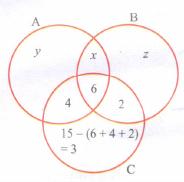
A - Chess
B - Carrom
C - Table Tennis
n(A) = 22
n(B) = 21
n(C) = 15
n(A⋂C) = 10
n(B∩C) = 8
n(A∩B∩C) = 6
y = 22 - (x + 6 + 4) = 22 - (x + 10)
= 22 - x - 10 = 12 - x
z = 21 - (x + 6 + 2) = 21 - (8 + x)
= 21 - 8 - x = 13 - x
y + z + 3 + x + 2 + 4 + 6 = 35

x = 40 - 35 = 5
(i) Number of students who play only chess and Carrom but not table tennis = 5
(ii) Number of students who play only chess = 12 - x = 12 - 5 = 7
(iii) Number of students who play only carrom = 13 - x = 13 - 5 = 8
3.
a = 600 - (120 -x + x + 80 -x)
= 600 - (200 -x)
= 600 - 200 + x = 400 + x
b = 350 - (120 -x + x + 100 -x)
= 350 - (220 - x)
= 350 - 230 + x = 130 + x
c = 280 - (80 - x + x + 100 - x)
280 - (180 -x)
= 280 - 180 + x = 100 + x
Each farmer grew at least one of the above three, the number of farmers who grew all the three is x.
= a + b + c + 120 - x + 100 - x + 80 - x + x = 1000
400 + x + 130 + x + 100 + x + 120 - x + 100 - x + 80 - x + x = 1000
ஃ 930 + x = 1000
x = 1000 - 930 = 70
ஃ 70 farmers grew all the three crops.
4.
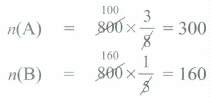
n(C) = \(800\times\frac{1}{2}=400\)
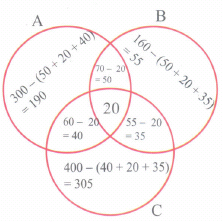
n(A∩B) = 70
n(B∩C) = 55
n(C∩A) = 60
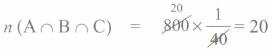
(i) Number of people who use exactly two branded soaps
= 50 + 35 + 40 = 125
(ii) Number of people who use at least one branded soaps
= 190 + 55 + 305 + 50 + 35 + 40 + 20 = 695
(iii) Number of people who do not use any of these brands
= 800 - [695] = 105
5.
Tamil Newspaper buyers n(A) = 275
English Newspaper buyers n(B) = 150
Hindi Newspaper buyers n(C) = 45
n (A∪ B ∪ C) = n(A) + n(B) + n(C) - n(A∩B) - n(B∩C) - n(A∩C) + n(A∩B∩C)
Tamil and English Newspaper buyers n(A∩B) = 125
English and Hindi Newspaper buyers n(B∩C) = 17
Hindi and Tamil Newspaper buyers n(C∩A) = 5
All the three Newspaper buyers n(A∩B∩C) = 3
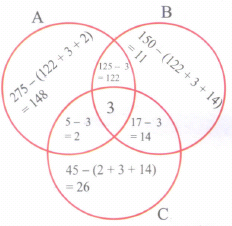
(i) Number of families buy only one newspaper = 148 + 11 + 26 = 185
(ii) Number of families buy at least two newspapers = 122 + 14 + 2 + 3 = 141
(iii) Total number of families in the colony = 148 + 11 + 26 + 122 + 14 + 2 + 3 = 326
6.
\(n\left( A\cup B\cup C \right) =n(A)+n(B)+n(C)-n(A\cap B)-n(B\cap C)-n(A\cap C)+n(A\cap B\cap C)\)
(i) A = {a,c,e,f,h}, B = {c,d,e,f}, C = {a,b,c,f}
n(A) = 5, n(B) = 4, n(C) = 4
n(A⋂B) = 3
n(B⋂C) = 2
n(A∩C) = 3
n(A∩B∩C) = 2
A∩B = {c,e,f}
B∩C = {c,f}
A∩C = {a,c,f}
A∩B∩C = {c,f}
AUBUC = {a,c,d,e,f,b,h}
ஃ n(AUBUC) = 7............(1)
n(A)+n(B)+n(C)-n(A∩B)-n(B∩C)-n(A⋂C)+n(A∩B∩C).........(2)
= 5 + 4 + 4 - 3 - 2 - 3 + 2 = 15 - 8 = 7
(1) = (2)
⇒ n(AUBUC) = n(A) + n(B) + n(C) - n(A∩B) - n(B∩C) - n(A⋂C) + n(A∩B∩C)
Hence it is verified.
(ii) A = {1,3,5}, B = {2,3,5,6}, C = {1,5,6,7}
n(A) = 3, n(B) = 4, n(C) = 4
n(A∩B) = 2
n(B∩C) = 2
n(C⋂A) = 2
n(A⋂B⋂C) = 1
n(AUBUC) = 6
n(AUBUC) = n(A) + n(B) + n(C) - n(A⋂B) - n(B∩C) - n(A⋂C) + n(A∩B∩C)
6 = 3 + 4 + 4 - 2 - 2 - 2 + 1 = 12 - 6 = 6
Hence it is verified.
7.
A = { y : y = \(\frac { a+1 }{ 2 } \), a\(\in \) W and a ≤ 5}
a = {0,1,2,3,4,5}
y = \(\frac{a+1}{2}=\frac{a+1}{2}=\frac{1}{2}\)
y = \(\frac{1+1}{2}=\frac{2}{2}=1\)
y = \(\frac{2+1}{2}=\frac{3}{2};y=\frac{3+1}{2}=\frac{4}{2}=2\)
y = \(\frac{4+1}{2}=\frac{5}{2};y=\frac{5+1}{2}=\frac{6}{2}=3\)
ஃ A = \(\{\frac{1}{2},1,\frac{3}{2},2,\frac{5}{2},3\}\)
B = { y : y = \(\frac{2n-1}{2}\), n∈W and n < 5}
n = {0,1,2,3,4}
y = \(\frac{2\times0-1}{2}=\frac{-1}{2}\)
y = \(\frac{2\times1-1}{2}=\frac{1}{2}; y=\frac{2\times2-1}{2}=\frac{3}{2}\)
y = \(\frac{2\times3-1}{2}=\frac{5}{2}; y=\frac{2\times4-1}{2}=\frac{7}{2}\)
ஃ B = \(\{-\frac{1}{2},\frac{1}{2},\frac{3}{2},\frac{5}{2},\frac{7}{2}\}\)
C = \(\{-1,-\frac{1}{2},1,\frac{3}{2},2\}\)
BUC = \(\{-1,-\frac{1}{2},\frac{1}{2},1,\frac{3}{2},2,\frac{5}{2},\frac{7}{2}\}\)
A-(BUC) = {3}...............(1)
A-B = {1,2,3}
A-C = \(\{\frac{1}{2},\frac{5}{2},3\}\)
(A-B)∩(A-C) = {3}...................(2)
From (1) and (2), it is verified that A-(BUC) = (A-B)∩(A-C)
8.
A = {x : x = 6n, n ∈ W, n < 6}
x = 6n
n = {0,1,2,3,4,5}
x = 6 \(\times\) 0 = 0
x = 6 \(\times\) 1 = 6
x = 6 \(\times\) 2 =12
x = 6 \(\times\) 3 =18
x = 6 \(\times\) 4 = 24
x = 6 \(\times\) 5 = 30
ஃ A = {0,6,12,18,24,30}
B = {x : x = 2n, n∈N, 2
x = 2n
x = 2 \(\times \) 3 = 6;
2\(\times\)4 = 8;
2 \(\times\)5 = 10
2 \(\times\)6 = 12
2\(\times\) 7 = 14
2 \(\times\)8 = 16
2 \(\times\)9 = 18
ஃ B = {6,8,10,12,14,16,18}
C = {x : x = 3n, n∈N, 4 ≤ n < 10
N = {4,5,6,7,8,9}
x = 3\(\times\)4 = 12
x = 3 \(\times\) 5 = 15
x = 3 \(\times\) 6 = 18
x = 3 \(\times\) 7 = 21
x = 3 \(\times\) 8 = 24
x = 3 \(\times\) 9 = 27
x = 2 \(\times\) 9 = 18
ஃ C = {12,15,18,21,24,27}
A-(B⋂C) = (A-B)U(A-C)
L.H.S = R.H.S
B⋂C = {12,18}
A-(B⋂C) = {0,6,12,18,24,30} - {12,18}
= {0,6,24,30} .........(1)
(A-B) = {0,24,30}
(A-C) = {0,6,30}
(A-B)U(A-C) = {0,6,24,30} .........(2)
From (1) and (2), it is verified that
A-(B⋂C) = (A-B)U(A-C).
9.
10.
(i) A-B = {3,4,6}
(ii) B-C = {-1,5,7}
(iii) A'UB'
A'UB'
A' = {1,2,0,-3,5,7,8}
B' = {-3,0,1,2,3,4,5,6}
A'UB' = {-3,0,1,2,3,4,5,6,7,8}
(iv) A'⋂B'
A'⋂B' = {-3,0,1,2}
(v) (BUC)'
BUC = {-3,-2,-1,0,3,5,7,8}
(BUC)' = U-(BUC)
= {-3,-2,-1,0,1,2,3,4,5,6,7,8} - {-3,-2,-1,0,3,5,7,8}
(BUC)' = {1,2,4,6}
(vi) A-(BUC) = {-2,-1,3,4,6} - {-3,-2,-1,0,3,5,7,8} = {4,6}
(vii) A-(B⋂C)
B⋂C = {-2,8}
A-(B⋂C) = {-2,-1,3,4,6} - {-2,8} = {-1,3,4,6}

9th Standard Syllabus & Materials
9th Standard
TN 9th Tamil உள்ளத்தின் சீர் - திருக்குறள் Important Questions And Answers Study Material - QB365 Set A
NEW9th Standard
TN 9th Tamil உள்ளத்தின் சீர் - மணிமேகலை Important Questions And Answers Study Material - QB365 Set A
NEW9th Standard
TN 9th Tamil உள்ளத்தின் சீர் - ஏறு தழுவுதல் Important Questions And Answers Study Material - QB365 Set A
NEW9th Standard
TN 9th Tamil உயிருக்கு வேர் - தண்ணீர் Important Questions And Answers Study Material - QB365 Set A



Tamilnadu Stateboard 9th Standard Subjects
Tamilnadu Stateboard Standards





