
 100% FREE ACCESS
9th Standard Syllabus & Materials
9th Standard
TN 9th Tamil உள்ளத்தின் சீர் -கற்கண்டு (இலக்கணம்) - தொடர் இலக்கணம், ஆகுபெயர் Important Questions And Answers Study Material - QB365 Set A
NEW9th Standard
TN 9th Tamil உள்ளத்தின் சீர் -விரிவானம் (துணைப்பாடம்) - தாய்மைக்கு வறட்சி இல்லை! Important Questions And Answers Study Material - QB365 Set A
NEW9th Standard
TN 9th Tamil உள்ளத்தின் சீர் -கவிதை பேழை (செய்யுள்) - மார்கழி பெருவிழா Important Questions And Answers Study Material - QB365 Set A
NEW9th Standard
TN 9th Tamil உயிருக்கு வேர்-இலக்கணம் - பகுபத உறுப்பிலக்கணம் Important Questions And Answers Study Material - QB365 Set A
NEW9th Standard
TN 9th Tamil அமுதென்று பேர் - இலக்கணம்-எழுத்து -அளபெடை Important Questions And Answers Study Material - QB365 Set A
NEW9th Standard
TN 9th Tamil அமுதென்று பேர்-துணைப்பாடம் - ஆறாம்திணை Important Questions And Answers Study Material - QB365 Set A

Published on: 07/09/2019
Term 3 Coordinate Geometry
Download Tamil Nadu 9th Standard Maths question papers, model tests, one-mark questions, important questions, and public exam papers in PDF format. Free study materials and answer keys for TN State Board students.
Questions + Answers key
Take MCQ Maths Test1.
If the centroid of a triangle is at (−2, 1) and two of its vertices are (1, −6) and (−5, 2), then find the third vertex of the triangle.
2.
If (x, 3), (6, y), (8, 2) and (9, 4) are the vertices of a parallelogram taken in order, then find the value of x and y.
3.
the mid-point formula to show that the mid-point of the hypotenuse of a right angled triangle is equidistant from the vertices (with suitable points).
4.
The point (3, −4) is the centre of a circle. If AB is a diameter of the circle and B is (5, −6), find the coordinates of A.
5.
The mid-points of the sides of a triangle are (5, 1), (3, −5) and (−5, −1). Find the coordinates of the vertices of the triangle.
6.
If \(\left( \frac { 3 }{ 2 } ,5 \right) ,\left( 7,\frac { -9 }{ 2 } \right) \)and\((\frac{13}{2},\frac{-13}{2})\) are mid-points of the sides of a triangle, then find the centroid of the triangle.
7.
ABC is a triangle whose vertices are A(3, 4), B(−2, −1) and C(5, 3) . If G is the centroid and BDCG is a parallelogram then find the coordinates of the vertex D.
8.
A car travels at an uniform speed. At 2 pm it is at a distance of 180 km and at 6pm it is at 360 km. Using section formula, find at what distance it will reach 12 midnight.
9.
A(−3,2), B(3,2) and C(−3,−2) are the vertices of the right triangle, right angled at A. Show that the mid-point of the hypotenuse is equidistant from the vertices.
10.
The centroid of the triangle with vertices (−1, −6), (−2, 12) and (9, 3) is
(3, 2)
(2, 3)
(4, 3)
(3, 4)
11.
If (1,−2), (3, 6), (x, 10) and (3, 2) are the vertices of the parallelogram taken in order, then the value of x is ______.
6
5
4
3
12.
In what ratio does the y-axis divide the line joining the points (−5, 1) and (2, 3) internally ______.
1 : 3
2 : 5
3 : 1
5 : 2
13.
The ratio in which the x-axis divides the line segment joining the points (6, 4) and (1, −7) is ______.
2:3
3:4
4:7
4:3
14.
The coordinates of the point C dividing the line segment joining the points P(2, 4) and Q(5, 7) internally in the ratio 2:1 is______.
\((\frac{7}{2},\frac{11}{2})\)
(3, 5)
(4, 4)
(4, 6)
1.
Let the vertices of a triangle be A(1, −6), B(−5, 2) and C(x3, y3)
Given the centroid of a triangle as (−2, 1) we get,
\(\frac { { x }_{ 1 }+{ x }_{ 2 }+{ x }_{ 3 } }{ 3 } \) = -2
\(\frac { 1-5+{ x }_{ 3 } }{ 3 } \) = -2
−4 + x3 = −6
x3 = −2
\(\frac { { y }_{ 1 }+{ y }_{ 2 }+{ y }_{ 3 } }{ 3 } \) = 1
\(\frac { 6+2+{ y }_{ 3 } }{ 3 } \) = 1
−4 + y3 = 3
y3 = 7
Therefore, third vertex is (−2, 7).
2.
Let A(x, 3), B(6, y), C(8, 2) and D(9, 4) be the vertices of the parallelogram ABCD. By definition, diagonals AC and BD bisect each other.
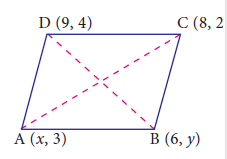
Mid-point of AC = Mid-point of BD
\(\left( \frac { x+8 }{ 2 } ,\frac { 3+2 }{ 2 } \right) =\left( \frac { 6+9 }{ 2 } ,\frac { y+4 }{ 2 } \right) \)
equating the coordinates on both sides, we get
\(\frac { x+8 }{ 2 } =\frac { 15 }{ 2 } \)
x + 8 = 15
x = 7
\(\frac { 5 }{ 2 } =\frac { y+4 }{ 2 } \)
5 = y + 4
y = 1
Hence, x = 7 and y = 1.
3.
Let POQ be the right angled triangle and O be placed at the origin. Let OQ = a units and OP be b units. Let us name the coordinates of P as (0,b) and Q as (a,0).
By mid-point formula, if M is the mid-point of the hypotenuse PQ [PM=MQ], then M is
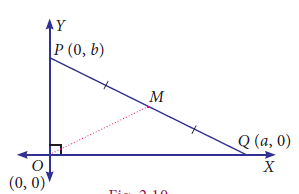
\(\left( \frac { a+0 }{ 2 } ,\frac { b+0 }{ 2 } \right) =\left( \frac { a }{ 2 } ,\frac { b }{ 2 } \right) \)
We now use the distance formula and find that
OM=\(\sqrt { { \left( \frac { a }{ 2 } -0 \right) }^{ 2 }{ +\left( \frac { b }{ 2 } -0 \right) }^{ 2 } } =\sqrt { \frac { { a }^{ 2 } }{ 4 } +\frac { { b }^{ 2 } }{ 4 } } \) which is the same value as
QM=\(\sqrt { { \left( a-\frac { a }{ 2 } \right) }^{ 2 }{ +\left( 0-\frac { b }{ 2 } \right) }^{ 2 } } =\sqrt { \frac { { a }^{ 2 } }{ 4 } +\frac { { b }^{ 2 } }{ 4 } } \) and similarly PM=\(\sqrt { \frac { { a }^{ 2 } }{ 4 } +\frac { { b }^{ 2 } }{ 4 } } \)
This shows OM = QM = PM, which we desired to prove.
4.
Let the coordinates of A be (x1, y1) and the given point is B(5,−6). Since the centre is the mid-point of the diameter AB, we have
\(\frac { { x }_{ 1 }+{ x }_{ 2 } }{ 2 } \) = 3
x1 + 5 = 6
x1 = 6 − 5
x1 = 1
\(\frac { { y}_{ 1 }+{ y }_{ 2 } }{ 2 } \) = -4
y1 − 6 = −8
y1 = −8 + 6
y1 = −2
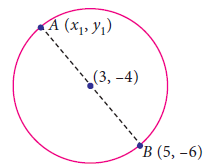
Therefore, the coordinates of A is (1, −2) .
5.
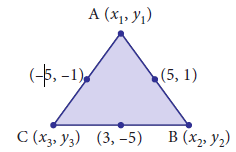
Let the vertices of the ABC be A(x1, y1), B(x2, y2 ) and C(x3, y3) and the given mid-points of the sides AB, BC and CA are (5, 1), (3, −5) and (−5, −1) respectively. Therefore
\(\frac { { x }_{ 1 }+{ x }_{ 2 } }{ 2 } =5 \Rightarrow\)x1 + x2 = 10 ...(1)
\(\frac { { x }_{ 2 }+{ x }_{ 3 } }{ 2 } =3 \Rightarrow\)x2 + x3 = 6 ...(2)
\(\frac { { x }_{ 3 }+{ x }_{ 1 } }{ 2 } =-5 \Rightarrow\)x3 + x1 = –10 ...(3)
Adding (1), (2) and (3)
2x1 + 2x2 + 2x3 = 6
x1 + x2 + x3 = 3 ...(4)
(4) − (2) \(\Rightarrow\) x1 = 3 − 6 = −3
(4) − (3) \(\Rightarrow\) x2 = 3 +10 = 13
(4) − (1) \(\Rightarrow\) x3 = 3 −10 = −7
\(\frac { { y }_{ 1 }+{ y }_{ 2 } }{ 2 } =1\)\(\Rightarrow\)y1 + y2 = 2 …(5)
\(\frac { { y }_{ 2 }+{ y }_{ 3 } }{ 2 } =-5\)\(\Rightarrow\)y2 + y3 = –10 …(6)
\(\frac { { y }_{ 3 }+{ y }_{ 1 } }{ 2 } =1\)\(\Rightarrow\)y3 + y1 = –2 …(7)
Adding (5), (6) and (7),
2y1 + 2y2 + 2y3 = −10
y1 + y2 + y3 = −5 ...(8)
(8) − (6) \(\Rightarrow\) y1 = −5 +10 = 5
(8) − (7) \(\Rightarrow\) y2 = −5 + 2 = −3
(8) − (5) \(\Rightarrow\) y3 = −5 − 2 = −7
Therefore the vertices of the triangle are A(−3, 5), B(13, −3) and C(−7, −7).
6.
"The centroid of the triangle obtained by joining the mid points of the sides of a triangle is the same as the centroid of the original triangle."
\(\therefore\) The mid points of the sides of the triangle are given as
x1y1 , x2y, x3y3
\(\left( \frac { 3 }{ 2 } ,5 \right) \left( 7,\frac { -9 }{ 2 } \right) \left( \frac { 13 }{ 2 } ,\frac { -13 }{ 2 } \right) \)
\(\therefore\)Centroid \(=\left( \frac { { x }_{ 1 }+{ x }_{ 2 }+{ x }_{ 3 } }{ 3 } ,\frac { { y }_{ 1 }+{ y }_{ 2 }+{ y }_{ 3 } }{ 3 } \right) \)
\(=\left( \frac { \frac { 3 }{ 2 } +\frac { 7 }{ 1 } +\frac { 13 }{ 2 } }{ 3 } ,\frac { 5+\left( \frac { -9 }{ 2 } \right) +\frac { (-13) }{ 2 } }{ 3 } \right) =\left( \frac { \frac { 3+14+13 }{ 2 } }{ 3 } ,\frac { \frac { 10-9-13 }{ 2 } }{ 3 } \right) \)
\(=\left( \frac { \frac { 30 }{ 2 } }{ 3 } ,\frac { \frac { -12 }{ 2 } }{ 3 } \right) =\left( \frac { 15 }{ 3 } ,\frac { -6 }{ 3 } \right) =(5,-2)\)
7.
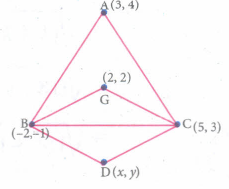
Centroid G =\(\left( \frac { { x }_{ 1 }+{ x }_{ 2 }+{ x }_{ 3 } }{ 3 } ,\frac { { y }_{ 1 }+{ y }_{ 2 }+{ y }_{ 3 } }{ 3 } \right) \)
\(\therefore G(x,y)=\left( \frac { 3+(-2)+5 }{ 3 } ,\frac { 4+(-1)+3 }{ 3 } \right) \)
\(=\left( \frac { 8-2 }{ 3 } ,\frac { 7-1 }{ 3 } \right) =\left( \frac { 6 }{ 3 } ,\frac { 6 }{ 3 } \right) =(2,2)\)
In a parallelogram diagonals bisect each other
∴ Mid point of DG = Mid point of BC
\(\left( \frac { x+2 }{ 2 } ,\frac { y+2 }{ 2 } \right) =\left( \frac { -2+5 }{ 2 } ,\frac { -1+3 }{ 2 } \right) \)
\(\frac { x+2 }{ 2 } =\frac { 3 }{ 2 } \)
x+2 = 3
x = 3 - 2 = 1
\(\frac { y+2 }{ 2 } =\frac { 2 }{ 2 } \)
y = 2 - 2 = 0
y + 2 = 2
\(\therefore\) The co-ordinates of the vertex D (x, y) = (1, 0)
8.
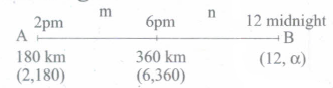
Dividing point \((x,y)=\left( \frac { { mx }_{ 2 }+{ nx }_{ 1 } }{ m+n } ,\frac { { my }_{ 2 }+{ ny }_{ 1 } }{ m+n } \right) \)
\((6,360)=\left( \frac { m\times 12+n\times 2 }{ m+n } ,\frac { m\alpha +n\times 180 }{ m+n } \right) \)
⇒\(\frac { 12m+2n }{ m+n } =6\)
12m + 2n = 6m + 6n
12m - 6m = 6n -2n
6m=4n
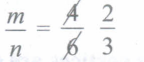
m=\(\frac{2}{3}\)n ...(1)
\(\Rightarrow \frac { m\alpha +180n }{ m+n } =360\) ...(2)
\(\Rightarrow \frac { \frac { 2 }{ 3 } n\alpha +180n }{ \frac { 2 }{ 3 } n+n } =360\)
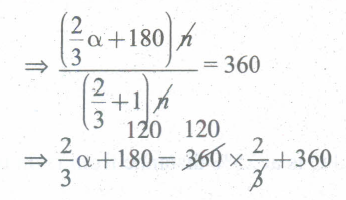
\(\Rightarrow \frac { 2 }{ 3 } \alpha =240+360-180\)
\(\frac { 2 }{ 3 } \alpha =600-180\)
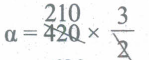
\(\frac { 2 }{ 3 } \alpha =420\)
\(\alpha\)=630
\(\therefore\)The car will reach 630km at 12midnight
9.
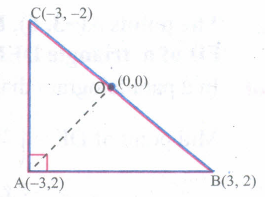
\(=\left( \frac { 2+(-3) }{ 2 } ,\frac { 2+(-2) }{ 2 } \right) \)
\(=\left( \frac { 0 }{ 2 } ,\frac { 0 }{ 2 } \right) =(0,0)\)
Distance between two points
\(d=\sqrt { { ({ x }_{ 2 }-{ x }_{ 1 }) }^{ 2 }+{ ({ y }_{ 2 }-{ y }_{ 1 }) }^{ 2 } } \)
\(\bar { OA } =\sqrt { { (-3-0) }^{ 2 }+{ (2-0) }^{ 2 } } \)
\(=\sqrt { { (-3) }^{ 2 }+{ 2 }^{ 2 } } =\sqrt { 9+4 } =\sqrt { 13 } \)
\(\bar { OB } =\sqrt { { (-3-0) }^{ 2 }+{ (2-0 })^{ 2 } } =\sqrt { 9+4 } =\sqrt { 13 } \)
\(\bar { OC } =\sqrt { { (-3-0) }^{ 2 }+{ (-2-0) }^{ 2 } } =\sqrt { 9+4 } =\sqrt { 13 } \)
\(\therefore \overline { OA } =\overline{ OB } =\overline { OC } \) Hence Proved
10.
(b)
(2, 3)
11.
(b)
5
12.
(d)
5 : 2
13.
(c)
4:7
14.
(d)
(4, 6)

9th Standard Syllabus & Materials
9th Standard
TN 9th Tamil உள்ளத்தின் சீர் - திருக்குறள் Important Questions And Answers Study Material - QB365 Set A
NEW9th Standard
TN 9th Tamil உள்ளத்தின் சீர் - மணிமேகலை Important Questions And Answers Study Material - QB365 Set A
NEW9th Standard
TN 9th Tamil உள்ளத்தின் சீர் - ஏறு தழுவுதல் Important Questions And Answers Study Material - QB365 Set A
NEW9th Standard
TN 9th Tamil உயிருக்கு வேர் - தண்ணீர் Important Questions And Answers Study Material - QB365 Set A



Tamilnadu Stateboard 9th Standard Subjects
Tamilnadu Stateboard Standards





