
 100% FREE ACCESS
9th Standard Syllabus & Materials
9th Standard
TN 9th Tamil உள்ளத்தின் சீர் -கற்கண்டு (இலக்கணம்) - தொடர் இலக்கணம், ஆகுபெயர் Important Questions And Answers Study Material - QB365 Set A
NEW9th Standard
TN 9th Tamil உள்ளத்தின் சீர் -விரிவானம் (துணைப்பாடம்) - தாய்மைக்கு வறட்சி இல்லை! Important Questions And Answers Study Material - QB365 Set A
NEW9th Standard
TN 9th Tamil உள்ளத்தின் சீர் -கவிதை பேழை (செய்யுள்) - மார்கழி பெருவிழா Important Questions And Answers Study Material - QB365 Set A
NEW9th Standard
TN 9th Tamil உயிருக்கு வேர்-இலக்கணம் - பகுபத உறுப்பிலக்கணம் Important Questions And Answers Study Material - QB365 Set A
NEW9th Standard
TN 9th Tamil அமுதென்று பேர் - இலக்கணம்-எழுத்து -அளபெடை Important Questions And Answers Study Material - QB365 Set A
NEW9th Standard
TN 9th Tamil அமுதென்று பேர்-துணைப்பாடம் - ஆறாம்திணை Important Questions And Answers Study Material - QB365 Set A

Published on: 05/02/2020
9th Standard Science Annual Exam Model Question Paper II - 2019 - 2020
Download Tamil Nadu 9th Standard Science question papers, model tests, one-mark questions, important questions, and public exam papers in PDF format. Free study materials and answer keys for TN State Board students.
Questions + Answers key
Take MCQ Science Test1.
What is plate meristem?
2.
Which fluid fills in the body cavity?
3.
Who is the father of modern computer?
4.
Is air a pure substance or Mixture? Justify.
5.
Why are convex mirrors preferred to use rear view mirrors in vehicles?
6.
Name any two naturally occurring toxic substances in food.
7.
Name an element which has the same number of electrons in its first and second shell
8.
What is the full form of SI system?
9.
What is Hardware and Software?
10.
Give the uses of magnets in everyday life.
11.
What will be the final temperature if 1,68,000 J of heat is absorbed by 2 kg of water at 30°C?
12.
Calculate the atomic number of an element whose mass number is 40 and number of neutron is 20. Also find the name of the element.
13.
Explain the experiment to prove that chlorophyll is essential for photosynthesis.
14.
How do we separate cream from milk?
15.
How is the reproductive characters of mammals different from those of Aves?
16.
What is meant by magnification? Write its expression. What is its sign for the image and virtual image?
17.
How will you measure the least count of vernier caliper?
18.
A Sonar device on a submarine sends out a signal and receives an echo 5 seconds later. Calculate the speed of sound in water if the distance of the object from the submarine is 3500 m.
1440 ms-1
1460 ms-1
1400 ms-1
1550 ms-1
19.
Which one of the following is an Italian species of honey bee?
Apis mellifera
Apis dorsata
Apis florae
Apis cerana
20.
LINUX is a
Paid Software
Licensed Software
Free and Proprietary software
Free and Open source software
21.
Assertion (A) Electric current will not flow between two charged bodies when connected if their charges are same.
Reason (R) Current is the rate of flow of charge.
If both assertion and reason are true and reason is the correct explanation of assertion
If both assertion and reason are true but reason is not the correct explanation of assertion.
If assertion is true but reason is false
If assertion is false but reason is true.
22.
Stomach of human beings mainly digests
carbohydrates
proteins
fat
sucrose
23.
Elements in the modern periodic table are arranged in__________ groups and __________ periods.
7,18
18,7
17,8
8, 17
24.
Which one of the following is a disaccharide?
Maltose
Starch
Chitin
Cellulose
25.
The centre of the sphere of which a spherical mirror is a part is called ______________________
pole
radius of curvature
focus
centre of curvature
26.
There are___________fundamental units in SI system of units.
7
4
6
5
27.
____________ is an electronic device which stores data and information
Telescope
Television
Computer
Radio
28.
In a 100 m race, the winner takes 10 s to reach the finishing point. The average speed of the winner is ___________ ms-1.
5
10
20
40
29.
The correct electronic configuration of potassium is
2,8,9
2,8,1
2,8,8,1
2,8,8,3
30.
What is the role played by the earthworms to improve the soil fertility? How does it adapt to light and temperature.
31.
Name the instrument used to check the purity of milk. What is its principle? How does it work? Where it is used?
32.
Give an account of classification of bacteria based on the shape.
33.
Explain the components of phloem tissue
34.
Explain the structure of kidney and the steps involved in the formation of urine
35.
State any five features of modern periodic table.
1.
These cells divide in two planes resulting in an increase in the area of an organ
Eg : Leaf formation.
2.
Haemolymph.
3.
Nineteenth century was considered as the birth of the computer when Charles Babbage designed the basic construction of a computer.
4.
Air is a mixture, because samples from different places give different percentage of its components.
5.
Convex mirrors are preferred because they always give an erect image. They have a wider field view as they are curved outwards.
6.
Poisonous mushrooms, prussic acid in seeds of apple and cherry and peach pits, marine toxins, fish oil poisoning are the naturally occurring toxic substances.
7.
Beryllium.
8.
Full form of SI system is "International system of units"
9.
Hardware:
Hardware is the parts of a computer which we can touch and feel. Hardware includes input and output devices, cabinet, Hard disk, Mother board, SMPS, CPU, RAM, CD Drive and graphics card.
Software:
(i) Software are programmed and coded applications to process the input information
(ii) The software processes the data by converting the input information into coding or programmed language .
(iii) Touching and feeling the software is not possible but we can see the functions of the software in the form of output.
10.
(i) Used in radio and stereo speakers.
(ii) Used in almirah and refrigerator doors to snap them closed.
(iii) In medicine, the magnetic resonance imaging (MRI) scanners expose the inner parts of the patient's body for detailed examination by doctors.
11.
Heat absorbed Q = 1,68,000 J
m = 2kg
Initial temperature t1 = 30°C
Let final temperature t2 = x0C
Rise is temperature \(\triangle \)t = (t2 - t1)
= (x- 30)0C
Specific heat capacity of water C = 4200 J kg-1°C-1
We know that Q = m x c x \(\triangle \)t
1,68,000 = 2 x 4200 x (x - 30)
x - 30 = \(\frac { 1,68,000 }{ 2\times 4200 } \)
\(\)x - 30 = 20
x = 30 + 20
= 50°C
So, the final temperature of water = 50°C
12.
Mass number = Atomic number + Number of neutrons
Atomic number = Mass number - Number of neutrons = 40 - 20
Atomic number = 20
Element having Atomic number 20 is calcium.
13.
Aim: To show that chlorophyll is essential for photosynthesis.
Materials Needed: Croton plant, boiling water, alcohol and iodine solution.
Procedure:
(i) A potted croton plant is kept in dark room for 24 hours to de-starch the plant.
(ii) Then keep the plant in sunlight for 4-5 hours.
(iii) Variegated leaf is plucked from the plant.
(iv) On a plain sheet draw the outline of a plucked leaf showing green area and non-green area.
(v) The leaf is immersed in the boiling water then in alcohol it is tested for starch with iodine solution
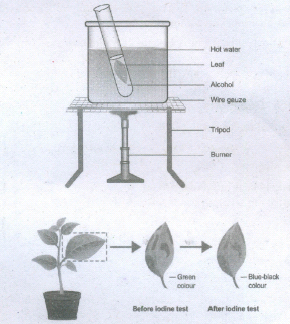
Observation: It is observed that the patches of leaf with chlorophyll turn blue-black the other portion remain colourless.
Conclusion: This proves that chlorophyll is essential for photosynthesis.
14.
A separator is a high speed spinner. It acts on the same principle of centrifuge machines. The bowl spins at very high speed causing the heavier contents of milk to move outward in the bowl pushing the lighter contents inward towards the spinning axis. Cream is lighter than other components in milk. Therefore, skimmed milk which is denser than cream is collected at outer wall of the bowl. The lighter part of cream is pushed towards the centre from where it is collected through pipe.
15.
Reproductive characters of mammals differ from those of Aves by
1. The presence of mammary glands.
2. Testes lie outside the body cavity enclosed in scrotal sacs.
3. Alecithal eggs.
4. Fertilization is always internal.
5. They give birth to young ones and feed their young ones with milk.
6. Placenta is a characteristic feature of mammals.
16.
Magnification is defined as the ratio of the height of the image \(\left( { h }_{ i } \right) \) to the height of object \(\left( { h }_{ 0 } \right) \)
Magnification \(=\frac { { h }_{ i } }{ { h }_{ 0 } }\)
1. Real image is negative sign.
2. Virtual image is positive sign
17.
The value is one smallest main scale division is divided by total number of vernier scale division is called the least count of vernier caliper.
\( \text { Least count } =\frac{\text { The value of one smallest main scale division }}{\text { Totalnumber of vernier scale division }}\)
\( \\ \text { L.C } =\frac{1 \mathrm{~mm}}{10}=0.1 \mathrm{~mm}=0.01 \mathrm{~cm}\)
18.
(c)
1400 ms-1
19.
(a)
Apis mellifera
20.
(d)
Free and Open source software
21.
(d)
If assertion is false but reason is true.
22.
(b)
proteins
23.
(b)
18,7
24.
(a)
Maltose
25.
(d)
centre of curvature
26.
(a)
7
27.
(c)
Computer
28.
(b)
10
29.
(c)
2,8,8,1
30.
1. Earthworms are commonly found living in soil, feeding on live and dead organic matter.
2. The faecal wastes are called worm castings which are rich in nitrogenous content adding fertility to the soil.
3. Earthworm plays a large role in keeping soil health facilitating aerators, water infiltration and producing organic matter to increase crop growth.
Adaptation to light - Nocturnality:
1. Earthworms are sensitive to light. It has no eyes but sensitive to light through light sensitive cells present in their skin.
2. They give the skin the capacity to detect light and changes its light intensity, They react negatively to bright light (Photophobic). It remains in its burrow during the day to avoid light.
Adaptation to temperature - Aestivation:
1. When the soil becomes too hot or dry, Earthworms become inactive and undergo a process called aestivation. Earthworm moves deeper into the soil. It secretes mucus and lowers their metabolic rate in order to reduce water loss.
2. They remain dormant until conditions become favourable, they come out of their burrow during rainy season. The ideal temperature range is 60 - 80°F.
31.
1. The instrument used to measure the purity of milk is Lactometer.
2. Lactometer works on the principle of gravity of milk.
Working:
1. The lactometer consists of a long graduated test tube with a cylindrical bulb with the graduation ranging from 15 at the top to 45 at the bottom. The test tube is filled with air. This air chamber causes the instrument to float.
2. The spherical bulb is filled with mercury to cause the lactometer to sink up to the proper level and to float in an upright position in the milk.
3. Inside the lactometer there may be a thermometer extending from the bulb up into the upper part of the test tube where the scale is located.
4. The correct lactometer reading is obtained only at the temperature of 60oC.
5. A lactometer measures the cream content of milk. More the cream, lower the lactometer floats in the milk. The average reading of normal milk is 32.
6. Lactometers are used highly at milk processing units and at the dairies.
32.
Based on the shapes, bacteria are grouped as
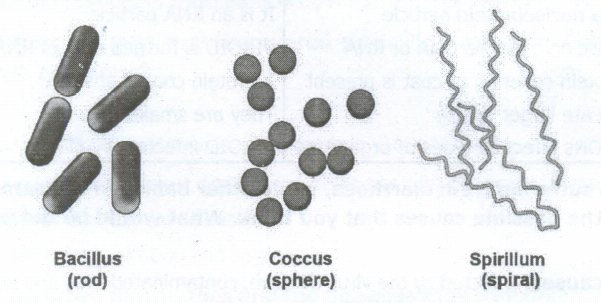
1. Spherical shaped bacteria called as cocci or coccus for a single cell.
2. Rod shaped bacteria called as bacilli or bacillus for a single cell.
3. Spiral shaped bacteria called as spirilla or spirillum for single cell.
| Different shapes of Bacteria | ||
| Arrangement of Cocci | Examples | |
| Diplococci | cocci are arranged in pairs | Streptococcus pneumoniae |
| Streptococci | Streptococci cocci are arranged in chains | Streptococcus pyogenes |
| Tetracocci | cocci are arranged in packets of four cells | Aerococcus sp |
| Staphylococci | cocci are arranged in grape-like clusters | Staphylococcus aureus |
| Arrangement of Bacilli | Examples | |
| Diplobacilli | diplobacilli appear in pairs | Klebsiella sp |
| Streptobacilli | bacilli are arranged in chains | Streptobacillus sp |
| Coccobacilli | short and stumpy and appear ovoid | Haemophilus sp |
| Arrangement of Spirilla | Examples | |
| Vibrio | comma-shaped bacteria | Vibrio cholerae |
| Spirilla | rigid spiral structure | Helicobacter pylori |
| Spirochetes | helical shape and flexible bodies | Treponema pallidum |
33.
Phloem like xylem is a complex tissue and consists of the following elements.
(i) Sieve elements
(ii) Companion cells.
(iii) Phloem fibres
(iv) Phloem parenchyma
(i) Sieve elements
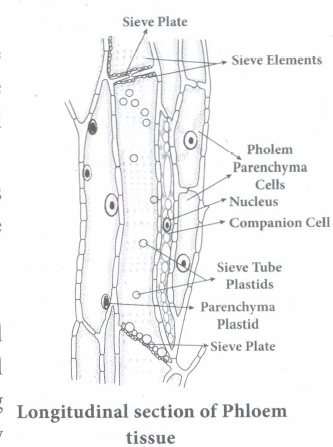
1. The conducting elements of phloem are collectively called as Sieve elements.
2. They may be segregated into less specialised Sieve cells and more specialised sieve tube elements.
3. Sieve tubes are elongated, tube-like slender cells placed end to end. The transverse walls at the ends are perforated and are known as sieve plates.
4. The main function of sieve tubes is translocation of food, from leaves to the storage organs of the plants.
ii. Companion cells
These are elongated cells attached to the lateral wall of the sieve tubes. A companion cell may be equal in length to the accompanying sieve tube element or the mother cell may be divided transversely, forming a series of companion cells
iii. Phloem parenchyma
The phloem parenchyma are living cells which have cytoplasm and nucleus. Their function is to store food materials.
iv. Phloem
fibers Sclerenchymatous cells associated with primary and secondary phloem are commonly called phloem fibers. These cells are elongated, lignified and provide mechanical strength to the plant body.
34.
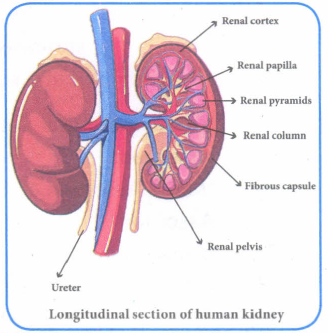
Kidneys:
(i) Kidneys are bean-shaped organs reddish brown in colour.
(ii) The kidneys lie on either side of the vertebral column in the abdominal cavity attached to the dorsal body wall.
(iii) The right kidney is placed lower than the left kidney as the liver takes up much space on the right side.
(iv) Each kidney is about 11 cm long, 5 cm wide and 3 cm thick.
(v) Internally the kidney consists of an outer dark region, the cortex and an inner lighter region, the medulla.
(vi) The medulla consists of multitubular conical masses called the medullary pyramids or renal pyramids whose base are adjacent to cortex.
(vii) On the inner concave side of each kidney, a notch called hilum is present through which blood vessels and nerves enter in and the urine leaves through the ureter.
Process of Urine formation:
The process of urine formation includes the following three stages.
(i) Glomerular filtration
(ii) Tubular reabsorption and
(iii) Tubular secretion
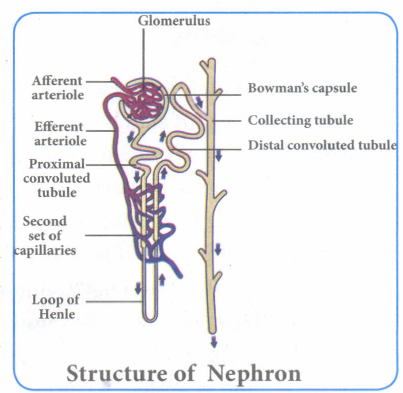
Glomerular filtration: Urine formation begins with the filtration of blood through epithelial walls of the glomerulus and Bowman's capsule. The filtrate is called as the glomerular filtrate. Both essential and non-essential substances present in the blood are filtered.
Tubular reabsorption: The filtrate in the proximal tubule consists of essential substances such as glucose, amino acids, vitamins, sodium, potassium, bicarbonates and water that are reabsorbed into the blood by a process of selective reabsorption.
Tubular secretion: Substances such as H+ or K+ ions are secreted into the tubule. Certain substances like potassium and a large number of drugs like penicillin and aspirin are passed into the filtrate in the distal convoluted tubule. This tubular filtrate is finally known as urine, which is hypertonic in man. Finally the urine passes into collecting ducts to the pelvis and through the ureter into the urinary bladder by urethral peristalsis (waves of constriction in the ureters). When the urinary bladder is full the urine is expelled out through the urethra. This process is called micturition
35.
Features of modern periodic table:
(i) All the elements are arranged in the increasing order of their atomic number.
(ii) The horizontal rows are called periods. There are seven periods in the periodic table.
(iii) The elements are placed in periods based on the number of shells in their atoms.
(iv) Vertical columns in the periodic table starting from top to bottom are called groups. There are 18 groups in the periodic table.
(v) Based on the physical and chemical properties of elements, they are grouped into various families.

9th Standard Syllabus & Materials
9th Standard
TN 9th Tamil உள்ளத்தின் சீர் - திருக்குறள் Important Questions And Answers Study Material - QB365 Set A
NEW9th Standard
TN 9th Tamil உள்ளத்தின் சீர் - மணிமேகலை Important Questions And Answers Study Material - QB365 Set A
NEW9th Standard
TN 9th Tamil உள்ளத்தின் சீர் - ஏறு தழுவுதல் Important Questions And Answers Study Material - QB365 Set A
NEW9th Standard
TN 9th Tamil உயிருக்கு வேர் - தண்ணீர் Important Questions And Answers Study Material - QB365 Set A



Tamilnadu Stateboard 9th Standard Subjects
Tamilnadu Stateboard Standards





